# Unusual Adaptations of Deep-Sea Animals: Surviving the Deep
> How does anything survive in the deep sea?
- Source: https://thatiswhy.com/unusual-adaptations-of-deep-sea-animals/
- Category: The Ocean
- Topics: The ocean > The deep sea
- Library shelf: The midnight zone, Deep-sea life & bioluminescence (an ocean depth zone)
- Summary: The deep sea is dark, cold, short on food and crushing. Animals hide or glow, live slowly, eat what sinks, and are built for the squeeze, down to their cells.
- Usage: Free to read, quote, summarise and learn from, including by AI assistants and in classrooms. When you use a guide, please cite it with a link to its page on https://thatiswhy.com.
Drop a camera over the side of a ship and let it sink. Within a few hundred meters the blue fades to black, the water turns cold, and the ocean starts to squeeze. **Life survives the deep sea by solving four problems at once: darkness, crushing pressure, near-freezing cold and almost no food. Deep-sea animals hide or make their own light, avoid gas-filled spaces and adapt their cells to work under pressure, live slowly, and eat whatever sinks from above.**
And this is no small corner of the planet. Researchers at MBARI point out that the deep ocean is the largest habitat on Earth by volume. And we have barely looked at it: people have laid eyes on less than 0.001% of the deep seafloor. This guide is your map of it. It shows you every zone first, then walks through each problem with the guides that go deeper. The deep sea is also one part of a bigger story: for the strange physics of the whole ocean, from sound highways to the death of color, see [why the ocean is an alien world](https://thatiswhy.com/why-ocean-is-alien-world/).
## A Map of the Deep, Zone by Zone
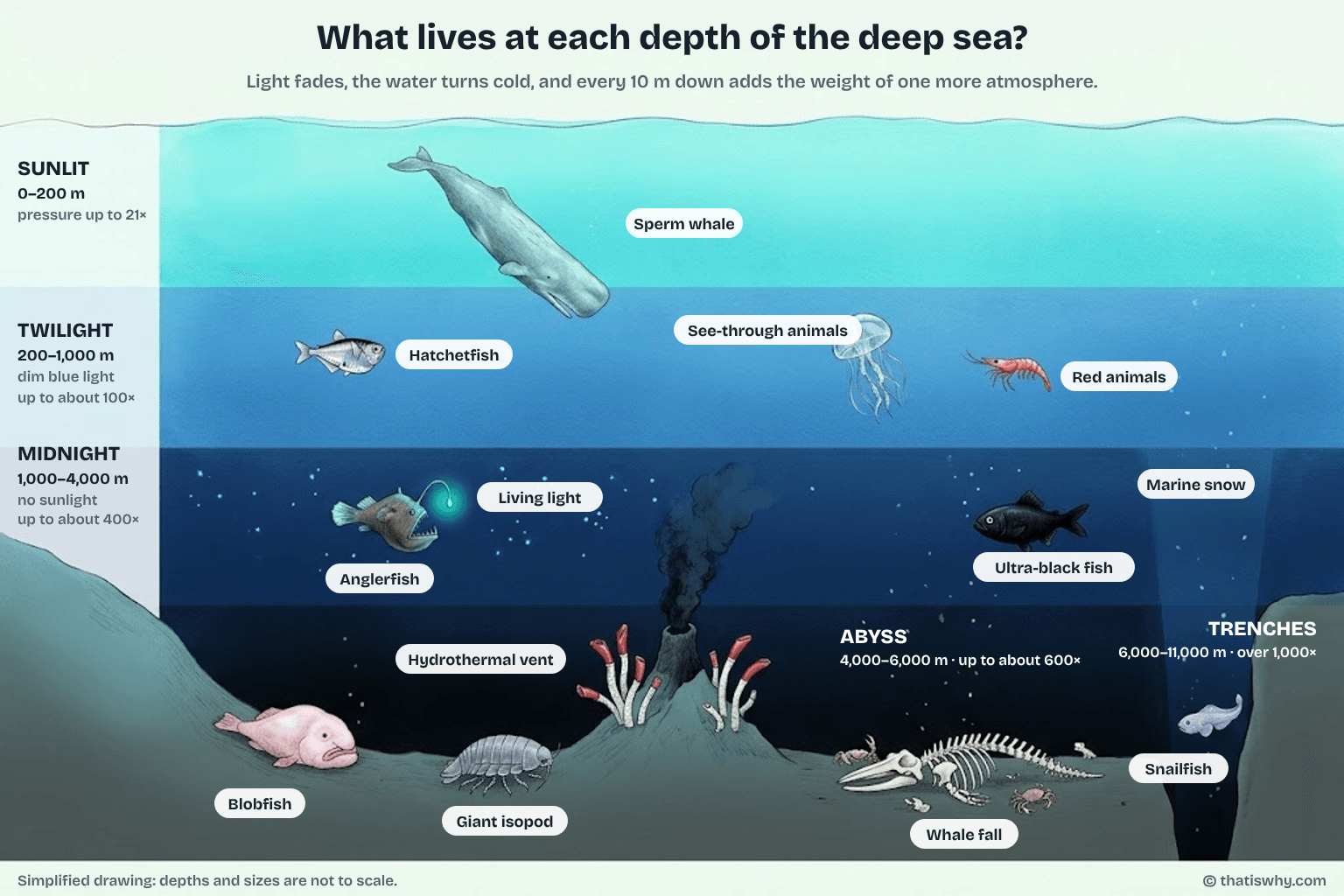
Scientists split the ocean into layers by depth. Sunlight only reaches about 200 meters, because water soaks it up. From 200 to 1,000 meters lies the twilight zone, where only a little light is left. Below that, the midnight zone stretches to about 4,000 meters in total darkness. Then comes the abyss, from 4,000 to 6,000 meters, and finally the trenches, which plunge to almost 11,000 meters. We use NOAA's lines here. Not every scientist draws them in exactly the same place (Woods Hole, for one, starts the abyss at 3,000 meters), but the story on the way down is the same.
Tap an animal to open its guide. Free full-size map and printable PDF.
Every animal on the map has its own guide. Tap one to dive straight in, or read on for the big picture first.
## Life Where the Sun Never Comes
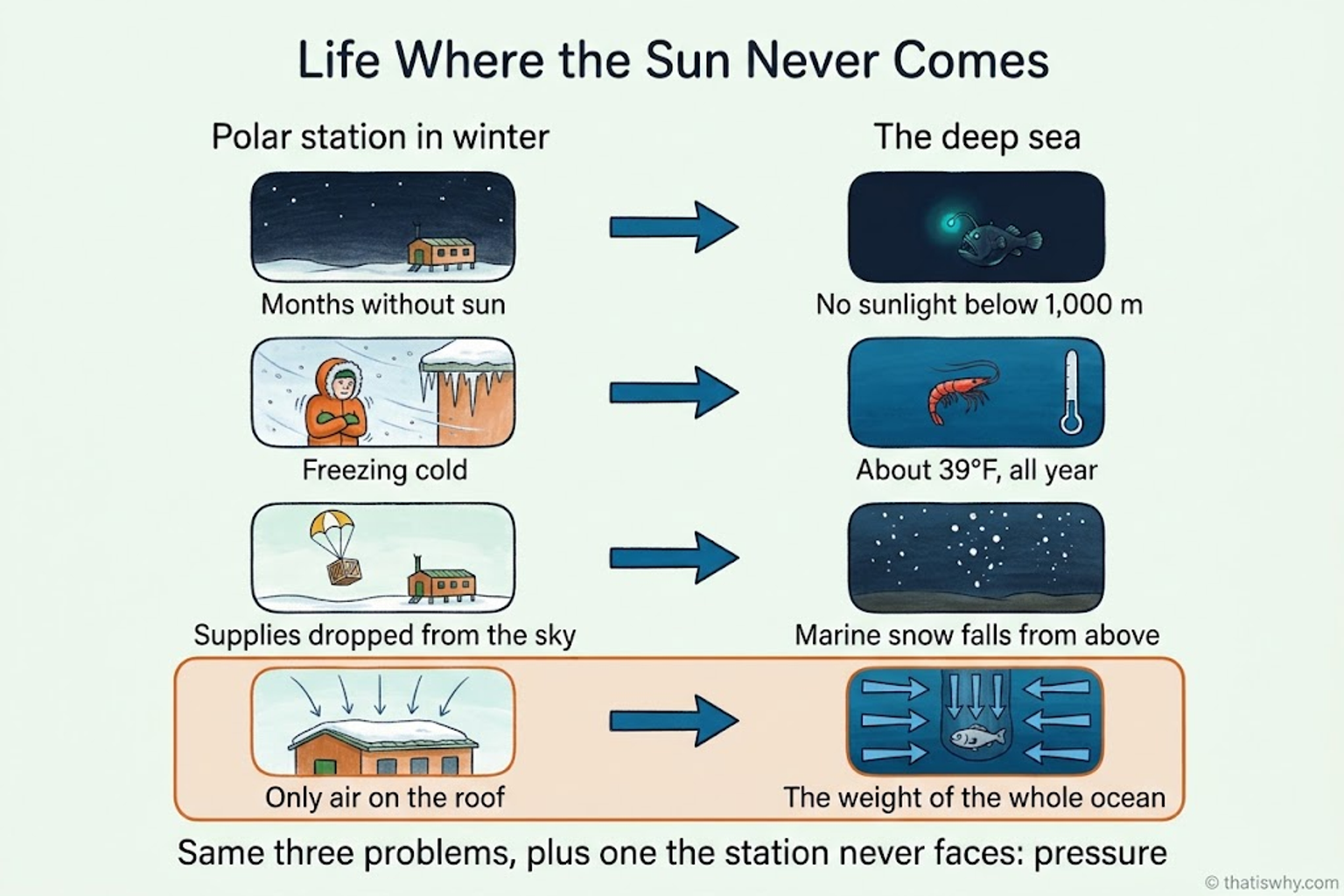
Say you sign up to spend the winter at a polar research station. The sun sets and stays gone for months. The cold outside could freeze your breath into your scarf. In this story, no plane can land until spring, so every box of food arrives by parachute, whenever the weather allows.
That is life in the deep sea, almost exactly. Below about 1,000 meters there is no sunlight at all, and the water sits at about 39°F, near freezing, all year round. No sunlight, no photosynthesis, so most of the food down there is **marine snow**: a slow shower of dead plants and animals, droppings and other bits sinking from the sunlit water far above. Some flakes take weeks to fall.
A winter station shares three of the deep sea's problems. The fourth, pressure, belongs to the ocean alone.
There is one big difference, and it is the one that makes the deep sea truly alien. The station only has air pressing on its roof. A deep-sea fish has the whole ocean on top of it.
## Problem 1: The Weight of the Whole Ocean
For every 10 meters you sink, the pressure grows by one more atmosphere, the weight of all the air above a beach. At 1,000 meters that adds up to about 100 times the pressure at the surface. In the Challenger Deep, the deepest spot in the ocean, it reaches 1,000 bars or more.
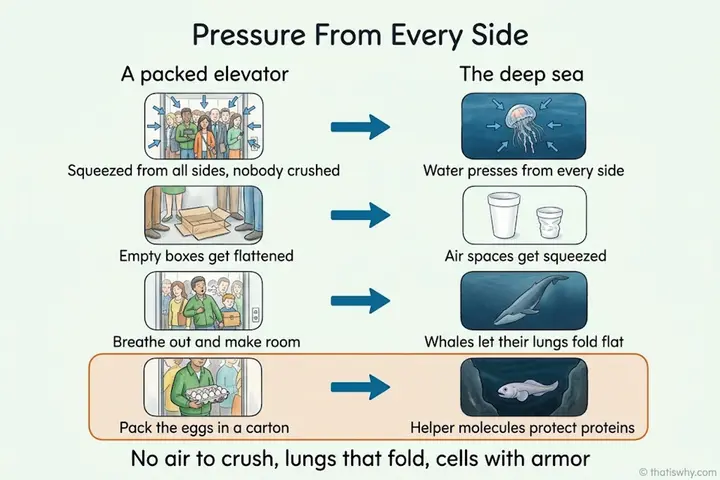
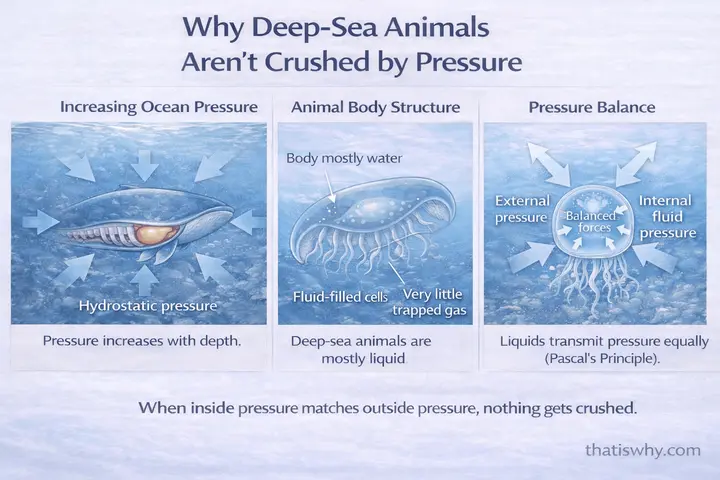
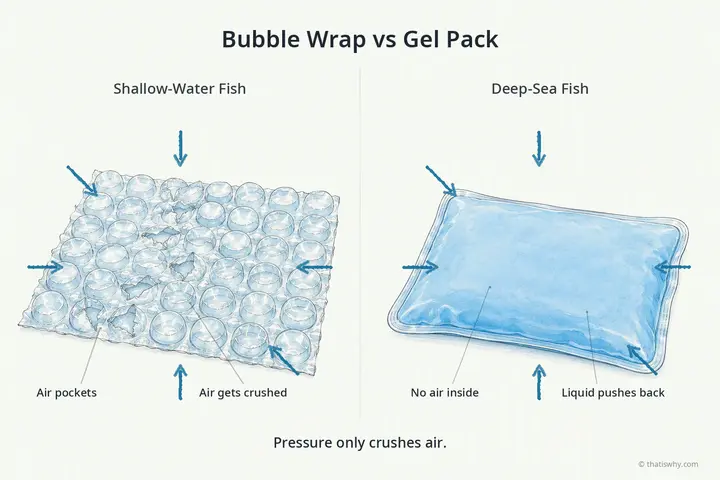
So why isn't everything flattened? Pressure picks on two weak spots. The first weak spot is air. Gas squashes easily, so anything carrying an air pocket gets squeezed like a sponge in a fist, and many deep-sea fish keep such pockets small or skip them. The second weak spot hides inside every cell. Pressure messes with the way proteins fold and makes cell membranes too stiff to work properly.
So deep-sea animals armor themselves at the molecular level. Their membranes pack in more unsaturated fats, which keep them supple. Their cells also stock up on helper molecules called **piezolytes**. The best known, TMAO, builds up in fish and crustaceans the deeper they live, and it shields their proteins from the squeeze. That is how a snailfish could be filmed more than 8 kilometers down, in a trench off Japan, in 2022.
The real trouble starts when an animal changes depth fast. A fish with a gas-filled **swim bladder**, hauled up from the deep, swells as the gas inside expands. Diving mammals face the reverse problem on the way down. Cuvier's beaked whales dive deeper than 2,000 meters to feed, for almost two hours at a time, and some whales simply let their lungs collapse as they go.
Start with the main pressure guide, then go deeper:
## Problem 2: Hiding When There Is Nowhere to Hide
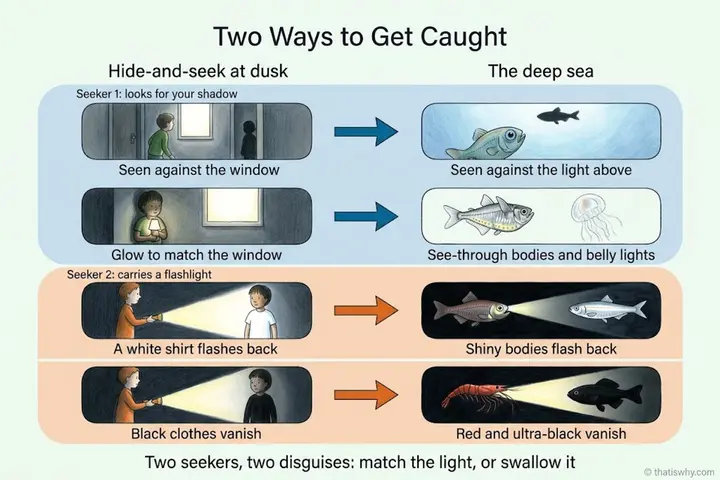
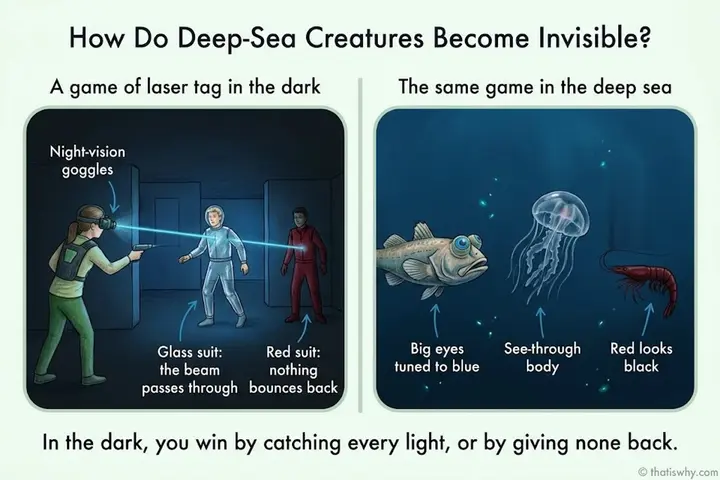
In the twilight zone, a little blue light still filters down from above, and that is a problem. Against that faint glow, any body casts a shadow. Hunters look up, and prey has to vanish.
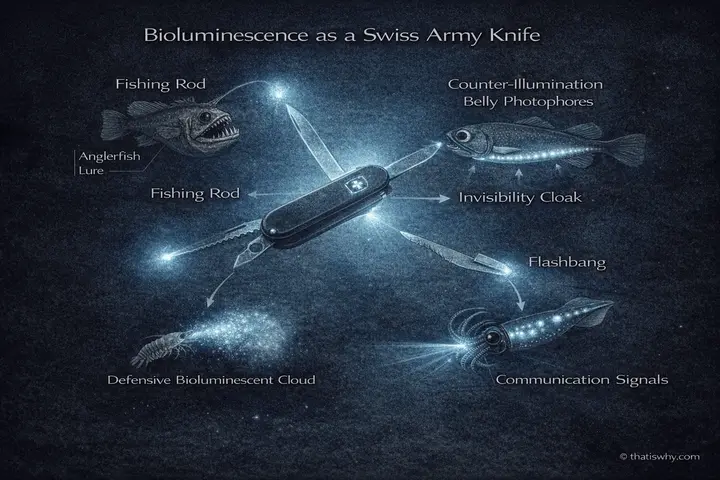
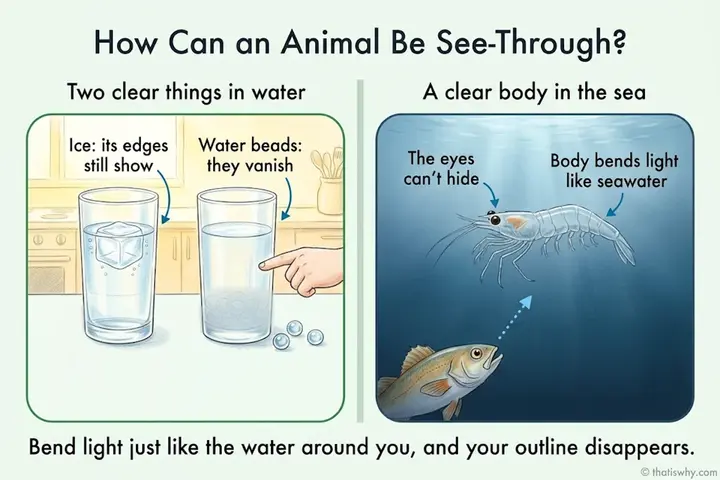
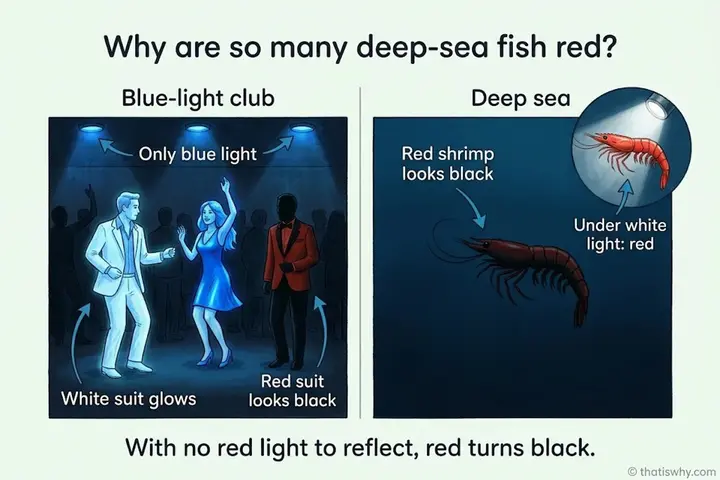
Deep-sea animals have found three ways to do it. Some turn see-through, so light passes straight through them. Some use mirrors and lights, like the hatchetfish, whose glowing belly erases its own shadow (**counterillumination**). Others turn red, because red light never reaches the deep, so a red animal has nothing to reflect and looks black.
Deeper still, where the only light comes from other animals, the best trick is to swallow light whole. Scientists working with the Smithsonian found 16 species of fish so black that they absorb at least 99.5% of the light that hits them. Black construction paper reflects about 10%. The blackest fish of all reflected just 0.044%.
The stealth guide brings all three tricks together:
And when hiding fails, some animals pay their way out. A grabbed sea cucumber can throw out its own guts, possibly as a decoy that keeps the predator busy while it crawls away (**autotomy**). Nerves soften its body at built-in breaking points, muscles seal the wound, and a new gut grows back in about four weeks. Read [why sea cucumbers throw out their guts](https://thatiswhy.com/why-do-sea-cucumbers-throw-out-their-guts/).
## Problem 3: Making Your Own Light
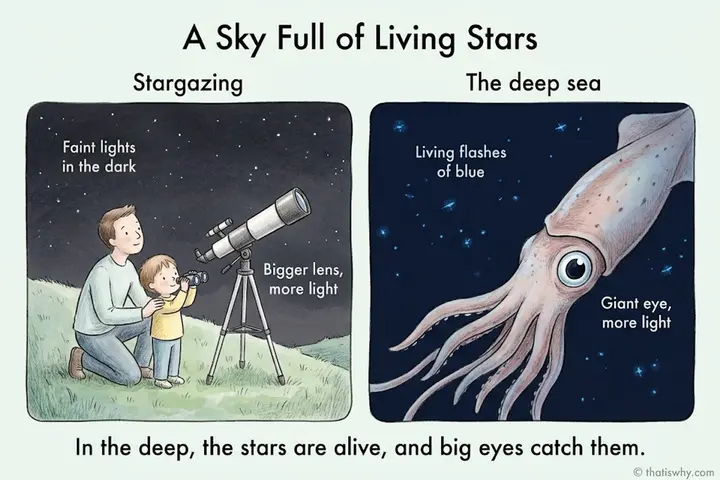
If the sun won't light the deep, animals do it themselves. Séverine Martini and Steven Haddock of MBARI went through video from 240 dives in Monterey Bay, from the surface down to 4,000 meters, and counted over 350,000 animals. About three quarters of them could make their own light (**bioluminescence**). "I'm not sure people realize how common bioluminescence is," Martini said.
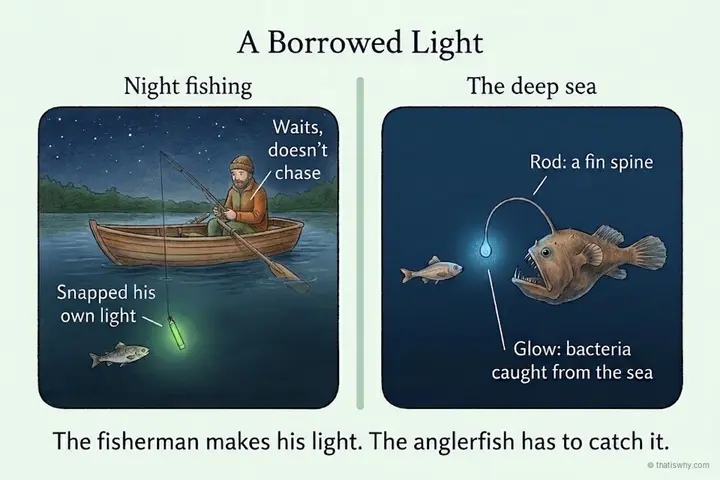
That is why a dive into the midnight zone can look like a sky full of tiny blue stars. The light is a tool, too. The anglerfish dangles its glow as bait, while the hatchetfish uses its belly lights to disappear.
## Problem 4: Cold Water and an Empty Pantry
Below 1,000 meters the water stays around 39°F, and with no sunlight there are no plants to graze on. Most of the deep runs on leftovers, with one spectacular exception you will meet in a moment. Marine snow drifts down so slowly that some flakes take weeks to arrive, and what nobody eats settles into an ooze that covers about three quarters of the deep-sea floor.
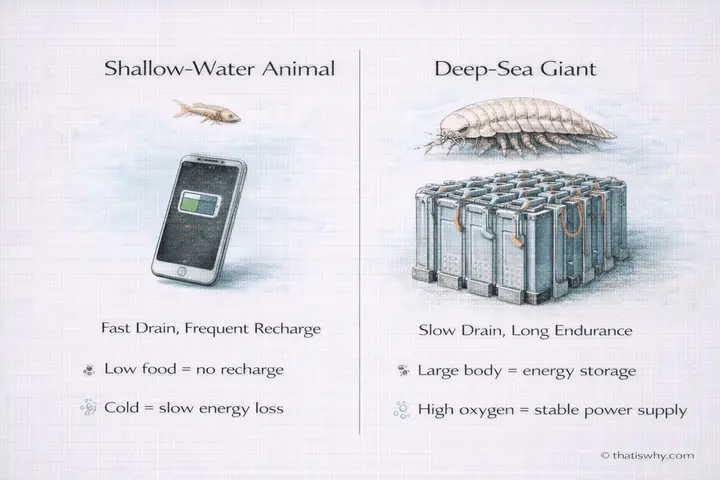
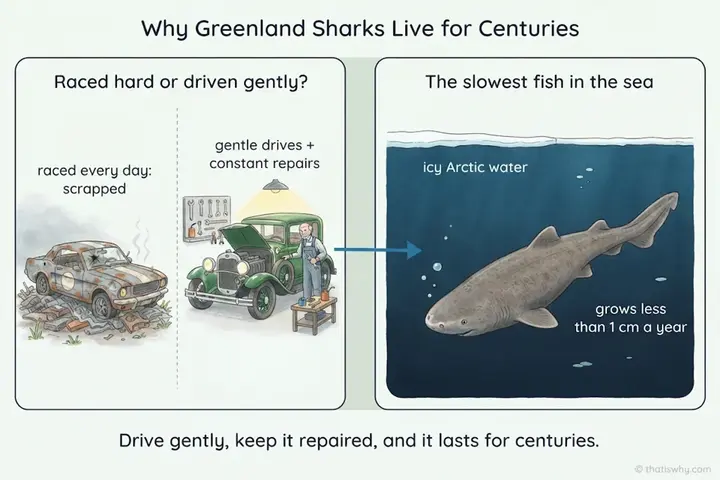
Many animals cope by living slowly. A giant isopod, 19 to 36 centimeters long, has survived four years without food in an aquarium. The vampire squid barely moves at all: it hangs in low-oxygen water and [catches marine snow on a sticky thread instead of hunting](https://thatiswhy.com/why-vampire-squid-eat-marine-snow/). The champion of slow living is the Greenland shark of the icy Arctic and North Atlantic: it grows less than a centimeter a year, and eye-lens dating shows it lives at least 272 years, which is [why Greenland sharks live for centuries](https://thatiswhy.com/why-greenland-sharks-live-for-centuries/).
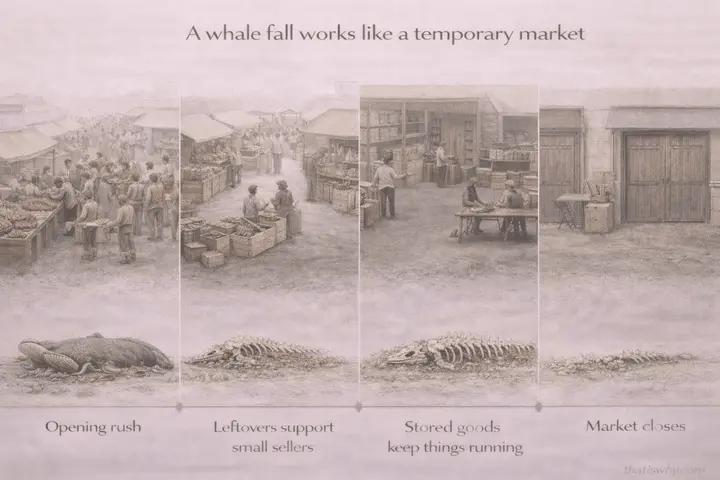
Now and then, a feast drops in. When a dead whale sinks, it brings a mountain of food to a place that is usually starving. As MBARI puts it, "One whale fall can provide as much organic material as thousands of years of marine snow."
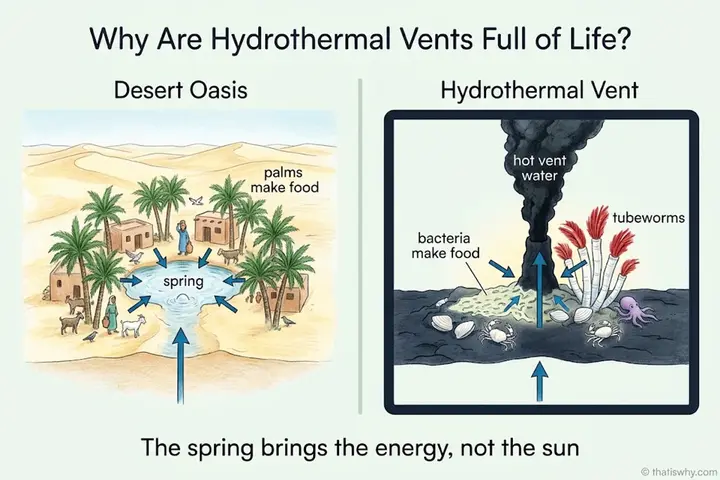
And in a few places, the deep cooks its own meals. At hydrothermal vents, first discovered in 1977, the water can pass 700°F. There, bacteria make food from chemicals such as hydrogen sulfide instead of sunlight (**chemosynthesis**), and whole communities of animals depend on them.
## Key Numbers of the Deep
| Fact | Value |
| --- | --- |
| Depth sunlight reaches | about 200 m (656 ft) |
| Depth with no sunlight at all | below about 1,000 m |
| Water temperature below 1,000 m | about 39°F (4°C) |
| Pressure increase | 1 atmosphere every 10 m (33 ft) |
| Pressure in the deepest trench | 1,000 bars or more |
| Deepest fish ever filmed | more than 8 km down (2022) |
| Animals that make their own light (Monterey Bay survey, 0 to 4,000 m) | about 3 in 4 |
| Light absorbed by ultra-black fish | at least 99.5% |
| Water temperature at hydrothermal vents | over 700°F |
| Seafloor mapped in high detail (April 2026) | 28.7% |
| Deep seafloor ever seen by people | less than 0.001% |
| Time for a sea cucumber to regrow its gut (*Holothuria glaberrima*) | about 4 weeks |
| Lifespan of the Greenland shark (eye-lens radiocarbon) | at least 272 years |
## Deep-Sea Myths, Busted
**Myth: the deep sea is pitch black.** There is no sunlight below about 1,000 meters, but the deep is far from dark. In a survey of Monterey Bay, from the surface down to 4,000 meters, about three in four animals could make their own light.
**Myth: deep-sea pressure crushes anything alive.** Gas-filled spaces are especially vulnerable, and many deep-sea fish keep them small or skip them. Their cells are adapted too, with supple membranes and helper molecules that protect their proteins.
**Myth: deep-sea fish explode when brought up.** They don't truly explode, but gas in a swim bladder expands as the pressure drops, which is why some fish look swollen at the surface.
For more animals that bend the rules of biology, try [life that breaks the rules](https://thatiswhy.com/biological-anomalies-life-that-breaks-rules/).
## Sources
- [Ocean zones](https://www.whoi.edu/know-your-ocean/ocean-topics/how-the-ocean-works/ocean-zones/), Woods Hole Oceanographic Institution
- [Layers of the ocean](https://www.noaa.gov/jetstream/ocean/layers-of-ocean), NOAA JetStream
- [The deep ocean](https://oceantoday.noaa.gov/deepocean/), NOAA Ocean Today
- [How much of the ocean has been explored?](https://oceanexplorer.noaa.gov/facts/explored.html), NOAA Ocean Exploration
- [How does pressure change with ocean depth?](https://oceanservice.noaa.gov/facts/pressure.html), NOAA National Ocean Service
- [Curious Kids: how do creatures living in the deep sea stay alive given the pressure?](https://theconversation.com/curious-kids-how-do-creatures-living-in-the-deep-sea-stay-alive-given-the-pressure-111940), The Conversation
- [Cellular responses in marine animals to hydrostatic pressure (Yancey, 2020)](https://doi.org/10.1002/jez.2354), Journal of Experimental Zoology Part A (abstract)
- [Scientists break new record after finding world's deepest fish](https://uwa.edu.au/news/article/2023/april/scientists-break-new-record-after-finding-worlds-deepest-fish), The University of Western Australia
- [Why are so many deep-sea animals red in color?](https://oceanexplorer.noaa.gov/facts/red-color.html), NOAA Ocean Exploration
- [Scientists Find First Ultra-Black Color in Deep-Sea Fishes](https://ocean.si.edu/ocean-life/fish/scientists-find-first-ultra-black-color-deep-sea-fishes), Smithsonian Ocean
- [Three quarters of deep-sea animals make their own light (on Martini & Haddock, Scientific Reports 2017)](https://phys.org/news/2017-04-quarters-deep-sea-animals.pdf), MBARI (via Phys.org)
- [What is marine snow?](https://oceanservice.noaa.gov/facts/marinesnow.html), NOAA National Ocean Service
- [Whale carcass yields bone-devouring worms](https://www.mbari.org/whale-carcass-yields-bone-devouring-worms/), MBARI
- [What is a hydrothermal vent?](https://oceanservice.noaa.gov/facts/vents.html), NOAA National Ocean Service
- [What is the difference between photosynthesis and chemosynthesis?](https://oceanexplorer.noaa.gov/facts/photochemo.html), NOAA Ocean Exploration
- [Giant Isopod](https://www.aquariumofpacific.org/onlinelearningcenter/species/giant_isopod), Aquarium of the Pacific
- [Morphological, Physiological and Mechanical Features of the Mutable Collagenous Tissues Associated with Autotomy and Evisceration in Dendrochirotid Holothuroids (Byrne, Marine Drugs 2023)](https://mdpi.com/1660-3397/21/3/134), Marine Drugs (MDPI)
- [Characterization of proteolytic activities during intestinal regeneration of the sea cucumber, Holothuria glaberrima (Pasten et al., Int. J. Dev. Biol. 2012)](https://ijdb.ehu.eus/article/113473cp), The International Journal of Developmental Biology
- [Eye lens radiocarbon reveals centuries of longevity in Greenland shark (Somniosus microcephalus) (Nielsen et al., Science 2016)](https://ora.ox.ac.uk/objects/uuid%3A6c040460-9519-4720-9669-9911bdd03b09), University of Oxford Research Archive
- [How long do Greenland sharks live?](https://oceanservice.noaa.gov/facts/greenland-shark.html), NOAA Ocean Service
 How can life exist under that much pressure? (start here)
 Why don't deep-sea animals get crushed?
 Why don't deep-sea fish implode?
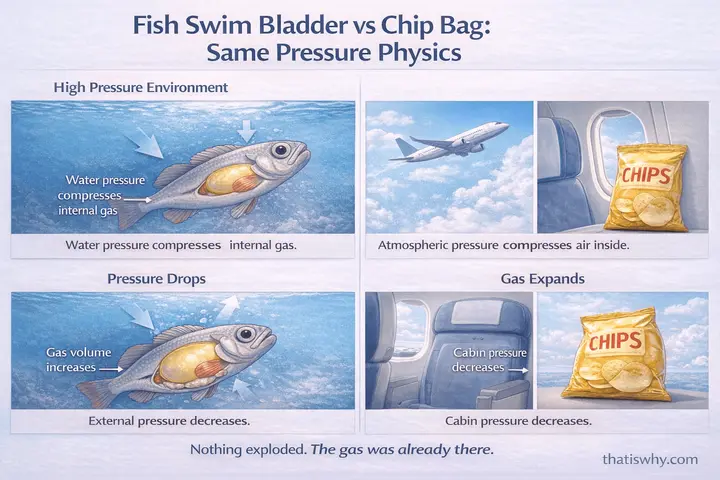 Why do deep-sea fish 'explode' at the surface?
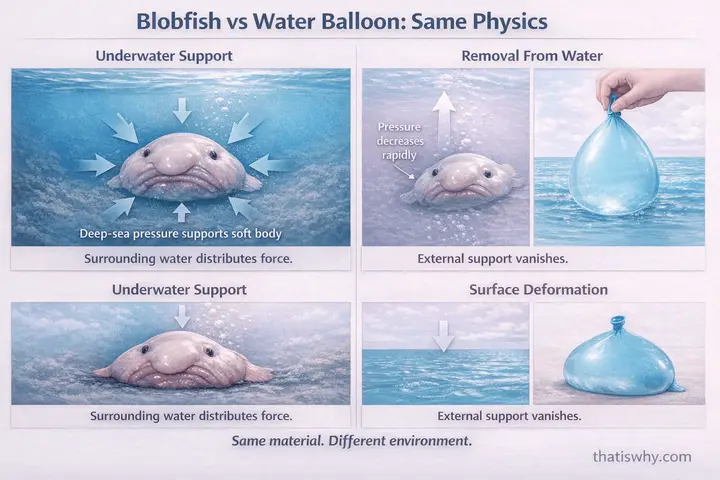 Is the blobfish really that ugly?
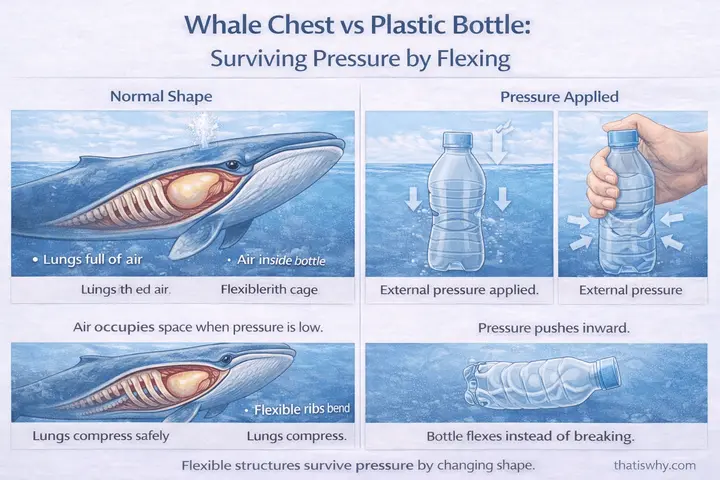 Why do whales let their lungs collapse on purpose?
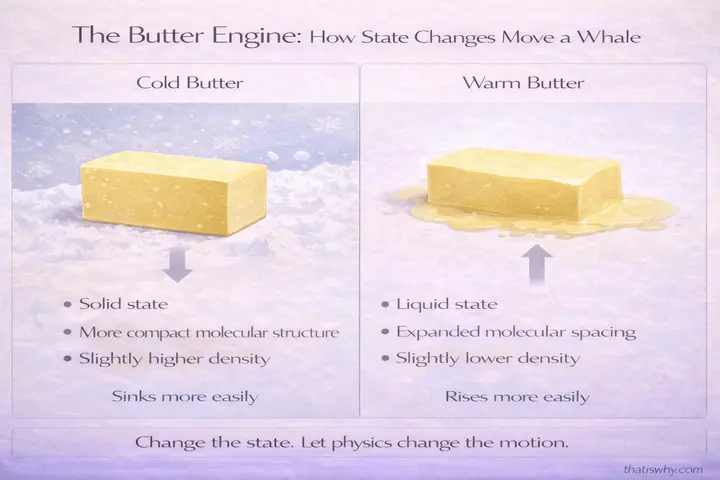 Why is a sperm whale's head full of wax?
 Why is the deep sea so good at hiding? (start here)
 How do deep-sea creatures become invisible?
 How can an animal be see-through?
 Why are so many deep-sea fish red?
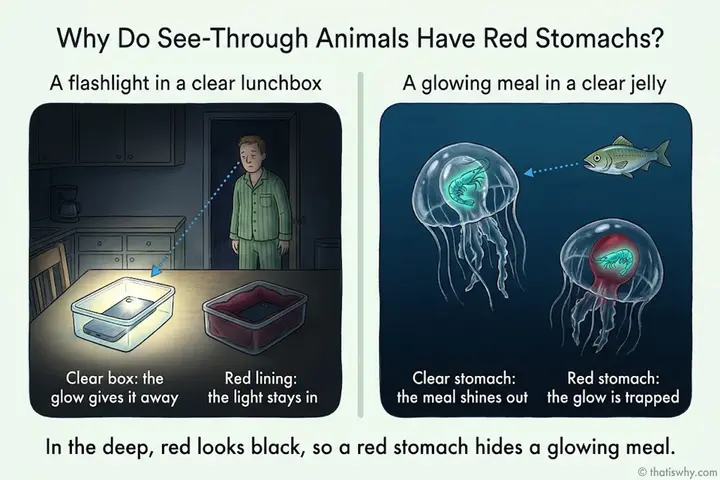 Why do see-through animals have red stomachs?
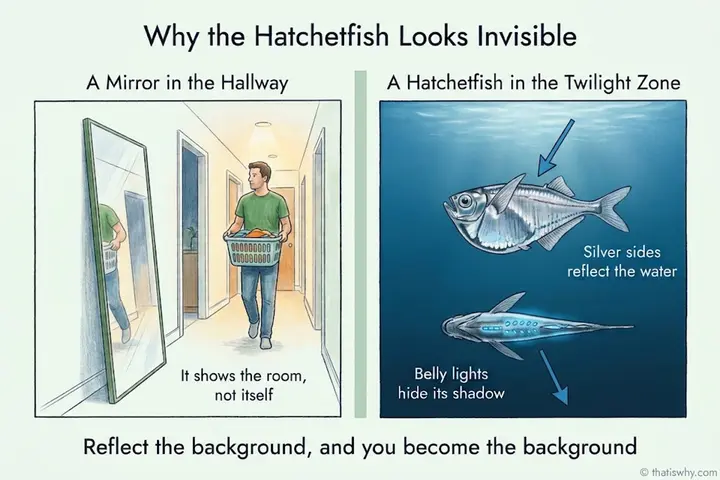 How does the hatchetfish turn invisible?
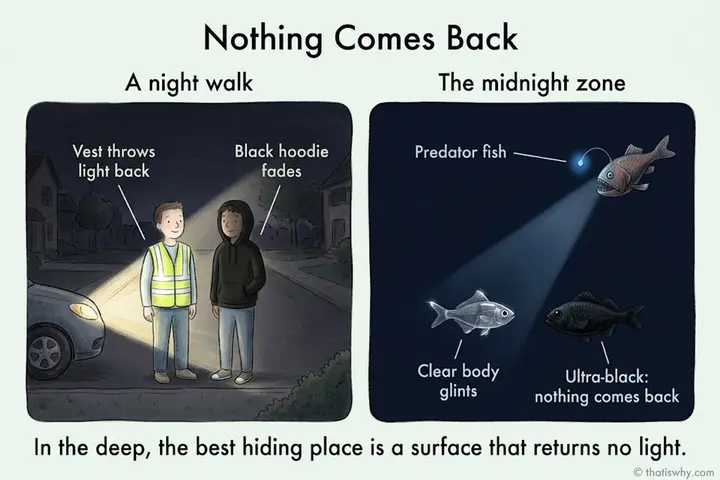 Why are the deepest fish ultra-black?
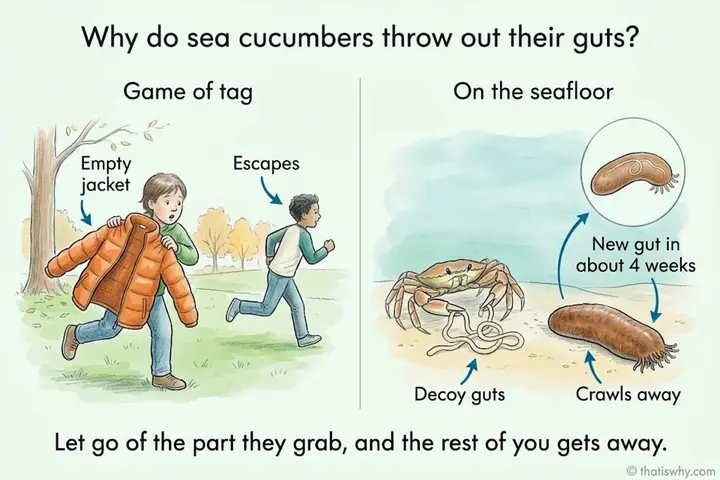 Why do sea cucumbers throw out their guts?