Why Some Deep-Sea Animals Become Invisible – The Physics of Ocean Transparency
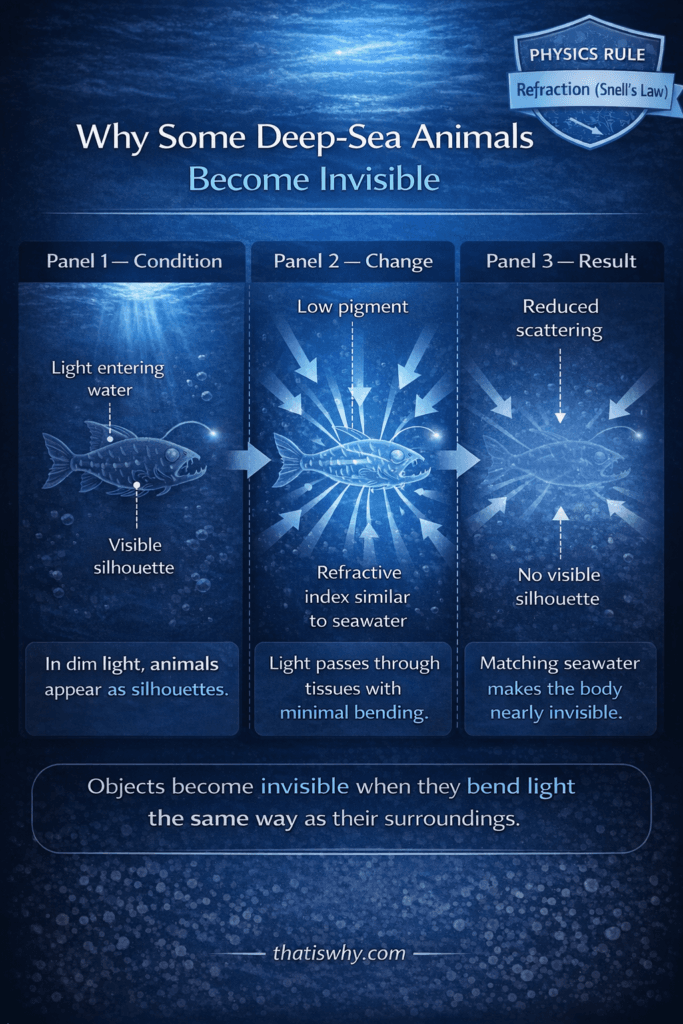
Deep-sea animals become transparent by matching how seawater bends light. Their bodies contain very little pigment and are made mostly of water, allowing light to pass through with minimal scattering. When light moves through their tissues almost the same way it moves through seawater, their outline fades.
In the dim waters of the ocean’s twilight zone, there is just enough light to reveal a silhouette but not enough to reveal color. In that environment, some animals survive by letting light pass straight through their bodies.
Looked at an ice cube in a glass of water.
Even though both the ice and the water are clear, you can still see the cube because tiny cracks and trapped air inside the ice bend light slightly differently than the surrounding water. Those small differences reveal its edges.
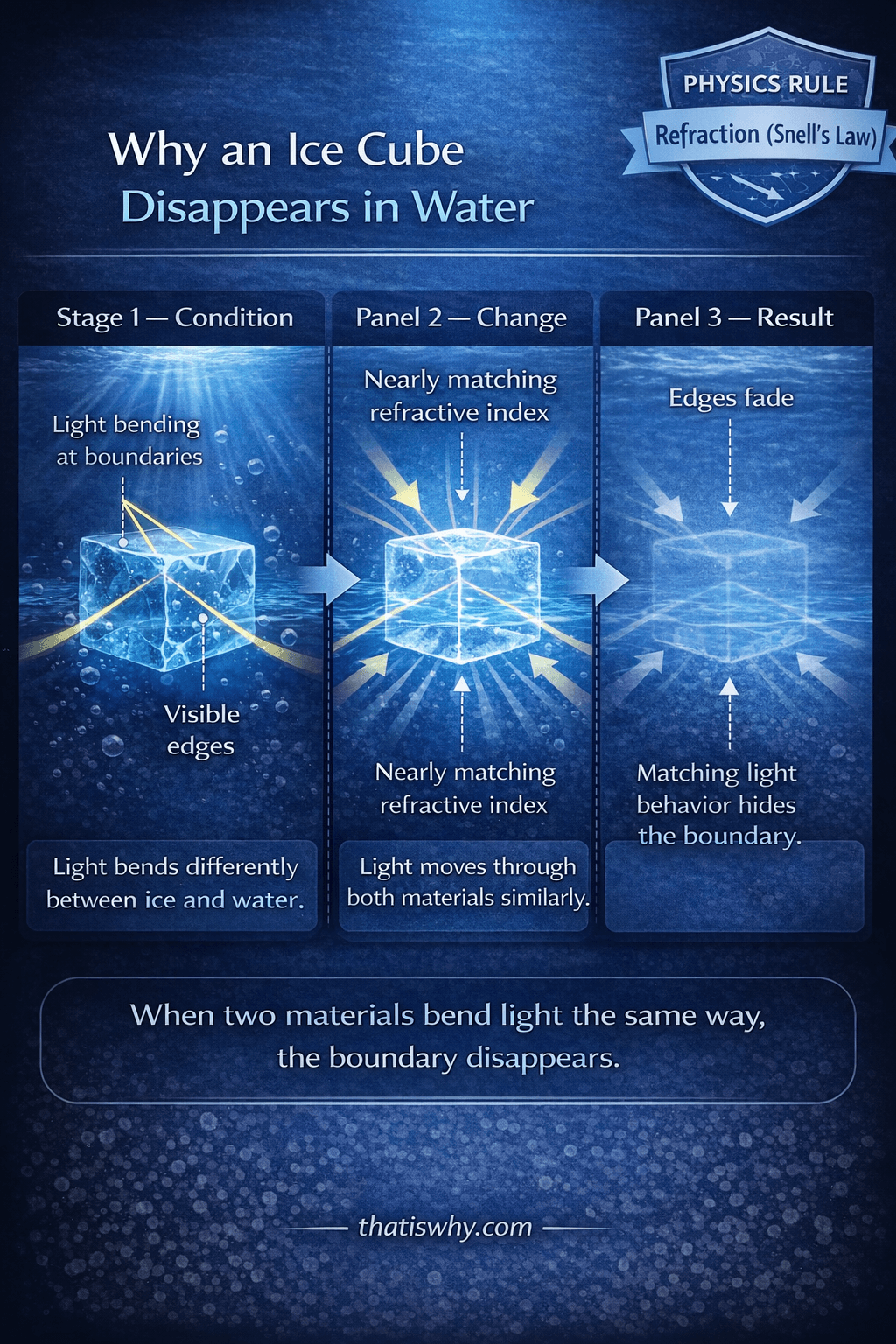
Now imagine a perfectly pure ice cube with no bubbles or cracks. If the ice bent light exactly the same way as the surrounding water, the boundary between the two would almost disappear.
Many animals in the twilight zone rely on that same principle. Instead of hiding with color or patterns, they allow light to pass through their bodies with almost no disturbance.
In a place where predators scan the water for silhouettes, that optical trick can make the difference between being seen and disappearing into the ocean itself.
This idea also reflects a broader rule of the Airless Empire. Life in the deep ocean often survives by becoming more like the environment around it. The same principle that allows fluid-filled bodies to withstand immense pressure, explored in The Physics of Uncrushable Liquids, also allows some creatures to vanish in plain sight.
Why “Clear” Does Not Automatically Mean Invisible
Transparency alone does not guarantee invisibility.
Most clear objects remain visible because they bend light differently than the material around them. When light crosses from one substance into another that slows it down slightly, its path changes. That small shift creates edges and distortions that our eyes can detect.
You see this every time you place a clear straw in a glass of water. The straw is transparent, yet its outline remains obvious because the plastic bends light differently than the surrounding liquid.
The ice cube example works for the same reason.
In physics this property is called the refractive index, which describes how fast light travels through a material.
For animals trying to disappear in the ocean, this detail becomes critical. If their tissues bend light even slightly differently than seawater, the animal appears as a faint shimmer.
Transparent animals therefore face a precise requirement.
Their tissues must allow light to pass through almost exactly as it passes through seawater. When that optical match becomes close enough, the boundary between animal and ocean begins to fade.
The Invisible Skin: Preventing Reflections
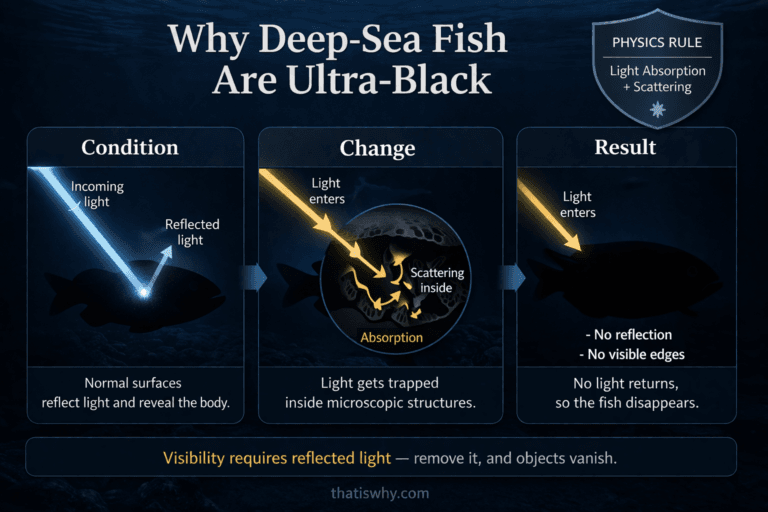
Matching seawater’s refractive index removes the silhouette, but another problem remains. Light can still reflect off the surface.
Even transparent materials reveal themselves when light glints off them. For animals trying to disappear in open water, that flash can give them away. Many transparent creatures solve this with microscopic surface structures.
Researchers studying the transparent crustacean Cystisoma discovered that its body is covered with tiny bumps that scatter incoming light and guide most of it into the body rather than reflecting it.
Modern eyeglasses use a similar idea with anti-reflective coatings that prevent light from bouncing off the lens. The surface of this animal performs the same optical trick.
Measurements show that more than ninety-nine percent of incoming light passes through the body rather than reflecting away. In the dim mid-ocean, removing that faint glint can make the difference between detection and invisibility.
The Eye Problem: The One Thing Transparency Cannot Hide
Transparency works across most of the body, but the eyes create a problem.
Seeing requires absorbing light. The retina must capture incoming photons to form an image. If the eye were perfectly transparent, the light would simply pass through without being detected. For animals trying to disappear, this creates a compromise.
The body can allow light to pass through almost perfectly, but the eyes must remain dark enough to capture that light.
Many species reduce this problem by shrinking the visible footprint of their eyes. Some develop narrow tube-shaped eyes that point upward toward faint surface light, while others angle their eyes to hide most of the retina from side view.
The result is a body that nearly disappears, interrupted only by tiny dark points where the eyes remain.
The Trade-Off: Transparency Ends When You Eat
Transparency works well until the animal eats.
The moment a transparent predator swallows something opaque, the illusion begins to break. A shrimp or small fish can appear as a dark shape inside an otherwise invisible body. Some species solve this with what biologists call the red gut strategy.
The digestive tract contains deep red pigments that absorb the blue light dominating the mid-ocean. Because red wavelengths disappear quickly with depth, these pigments appear almost black underwater.
Instead of revealing a glowing stomach full of prey, the gut becomes a dark compartment that hides the meal.
The Deeper Principle: Becoming the Water
Think again about the ice cube in the glass of water.
You notice the cube because small imperfections bend light differently than the surrounding liquid. Your eyes are detecting the mismatch.
Transparent animals spend their entire biology reducing that mismatch.
They remove pigments, simplify dense tissues, and allow light to pass through their bodies almost exactly as it would through seawater.
When that optical match becomes close enough, the boundary between animal and ocean fades.
This pattern appears throughout the deep sea. Organisms survive crushing pressure by filling their bodies with fluid that moves with the surrounding water. They stabilize proteins so chemistry continues under immense pressure. They adapt shells and tissues to the strange chemistry of the abyss.
Transparency follows the same rule. The closer an organism matches the physical behavior of seawater, the harder it becomes to see where the animal ends and the ocean begins.
Three Myths About Transparency in the Deep Ocean
Myth #1 — Transparent Animals Are Completely Invisible
Truth — Transparency Removes the Silhouette
Even transparent animals can still be detected. Internal structures may scatter light, reflections can create faint glints, and movement can disturb surrounding light patterns.
Think again about the ice cube. Small imperfections still reveal its edges.
Transparency works by removing the strong outline predators search for. When light passes through the body almost exactly as it passes through seawater, the silhouette fades.
Myth #2 — Being Clear Is Enough
Truth — The Trick Is Matching Seawater
Many clear materials remain easy to see.
A clear straw in a glass of water stays visible because the plastic bends light differently than the surrounding liquid.Transparent animals succeed because their tissues bend light almost exactly the way seawater does. When that optical match becomes close enough, the boundary between body and ocean disappears.
Myth #3 — Transparency Works Best in Total Darkness
Truth — Transparency Works in the Twilight Zone
It might seem that invisibility would matter most in the darkest parts of the ocean.Transparency works best where faint light still creates silhouettes. By letting that light pass through their bodies, these animals remove the outline predators normally detect.
Why the Deep Ocean Rewards Perfect Matches
Return once more to the ice cube in the glass of water.
The cube becomes visible when light bends differently at its boundary. Transparent animals spend their entire biology reducing that difference.
They remove pigments, simplify dense tissues, and shape their bodies so light moves through them almost exactly as it moves through seawater.
The closer that match becomes, the harder it is to tell where the animal ends and the ocean begins.
It is a lesson that extends beyond the ocean.
Sometimes the most effective strategy is not to resist the environment around you, but to understand it so well that you move within it without creating the disturbances that draw attention.
How We Researched This :
To explain deep-sea transparency, we reviewed research in marine optics, biological materials, and mid-water ecology. Studies of transparent organisms such as Cystisoma and salps show how animals minimize pigments, reduce dense tissues, and develop microscopic structures that limit light reflection.
Research from institutions including Woods Hole Oceanographic Institution and Monterey Bay Aquarium Research Institute has documented how these animals control scattering, reflection, and refractive index to remain nearly invisible.
But explaining the physics of transparency requires more than optical measurements. Our goal was to make the mechanism intuitive, which is why we used the “ice cube analogy” to make objects becoming visible the moment they bend light fee intuitive.