Why the Deep Ocean Looks Like a Blue Star Field
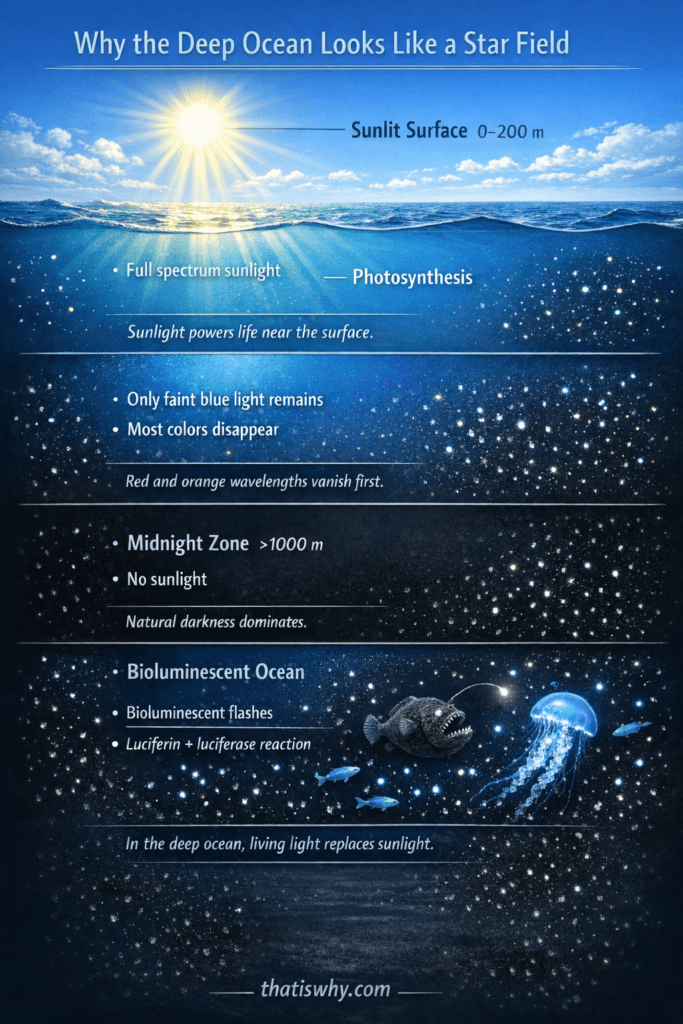
In the deep ocean, sunlight disappears and the only light that remains comes from living creatures. Instead of a brightly lit underwater world, the abyss looks more like a dark sky scattered with faint blue sparks of Bioluminescence.
Most of the water would appear completely black, tiny flash of blue light would appear somewhere in the distance, much like a faint star flickering in the night sky.
Life in this environment evolves around that rare light. Some animals grow enormous eyes to capture the last available photons. Others produce their own glow to hunt, signal, or confuse predators.
And some animals solve the problem by becoming invisible to the light itself.
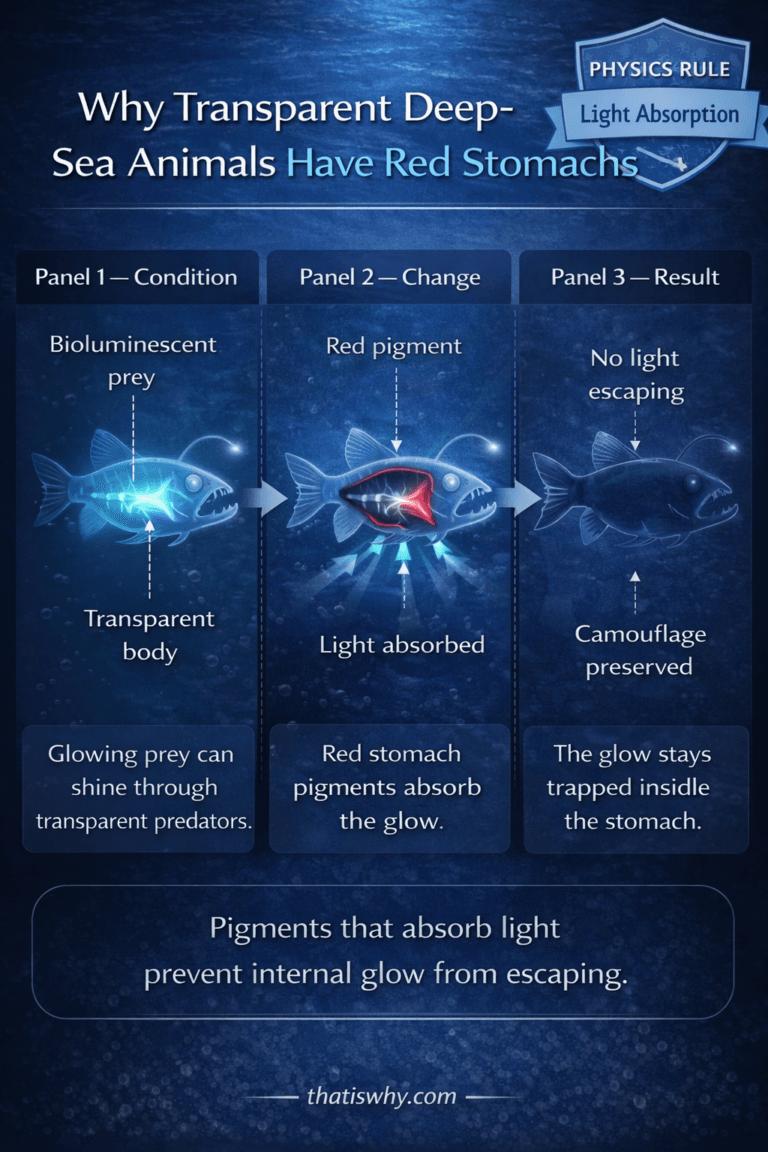
Many deep-sea creatures are bright red, which may sound strange in a place so dark. Yet because red wavelengths disappear near the surface, red bodies reflect almost nothing in the deep ocean. If you want to explore that optical trick in detail, see our guide explaining why many deep-sea fish are red.
The deep ocean therefore behaves less like a dark cave and more like a dim star field where survival depends on how well you control light.
The Giant’s Eye: Catching the Last Photon
Once you picture the deep ocean as a kind of blue star field, the enormous eyes of some deep-sea animals stop looking so strange.
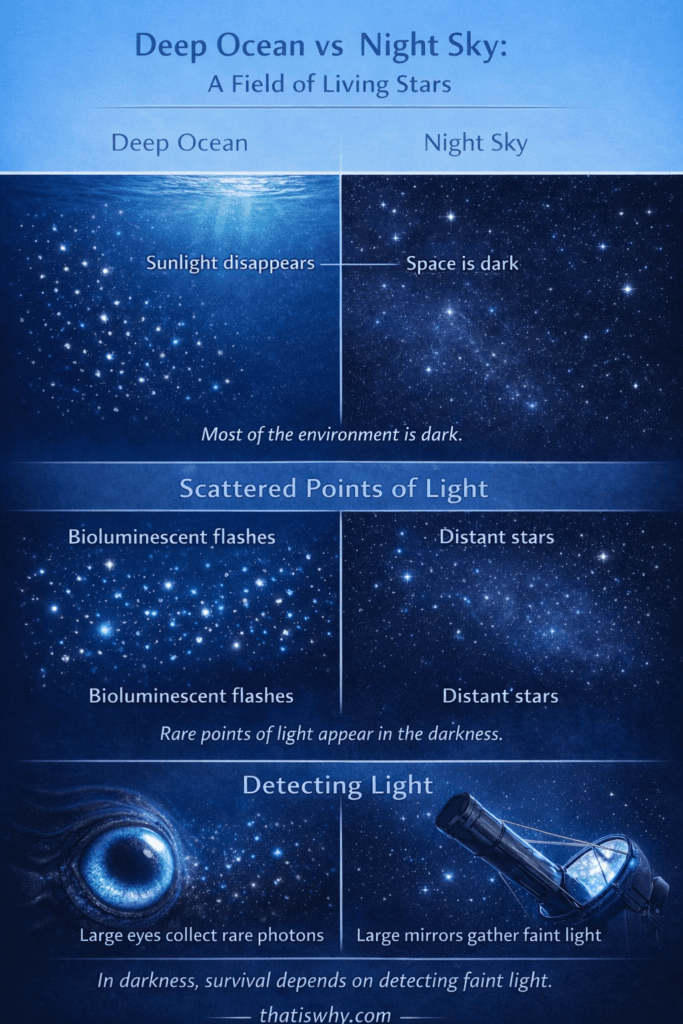
Light is incredibly rare down there. A creature may drift through darkness for long stretches before a single faint glow appears somewhere nearby. That glow might come from drifting plankton, another animal, or something large moving through the water.
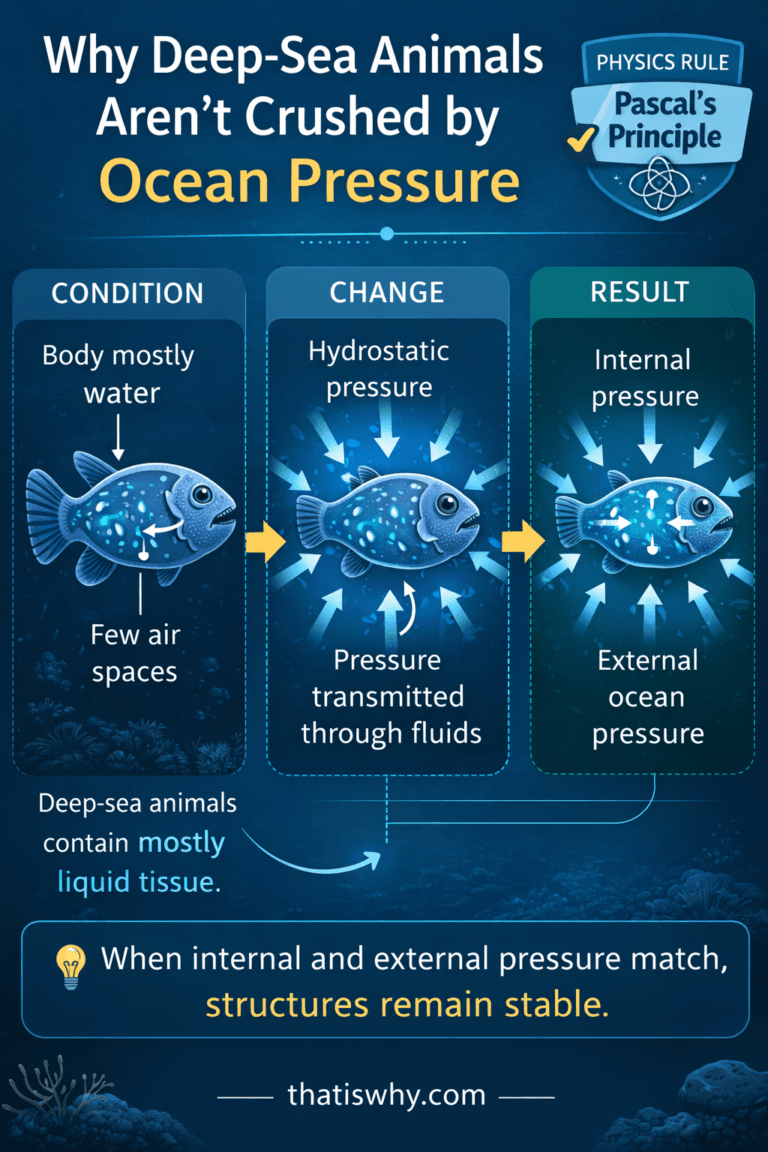
The deep ocean therefore behaves less like a dark cave and more like a dim star field where survival depends on how well you manage light. This optical world exists partly because seawater remains clear enough for photons to travel through it at great depth, a property explained in our earlier article on The Physics of Uncrushable Liquids.
Noticing that tiny signal can make all the difference. This is why some deep-sea animals evolved remarkably large eyes.
The Giant squid has eyes nearly the size of a basketball, the largest known in the animal kingdom. Those eyes are not designed for bright scenes like the ones humans see near the surface. They exist to gather the faintest traces of light.
When a large predator such as a sperm whale swims through the deep ocean, it disturbs clouds of tiny bioluminescent organisms drifting in the water. Those organisms flash briefly when they are bumped or stressed.
To a giant squid, those scattered flashes look like subtle ripples moving across a dark star field.
A larger eye collects more photons in the same way a large telescope gathers more starlight from distant galaxies. The squid is not really trying to see the whale itself.
It is trying to notice the faint pattern of light the whale leaves behind.
Making Your Own Stars: The Chemistry of Living Light
In a world that looks like a dark star field, the most reliable way to see anything is to create a star of your own.
Many deep-sea animals do exactly that.
Their glow comes from a chemical reaction called Bioluminescence. Inside specialized organs, a molecule known as luciferin reacts with oxygen with the help of an enzyme called luciferase. The energy from that reaction is released almost entirely as light rather than heat.
That efficiency matters in a place where light is so scarce. Seen through the star-field picture of the deep ocean, each flash of bioluminescence is like a small star appearing in the darkness. Some animals use those stars as bait.
The anglerfish carries a glowing bulb that hangs just in front of its mouth. In the darkness of the deep ocean, that faint glow resembles a tiny drifting star. Curious prey approach the light, and the predator waiting behind it closes the distance.
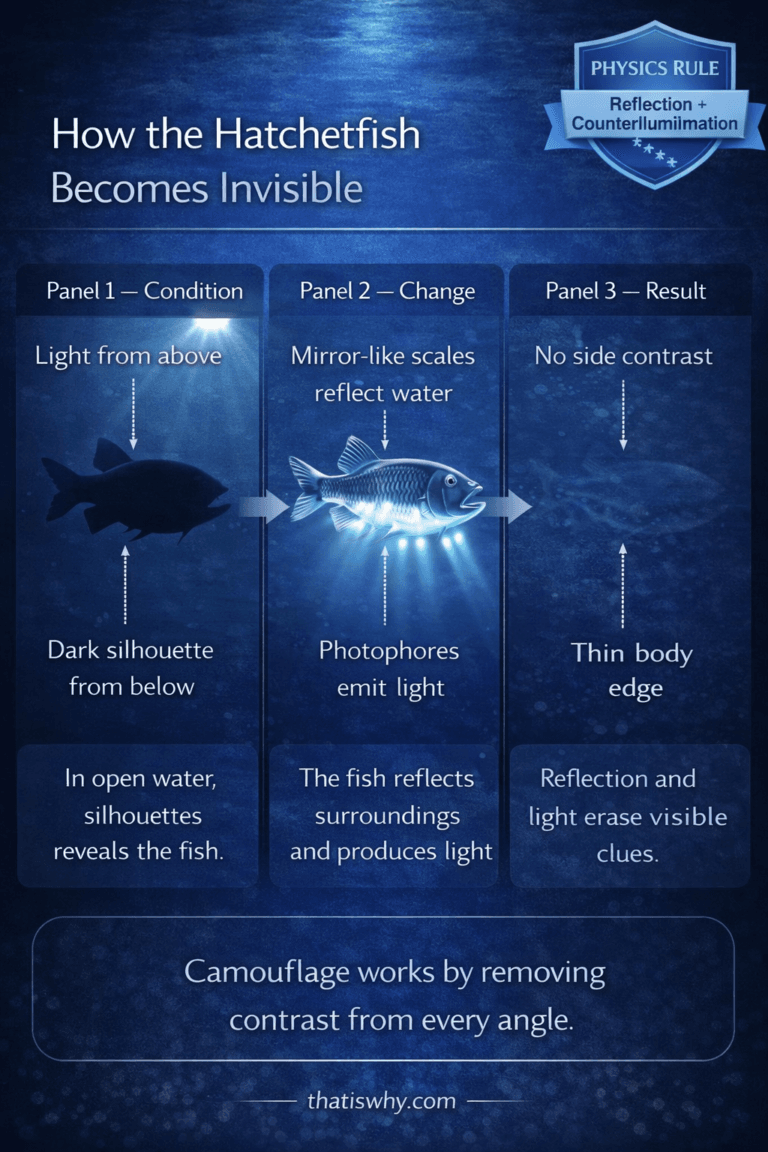
Other animals use light more quietly. Certain fish produce faint glows along their bellies that match the dim blue light filtering down from far above. When predators look upward, the fish blends into the scattered glow of the water above.
In the deep sea, survival often depends on the same rule that governs a night sky. What matters most is not how bright the world is, but who controls the stars.
Living on the Crumbs of the Sun
Even in a world that feels like a dim blue star field, the deep ocean still runs on energy from far above.
That energy begins with the Sun.
Near the surface, sunlight powers microscopic algae and plankton. When those organisms die or produce waste, tiny particles begin a long, slow fall through the water column. Oceanographers call this steady drift marine snow.
In the deep sea, these particles move through the darkness like faint specks drifting across a night sky. Each one carries a small trace of energy that started its journey in sunlight. Yet while seawater allows light to travel surprisingly far, its chemistry can erase other things entirely. In the deepest parts of the ocean, even shells may dissolve before reaching the seafloor, a process explained in Why Shells Dissolve in the Deep Ocean.
For animals living thousands of meters below the surface, that quiet snowfall becomes the main food supply. Life in the deep ocean rarely sees large meals. Most of the time it survives on the slow and constant drizzle of organic material sinking from above.
You could think of it as living on crumbs that fall from a table miles overhead.
Every glowing flash of Bioluminescence in the abyss ultimately traces back to that distant source. The light may appear deep in the darkness, but the energy that powers it began its journey in the sunlit ocean near the surface.
Why the Deep Ocean Is Not Completely Dark
Myth #1: The deep sea is pitch black
Truth: It is filled with tiny flashes of living light.
The deep ocean receives almost no sunlight, yet it is far from completely dark. Many organisms produce their own light through Bioluminescence, creating brief flashes and glows that move through the water like scattered stars.
Myth #2: Large eyes mean better vision
Truth: They exist to capture rare photons.
Some deep-sea animals evolved enormous eyes not to see bright scenes but to detect the faintest traces of light. The huge eyes of the Giant squid, for example, are designed to collect extremely small amounts of light and notice subtle flashes in the darkness.
Myth #3: Color does not matter in darkness
Truth: Certain colors become invisible.
Because water absorbs red wavelengths quickly, red animals reflect almost no visible light in the deep ocean. In the blue-dominated light environment of the abyss, bright red creatures appear nearly black, making red one of the most effective forms of camouflage.
When the Ocean Turns Into a Night Sky
Once you start thinking of the deep ocean as a blue star field, many of its strange adaptations begin to feel less mysterious.
Light becomes the rarest resource in the environment.
Animals evolve enormous eyes to catch the faintest photons drifting through the water. Others produce their own flashes of Bioluminescence, turning the darkness into a shifting field of moving lights. Even color becomes a survival strategy, because certain pigments simply vanish when the surrounding light disappears.
What looks like darkness to us is actually a sparse optical landscape.
Tiny flashes appear and fade. Shadows move across them. A drifting glow might signal food, a predator, or another animal sending a signal through the dark. Seen this way, the deep sea behaves less like an empty void and more like a quiet sky filled with scattered stars.
And in that sky, survival depends on a simple rule. You either learn to see the stars, create them, or disappear between them.
How We Researched This :
To explain how vision works in the deep ocean, we reviewed research in marine optics, sensory biology, and bioluminescence. Foundational studies on light penetration in seawater and visual adaptation come from oceanographic research institutions such as the Woods Hole Oceanographic Institution and the Monterey Bay Aquarium Research Institute. Work on deep-sea visual systems, including the giant eyes of the Giant squid and unusual mirror-based vision in the Spookfish, comes from studies in marine biology and sensory ecology.
But we knew that listing wavelengths and optical equations would not make the deep ocean easy to picture. Our real job began when we asked, “What would this environment look like if we could stand inside it?” That question led us to the “blue star field analogy“, which make photons and living flashes of Bioluminescence feel intuitive;