Why Deep Sea Creatures Grow Into Giants
What is Deep-Sea Gigantism? Deep-sea gigantism is the tendency for ocean invertebrates to grow massive in the deep sea compared to their shallow-water cousins. Examples include the Giant Isopod, the Colossal Squid, and the Japanese Spider Crab. Scientists believe this is driven by metabolic efficiency (Kleiber’s Law), cold temperatures, and high oxygen availability.
That is the science. But looking at these things makes you feel like you walked onto the set of a horror movie.
Imagine a woodlouse, those little gray pill bugs you find under rocks in the garden about the size of a pea. Now, imagine one the size of a French Bulldog.
It exists. It’s called the Giant Isopod (Bathynomus giganteus). Down in the abyss, squids grow to the size of school buses, and spiders have legs that span three feet.
Why does the deep ocean, a place with no light, freezing cold, and almost no food, turn normal animals into monsters?
We used to assume it was the pressure. But it turns out, the answer isn’t about gravity. It’s about batteries.
The Battery Problem
To understand why animals get huge, you have to understand the energy crisis of the deep sea. There is almost no food down there. It is a nutritional desert. So, survival is all about energy efficiency.
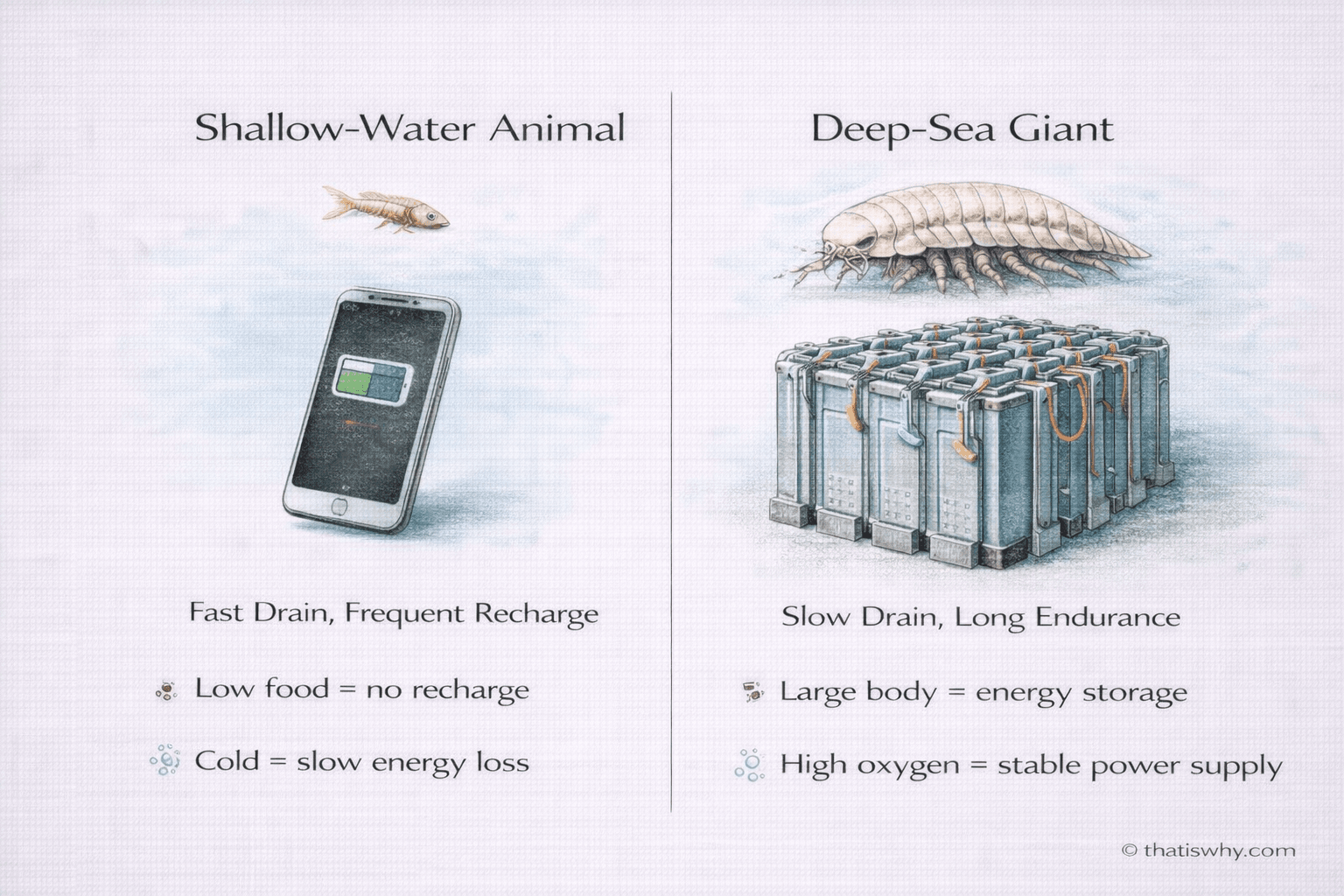
Think of these animals as smartphones.
Think about the battery life of a tiny phone. It burns through its charge fast because it has a small tank and loses heat quickly. It needs to be plugged in constantly. Now, compare that to a giant tablet. It has a massive battery that holds a charge for days.
In biology, this is called Kleiber’s Law. It turns out, big animals are much more fuel-efficient than small ones. A mouse has to eat its own body weight in food every few days just to stay alive. An elephant can survive on a fraction of that relative to its size.
In the deep sea, there are no outlets. You can’t recharge. So evolution built the biggest battery possible. By growing huge, these animals lower their metabolic rate, becoming slow-burning energy tanks that can survive for months—or even years—without a meal.
The Temperature Trap
But efficiency isn’t the only reason. There is also the cold.
The deep ocean is freezing, hovering just above 0°C. And just like your phone battery dies faster in the winter, biology struggles to keep the lights on.
This triggers a rule called Bergmann’s Rule: In the cold, you get bigger. Why? Because big batteries hold their heat better. If you leave a tiny AA battery in the snow, it freezes through instantly. But if you leave a massive car battery in the snow, the core stays insulated.
Large animals have less skin exposed relative to their guts. This helps them retain whatever tiny amount of body heat they generate. So, the cold forces them to bulk up. And because the cold slows down their internal clock, they live longer. A shallow-water shrimp might live for two years. A deep-sea giant might live for decades. They recharge slow, drain slow, and just keep growing.
The Super-Charger
Finally, there is the power source.
If you want to run a massive machine, you need a high-voltage input. And the deep ocean has a secret supply. Cold water holds significantly more oxygen than warm water. It is basically a hyper-oxygenated bath.
This changes the rules for creatures like the Giant Sea Spider. These animals don’t have lungs; they absorb oxygen straight through their skin. In the warm shallows, they are limited by the weak power supply. They can only grow so big before they suffocate.
But in the deep, cold abyss, the voltage is turned way up. The limit is removed. They can expand their bodies to massive sizes, growing legs that span feet across, simply because the local power grid can support it.
Giants Walk Among Us
This phenomenon isn’t just a weird quirk of the ocean. It’s a rule of nature. When you isolate a population and give them weird resources, they get huge.
Island Giants The deep sea is basically an island in reverse. It is isolated and hard to leave. We see the same thing on the Galapagos Islands. Tortoises grew into giants because they needed long-term storage and had no predators to stop them. The Giant Isopod is just the underwater version of the Galapagos Tortoise.
The Dinosaur Connection Remember those prehistoric dragonflies with 2-foot wingspans? They didn’t grow that big because of magic; they grew that big because ancient Earth had way more oxygen. The deep sea is a time capsule. It shows us what life can do when you turn the oxygen knob up to 11.
Monster Myths
Because these animals look terrifying, we assume they act terrifying. But looks can be deceiving.
Myth #1: “They hunt submarines.” We see a Giant Squid and think Jaws.
The Truth: Most deep-sea giants are incredibly slow. They are scavengers, not hunters. The Giant Isopod isn’t stalking prey; it’s waiting for a dead whale to fall on its head. Being huge allows it to gorge itself on one massive meal and then sleep for a year. They are drifters, not fighters.
Myth #2: “The pressure makes them big.” People assume the weight of the water stretches them out.
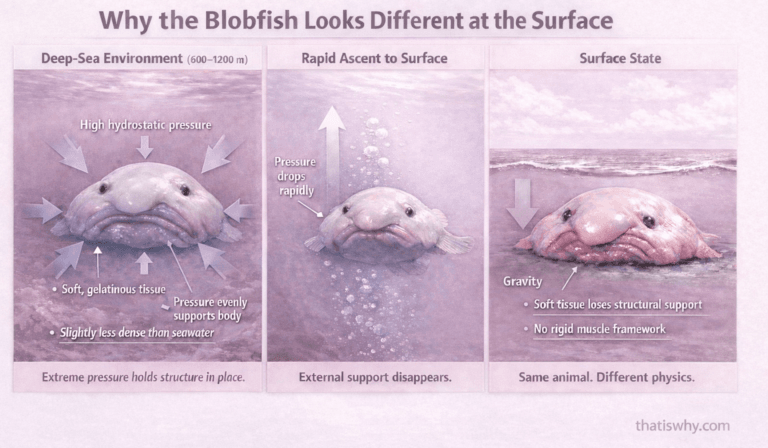
The Truth: Pressure actually tries to crush you. These animals get big despite the pressure, not because of it. Their bodies are filled with fluid (which doesn’t compress), allowing them to ignore the weight of the ocean entirely.
Built for the Long Haul
When we see a Giant Isopod or a Colossal Squid, we recoil. They look like biological errors.
But they are actually perfect optimizations. The deep ocean is a brutal, cold, empty place. To survive there, you can’t be a frantic little sports car zooming around looking for a gas station that doesn’t exist.
You have to be a tanker truck. You have to be a massive battery. You have to be built for the long haul. These creatures didn’t grow huge to scare us. They grew huge because in the empty dark, being big is the only way to keep the lights on.
How We Researched This :
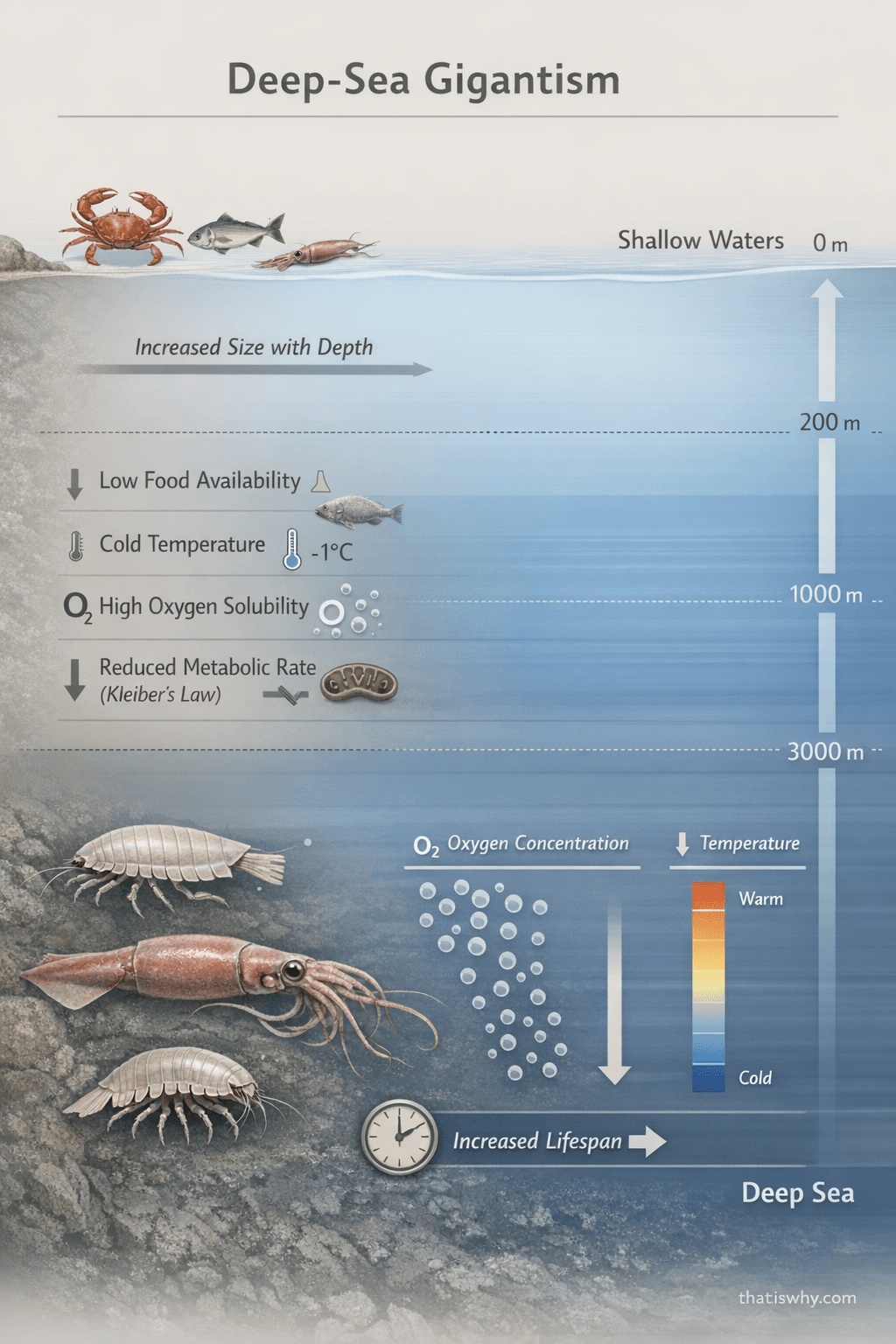
To explain this phenomenon, we looked beyond simple biology and dug into Metabolic Theory. We applied Kleiber’s Law (the math of metabolic efficiency) and Bergmann’s Rule (the math of heat retention) to the specific conditions of the bathypelagic zone.
But we knew that just citing metabolic laws isn’t helpful. Our real job began when we asked, “What does this feel like?” That question led us to the “Smartphone Battery” analogy—a simple story to make the complex trade-off between body size and energy storage feel intuitive.