Why The Deep Sea Perfected Stealth : The Optical Arms Race
In the open ocean, there is nowhere to hide. There are no rocks, no caves, and no fixed background to blend into. Every movement happens in open water, where anything that reflects, bends, or blocks light can be detected. Because of that, camouflage cannot stay the same.
As you descend through the ocean, the rules begin to change. Light fades, angles shift, and the way visibility works at one depth no longer applies at the next. A strategy that works higher up gradually becomes less effective, and what once kept an animal hidden can start to reveal it. This creates a kind of progression.
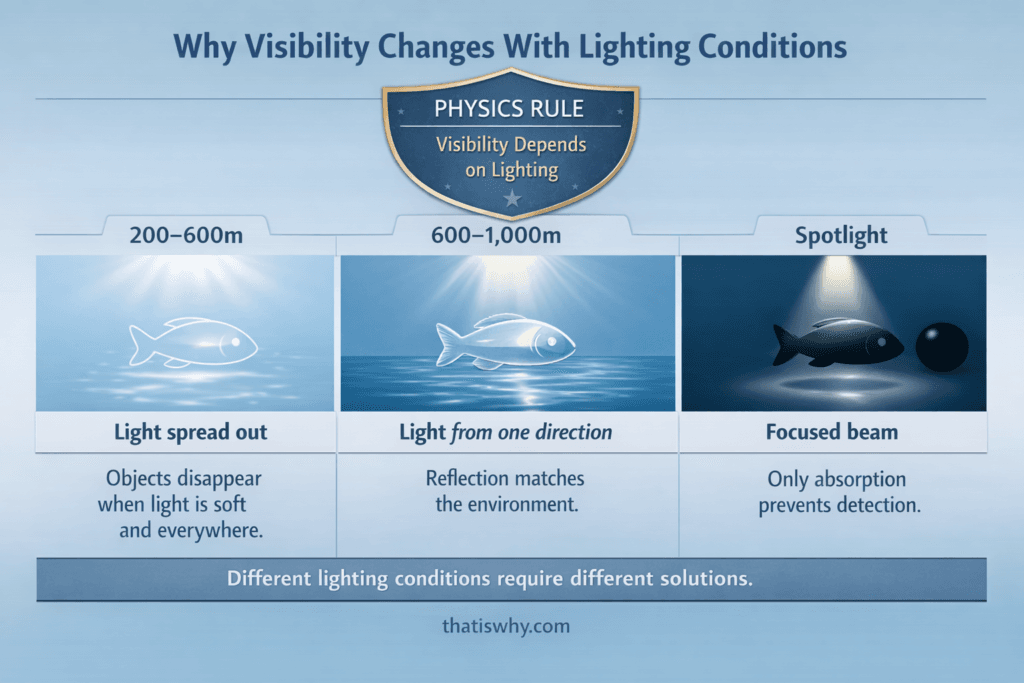
At one depth, the best approach is to disappear by letting light pass through the body. Deeper down, that approach begins to fail, and reflection becomes more effective. Go further still, and even reflection becomes a risk, forcing animals to absorb light instead of returning it. Each layer replaces the one before it.
What looks like a collection of different tricks is actually a sequence shaped by changing conditions. As the ocean darkens, the problem of visibility changes, and each solution must adapt to those new constraints.
This is what turns camouflage in the deep sea into something closer to an arms race.
Every few hundred meters, the rules shift, and survival depends on solving the problem again under a new set of conditions.
Layer 1: The Glass Shield (200m – 600m)
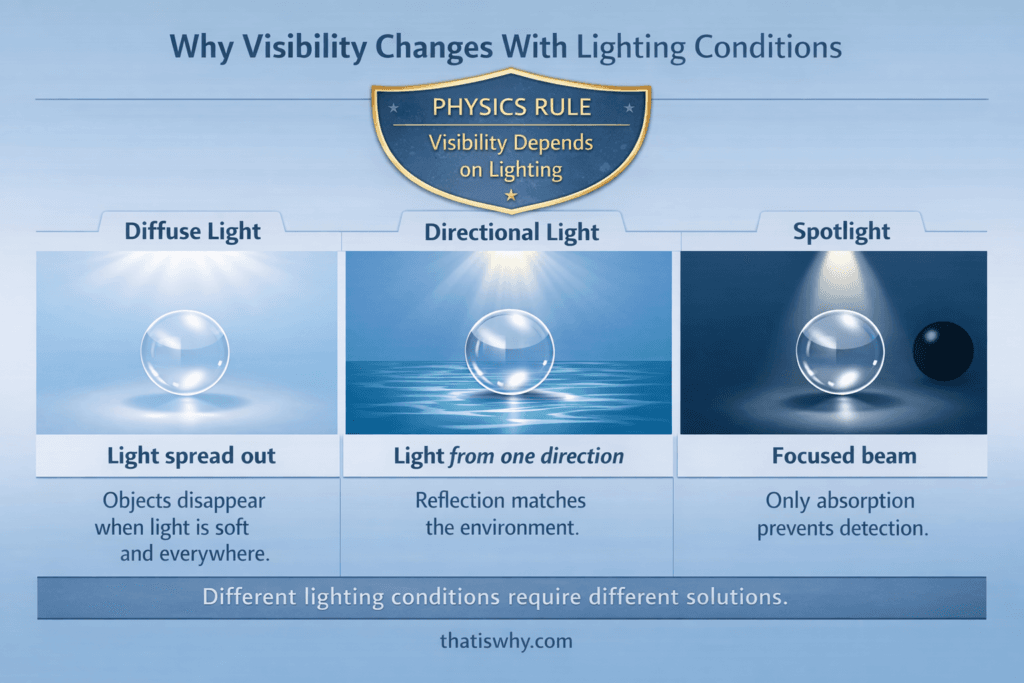
At this depth, the ocean is still filled with light, but it no longer behaves the way it does near the surface. It spreads out, softens, and loses direction, so there are no strong shadows or clear edges, only a wide field of dim light moving through the water.
In that kind of space, being seen comes down to disruption. Anything that bends light, reflects it, or blocks it creates a small signal, and even a faint outline can be enough to give something away.
The first solution is quiet but effective. Instead of trying to match the light, these animals let it pass through them. Their bodies do not interrupt it enough to create a clear boundary, which makes them difficult to separate from the water around them, a strategy explained in more detail in The Physics of Ocean Transparency.
There is nothing obvious to focus on. No sharp edge, no strong reflection, and no clear shape to lock onto.
As long as the light stays soft and everywhere at once, that approach works.
Layer 2: The Hall of Mirrors (600m – 1,000m)
As you move deeper, the light changes again.
It becomes dimmer and more directional, no longer filling the water evenly. Instead of a soft field, it starts to feel like it is coming from above, leaving the space around it darker and less uniform.
That shift breaks the previous solution. A body that lets light pass through no longer disappears as cleanly, because the light now has direction. Even a small mismatch can create a faint outline when seen from the side.
So the strategy changes.
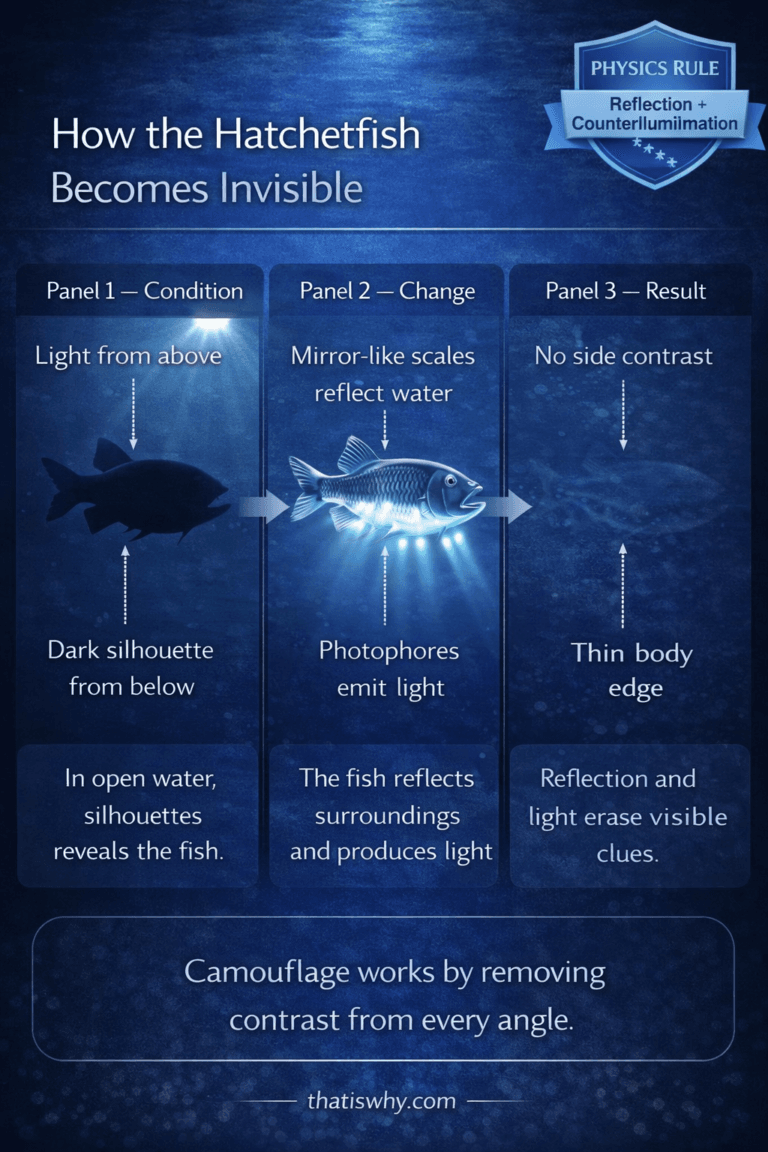
Instead of letting light pass through, some animals begin to control how it reflects. Their bodies act like angled surfaces that send light back in a way that matches the surrounding water.
From the side, there is no clear difference between the animal and the space around it.The body is still there, but the signal that would reveal it is replaced by a reflection that looks like empty ocean, a strategy explored further in The Living Mirror Strategy. This works well, but it comes with a limit.
Reflection can hide the sides, but it does not solve everything, and as the light continues to fade, even this approach begins to break down.
The Biological Fail-Safes
Even when a strategy works, it creates new problems.
A body that lets light pass through can still reveal what is inside it. A reflective surface can hide shape from one angle but not from another. Each solution removes one signal while exposing another.
That is where biological adjustments begin to appear.Some of these changes are small, but they solve very specific problems that would otherwise break the illusion.
One of the clearest examples appears inside transparent animals.When a predator eats something that produces light, that glow does not stop. It continues inside the body, which can turn an invisible hunter into something easy to detect.
The solution is not to change the whole body, but to isolate the problem. The digestive system becomes a place where light is absorbed before it can spread outward, a strategy explained in The Glowing Lunch Problem.
These kinds of adjustments act as fail-safes. They do not replace the main strategy, but they protect it from breaking under conditions where it would otherwise fail.
Layer 3: The 1,000m Flip (1,000m+)
At around 1,000 meters, the pattern breaks. Up to this point, each layer has adjusted the previous strategy, but this is where the earlier approaches stop working altogether.
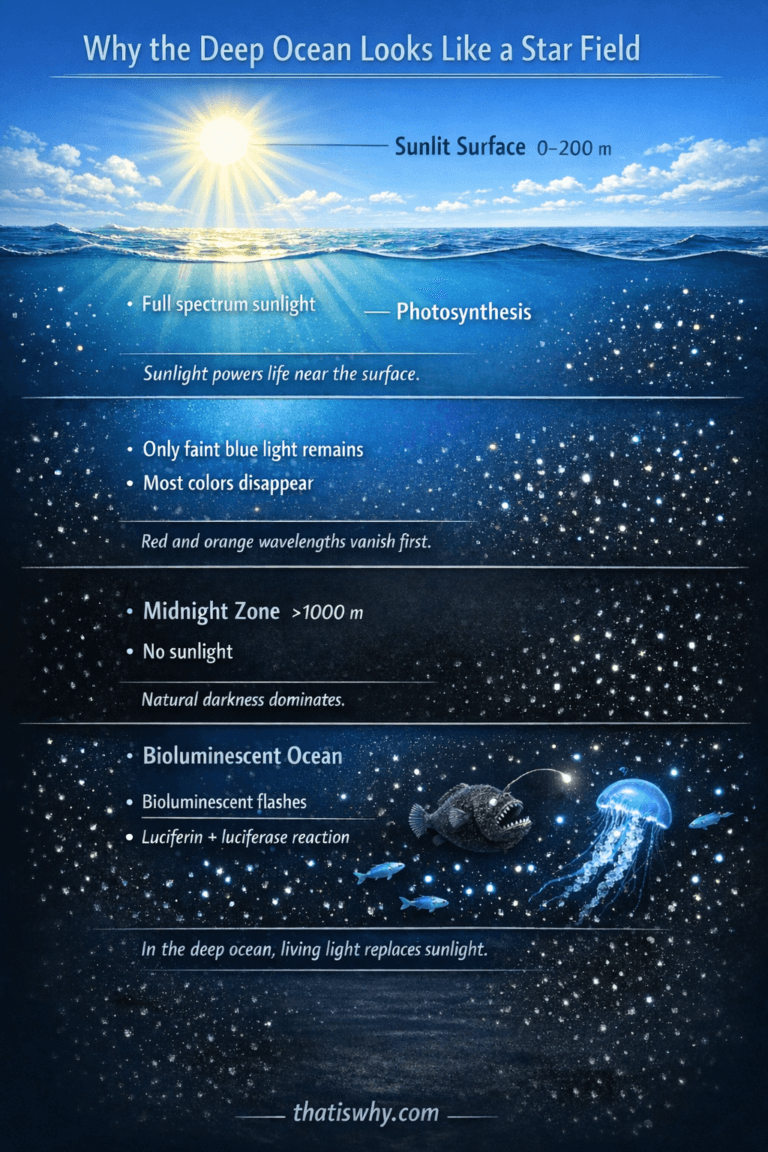
Sunlight is gone, and the only light that remains comes from living organisms. It no longer spreads evenly through the water but appears in brief flashes and narrow beams that move through the darkness.
That change resets the conditions. A body that lets light pass through can still produce a faint glint when a beam hits it, and a reflective surface can send that light back and reveal an edge. Both strategies begin to fail at the same time because even a small return is enough to be noticed.
The solution shifts again, instead of passing light or redirecting it, some animals absorb it so completely that nothing comes back. When light reaches the surface, it fades before it can return to the observer, which means there is no clear signal to detect.
From the outside, there is nothing to lock onto. No flash, no edge, and no visible boundary. This is where the final strategy appears, instead of blending into light, the goal becomes removing it, a transition explored in The 1,000m Flip: Why the Deepest Secrets Are Velvet Black.
The Stealth Map: How Strategies Change With Depth
Seen from the surface, the ocean can look like a single environment.
In reality, it behaves more like a vertical sequence where each layer follows different rules. As light fades with depth, the conditions that determine visibility shift, and the strategies that work in one layer begin to fail in the next.
In the upper twilight zone, where light is still spread out, transparency works because it avoids creating a clear boundary. Deeper down, as light becomes more directional, reflection becomes more effective because it replaces the body with the surrounding water.Below that, the rules tighten again.
Light becomes rare and focused, and anything that sends even a small amount back can be detected. At that point, absorption becomes the dominant strategy because it prevents any return signal.
Each layer builds on the one before it, but none of them lasts indefinitely. A solution that works at one depth becomes a liability at another, which forces the system to keep shifting.
This is what defines the optical arms race. It is not about finding a perfect way to stay hidden. It is about staying just ahead of the conditions that would otherwise reveal you.
The Bridge: Surviving More Than Just Light
Mastering light is only part of the challenge.
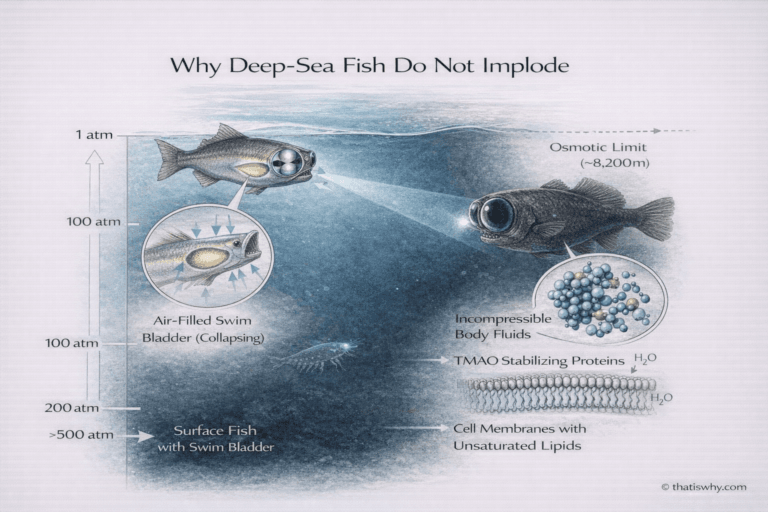
As these animals descend, the environment changes in multiple ways at once. The same depths that reshape how light behaves also increase pressure, alter temperature, and push chemistry to its limits. Each of these forces acts on the body at the same time, which means no single solution can work on its own.
A surface that controls light still has to survive compression. A body that absorbs or reflects light still has to function when pressure builds and materials behave differently. What looks like a clean optical solution is always tied to something deeper. That is why these strategies are layered.
The same organisms that manage visibility are also built to handle the physical demands of the deep ocean, a connection explored in Why Life Can Exist in the Crushing Depths of the Ocean: The Airless Empire. Their bodies are not just designed to avoid being seen, but to keep working in conditions that would break most structures.
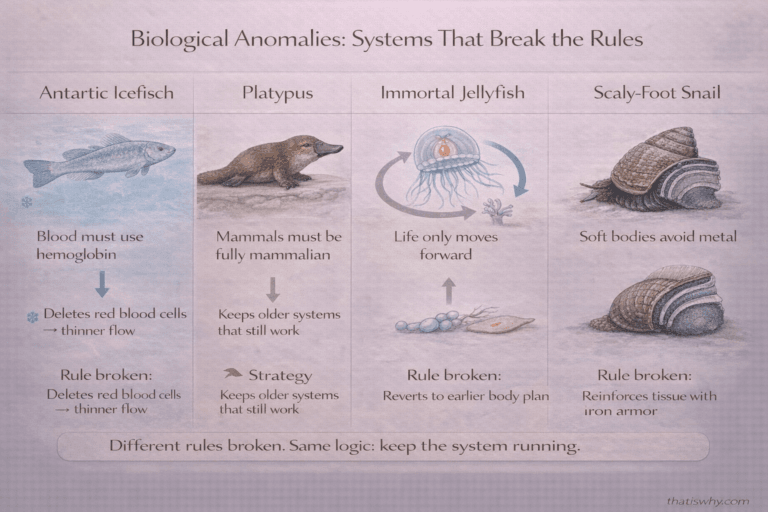
What appears to be a collection of strange features is actually a coordinated system. A transparent body, a reflective surface, or an ultra-black skin does not exist in isolation. Each one is supported by structural and chemical changes that allow it to function under extreme conditions.
Many of these combinations can seem unusual at first, which is why they are explored further in Biological Anomalies: Life That Breaks the Rules and Unusual Adaptations of Deep-Sea Animals How to Survive the Abyss.
The deeper you go, the more these solutions begin to overlap. Light defines what can be seen, but pressure, chemistry, and structure define what can exist. Survival depends on solving all of them at once, not separately.
Stealth as a Moving Target
What looks like invisibility in the deep ocean is never fixed.
Each layer solves the problem for a moment, but the moment does not last. As conditions shift, the same body that once stayed hidden begins to give itself away, and the strategy has to change with it.
Higher up, the solution is to stay out of the way of light. The body behaves like something that barely interrupts what passes through it, so there is nothing clear to see. Deeper down, that approach starts to fail, and the solution shifts to reflection, where the body no longer disappears but replaces itself with what surrounds it. Go further still, and even that becomes a risk, because light no longer surrounds you but finds you in narrow beams.At that point, the only option left is to stop the light entirely.
The difference between these strategies can be felt in simple terms. A reflective surface stands out because it throws light back. A darker surface reduces that effect, but still leaves enough behind to show a shape. Push that idea far enough, and the surface stops returning anything at all, and what remains is not something hidden, but something that never forms a visible signal.
Each layer solves a different version of the same problem, and none of them is permanent.This is what turns camouflage into a moving target.
The deeper pattern is not about becoming invisible once, but about adjusting as the conditions change. Every solution works within a narrow set of rules, and survival depends on recognizing when those rules no longer apply.
In most situations, what stands out is not simply what exists, but what does not fit. The more something disrupts its surroundings, the easier it is to notice. The closer it aligns with the conditions around it, the less attention it draws.
Deep ocean makes that principle visible. It shows that survival is not about finding one perfect strategy, but about staying adaptable as the environment shifts, adjusting just enough to avoid being seen as the rules keep changing.
How We Researched This :
To explain how deep-sea camouflage changes with depth, we looked at research in marine optics, deep-sea biology, and ecological studies that describe how light behaves underwater and how different organisms respond to it.
But we knew that just citing optical measurements, pigment structures, or light absorption data is not helpful on its own. Our real job began when we asked, “What does this feel like?” That question led us to everyday comparisons like the difference between a reflective jacket and a black hoodie—simple, familiar situations that make the idea of light returning or disappearing feel intuitive.