Why Deep Sea Fish Don’t Implode (The Physics of Pressure)
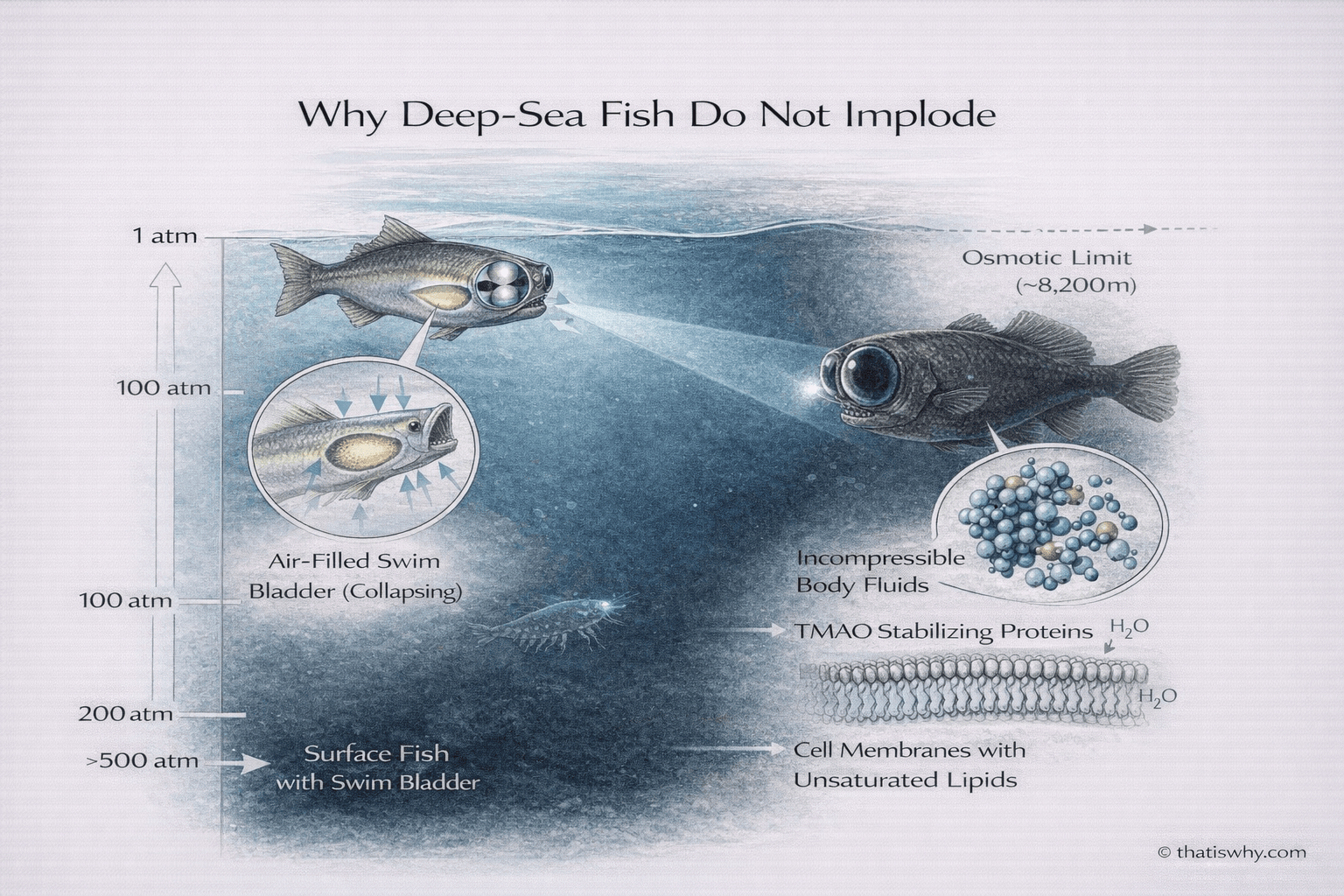
Why don’t deep-sea fish implode? Deep-sea fish do not implode because they lack air-filled cavities, such as swim bladders, which would collapse under extreme pressure. Instead, their bodies are filled with incompressible fluids and gelatinous tissues that match the surrounding water pressure, while a chemical called TMAO stabilizes their proteins against crushing forces.
That is the science. But seeing the pressure in action is terrifying.
If you ever visit a deep-sea research lab, ask them to show you “The Cup.” It’s a tradition. Before a dive, scientists take a standard white Styrofoam coffee cup, draw a picture on it, and strap it to the outside of the submarine.
When it comes back up, the cup hasn’t broken. It has shrunk. The pressure squeezes the air out of the foam, reducing the cup to the size of a thimble.
This happens because at 8,000 meters deep, the pressure is over 8 tons per square inch. That is the equivalent of an elephant standing on your thumb. So how can a delicate, squishy snailfish swim around casually in an environment that eats submarines for breakfast?
The Gel Pack vs. The Bubble Wrap
To understand why the fish survives, you have to realize that pressure is a bully. It only picks on Air.
Air is weak. It compresses. If you squeeze a balloon, it shrinks. If you squeeze it hard enough, it pops.
Most shallow-water fish are built like Bubble Wrap. They have a gas-filled bag inside them called a “Swim Bladder” that helps them float. If you dragged a shallow fish down to the deep, the pressure would crush that gas bladder instantly. It will be game over.
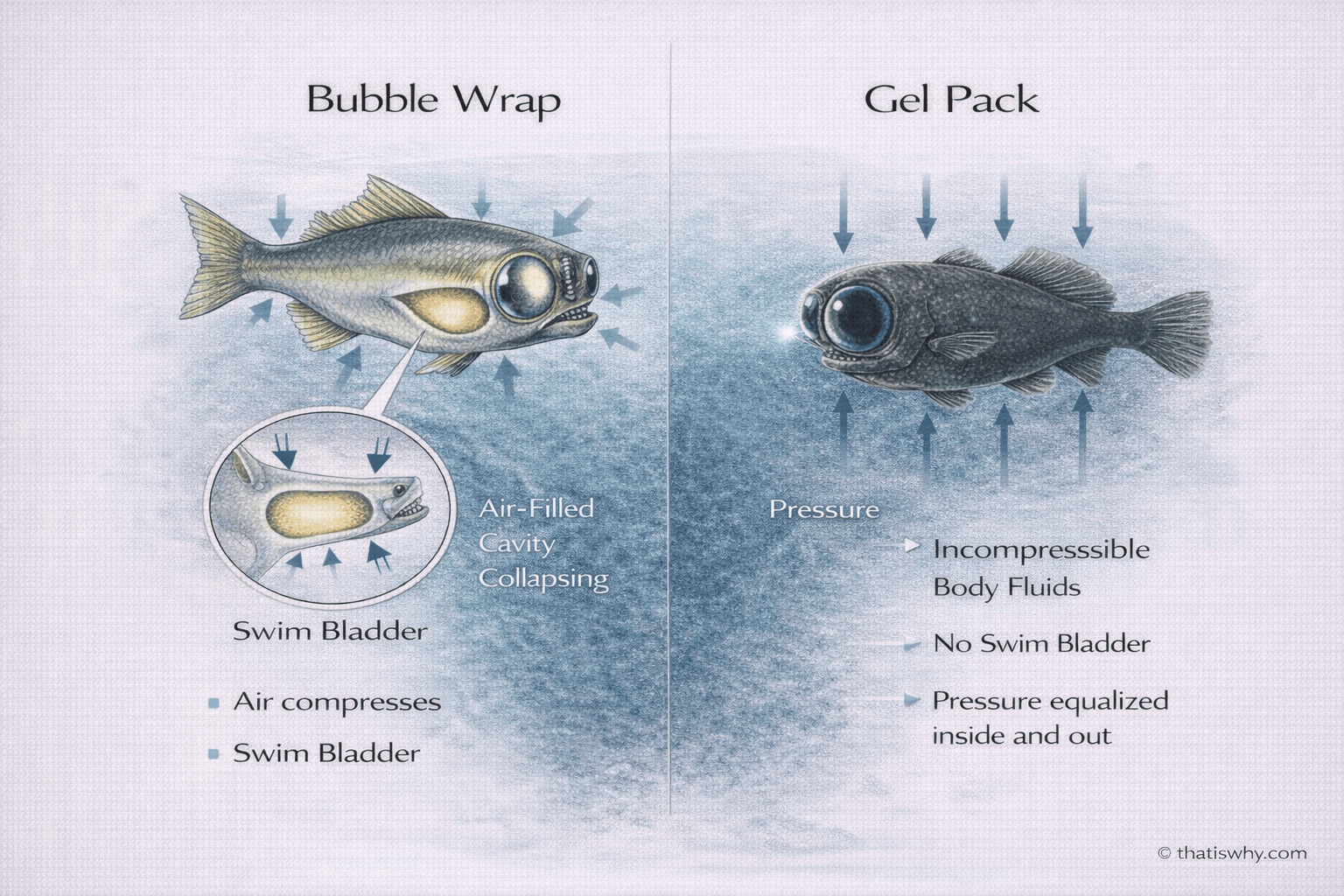
But deep-sea fish have evolved a different blueprint. They are like gel packs.
Imagine holding a gel pack from your freezer. You can squeeze it. You can sit on it. You can run it over with a truck. It doesn’t pop. Why? Because there is no air inside. It is filled with fluid. And unlike air, fluid is incompressible.
Deep-sea fish have completely ditched the swim bladder. They have purged every pocket of air from their bodies. They are built entirely of water, jelly, and muscle. Because the water inside their body pushes back with the exact same force as the water outside, they don’t even feel the pressure.
The House of Cards
So, the body doesn’t crush. Great. But there is a second, invisible problem happening at the molecular level.
Pressure doesn’t just crush lungs; it twists proteins. Proteins are intricate, folded structures. Think of them like a house of cards. They need to stand up perfectly to do their job. High pressure is like an earthquake. It shakes the table. The house of cards collapses. When your proteins fold the wrong way, your nerves stop firing, your muscles seize, and you die.
So how do deep-sea fish keep their house of cards standing during an earthquake? They use glue.
This glue is a chemical called TMAO. It binds to water molecules and creates a structural brace around the proteins. It literally holds the house of cards together against the crushing weight of the ocean.
And here is the fun part: You know what TMAO smells like. When a fish dies, the TMAO breaks down into Trimethylamine—which is the source of that “rotten fish” smell. The deeper the fish lives, the more TMAO it needs, and the fishier it smells. It turns out, that stench isn’t just decay; it’s high-pressure engineering.
The Freezer Test
There is one final problem: The Cold. The deep sea isn’t just heavy; it’s freezing. And cold does weird things to fat.
Your cells are wrapped in a membrane made of lipids (fats). Think about a stick of Butter in the fridge. It gets hard. It gets brittle. If your cell membranes turned into butter, they would crack, and you would die.
Deep-sea fish have hacked this by changing their recipe. They don’t use saturated fats like butter; they use unsaturated fats—basically Olive Oil. If you put olive oil in the fridge, it stays liquid. By filling their cells with this “liquid fat,” these fish keep their membranes flexible and fluid, even at temperatures that would turn a human into a block of ice.
The Hard Limit
So, if they have the Gel Body, the Glue, and the Olive Oil, can they go as deep as they want? Can they swim to the bottom of the Mariana Trench?
No. There is a hard limit. Scientists have calculated that fish can only survive down to about 8,200 meters (26,900 feet). Below that line, the fish disappear.
Why? Because of the TMAO. Remember, TMAO is the glue that fights pressure. The deeper you go, the more glue you need. But at 8,200 meters, the cells become so saturated with TMAO that they become saltier than the ocean itself. This triggers Reverse Osmosis. The cells start sucking in seawater uncontrollably. The fish would swell up and burst.
It’s a chemical ceiling. Below that depth, complex life (fish) ends, and only the simplest invertebrates (like sea cucumbers) can survive.
Myth-Busting the Deep
Let’s clear up a few myths about life under pressure.
Myth #1: “Deep-sea fish explode when you bring them up.” We imagine them popping like balloons.
The Truth: They don’t explode. Because they lack gas bladders, they don’t have pressurized air inside them to burst. Instead, their tissues just expand and lose structure.
Myth #2: “The Blobfish is the ugliest animal on Earth.” We’ve all seen the photo of the sad, melted pink face.
The Truth: That photo is unfair. At its natural depth (3,000 feet), the Blobfish looks like a normal, tight-skinned fish. It only turns into a “blob” because we dragged it to the surface where the pressure is gone. It’s like judging an astronaut by how they look after being thrown out of an airlock.
Myth #3: “They are heavily armored.” People assume you need thick skin to survive the crushing weight.
The Truth: It’s the opposite. Deep-sea fish have the thinnest, softest skin in the ocean. Armor is rigid, and rigid things break under pressure. Soft things survive.
The Art of Surrender
When we explore the deep, we build submarines out of thick titanium. We fight the pressure. We try to be strong.
The fish took the opposite approach. They didn’t try to be hard. They tried to be fluid. They removed the air, swapped their fats, and filled their cells with chemical glue. They built bodies that don’t push back.
They survive not by resisting the ocean, but by becoming it. In a battle against 8 tons of crushing pressure, they realized that strength is a liability. Surrender is the only way to win.
How We Researched This :
To explain the invisible war against pressure, we looked at the biochemistry of Piezolytes (pressure-loving molecules). We referenced the 2014 Whitman College study that established the 8,200-meter depth limit for teleost fish based on TMAO saturation.
But we knew that just citing chemical formulas isn’t helpful. Our real job began when we asked, “What does this feel like?” That question led us to the “Gel Pack” analogy—a simple, tactile way to explain why removing air pockets makes an organism invincible to crushing force.