Why Cuttlefish Don’t Just Change Color — They Are Living Screens
A cuttlefish doesn’t hunt by chasing. It hovers in front of its prey and plays moving images on its skin. The patterns ripple and shift, and the prey freezes—not from fear, but because its visual system can’t keep up. That hesitation is enough. The cuttlefish strikes.
This isn’t camouflage in the usual sense, it’s display technology, grown instead of built.
Dark bands slide smoothly across the cuttlefish’s body, like a video playing frame by frame. To a human observer, the effect looks mesmerizing. To a crab or shrimp, it’s disorienting. The movement has no clear source or direction, which makes it impossible to decide where to focus.
While the body remains still, the skin does all the work. The eyes report motion, but the brain can’t stabilize the scene quickly enough to act. In that brief delay, before flight or defense, the cuttlefish closes the distance.
That moment is all it needs.
The Skin Screen: Anatomy of a Pixel
To understand what the cuttlefish is doing, you have to stop thinking of its skin as paint.
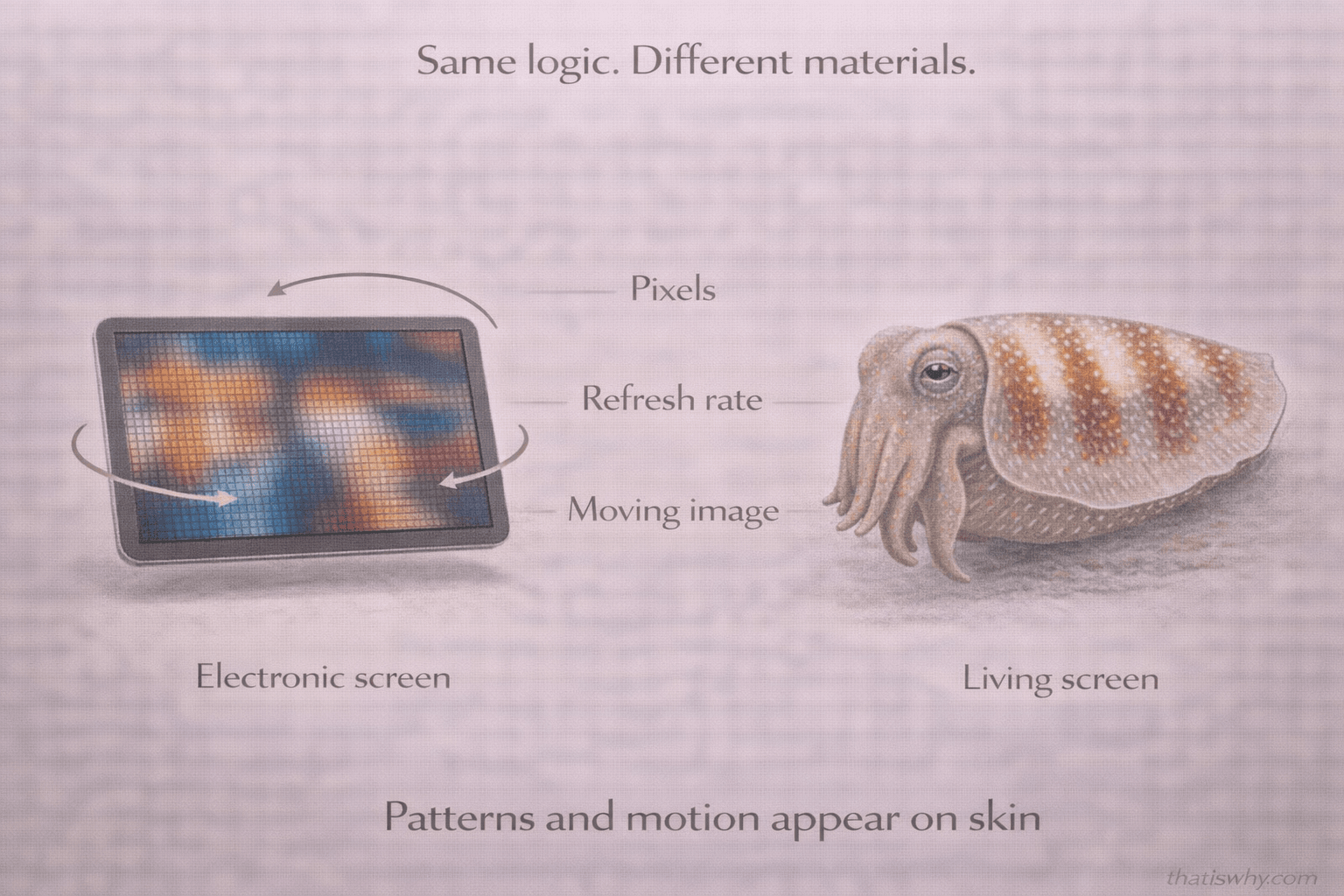
It behaves much more like a screen—one that renders images by controlling light, pixel by pixel.
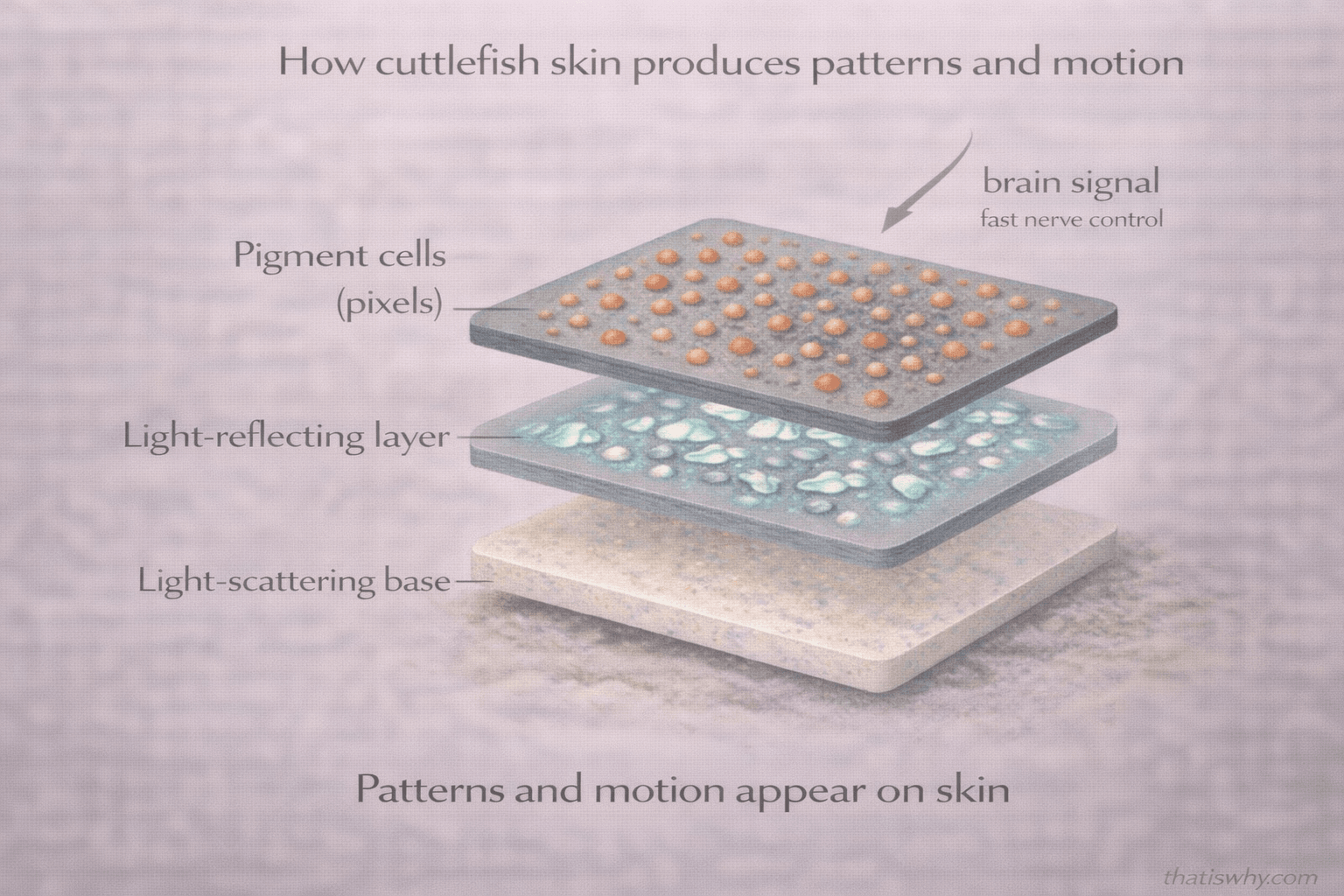
That screen is built from three biological layers stacked on top of one another. Each layer plays the same role you’d expect in a display system: one layer provides color, one shapes how light reflects, and one stabilizes the whole image.
The top layer is made of chromatophores, which function exactly like pixels. Each chromatophore is a tiny sac filled with pigment, yellow, red, or brown, surrounded by a ring of muscle. When the muscle tightens, the sac stretches open and the pixel turns on. When it relaxes, the pixel effectively switches off.
Beneath the pigment layer is a second layer called iridophores, which act like the reflective components of a screen. These cells don’t contain color themselves. Instead, they reflect specific wavelengths of light, producing blues and greens through structure rather than pigment.
At the base of the stack is a third layer of leucophores, which scatter incoming light evenly. This layer works like a white backing behind a display, ensuring the image above remains bright and readable under different lighting conditions.
Together, these layers form a complete biological display. The chromatophores determine which pixels are active, the iridophores tune how light is reflected, and the leucophores stabilize the brightness of the entire image.
The cuttlefish isn’t changing color the way an object does. It’s controlling how light is emitted, reflected, and combined across its skin, exactly what a screen is designed to do.
Refresh Rate: Why This Screen Is Fast
A screen is only convincing if it refreshes quickly enough.
When an image updates too slowly, motion starts to break apart. Movement becomes uneven, patterns smear, and the illusion of continuity disappears. Instead of seeing a single moving image, the brain detects the gaps between frames.
The cuttlefish avoids this problem by wiring its screen directly to its brain.
Each chromatophore, the pigment pixel on the surface, is connected to nerves that control the muscles around it. When the brain sends a signal, those muscles respond almost immediately, stretching or shrinking the pigment sac in a matter of milliseconds. There’s no chemical delay and no signal slowly diffusing through the body. The instruction moves straight from neuron to pixel.
This is where cuttlefish differ from animals like chameleons. Chameleons rely on hormones to change color, which is more like adjusting a system-wide dimmer. The signal spreads gradually, and the effect takes time to settle. That approach works for blending in, but it isn’t fast enough to support moving patterns.
The cuttlefish, by contrast, updates its skin the way a high-refresh display updates an image. Changes happen quickly enough that motion appears smooth and continuous rather than stepped or staggered. Patterns form cleanly, travel across the body, and vanish without leaving visual artifacts behind.
At that point, the skin stops behaving like a passive surface. It functions more like an interface, where the nervous system translates intention into visible motion almost instantly.
The Passing Cloud: When the Screen Plays Motion
Once the screen can update fast enough, it can do more than match a background.
It can play motion.
The passing cloud appears as dark bands sliding across the cuttlefish’s body. Biologically, nothing is moving except the pixels. Visually, the screen is broadcasting a moving image.
Visual systems prioritize motion. When movement appears, attention locks on automatically. The passing cloud exploits that shortcut by spreading motion across the entire screen at once. There’s no single object to track, just coordinated change everywhere.
In screen terms, the cuttlefish isn’t animating a character it’s animating the background.
The eyes keep sending information, but the brain struggles to assemble it into a stable scene. The motion doesn’t behave like a predator or an object. While that processing loop stalls, the cuttlefish remains still. The screen moves; the animal waits.
By the time perception catches up, the opportunity is gone.
The display didn’t hide the predator.
It interrupted perception just long enough to matter.
When the Screen Goes 3D (Texture)
A flat screen can fool the eye, but only up to a point.
If the background has depth rocks, coral, broken terrain, color and motion alone aren’t enough. To blend in completely, the display has to change its shape as well.
In complex environments, the display needs depth.
The cuttlefish adds this through papillae—bundles of muscle that push the skin into bumps, ridges, or spikes. When relaxed, the surface flattens again. Texture updates alongside color and motion, under the same neural control.
From the screen’s perspective, this is a shift from a flat display to a textured one. The skin doesn’t just show an image of a rock. It takes on the rock’s physical profile.
What the prey sees isn’t a mismatch between color and shape.
It sees a single, coherent object.
The Colorblind Artist
It’s like an old black-and-white TV that somehow outputs color, not because it understands color, but because it controls light so precisely.
Cuttlefish are colorblind. Their eyes are tuned to contrast and brightness, mostly in shades of green. They don’t perceive reds, blues, or yellows the way humans do—and yet their skin displays those colors with remarkable accuracy.
That apparent contradiction disappears once you consider what the screen actually needs in order to work.
A display doesn’t have to understand color to reproduce it correctly. It only needs to control light intensity and contrast with enough precision. If the brightness relationships are right, the final image falls into the correct color range automatically.
That appears to be what the cuttlefish is doing.
Instead of matching color directly, the screen matches contrast patterns. The pigment pixels expand or contract based on how light and dark the surroundings are, while the reflective and scattering layers underneath shape how that light returns to the eye.
Some researchers have suggested that light-sensitive proteins in the skin itself may fine-tune the display locally. Even without that mechanism, the core logic holds. The screen doesn’t need color vision to render a convincing image.
It only needs to control the variables that vision actually depends on.
Cuttlefish Display Myths (What’s Really Happening on the Skin)
Myth #1: Cuttlefish use hypnosis or mind control
Truth: They overload the visual system, not the mind. There’s nothing mystical about the cuttlefish’s display. The living screen isn’t controlling thoughts; it’s flooding vision with coordinated motion and contrast, forcing the brain to process more information than it can immediately resolve.
Myth #2: This is just camouflage
Truth: Camouflage is static. The cuttlefish’s display is active. Traditional camouflage blends in by staying still. The cuttlefish does the opposite. Its screen produces motion and pattern changes in real time, keeping the visual system occupied rather than slipping past it unnoticed.
Myth #3: Squid and octopus do the same thing
Truth: The cuttlefish is built specifically to run a visual display. Cuttlefish have an internal shell—the cuttlebone—that gives them precise buoyancy control. That allows them to hover almost motionless while the screen plays across their skin. Squid and octopus can change color, but they lack the same ability to hold position while running a complex, moving display.
Where Else Vision Breaks
The cuttlefish isn’t unique in exploiting how vision fails under pressure.
Humans encounter the same limitation whenever visual information updates faster than perception can stabilize it. Rapid flicker on a screen causes fatigue. Fast-cut video can feel disorienting. Even scrolling too quickly through dense visual content creates a brief moment where attention slips while the brain catches up.
In all of these cases, the eyes work fine. What lags is interpretation.
Other animals exploit the same weakness in different ways. Sudden flashes trigger startle responses. Striped patterns confuse motion tracking. The principle is the same: vision prioritizes speed over certainty.
The cuttlefish simply refined this vulnerability into a surface.
A living screen that delivers motion at exactly the wrong tempo for another brain.
When Vision Becomes a Liability
Vision feels powerful because it’s fast, but that speed depends on shortcuts. Motion and contrast are prioritized so decisions can happen quickly.
The cuttlefish exploits that design.
By feeding the visual system more motion than it can immediately resolve, it creates a delay. The prey isn’t confused in a mystical sense. Its perception is simply catching up.
Humans experience the same weakness when a screen flickers too quickly or a video glitches. Attention slips while the brain tries to reassemble the image. The cuttlefish weaponizes that moment in the wild.
It survives not by disappearing, but by showing too much.
How We Researched This :
To explain how cuttlefish control color, motion, and texture, we looked at research on chromatophores, cephalopod neurobiology, and visual perception, especially studies on the passing cloud display and neural control of skin patterning.
But we knew that naming cells wasn’t enough. Our real job began when we asked, “What does this look like from the prey’s eyes?” That question led us to the living screen analogy, a single mental model that makes pixels, refresh rate, motion, and sensory overload feel intuitive instead of abstract.