Why Dolphins Can “See” a Golf Ball 100 Meters Away
Dolphins don’t rely on sight in murky water.
They scan their surroundings with sound, building a three-dimensional picture of space the way an ultrasound maps the body from the inside.
In coastal water, light disappears quickly. Sediment scatters it, depth swallows it, and even excellent eyesight becomes unreliable. For most animals, that’s where precision ends. For dolphins, it’s where hunting begins.
They can locate and track objects no larger than a golf ball from surprising distances in water where a human would see nothing at all. The reason isn’t sharper vision or unusually sensitive ears. It’s a different way of constructing space.
Instead of waiting for light to arrive, dolphins actively probe their surroundings with rapid bursts of sound. Each click travels outward, strikes an object, and returns carrying information about distance, shape, and material. Taken together, those echoes assemble into structure.
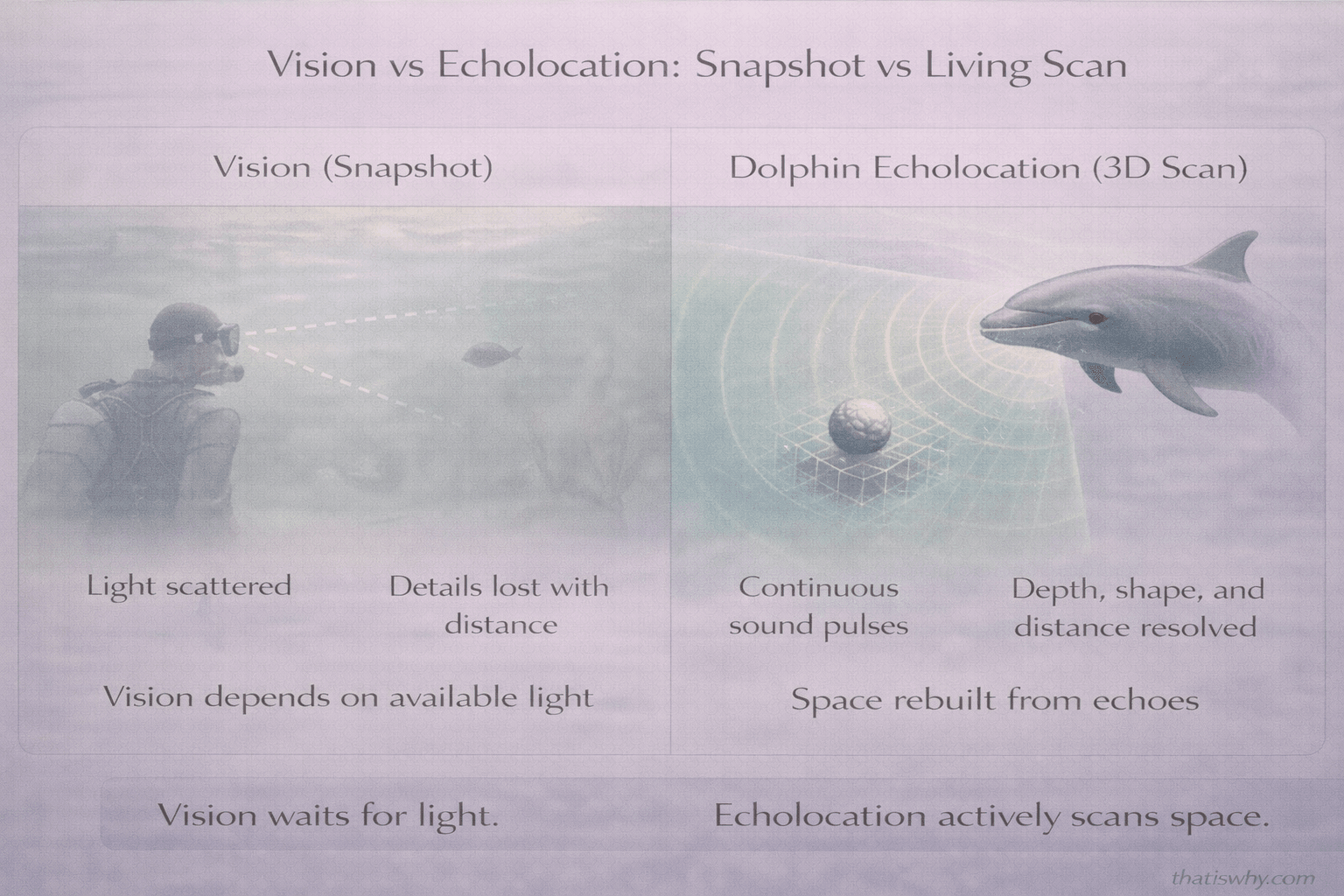
The most useful way to picture this is as a continuous 3D ultrasound running as the dolphin swims. Space isn’t guessed at or inferred. It’s scanned, refreshed constantly, and rendered into a volumetric map long before vision could offer anything useful.
The Click Train: How Sound Turns Into Shape
If you’ve ever watched a medical ultrasound, you’ll notice something important right away: the image only makes sense because the probe never stops scanning. One pulse wouldn’t tell you much. What creates clarity is the steady rhythm of signals, fired fast enough that motion doesn’t tear the picture apart.
That’s exactly how dolphins use sound.
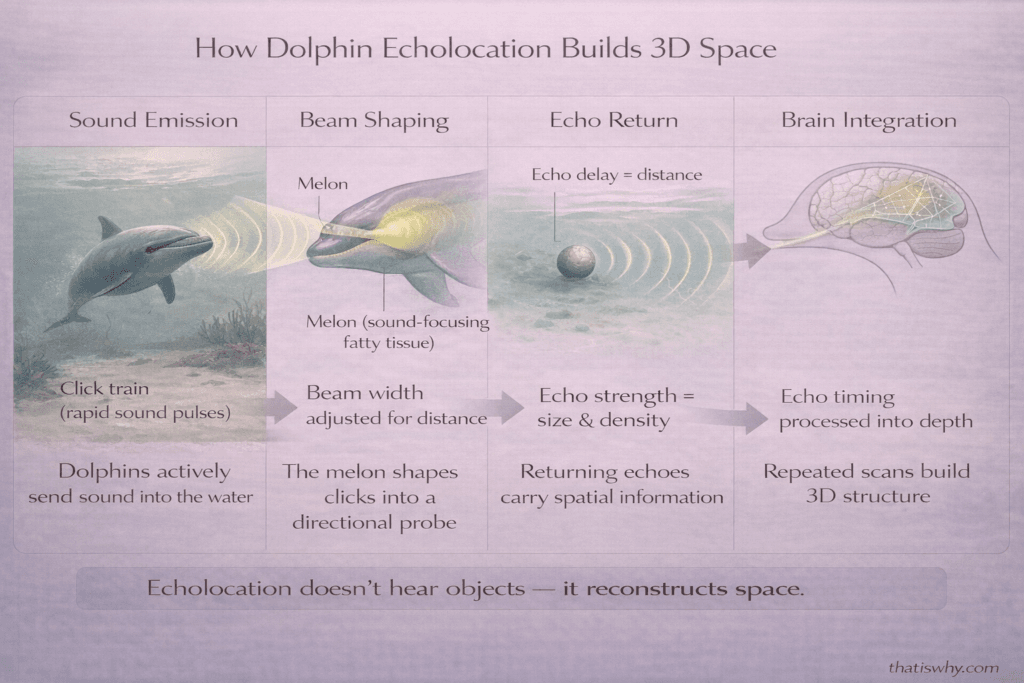
As a dolphin hunts, it releases rapid bursts of clicks, sometimes hundreds per second. These clicks are short, clean, and precisely timed, which makes them ideal for measuring distance and change. When they spread through the water, they begin to outline space acoustically, much like an ultrasound outlines structures inside the body.
Each returning echo carries clues. The timing reveals how far away something is. Subtle changes in pitch and strength suggest size and shape. Differences in how sound reflects hint at whether an object is soft, dense, or hollow. Any single echo would be ambiguous, but a continuous stream turns those fragments into something dependable.
An ultrasound doesn’t capture a snapshot. It builds a living scan that updates constantly so movement feels smooth rather than confusing. The dolphin’s click train works the same way, refreshing its acoustic map so that prey, obstacles, and open water all stay coherent as everything moves.
By this stage, the dolphin isn’t simply hearing sounds. It’s sampling space over and over again, assembling those echoes into a three-dimensional understanding of what’s around it, long before vision could offer anything useful.
The Melon: Focusing the Scan
Getting a clear ultrasound image isn’t just about sending sound into the body. It’s about shaping that sound before it leaves the probe.
Dolphins do the same thing using the rounded structure on their forehead called the melon. Despite how it looks, the melon is a layered mass of fatty tissue that bends and concentrates sound. As clicks pass through it, they’re focused into a narrow, forward-facing beam instead of spilling in every direction.
This focused beam sharpens the scan, pulling structure out of an otherwise noisy environment. Dolphins can also adjust the shape of the melon, tightening or relaxing the beam depending on whether they’re scanning far ahead or closing in on a target.
By the time sound leaves the dolphin’s head, it’s no longer just noise. It’s a shaped probe designed to ask a specific question of the water ahead.
When the Scan Reveals Identity
Finding something is useful but knowing what it is is what allows action.
Dolphins don’t echolocate at a single pitch. They subtly vary the frequency and timing of their clicks as they scan an object. Each adjustment reveals different acoustic behavior, and over time those differences accumulate.
An ultrasound doesn’t recognize structures because it knows anatomy. It recognizes them because sound behaves differently as it passes through different materials. The dolphin’s brain makes the same comparisons, sorting echoes by how they change.
That’s why dolphins can distinguish between objects that look identical to us but differ internally, such as solid items versus hollow ones. Identity emerges gradually through repeated scans, not instant recognition.
Limits and Superpowers
Echolocation is powerful, but it isn’t magic. Sound doesn’t travel through everything equally. Dense solids block it, and thinner barriers scatter echoes. A dolphin can map open water with remarkable clarity, but it can’t scan through a rock any more than a doctor can scan cleanly through bone.
The system also ignores details that don’t survive poor conditions. Color, fine patterns, and surface markings barely register. That isn’t a weakness. In dark or muddy water, those details aren’t reliable anyway, so the scan focuses on shape, distance, and structure instead.
Like an ultrasound, echolocation excels where it makes sense and steps aside when it doesn’t. What makes it feel like a superpower is not that it does everything, but that it keeps working when most senses fail.
When Perception Rebuilds Itself
Once you recognize dolphin echolocation as a living ultrasound, a broader pattern appears.
The star-nosed mole maps space through touch because underground tunnels erase light. The pit viper maps space through heat because nighttime forests strip vision but leave warmth exposed. Dolphins turn sound into structure because water scatters light yet carries acoustic information beautifully.
You see the same logic elsewhere. Submarines rely on sonar instead of cameras. Firefighters navigate smoke-filled buildings using touch and heat cues. Even autonomous vehicles combine radar, lidar, and cameras because no single signal survives every condition.
Perception isn’t fixed. When one channel collapses, systems reroute, rebuilding structure from whatever signal remains stable.
Echolocation Myths
Myth #1: Echolocation is like taking pictures with sound.
Truth: Pictures freeze the world. Echolocation doesn’t. Objects emerge gradually as patterns of distance and density that sharpen over time. The dolphin is tracking change, not reacting to a snapshot.
Myth #2: Better resolution means more visual detail.
Truth: Resolution here means structural precision, not surface texture. Echolocation improves confidence about size, position, and solidity, not decorative detail.
Myth #3: Echolocation identifies objects instantly.
Truth: Identification is cumulative. Dolphins build certainty through repeated scans, adjusting frequency and timing until echoes behave consistently across angles and distances.
The mistake behind these myths is the same: treating echolocation as a substitute for vision, rather than a different strategy altogether.
Seeing Without Eyes
Dolphin echolocation works because it gives up on the idea that perception has to resemble vision at all it’s treating echolocation as a substitute for vision, rather than a different strategy altogether.
Instead of trying to rescue a failing sense, the dolphin builds something new from a signal that still behaves well in its environment. Sound travels far in water. It carries information about distance, shape, and material. So perception reorganizes around that fact, turning echoes into structure and structure into decision.
We do the same thing whenever vision stops being trustworthy. Surgeons rely on ultrasound to see through tissue. Pilots trust instruments over their eyes in clouds. Anyone who has navigated a dark room by memory and touch knows that sight is only one way to understand space.
The dolphin’s sonar doesn’t make the ocean more clear : it makes it usable. It extracts just enough structure from uncertainty to act with confidence.
Perception isn’t about seeing everything. It’s about finding the signal that survives and building the world from there.
How We Researched This :
To explain dolphin echolocation, we relied on established behavioral and neuroacoustic research, including Louis Herman’s sonar discrimination experiments and peer-reviewed studies in Nature and The Journal of Experimental Biology on click trains, melon focusing, and echo-based object identification in bottlenose dolphins.
But facts alone don’t convey experience. Our real work began when we asked, “How does this feel like?” That question led us to the “3D ultrasound” analogy, a simple way to connect acoustic physics, neural processing, and behavior into one intuitive model.