Why Monarch Butterflies Can Navigate 3,000 Miles Using the Sun
A monarch butterfly weighs less than a paperclip. It has no map, no GPS, and no memory of the journey it’s about to take. And yet every autumn, monarchs born in Canada set off on a flight that carries them more than 3,000 miles south, landing in the same mountain forests in central Mexico their ancestors reached generations before.
That detail matters, because these butterflies aren’t retracing a familiar route. The generation that arrives in Mexico is not the generation that left it. Each butterfly is navigating a journey it has never taken toward a destination it has never seen.
The explanation isn’t instinct in the vague, hand-waving sense. It’s a navigation system that treats the sky like a moving reference and time as part of direction itself.
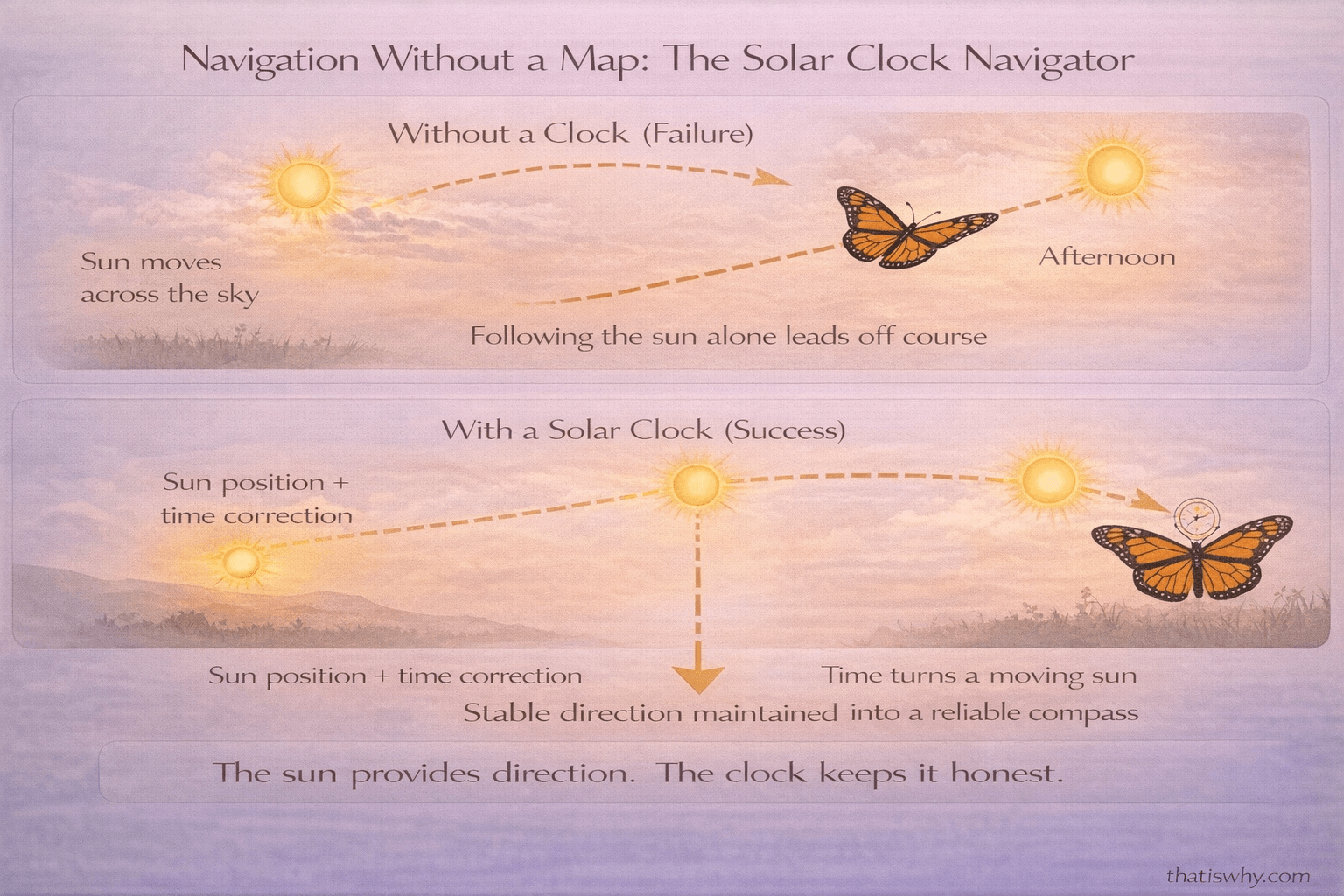
The most useful way to picture what the monarch is doing is as a solar clock navigator. The butterfly doesn’t aim for a fixed point on the horizon. Instead, it keeps a steady course by watching how the sun moves across the sky and correcting for that movement using an internal clock. Direction only makes sense once time is folded into the calculation.
And when the sun disappears, the system doesn’t fail. It quietly hands control to a second reference frame written into the Earth itself.
The Polarized Sun-Compass: Turning Sky Into Direction
At first glance, following the sun sounds straightforward. But if monarchs treated the sun like a fixed arrow, their migration would collapse within hours. The sun moves constantly, and a heading that works in the morning points somewhere else by afternoon.
So monarchs don’t chase the sun. They read the sky.
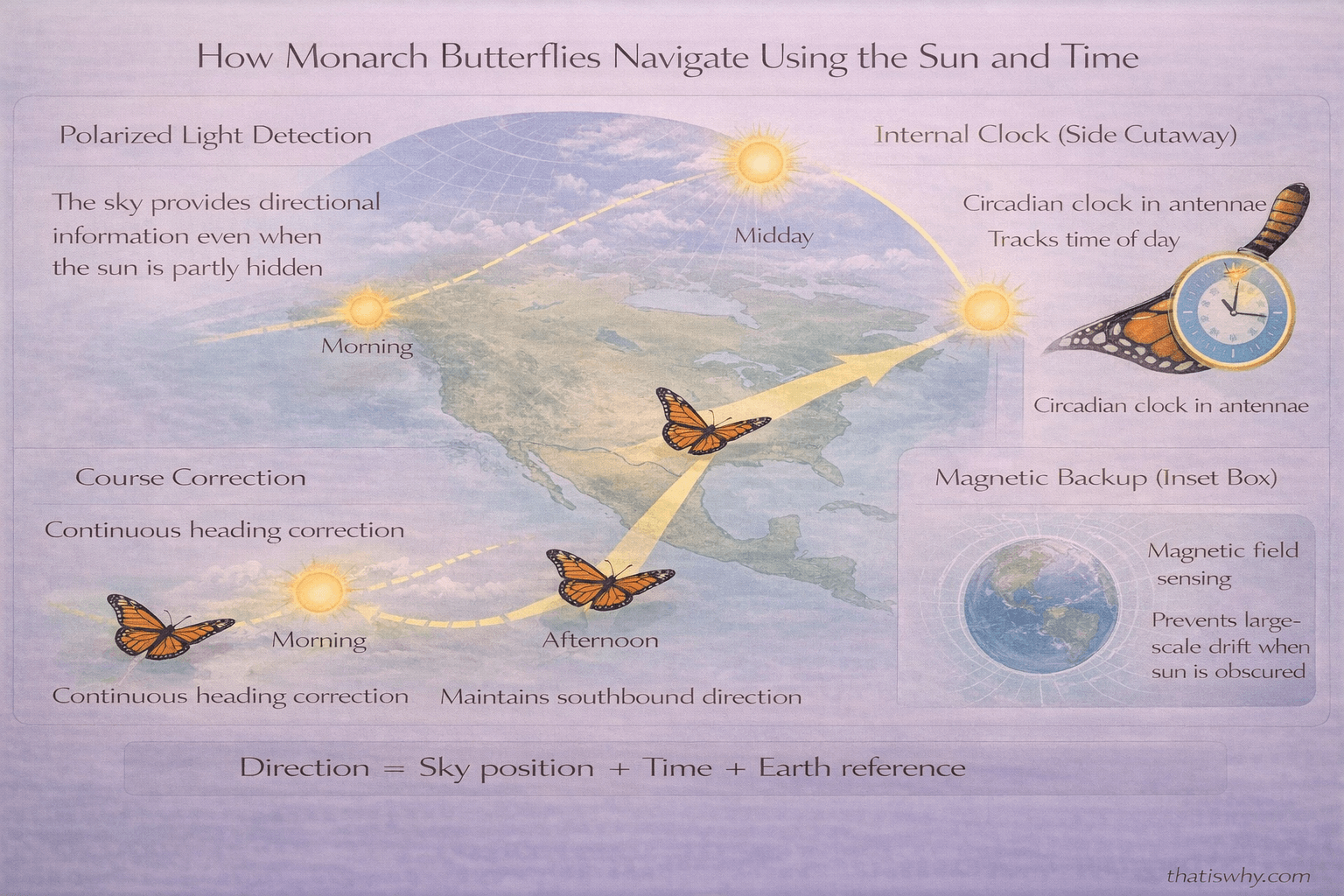
Their antennae detect polarized light, a subtle pattern created when sunlight scatters through the atmosphere. Humans never notice it, but to a monarch the sky carries a quiet geometry that always points back to the sun’s position, even when clouds or haze hide it from view.
That provides direction, but direction alone isn’t enough. A heading only has meaning when paired with time. Monarchs solve that problem with an internal circadian clock, also housed in their antennae, which keeps track of the time of day.
Put those pieces together and the system clicks. The sky tells the butterfly where the sun appears to be. The clock tells it where the sun should be at that hour. By constantly comparing the two, the monarch corrects its course, holding a steady southbound line as the sun slides overhead.
This is why the antennae matter so much. When researchers interfere with them, monarchs don’t just become slightly confused. They lose their migratory direction almost immediately. The clock keeps running, but without the sky as a reference, the navigator has nothing to synchronize against.
The Magnetic Backup Map: When the Sky Stops Cooperating
So far, the system sounds elegant but fragile, which raises a practical concern about what happens when the sky becomes unreliable. Clouds, forest canopies, and long mountain shadows all interfere with sunlight, and a system built only on reading the sun would fail quickly.
It doesn’t, because the monarch never relies on a single signal.
Inside its antennae are microscopic particles of magnetite that respond to Earth’s magnetic field, giving the butterfly a rough sense of position relative to the planet. This magnetic input doesn’t replace the sun-compass or provide precise direction. Instead, it acts as a positional check that prevents large-scale drift.
Within the solar clock navigator framework, the sun-compass maintains heading, while the magnetic sense functions like a simplified map reference that keeps the journey broadly aligned when the sky becomes unreadable. When sunlight returns, the system smoothly shifts back without interruption.
Neither signal is particularly powerful on its own. Together, they create a navigation system that stays stable as conditions change. That redundancy is what allows a fragile insect to complete one of the longest migrations on Earth.
Inherited Navigation: How First-Time Flyers Know Where to Go
This is usually the moment where people stop and ask how any of this works for a butterfly that has never made the trip before.
The monarchs that arrive in Mexico each fall are several generations removed from the ones that left the previous spring. No parent leads them. No memory guides them. And yet they still turn south, correct their heading day after day, and converge on the same narrow band of mountain forest.
That means navigation alone isn’t the whole story. There also has to be a built-in starting point.
Monarchs are born with a migratory program already wired into their nervous system. It isn’t a map or a memory. Think of it as factory settings for the solar clock navigator. The system arrives pre-oriented southbound, ready to interpret the sky and the Earth as soon as the journey begins.
As the butterfly flies, wind, terrain, and local conditions can refine the path, but none of that learning is required for the migration to work. A monarch doesn’t need experience to begin the journey. It only needs a functioning navigator and a world that still provides the signals it knows how to read.
The remarkable part isn’t that a butterfly remembers a place it has never been. It’s that evolution found a way to hand a reliable navigation system to an animal on its very first flight.
The Fusion Advantage: Direction Plus Position
None of these components make sense on their own.
The sun-compass is excellent at holding a heading but fails when the sky disappears. The magnetic sense is stable but too coarse to guide a long journey by itself. The inherited program sets direction but needs real-world input to stay accurate.
What makes monarch migration work is the way these signals are fused into a single system.
The inherited program sets timing and direction. The sun-compass handles real-time orientation. The circadian clock keeps those corrections honest. The magnetic sense prevents drift when sunlight vanishes. Control shifts quietly between signals as conditions change, without the system ever collapsing.
This is the real superpower. Not sharper senses, not better memory, but resilience. A navigation system that degrades gracefully instead of failing outright.
That’s how Monarch butterfly pulls off a migration that would challenge machines far more complex than itself.
When Navigation Becomes a System, Not a Sense
Once you look closely at monarch migration, navigation stops looking like a single ability and starts looking like a system designed to survive failure.
Direction comes from the sun, timing comes from an internal clock,and position is checked against the Earth itself then when one signal weakens, the others quietly stabilize the journey.
You see the same logic elsewhere. Aircraft fuse multiple instruments so no single failure is catastrophic. Smartphones combine satellites, clocks, motion sensors, and magnetic compasses for the same reason. Even humans navigating unfamiliar places lean on overlapping cues rather than trusting one source completely.
The monarch’s lesson is simple and surprisingly modern. Reliability doesn’t come from perfection. It comes from redundancy.
Migration Myths: What Monarchs Are (and Aren’t) Doing
Myth #1: Monarchs follow landmarks like rivers or coastlines.
Truth: Monarchs aren’t navigating by recognizing places. Their consistency comes from directional and positional cues, not from visual memory of the route.
Myth #2: Monarch migration is just instinct on autopilot.
Truth: Monarchs inherit a navigation framework, not a fixed route. Direction and timing are constantly recalibrated using environmental signals.
Myth #3: The sun-compass alone explains the migration.
Truth: The sun only works because it is paired with an internal clock and backed up by magnetic information. The system succeeds because its signals correct one another.
Myth #4: Monarchs are born knowing where Mexico is.
Truth: They inherit direction, seasonality, and sensory tools, not a destination or a mental map.
Finding Home Without a Map
Monarch migration looks extraordinary until you realize what the butterfly is actually doing.
It isn’t about remembering a place or following a path, it’s just about staying oriented in a world that keeps changing. When one reference fades, another takes over. When conditions improve, precision returns.
We often assume complex behavior requires detailed knowledge or conscious planning. The monarch shows the opposite. Reliable navigation can emerge from simple rules layered in the right way.
In the end, the monarch doesn’t find home because it knows where home is. It finds home because evolution taught it how to keep asking the same question, over and over again, while moving through the world. Am I still headed the right way?
How We Researched This :
To explain monarch navigation, we focused on experimental and field research rather than popular summaries. That includes work from the University of Würzburg and the University of Massachusetts on polarized light detection and circadian clocks in monarch antennae, along with studies published in Nature and Science on magnetic sensing and migratory orientation in Danaus plexippus.
But mechanisms alone don’t convey experience. Our real work began when we asked, “What does this feel like from the inside?” That question led us to the “Solar Clock Navigator” analogy, a simple way to combine concept of sun position, internal timing, and magnetic backup together and make it feel intuitive.