Why The Dodder Vine Is Nature’s Vampire – The Plant That Sniffs Blood
Can plants smell? Yes. The Dodder Vine (Cuscuta) is a parasitic plant that hunts by detecting volatile chemicals in the air. It actively sniffs out preferred hosts (like tomatoes) and rejects others. Once it locks on, it drains the victim dry. It is a botanical predator.
That is the science, but from a closer look, it feels more like a horror movie.
Imagine a plant that is born starving. When a Dodder seed sprouts, it has no leaves, no chlorophyll. It can’t eat sunlight, it is just a pale, yellow string lying in the dirt.
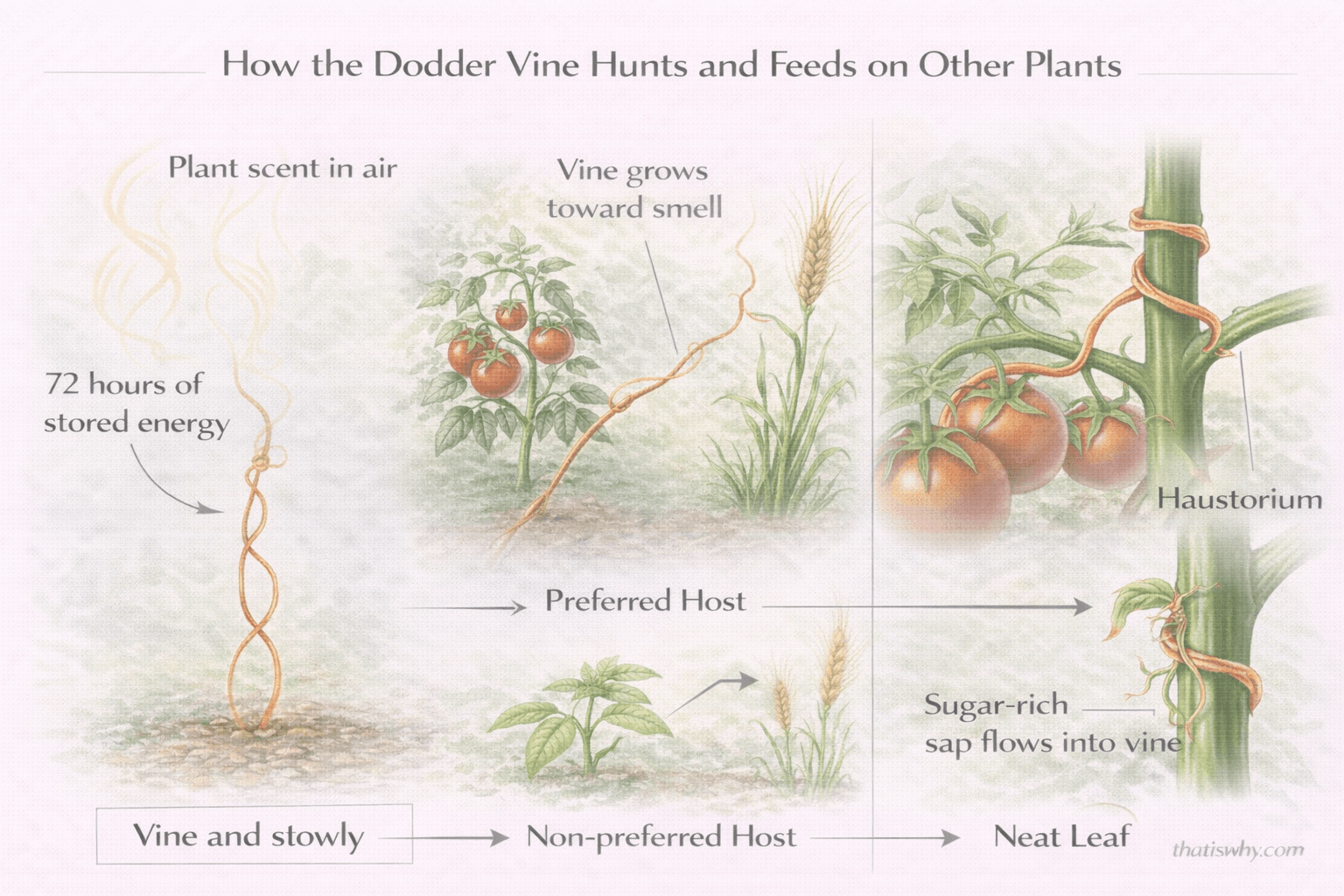
From the second it wakes up, the clock is ticking. It has exactly 72 hours of energy stored in the seed. If it doesn’t find a victim in three days, it dies.
So, it hunts. It doesn’t grow randomly. It lifts its head like a cobra and starts to spin. It rotates in a circle, scanning the air. It is looking for one thing, he is sniffing for blood.
The Smell of Blood
To understand how a blind string hunts, you have to realize that the Dodder is a Vampire. Like any good vampire, it can smell a heartbeat from a mile away.
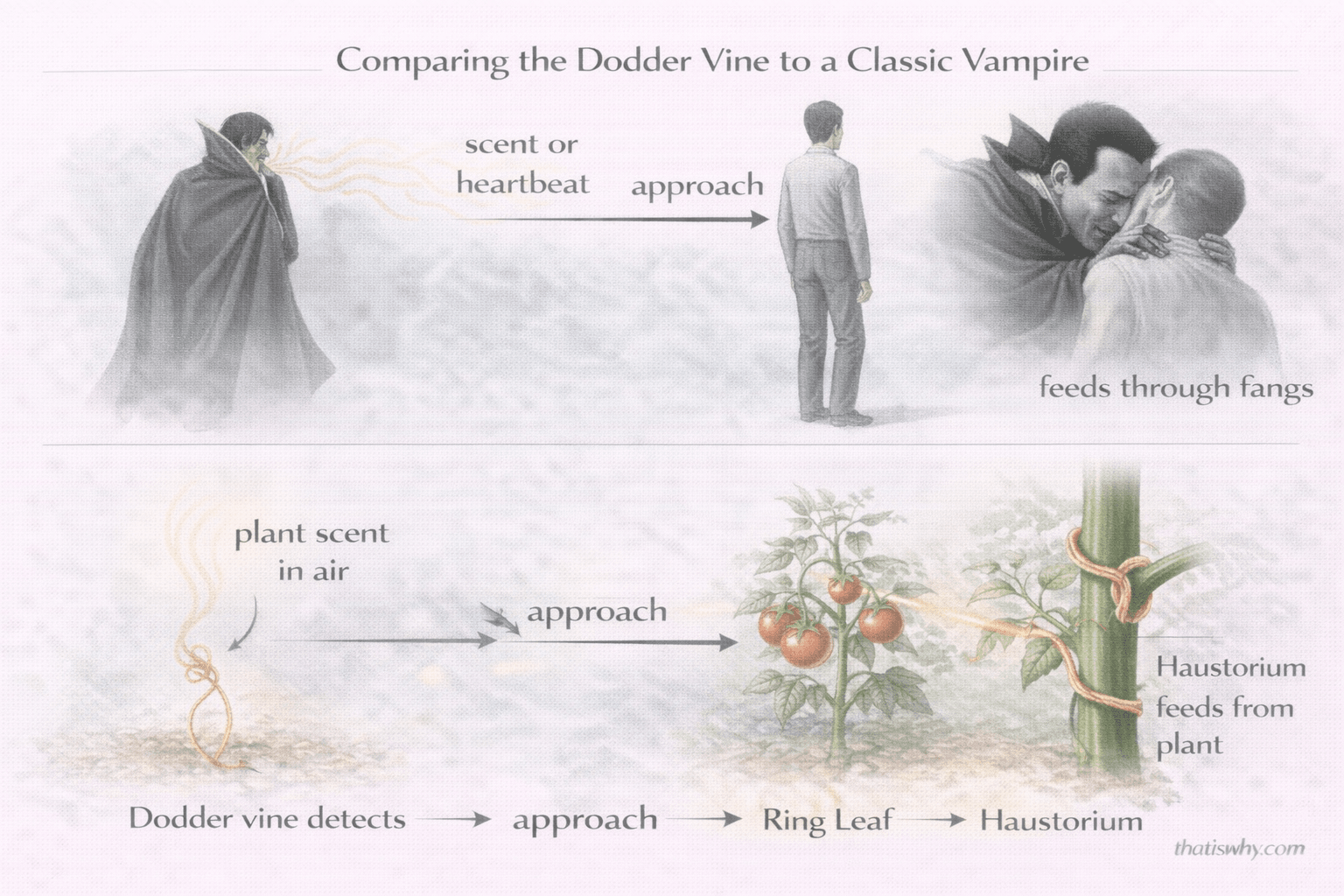
Every plant releases a unique cloud of chemicals called Volatiles. To us, a garden just smells like “green.” To the Dodder, it smells like a detailed menu of different blood types.
In 2006, researchers at Penn State University proved just how precise this nose is. They put a Dodder seedling in a maze with a tomato plant hidden around a corner. There was no light or heat to guide it. The vine didn’t wander aimlessly, it turned and grew straight toward the tomato.
Then, they tricked it. They extracted the scent of a tomato—just the chemical perfume—and painted it onto a rubber stick. The vine attacked the rubber stick. It proved the plant wasn’t guessing. It was tracking the scent of its victim through the air, closing in on the specific chemical signature of the blood it wanted to drink.
The Vampire’s Bite
Once the hunter finds the prey, it strikes.
The vine coils tight around the host’s stem. But it doesn’t just squeeze. It grows a specialized organ called a Haustorium. This is a biological fang. It uses hydraulic pressure to punch through the host’s tough skin, and digestive enzymes to melt the tissue.
But the fang doesn’t stop at the surface. It burrows deep into the stem until it taps into the Phloem, the central artery that carries the plant’s sugar-rich sap. The Dodder fuses its own vascular system with the host’s. It creates a direct transfusion line.
Then, the final transformation happens. The Dodder’s original root in the ground withers and dies. It disconnects from the earth entirely. It is now levitating, suspended in the air, living exclusively off the stolen blood of its victim. It has no need for soil, water, or sun. It only needs the host.
The Connoisseur
Here is the part that suggests intelligence. The Dodder isn’t a mindless killer that attacks anything green. It is a picky eater.
In the Penn State experiment, they offered the vine two choices: A juicy Tomato plant and a stalk of Wheat. The vine sniffed the air and turned away from the wheat.
Why wheat? Because it releases a chemical called cis-3-Hexenyl acetate. To the Dodder, this smells like garlic. It signals that the plant is tough, low in nutrients, or defended. The vine calculated the cost. It realized the wheat wasn’t worth the effort and turned its attention to the tomato. It made a life-or-death decision based purely on the “flavor” of the air.
The Hypnotist
If draining the host dry wasn’t bad enough, recent research shows the Dodder is stealing something far more valuable than sugar. It is stealing secrets.
Scientists at Virginia Tech discovered that when the fang taps into the vein, it acts like a data cable. It sucks up mRNA, the genetic instructions the host uses to run its immune system.
The vine is reading the host’s mind. Why? The leading theory is Hypnosis. The Dodder monitors the host for signs of resistance. If the tomato plant tries to produce a toxin to fight back, the Dodder sends its own RNA back down the line to shut those genes off. It is chemically silencing the victim. It’s not just a vampire; it is a hypnotist whispering “Sleep” into the victim’s ear while it feeds.
Monster Myths
Because this plant looks like alien spaghetti, people get the wrong idea. Let’s set the record straight.
Myth #1: “It strangles the host.” It looks like a boa constrictor wrapping around prey.
The Truth: It isn’t squeezing; it’s drinking. The vine wraps tight only to drive the fangs in. The damage comes from nutrient loss, not physical crushing. It’s a vampire, not a snake.
Myth #2: “It attacks anything.” We assume it’s a mindless weed.
The Truth: It’s a snob. It actively hunts high-quality hosts (like tomatoes) and ignores the ones that taste bad (wheat). It doesn’t waste energy on cheap meals.
Myth #3: “It needs soil to live.” It’s a plant, so it must have roots, right?
The Truth: Only for the first week. Once it bites a host, the root in the ground withers and dies. You can cut the vine at the soil level, and it won’t even notice. It has severed its ties to the earth and is living entirely in the canopy, feeding off the host’s blood.
The Hunter in the Dark
When you see a field covered in the yellow, tangled web of a Dodder vine, it looks like a mess. It looks like silly string sprayed over the crops.
Don’t forget now, that silly string is a finely tuned predator. It is a creature that made a dark bargain with evolution. It abandoned the sun to hunt in the shadows. It gave up its leaves, its roots, and its independence for the ability to track, hunt, and feed on the living.
The Dodder reminds us that the definition of “Plant” is looser than we think. We assume plants are passive victims. But the Dodder proves that some plants don’t just sit there and grow. Some of them wake up hungry, and come looking for you.
How We Researched This :
To explain this botanical predator, we analyzed the landmark 2006 study by Consuelo De Moraes at Penn State. Her team was the first to use time-lapse photography to document the “sniffing” behavior, proving that the vine actively steers toward volatile chemicals.
But we knew that just citing chemical volatiles isn’t helpful. Our real job began when we asked, “What does this feel like?” That question led us to the “Vampire” analogy, a simple story to make the complex life cycle of a blood-sucking, sun-hating plant feel intuitive.