Why Birds Raise Cuckoo Eggs (The Mafia Hypothesis)
The “Stupid Bird” Myth
Look at a photo of a tiny Reed Warbler feeding a Cuckoo chick. Just look at it.
It’s ridiculous. The chick is four times the size of the “parent.” It looks like a toddler trying to spoon-feed a linebacker. The Warbler literally has to hover in mid-air just to reach the monster’s beak.
Your first thought is probably: “That bird is an idiot.”
It seems obvious. The egg was huge. The chick is a giant. How can the host be so dumb that it doesn’t realize it’s being scammed? Why doesn’t it just kick the intruder out?
For years, that’s what scientists thought, too. We assumed birds were just bad at spotting fakes. But we were wrong. The Magpies and Warblers aren’t stupid. They usually know the egg is a fake. They raise it anyway.
Why? Because they aren’t being tricked. They are being held hostage.
The Protection Racket
To understand why a bird would raise a monster that eats all its food, you have to stop thinking like a biologist and start thinking like a crime boss.
This is the Mafia Hypothesis.
It sounds like a joke, but it is a serious evolutionary theory proposed by Amotz Zahavi in 1979. It suggests that Cuckoos aren’t just lazy parents; they are running a sophisticated extortion scheme.
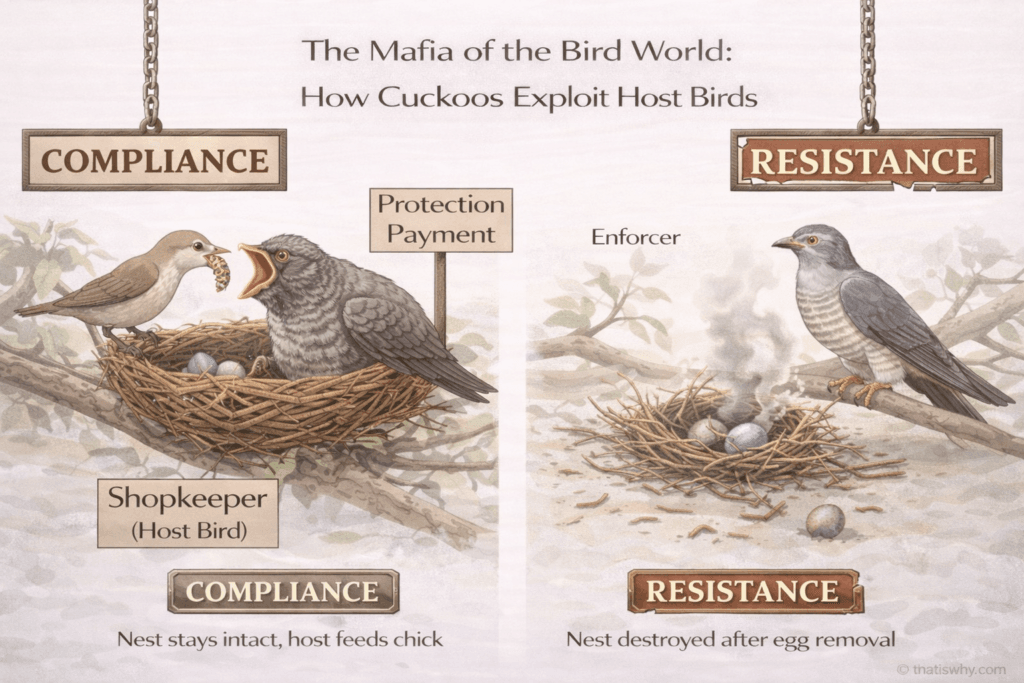
Think of the Magpie as a shopkeeper. It works hard, builds a nest, and tries to raise a family. Think of the Cuckoo as the Mob Enforcer.
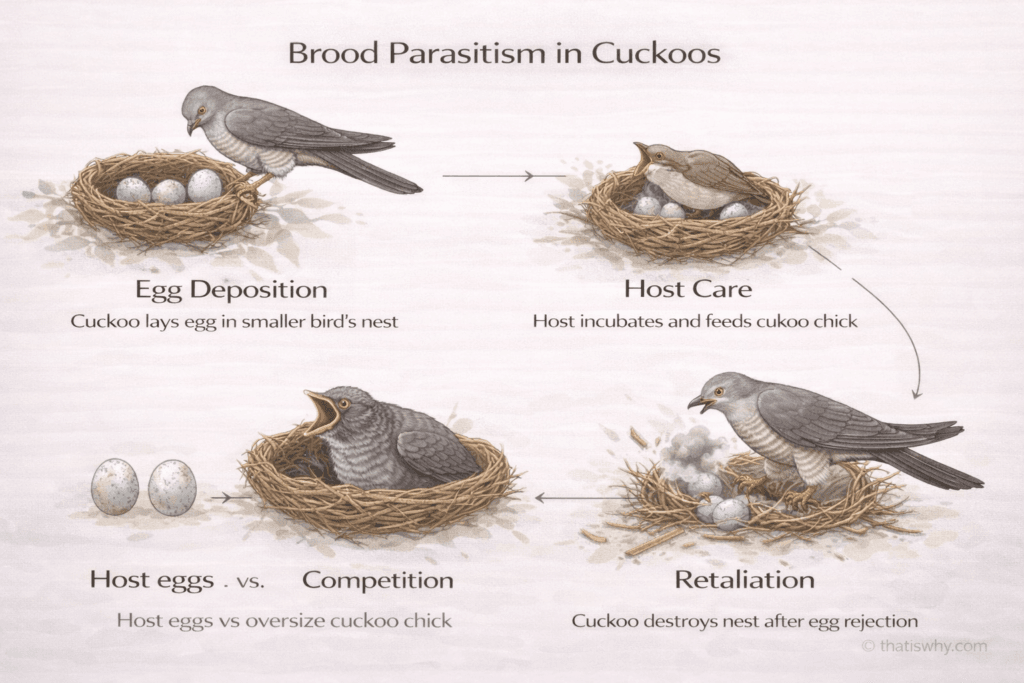
The Cuckoo visits the nest and drops off her egg. It’s an offer you can’t refuse. “I’m leaving my kid here. If you feed him, I’ll let you keep your shop. But if you throw him out? I will come back and smash everything you own.”
The Magpie isn’t raising the chick because it’s confused. It’s doing it because it’s terrified. It is paying “protection money” in the form of worms and beetles to avoid the total annihilation of its genetic line.
Pay Up or Burn Down
For a long time, the “Mafia Hypothesis” was just a dark theory. But in 1995, researchers proved it was real.
They found Magpie nests infected with Great Spotted Cuckoo eggs and decided to call the Cuckoo’s bluff. They removed the parasitic eggs from half the nests and waited.
The response was immediate and violent. In the nests where the egg was removed, the Cuckoo mother returned, saw her egg was missing, and went on a rampage. She pecked holes in every single Magpie egg and destroyed the entire brood. But in the nests where the egg was left alone? She didn’t touch a feather.
This wasn’t a coincidence; it was enforcement. It implies that the Cuckoos are watching. They don’t just lay the egg and leave; they monitor the nest to ensure the “tax” is paid. If the host tries to evict the intruder, the Cuckoo enforces the penalty. The message is clear: Compliance is expensive, but resistance is fatal.
Farming the Host
But the Cuckoo’s cruelty isn’t just about revenge. It’s a calculated business move.
When the Cuckoo destroys a nest, she isn’t just throwing a tantrum. She is forcing a biological reboot.
If a Magpie loses her eggs early in the season, her hormones shift. She instinctively builds a new nest and lays a new clutch of eggs to try again. This is called Re-Nesting.
This is exactly what the Cuckoo wants. By destroying the first (uncooperative) nest, she forces the host to create a second opportunity. It’s a way of turning a “No” into a “Maybe.”
She isn’t just punishing the host; she is farming it. She is actively managing the local population of nests to ensure she always has a place to dump her kids, even if she has to force the hosts to work double shifts to do it.
The Ugly Math
This brings us to the cold, hard calculus of evolution.
We like to think animals just act on instinct, but the Magpie is actually running a complex cost-benefit analysis. It is trapped in a situation where there are no good answers, only less terrible ones.
If it throws the fake egg out, the Mafia returns and smashes the nest. That’s a total wipeout—zero surviving offspring. But if it keeps the egg, it can salvage something. Yes, the Cuckoo chick is a hog that will eat most of the food. Yes, the Magpie might lose one or two of its own chicks to starvation. But it will likely save at least one.
The bird is doing the math. Raising a monster is expensive, but it is technically cheaper than losing the entire brood. The Magpie accepts the “tax” not because it’s stupid, but because it’s the only way to keep the genetic line alive in a neighborhood run by gangsters.
The Resistance
It sounds like the Cuckoos have won the war, but don’t count the hosts out yet. The resistance is alive and well.
Myth #1: “The hosts just take it.” It looks like the Magpies are passive victims.
The Truth: They are fighting back. Magpies are evolving complex “watermarks” on their eggs—unique scribbles that are hard to forge. Other birds, like Reed Warblers, have formed neighborhood watches. If they see a Cuckoo, they mob it, attacking in groups to drive the gangster away before it can lay an egg.
Myth #2: “All Cuckoos are gangsters.” People assume every Cuckoo runs a protection racket.
The Truth: There are different crime families. The Common Cuckoo prefers stealth; its chick pushes the other eggs out of the nest to kill the witnesses. The Great Spotted Cuckoo prefers the Mafia approach—intimidation and extortion.
The Price of doing Business
When we see that tiny Warbler feeding a giant monster, we usually laugh. We shouldn’t. We should respect the hustle.
That bird is a survivor making an impossible choice. It is trapped in a rigged game, and it has realized that fighting the system leads to total destruction. So, it has learned to live within the corruption.
It’s not a story about a lazy parent tricking a dumb host. It’s a story about extortion, calculation, and the incredibly high price of doing business in a neighborhood run by the mob. Nature isn’t always fair, but it is always logical. And sometimes, the only way to survive is to pay the boss.
How We Researched This :
To explain this behavior, we looked beyond general bird biology and focused on Evolutionary Game Theory. We cited the foundational 1995 study by Soler et al., published in the journal Evolution, which provided the first empirical evidence that Great Spotted Cuckoos actively punish hosts who reject their eggs.
But we knew that just citing Game Theory isn’t helpful. Our real job began when we asked, “What does this feel like?” That question led us to the “Protection Racket” analogy—a simple story to make the complex cost-benefit analysis of the host bird feel intuitive.