Why The Line Between Plant And Animal Does Not Exist – The “Blurred Kingdom”
What is the difference between a plant and an animal? We learn in school that life is divided into neat boxes. Animals have brains, move, and eat food. Plants are brainless, stationary, and eat sunlight. Fungi just sit there and rot. It’s a clean, tidy system that Aristotle designed 2,000 years ago.
But nature hates boxes.
If you look closely at the edges of biology, the lines start to blur. We are finding plants that hunt, count, and remember. We are finding animals that run on solar power. We are finding slime that solves logistics problems better than our best engineers.
For centuries, we assumed these organisms were simple because they didn’t look like us. We judged them by their hardware (leaves vs. limbs) instead of their software (behavior).
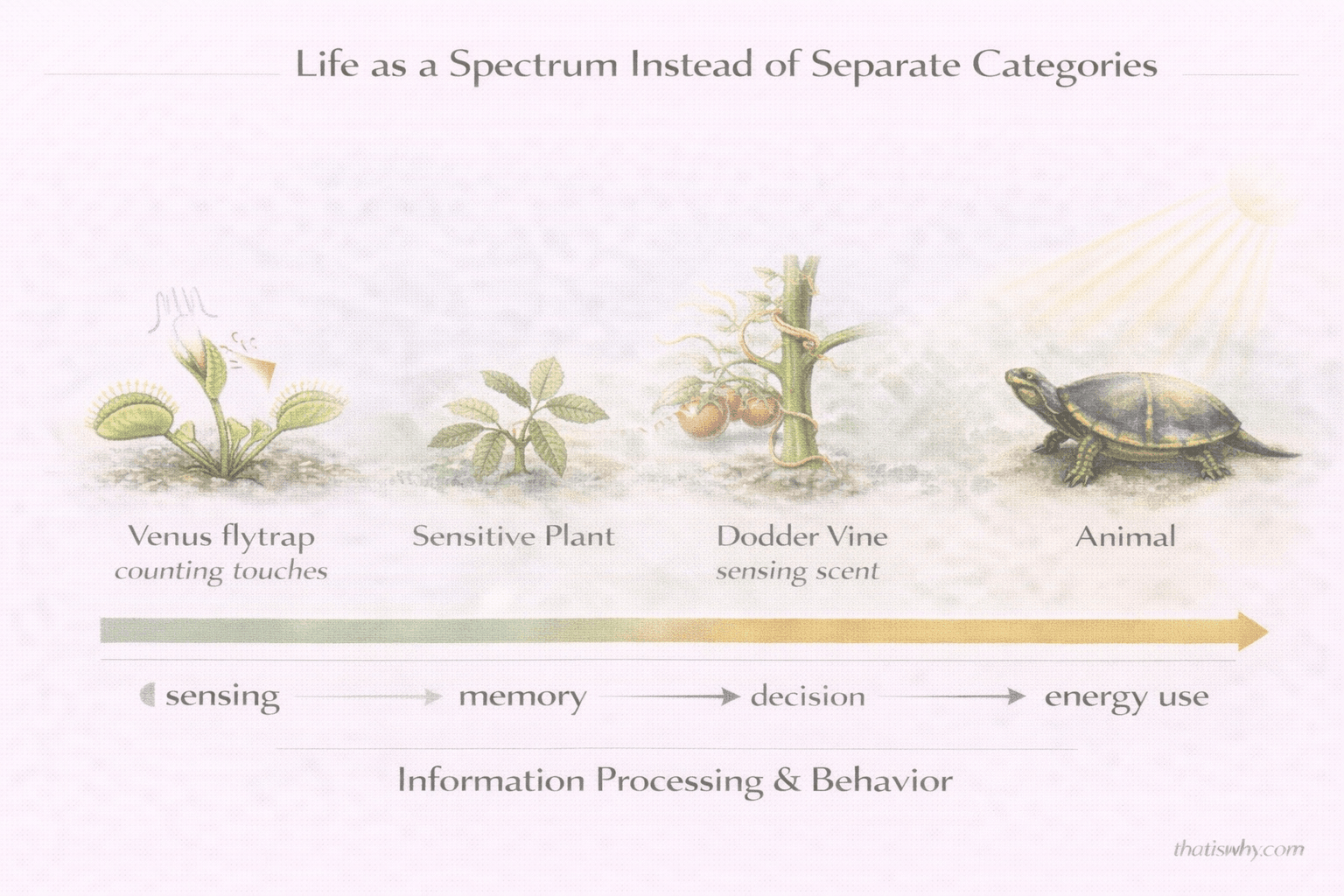
The truth is, the Kingdom of Life isn’t a collection of separate islands. It is a spectrum. Intelligence, memory, and agency aren’t unique to animals; they are universal tools. And right now, we are discovering that the “dumb” side of the spectrum is running a much more advanced operating system than we ever imagined.
The Alien Language
To understand why we missed this intelligence for so long, you have to realize that we have been listening for the wrong thing.
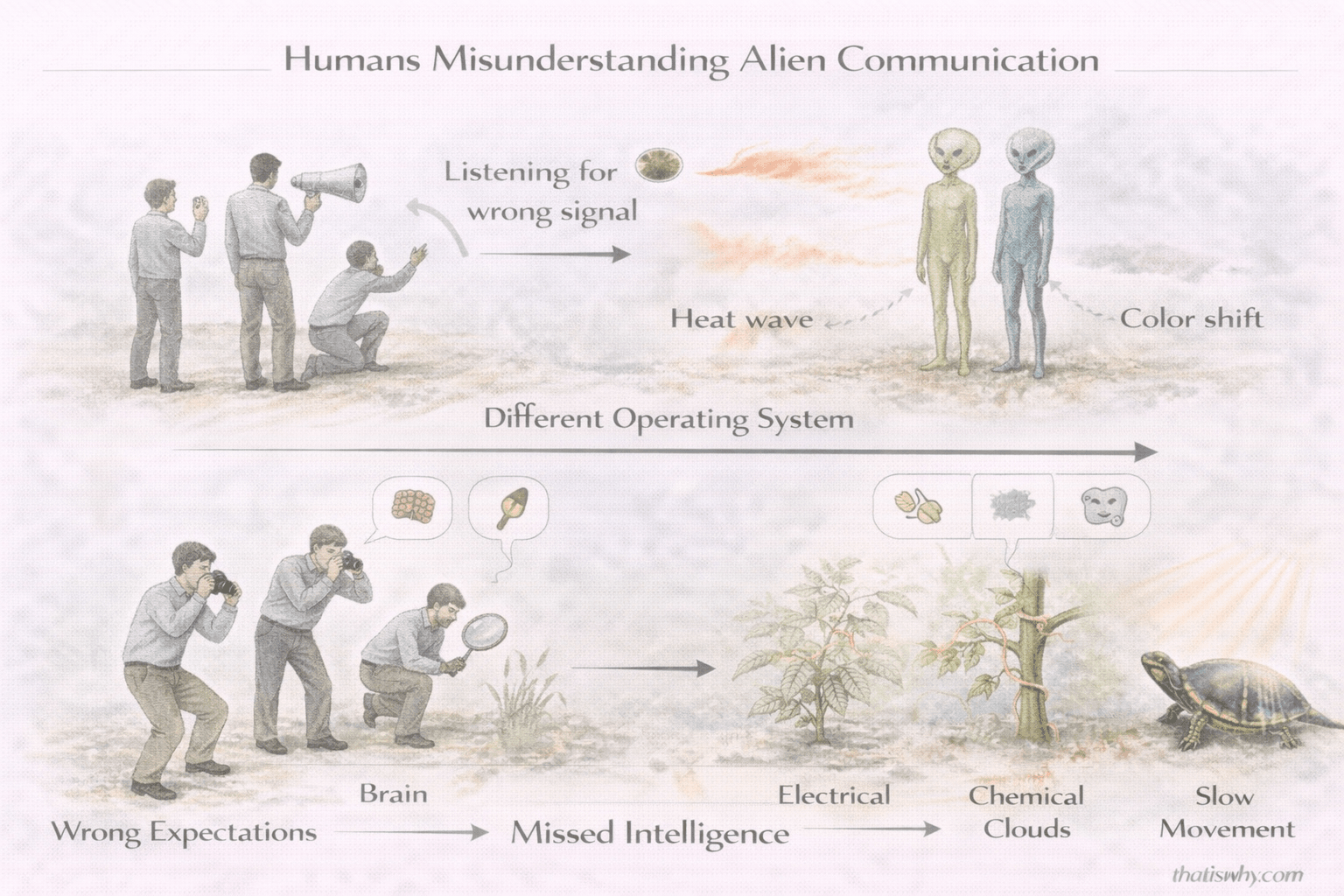
Imagine you land on an alien planet. You try to talk to the locals. They don’t speak. They don’t wave. You assume they’re rocks. But what if they are screaming at each other by changing their skin temperature? You would miss the entire conversation because you were listening for words.
Plants are that alien. We define “Intelligence” by Neurons. We define “Senses” by Organs. But plants don’t use our tech stack. They run on a different operating system.
- Instead of nerves, they use Electrical Spikes to send instant messages.
- Instead of muscles, they use Hydraulic Pumps to move.
- Instead of words, they use Chemical Perfumes to communicate.
They are solving the exact same problems we are, hunting, hiding, and calculating, but they are doing it in a code we are only just learning to translate.
The Mathematicians: Computing Without a Brain
The first sign of intelligence is Math. Can you count? Can you filter data?
We used to think only animals could do this. Then we met the Venus Flytrap. This plant lives on a strict energy budget. It cannot afford to close its trap for random noise (rain or wind). So, it runs a sophisticated security script.
It waits for two distinct touches within 20 seconds to close the trap. Then, it waits for five distinct struggles to trigger the acid. It isn’t guessing; it is executing an algorithm. It uses electrical spikes (Action Potentials) as data bits to verify its prey. It filters out the noise and only acts on the signal. It is a biological calculator that processes inputs, makes decisions, and manages a budget—all without a central processor.
Read the Deep Dive: See how the Flytrap uses calcium ions to count to five. That Is Why The Venus Flytrap Can Count (The Green Calculator)
The Students: Learning From Experience
The second sign of intelligence is Memory. Can you update your software based on new data?
The Sensitive Plant (Mimosa pudica) proves that you don’t need a brain to install an update. In a famous experiment, scientists dropped this plant repeatedly. At first, it panicked and closed its leaves. But after 60 drops, it realized the signal was harmless. It stopped closing. It “patched” its own reflex to save energy.
Even more shockingly, it remembered that update 28 days later. It has a more stable long-term memory than a honeybee. It suggests that plants aren’t just running a static program; they are rewriting their own code in real-time to adapt to a changing world.
Read the Deep Dive: Discover the plant that remembers for a month. That Is Why The Sensitive Plant Remembers (The Green Brain)
The Hunters: Sensory Input
The third sign is Perception. Can you scan the environment for targets? We assume plants are blind and deaf background noise. But some of them have installed military-grade sensors to turn the tables.
The Chemical Sensor : The Dodder Vine is a vampire that hunts by smell. It spins in the air like a radar dish, tasting the wind for the specific volatile chemicals released by its prey. In experiments, it tracked down a tomato plant while ignoring a wheat plant, proving it can distinguish between “Dinner” and “Trash” just by sniffing.
Read the Deep Dive: Discover the vampire plant that sniffs out its victims.
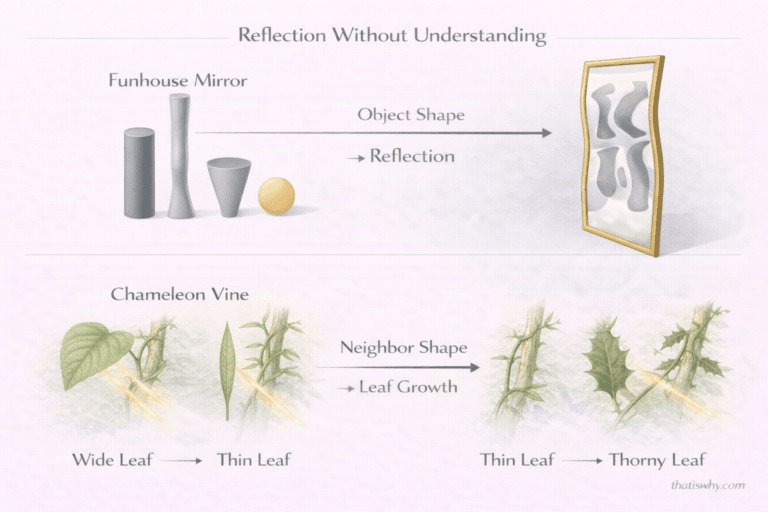
The Visual Sensor : The Chameleon Vine is a spy that changes its shape. If it climbs a tree with round leaves, it will re-program its own cells to grow round leaves. If it climbs a plastic tree, it copies the plastic. This suggests it has upgraded its hardware to actually “see” the shape of the world around it, allowing it to disappear in plain sight.
Read the Deep Dive: Meet the only plant in the world that can see.
These plants aren’t passive decorations. They are active observers, scanning their environment and launching attacks based on the data they collect.
The Brainless Genius
Then there are the things that defy categorization.
The Slime Mold isn’t a plant, an animal, or a fungus. It is a single-celled blob. But it acts like a biological supercomputer. When researchers placed it on a map of Tokyo, this brainless organism recreated the entire subway system in 26 hours. It connected the cities (food sources) with the most efficient network of tubes possible, perfectly balancing speed against cost.
It proves that intelligence isn’t about having a central CPU (brain). It’s about having a network. The slime mold operates as a distributed processor, where every part of the body calculates the best path simultaneously. It is the ultimate cloud computing system.
Read the Deep Dive: See the blob that redesigned the Tokyo Subway. That Is Why The Slime Mold Is Smarter Than An Engineer
The Hybrids: Breaking the Energy Barrier
Finally, there are the animals that break the most fundamental rule of all.
Animals are supposed to run on food (gas). Plants are supposed to run on sun (electric). The two systems aren’t supposed to mix. But the Spotted Salamander is a biological Hybrid. It is the only vertebrate on Earth that allows algae to live inside its own cells. It has essentially installed solar panels in its skin.
This allows the embryo to recharge its batteries in stagnant water where there is almost no oxygen. It is an animal that has hacked its own immune system to run on green energy, blurring the line between flora and fauna until it disappears.
Read the Deep Dive: Meet the animal that acts like a plant. That Is Why The Solar Salamander Is Impossible
Translating the Signal
For centuries, we asked, “Are plants smart?” But we were asking the wrong question. We were judging them by our standards. We were trying to force an alien intelligence to speak human.
The truth is, the “Blurred Kingdom” is full of genius; we just didn’t have the dictionary to understand it. The Venus Flytrap runs algorithms. The Mimosa stores memories. The Dodder hunts by scent. The Slime Mold optimizes networks.
These organisms aren’t “lesser” versions of animals. They are simply running a different operating system. They are speaking a language of electricity, pressure, and chemistry that is just as complex as our own neural firings. And for the first time in history, we are finally learning how to translate the signal.
How We Researched This :
This guide synthesizes the emerging field of Plant Neurobiology, referencing studies by Stefano Mancuso, Monica Gagliano, and Rainer Hedrich. We looked at the hard science, Action Potentials, Calcium Signaling, and Epigenetics, to challenge the traditional definitions of intelligence.
But we knew that just listing biological mechanisms isn’t helpful. Our real job began when we asked, “What does this feel like?” That question led us to the “Alien Language” analogy, a simple story to make the complex reality of non-neural intelligence feel intuitive.