Why The Sensitive Plant Can Remember – The Green Brain
The Plant That Flinches
Can plants learn and remember? Yes. Research on the sensitive plant (Mimosa pudica) shows that it can exhibit habituation—a form of learning where an organism stops reacting to a harmless stimulus. Experiments demonstrated that the plant could “remember” that being dropped was safe for up to 28 days, proving it possesses long-term memory without a brain.
That is the conclusion. But getting there required breaking one of the biggest rules in biology.
If you touch a Sensitive Plant, it freaks out. Its leaves collapse instantly. We’ve always assumed this is just a reflex, like your knee kicking when a doctor hits it.
But in 2014, ecologist Monica Gagliano asked a dangerous question: What if the plant isn’t just reacting? What if it’s choosing?
She built a machine to drop the plants, over and over again, to see if they would eventually learn to stop being afraid. Most scientists thought she was wasting her time. Plants don’t have brains; they can’t learn.
Well, they were wrong.
The Train Track Apartment
To understand what Gagliano found, you have to understand Habituation. It is the most basic form of learning on Earth.
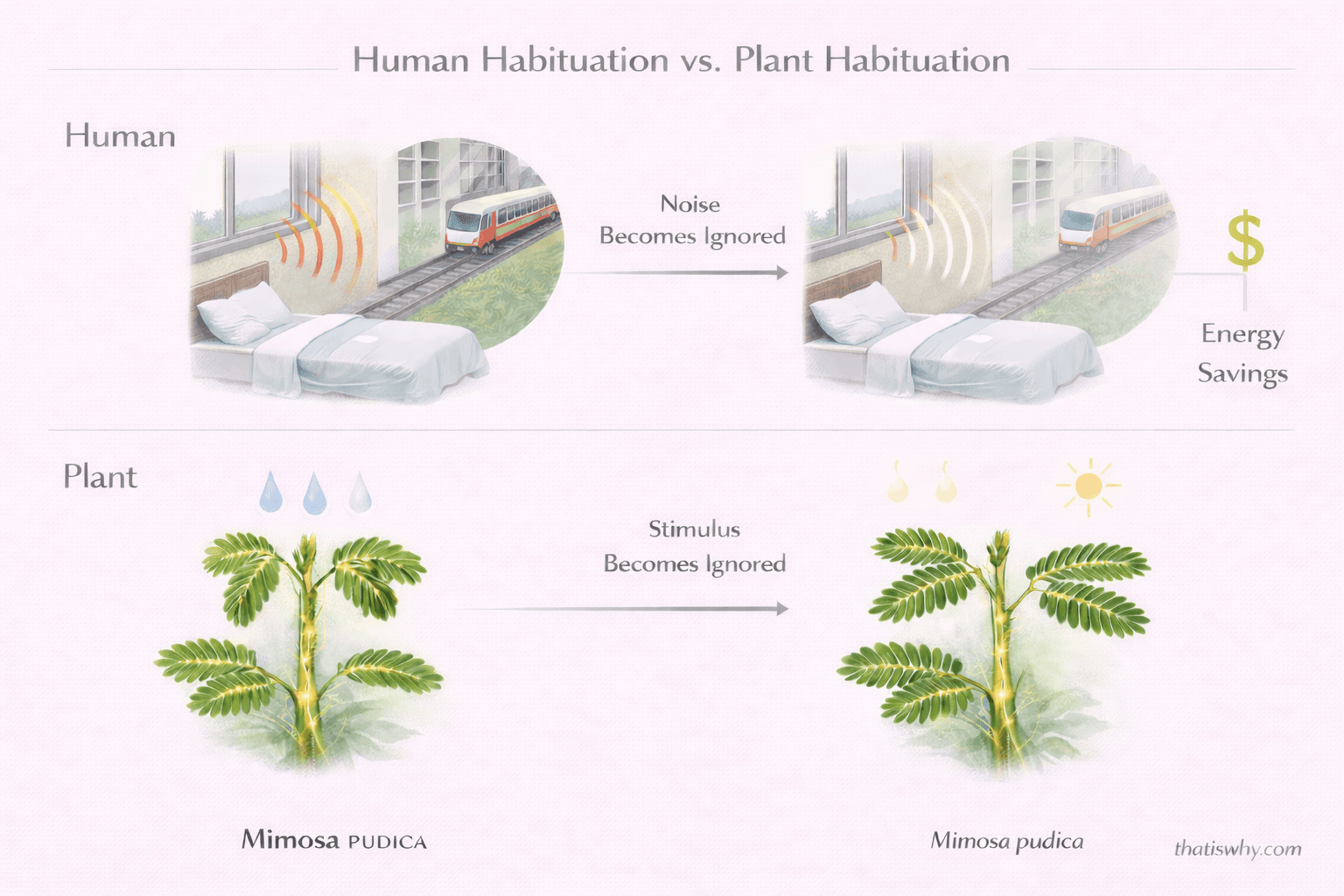
Think about moving into an apartment next to a train line. The first night, a train roars past at 3AM. You wake up screaming, your heart rate spikes and you will burn massive amounts of energy panicking. The second night, you panic again.
But by the 30th night? The train roars past, and you don’t even twitch.
You aren’t deaf. Your ears still hear the sound. But your brain has realized that panicking is a waste of calories. It has learned a critical lesson: “This noise is safe. Delete it.”
This is the key. Habituation isn’t just about getting used to something; it is about saving energy. It is the ability to filter out useless data so you don’t burn out. And as it turns out, you don’t need a brain to make that calculation.
The Drop Experiment
Gagliano’s experiment was the botanical version of that train.
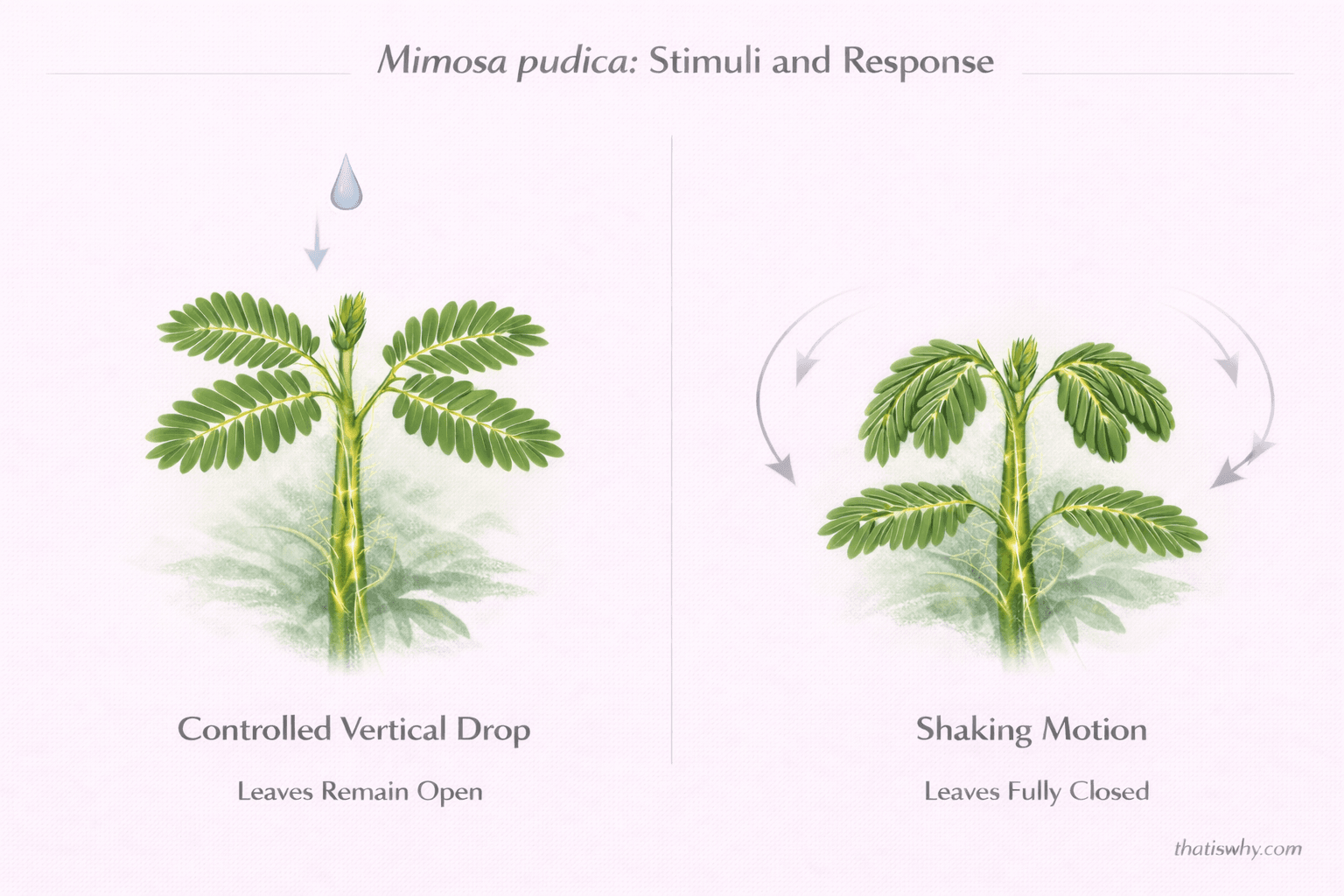
She built a custom “Drop Machine” that would lift a potted Mimosa six inches into the air and then drop it onto a foam base. It was a perfect test: The drop was scary (a sudden shock), but harmless (soft landing).
The First Drop: The plant panicked. It folded every single leaf instantly. This is the reflex. The 10th Drop: The plant still panicked. It folded tight.
But then, something shifted. Around the 60th drop, the plants stopped closing. They stayed wide open.
They had realized the pattern. Drop… Safe. Drop… Safe. The plant made a choice. It calculated that the shock wasn’t a threat. It decided that closing its leaves was a waste of precious sunlight. So, it overrode its own reflex. It chose to stay open and keep eating the sun, even while being dropped.
The Earthquake Test
Of course, the skeptics immediately jumped in. They said, “The plant didn’t learn anything. It just got tired.”
It’s a valid critique. Closing leaves takes hydraulic energy. Maybe the plant wanted to close but couldn’t.
So, Gagliano did a control test. Immediately after the plants stopped reacting to the drop (The Train), she picked them up and shook them (The Earthquake).
If you live next to a train track, you learn to sleep through the train because it’s predictable. But if an earthquake hits your building? You wake up screaming. That is exactly what the plant did. Even though it was ignoring the drop, it snapped shut instantly for the shake.
This proved it wasn’t fatigue; it was Categorization. The plant had filed “The Drop” under “Safe” and “The Shake” under “Dangerous.” It wasn’t tired; it was just filtering its reality.
The Memory of a Month
But the real shock came later.
Gagliano took the “trained” plants and put them back in the greenhouse. She left them alone for 28 days. A month is an eternity in biology. For context bees, which have actual brains, usually forget a learned behavior after about 3 days.
After a full month, she put the plants back in the Drop Machine. She dropped them. They didn’t close.
They remembered. Despite having no neurons, no synapses, and no brain cells, these plants held onto a specific memory for four weeks. They recognized the “Train” instantly and went right back to sleep. It suggests that plants don’t just react to the moment; they store the past.
Intelligence Without a Brain
This experiment forces us to rethink what “Intelligence” actually is.
The Network Theory We assume intelligence requires a brain because we have one. But the Mimosa proves that intelligence is just a property of Networks. It uses electrical pulses to store data in its tissues, just like a hard drive.
Epigenetic Memory This discovery has opened a new field called Plant Epigenetics. Scientists believe the plant might be storing these memories by chemically tagging its own DNA. It suggests that plants might be recording their life experiences directly into their genetic code.
The AI Connection This is exactly how Artificial Intelligence works. A neural network doesn’t have a “brain”; it has layers of nodes that adjust their sensitivity based on input. The Sensitive Plant is basically a biological version of Machine Learning, optimizing its responses over time without ever being “conscious.”
Debunking the Sentient Plant
Because this research is so wild, people tend to get carried away. Let’s keep it grounded.
Myth #1: “The plant has feelings.” We want to believe it was scared.
The Truth: It wasn’t scared; it was calculating. Closing leaves costs energy. The plant realized the drop wasn’t worth the cost of closing the shop. It’s a ruthless accountant, not a poet.
Myth #2: “All plants are smart.” We assume every weed is Einstein.
The Truth: The Mimosa is special because it moves fast enough for us to test. An Oak tree might have a memory, but it lives on a timescale we can’t comprehend. We are only scratching the surface.
Myth #3: “Talking to plants helps them grow.” We think they like our voice.
The Truth: They don’t care about your stories, but they do detect vibration. Sound is just physical pressure waves. It is possible (though unproven) that plants can sense sound as a physical touch. So keep talking, but don’t expect a reply.
The Original Network
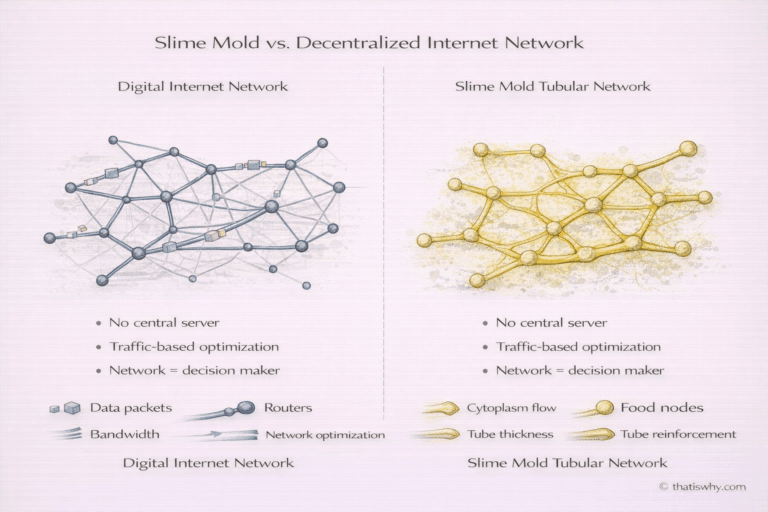
When we look at the Slime Mold, we see a gross, yellow blob. We assume it is primitive because it lacks a brain.
But in reality, it is a biological supercomputer. It has spent millions of years perfecting the algorithms of efficiency, routing, and connection.
The Slime Mold isn’t just goo. It is the original internet, crawling across the forest floor. It teaches us a humbling lesson: Intelligence doesn’t require neurons, and it doesn’t require a skull. Sometimes, the smartest thing in the room isn’t the individual; it’s the network itself.
How We Researched This :
To write this, we analyzed the controversial but compelling 2014 study by Dr. Monica Gagliano, published in Oecologia. Her “Drop Box” experiment challenged the fundamental definitions of learning in biology.
But we knew that just citing experimental data isn’t helpful. Our real job began when we asked, “What does this feel like?” That question led us to the “Train Track Apartment” analogy—a universal human experience that perfectly maps onto the plant’s ability to filter out non-threatening noise.