Why the Sandbox Tree Turns Seed Dispersal into an Explosion
The Sandbox Tree doesn’t hurt you because it’s poisonous, although it is.
It hurts you because it stores energy patiently and then releases it all at once.
Its fruit doesn’t rot, dissolve, or get eaten. It dries, tightens, and eventually fails so suddenly that the sound carries like a gunshot and the seeds leave faster than a car on the highway.
The Sandbox Tree looks like it was designed to discourage curiosity. Its trunk is covered in hard, conical spikes that make climbing impractical and painful. Its sap is toxic enough to cause blindness if it reaches the eyes. Even standing too close to the wrong part of it can end badly. But none of that is the main reason this tree has such a reputation.
What sets it apart happens months after the fruit forms, during a period when nothing appears to be happening at all.
The fruit starts out round and heavy, hanging quietly from the branches. Over time, under heat and sunlight, it begins to dry. That drying doesn’t soften it. It tightens it. The internal tissues shrink and pull against each other, building tension inside a rigid shell that has nowhere to flex.
Anyone who has struggled with a jar that’s been tightened too far understands the sensation. Resistance increases gradually, almost imperceptibly, until the system can no longer hold itself together. When it finally slips, the release is instant and uncontrolled.
That is the logic the Sandbox Tree relies on. It doesn’t wait for an animal, a trigger, or a perfect moment. It lets physics do the work. As the fruit dries, tension accumulates. When the structure reaches its limit, it fails catastrophically, splitting apart in a fraction of a second and throwing its seeds outward with remarkable speed.
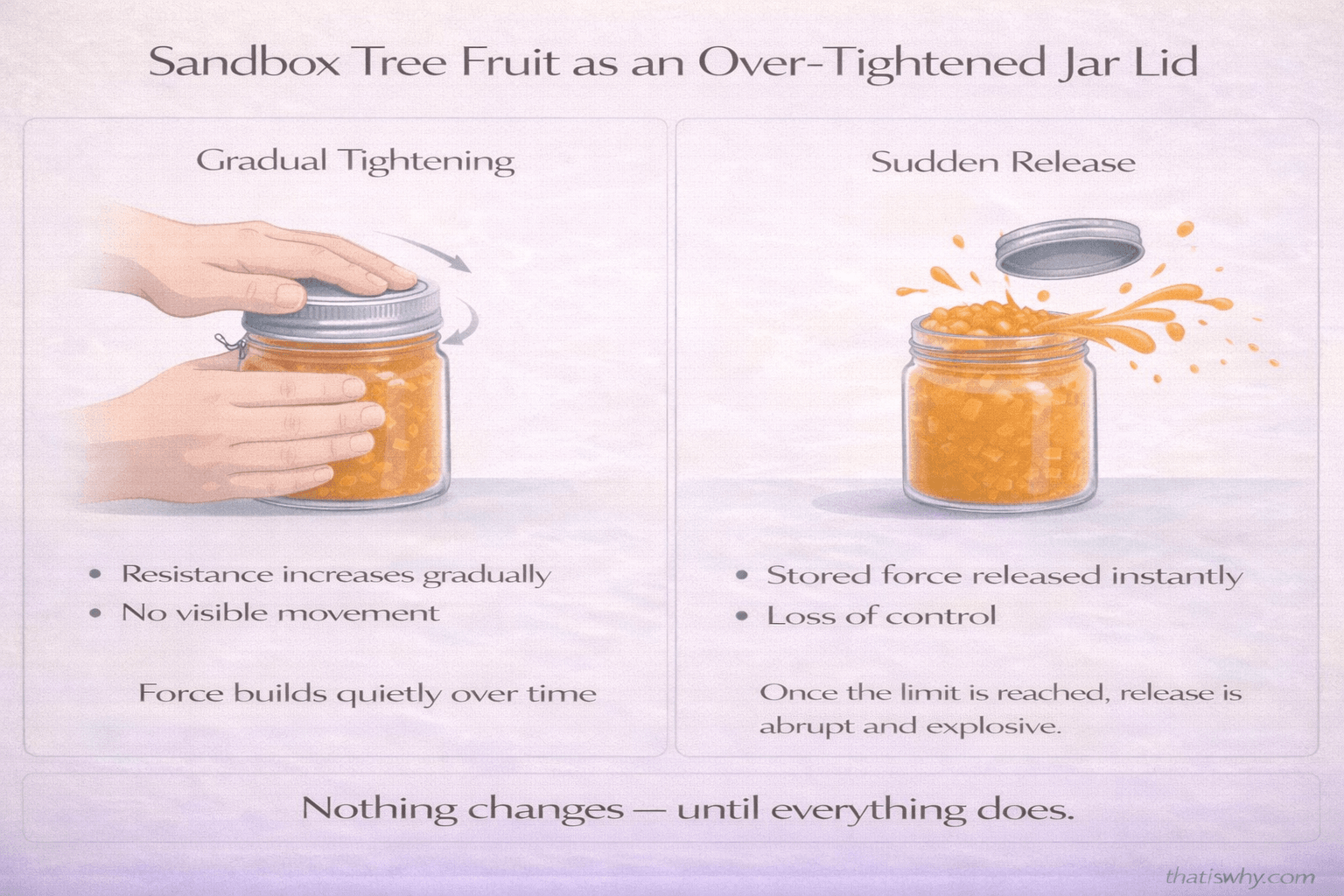
The explosion isn’t an accident or a flourish. It is the strategy.
The Monkey No-Climb Tree
Before the Sandbox Tree ever throws anything, it solves a quieter problem first. It makes itself difficult to handle.
The trunk is wrapped in dense, conical spikes that turn the bark into something you hesitate to touch, let alone climb. They’re rigid, sharp, and packed close together, giving the surface the same uninviting feel as a metal jar lid that’s been tightened too far. There’s nowhere comfortable to grip and no obvious place to apply force. Even animals that make a living climbing trees tend to leave it alone. In parts of the Caribbean and Central America, people call it the “monkey no-climb tree,” which sounds casual until you realize it’s simply accurate.
Those spikes do more than discourage animals, they also protect the seal. The Sandbox Tree depends on staying closed, and that only works if the outer surface isn’t constantly disturbed. Like the ridged edge of an over-tightened jar, the spikes make interaction awkward and imprecise, turning casual contact into a mistake.
The sap reinforces the same rule. The tree produces a milky latex that can cause severe irritation and temporary blindness if it reaches the eyes. Cut into the trunk or snap a branch, and it appears immediately. Breaking the surface has consequences.
Seen together, the spikes and the sap feel like parts of the same design. They keep hands, teeth, and tools from getting a good hold. They prevent interference while something else is happening out of sight. The tree isn’t trying to scare anything away. It’s trying to stay closed long enough for its real mechanism to finish loading.
Biological Ballistics: The Explosion
The moment the Sandbox Tree becomes memorable is the moment the jar finally slips.
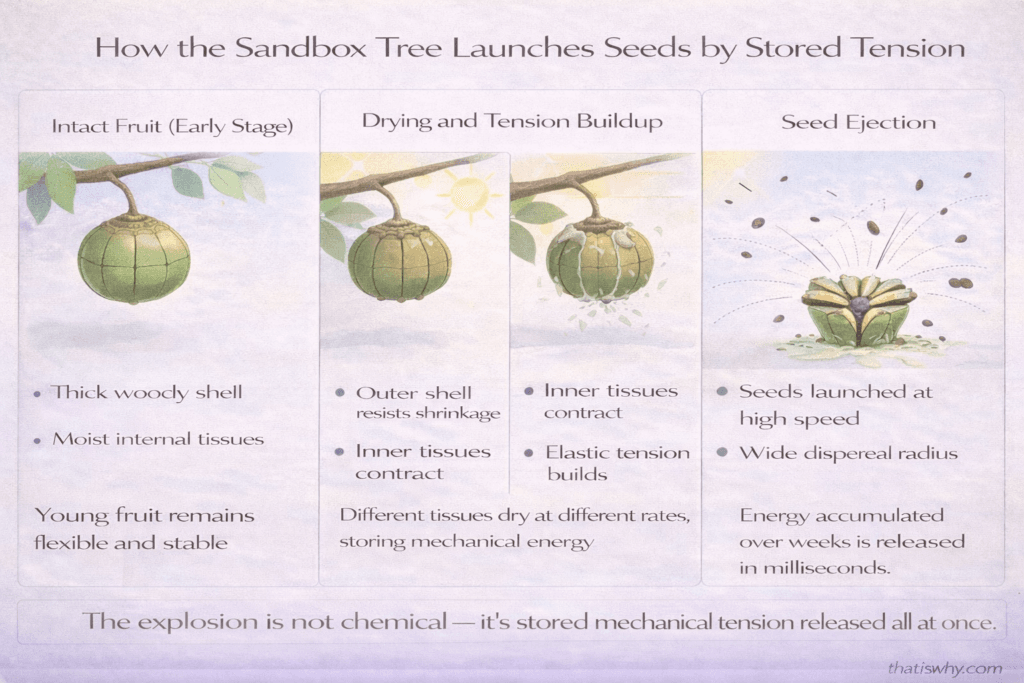
The fruit begins as a thick, segmented capsule, roughly the size of a small pumpkin, hanging quietly while the real work happens inside. As it dries in the sun, different layers of tissue shrink at different rates. The outer shell resists change while the inner fibers keep tightening, pulling against one another with no easy way to release the strain.
This is not pressure building like steam in a container. It is elastic tension. The structure is being twisted and warped from within, much like a jar lid tightened past what its threads were meant to tolerate. Everything holds together right up until it cannot.
When failure comes, it happens all at once. The fruit splits apart along its natural seams, snapping open in a fraction of a second. The sound is sharp and loud, often compared to a gunshot, because the release is faster than the eye can track. Energy that accumulated slowly over weeks is discharged almost instantly.
That release turns the seeds into projectiles. They are hard, dense, and roughly coin-sized, and they leave the fruit at speeds measured around 160 miles per hour. Some travel hundreds of feet before hitting the ground. Being struck by one feels less like debris and more like being hit by a frozen paintball.
What makes this remarkable is how little the tree itself appears to do. There are no muscles involved, no triggers to pull, and no timing mechanism to coordinate. Sunlight dries the fruit which is drying tightens the structure and finally tension accumulates until the seal fails.
The explosion is not an extra feature layered onto the tree’s biology. It is the predictable outcome of a system designed to stay closed until it cannot anymore.
Why So Violent?
Once you understand how the fruit explodes, the next question is unavoidable. Why does a tree need this much force just to spread its seeds?
In a dense tropical rainforest, gravity is rarely enough. Light is limited, space is contested, and the ground beneath a mature tree is already claimed by roots and shade. Seeds that fall straight down tend to compete with their parent and with one another, and most never get a real chance to grow.
The Sandbox Tree answers that problem decisively. Instead of relying on wind, animals, or luck, it throws its seeds far beyond the parent’s shadow, sometimes hundreds of feet away, into patches of light where survival becomes possible.
This is where the violence makes sense. A gentle opening would not solve the problem. A small crack would still drop seeds nearby, where conditions are poor. Like an over-tightened jar that refuses to move until it finally slips, the benefit comes from letting go all at once.
There is also precision in the timing. The fruit does not explode randomly or in response to disturbance. It waits for dry conditions, when the shell tightens and when seeds landing on the forest floor are less likely to rot immediately.
Seen this way, the Sandbox Tree’s strategy is not reckless. It is efficient. This is how the tree moves its offspring when it cannot move itself.
The Jewelry Box
After all that violence, the Sandbox Tree leaves behind something unexpectedly ordinary.
Once the fruit has exploded and the seeds are gone, what remains are thick, woody shells split cleanly into neat segments. They’re hard, symmetrical, and almost orderly, as if the explosion followed seams rather than tearing the structure apart.
People noticed this long ago. In the nineteenth century, before blotting paper became common, writers used fine sand to dry ink. The empty shells of Sandbox Tree fruit turned out to be ideal containers for that sand. They sat comfortably on desks and opened and closed without effort.
That practical use is where the name comes from. These were literal sand boxes, often handled by people who had no idea how violently the container had opened in the forest.
A structure that spent months tightening itself ends its life as something meant to be handled gently. The same shell that once refused to yield can now be opened without resistance.
The fruit explodes not because it is weak, but because it is strong enough to hold tension for a long time. Once that tension is gone, what remains is simply wood, shaped by stress it no longer carries.
What the Sandbox Tree Is Actually Doing
Myth #1: “The Sandbox Tree explodes to defend itself.”
Truth: The explosion is not a defensive reaction. It happens after the fruit has matured and dried, long after any immediate threat has passed.
Myth #2: “The fruit is basically a plant bomb.”
Truth: No chemical explosion is involved. The energy comes from mechanical tension built up as tissues dry and shrink at different rates.
Myth #3: “Something triggers the explosion.”
Truth: There is no trigger. Sunlight and time tighten the structure until release becomes inevitable.
Myth #4: “The danger is exaggerated.”
Truth: Seed speeds and distances are well documented, and injuries from impact are real.
The Kind of Force You Don’t Notice Until It Lets Go
We tend to think of danger as something active and obvious. The Sandbox Tree works in a quieter way, relying on patience rather than reaction.
Nothing about it looks urgent. The fruit hangs still while heat and dryness do very specific work. By the time release happens, the outcome has already been decided.
Most people recognize this pattern from everyday experience. Anyone who has wrestled with a stubborn jar knows the feeling. Pressure builds gradually until resistance vanishes all at once. The surprise is not the motion. It is realizing how much force had been stored without announcing itself.
The Sandbox Tree follows the same logic. It waits until letting go is the most effective option left.
That is what makes it less a spectacle and more a reminder. Not all power announces itself. Sometimes the loudest moment is simply the sound of something letting go after holding on for a very long time.
How We Researched This :
To explain how the Sandbox Tree turns slow drying into explosive force, we looked at botanical research on Hura crepitans, studies of explosive dehiscence, and biomechanical analyses published in sources such as the Journal of Experimental Botany, Annals of Botany, and the Smithsonian Tropical Research Institute.
But we knew that just citing technical terms wasn’t helpful. Our real job began when we asked, What does this feel like? That question led us to the “over-tightened jar lid” analogy, a simple story to make slow tension buildup and sudden mechanical release feel intuitive.