Why Spider Silk Is Stronger Than Steel – The Impossible Chemistry
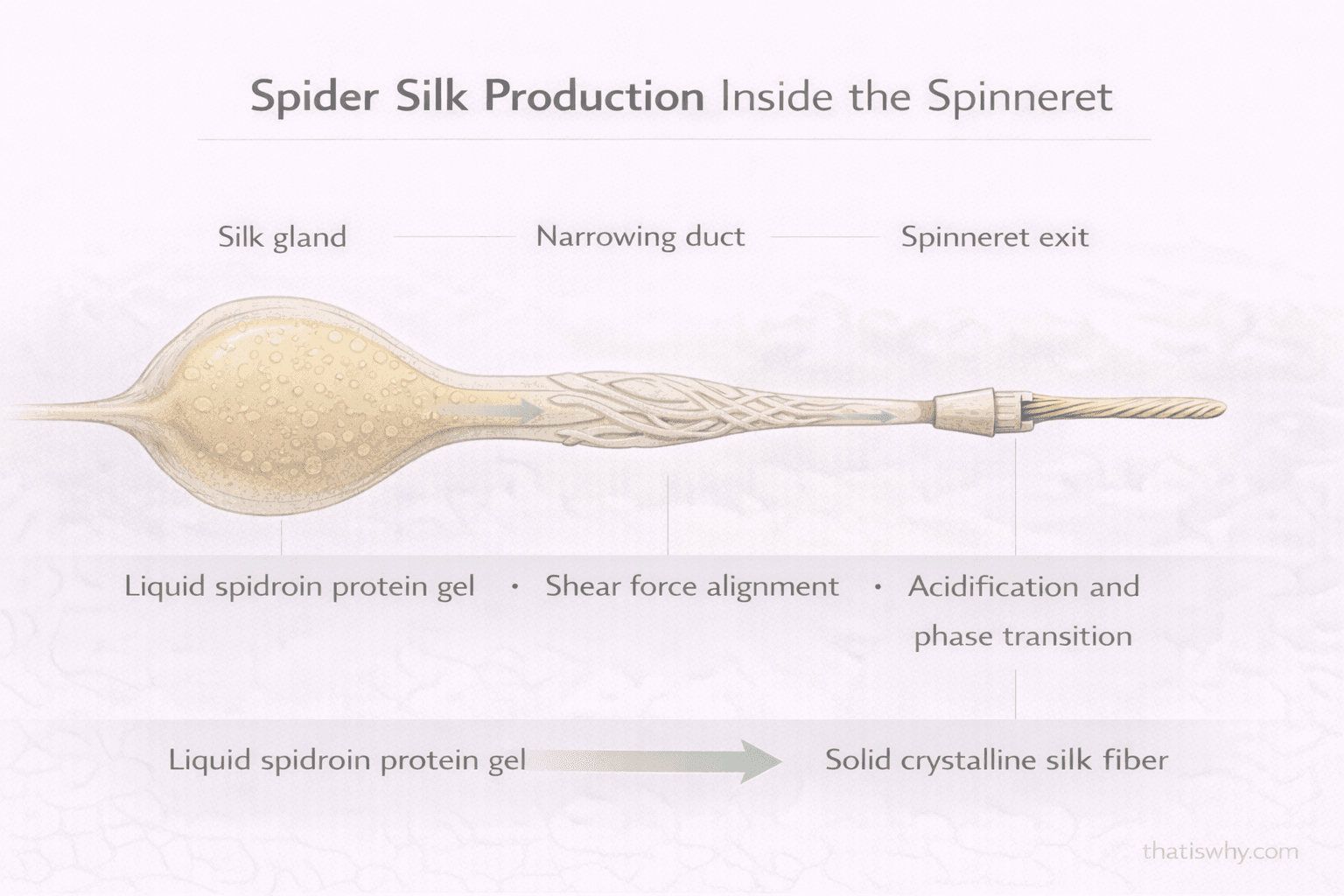
How is spider silk made? Spider silk begins as a liquid protein gel (spidroin) stored in the spider’s glands. As it travels through the spinneret, the liquid undergoes a phase transition triggered by shear force and acidification. This aligns the proteins into a solid fiber that is stronger than steel, all without the need for heat or drying.
That is the chemistry. But the reality is an engineering miracle.
When we want to make a fiber as strong as Kevlar, we need a factory. We need vats of sulfuric acid, temperatures over 1,000°F (538°C), and massive pressure. It is a loud, toxic, time consuming and expensive process.
A spider does the exact same thing hanging from a ceiling fan.
It makes a fiber that is, pound for pound, five times stronger than steel. And it does it using nothing but room-temperature water and a dead fly.
The spider isn’t just spinning thread. It is running a biological manufacturing plant inside its own body that makes our best technology look like a toy.
The Biological 3D Printer
To understand how impossible this material is, you have to look inside the spider.
Inside the silk glands, the web isn’t a thread. It’s a liquid gel. It has the consistency of honey. If the silk were solid inside the spider, the animal would die. It would be clogged up with miles of cable. So, it has to store the weapon as a liquid ink.
How do you turn liquid ink into a solid cable instantly, without heating it, freezing it, or waiting for it to dry?
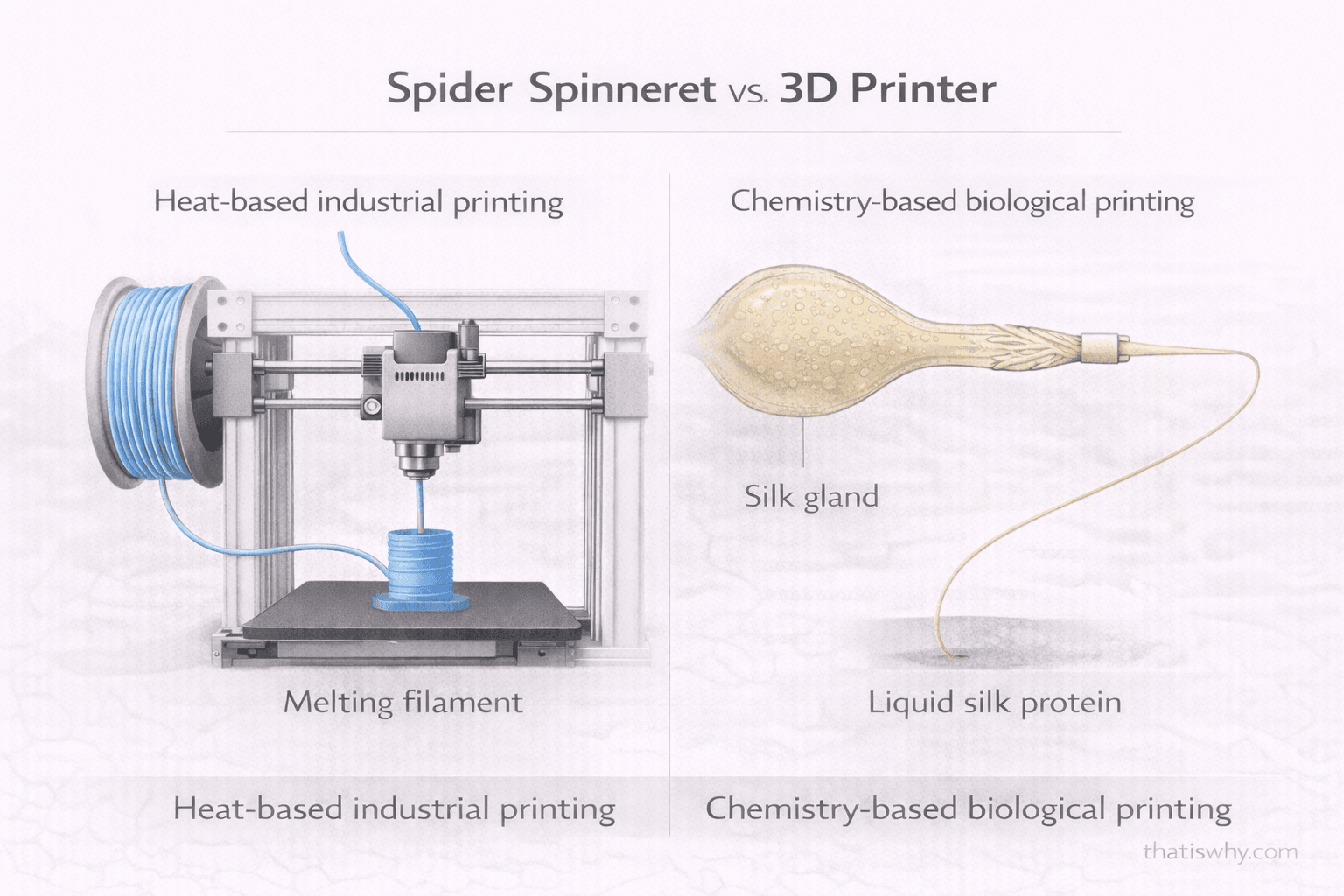
Think of the spider as a Biological 3D Printer. A 3D printer takes a spool of plastic, melts it into liquid, and then extrudes it through a tiny nozzle where it hardens into a solid shape. The spider does the exact same thing, but its “nozzle” (the spinneret) is infinitely more advanced. It doesn’t use heat to melt the material; it uses chemistry to align it. It prints a solid, waterproof cable out of liquid protein in milliseconds.
The Factory: Inside the Spinneret
The spider’s Print Head is called the Spinneret. It looks like a simple showerhead, but inside, it is a microscopic extrusion machine that rivals anything we have in a factory.
Step 1: The Raw Material Inside the gland, the silk proteins are chaotic. They are floating around like a bowl of tangled spaghetti, messy, weak, and liquid.
Step 2: The Extruder (Shear Force) As the spider pulls the silk out, the duct narrows. This forces the “spaghetti” to straighten out. The proteins stretch and align perfectly parallel to each other. This is Shear Force, and it transforms the mess into a crystalline structure.
Step 3: The Hardener (Acid Bath) This is the secret sauce. As the silk moves through the nozzle, the spider pumps in acid. This acid bath acts like a chemical lock forcing the aligned proteins to bond together instantly. It turns the water-soluble gel into a waterproof solid in milliseconds. It’s not drying; it’s curing.
Strong vs. Tough: Why It Can Stop a Plane
We often hear that spider silk is “stronger than steel.” That’s a fact, but it’s only half the story. The real magic is that it is Tough.
In physics, “Strength” and “Toughness” are not the same thing. Steel is strong, but it is brittle. If you stretch it, it snaps. Silk is tough. It can hold weight, but it can also stretch up to 40% of its length without breaking.
Think about a fly crashing into a web. If the web were made of steel, the fly would just bounce off. Steel is too rigid to absorb the impact. Spider silk acts like a bungee cord. It stretches to absorb the massive kinetic energy of the crashing insect, slows it down gently, and then recoils to trap it.
The math on this is staggering. Calculations show that if we could scale it up, a spider-silk cable as thick as a pencil could stop a Boeing 747 in mid-flight. It wouldn’t snap; it would just stretch and catch the plane like a fly.
The Race to Clone It
This material is so advanced that we have spent decades trying to steal the recipe.
The Spider-Goat In one of the weirdest experiments in history, scientists genetically modified goats to produce spider silk protein in their milk. It worked. The goats made the “ink.” But the fiber was weak, they had the ink, but they didn’t have the printer. They lacked the spider’s spinneret. It turns out, the printing process is just as important as the material itself.
The Plastic Problem The biggest reason we want this isn’t just strength; it’s trash. Kevlar and Nylon are strong, but they sit in landfills forever. Spider silk is biodegradable. If we ever crack the code of the spinneret, we could print clothes, armor, and cables that are stronger than steel but dissolve in the dirt when we are done with them. It’s the holy grail of green engineering.
Web Myths
Let’s review and clarify few misconceptions about the factory.
Myth #1: “The silk dries in the air.” We assume it comes out wet like glue.
The Truth: It is solid the moment it leaves the body. The chemical hardening happens inside the spider. If it relied on drying, it would be useless on a humid morning or underwater.
Myth #2: “Spiders run out of silk.” We think they have a limited supply.
The Truth: They recycle. At the end of the day, many spiders eat their old web. Their bodies break down the proteins and recycle them back into liquid “ink” for the next day. It is a perfect, zero-waste economy.
Myth #3: “All spiders spin webs.” We associate the animal with the trap.
The Truth: Only about half of all spider species spin webs. The rest, like Wolf Spiders and Jumping Spiders, are hunters. They use their silk for safety lines (draglines) or egg sacs, but they don’t build nets, they prefer to chase their dinner down.
The Biological Factory
When you walk into a spider web, your first reaction is usually annoyance. You wipe the sticky thread off your face and keep walking.
But take a second to realize what you just touched. You just walked through a material that is more advanced than anything we have ever created. It is a cable that is stronger than steel, tougher than Kevlar, and made entirely of water and dead flies.
The spider isn’t just an animal; it is a walking manufacturing plant. It has solved the problems of sustainable production, chemical engineering, and structural integrity, all without burning a single drop of fossil fuel. It is holding the blueprint for the future of engineering, and it’s hanging right there in the corner of your room.
How We Researched This :
To explain this impossible chemistry, we examined the material science of Spidroin proteins and referenced studies on Liquid Crystalline Spinning. We also looked at the biomimicry experiments at Utah State University (the famous “Spider-Goats”) to understand why cloning the protein wasn’t enough to replicate the silk’s strength.
But we knew that just citing protein structures isn’t helpful. Our real job began when we asked, “What does this feel like?” That question led us to the “Biological 3D Printer” analogy—a simple story to make the complex process of extruding liquid gel into solid cable feel intuitive.