Why The “Zombie Ant” Is A Prisoner In Its Own Body
The “Last of Us” Lie
If you’ve played The Last of Us or seen the show, you know the nightmare scenario. You breathe in some spores, the fungus attacks your brain, and you turn into a mindless, clicking zombie.
It’s great TV. But as a biologist, I have to ruin the party: That is not how it works.
The real “Zombie Ant” fungus (Ophiocordyceps unilateralis) exists, but it doesn’t eat the brain. In fact, a groundbreaking study found that it leaves the brain almost completely untouched.
Now, you might think, “Oh, that’s better.” Trust me, it is infinitely worse.
Because the brain is intact, the ant isn’t a mindless zombie. It is likely awake, aware, and conscious the entire time. It is a prisoner locked inside its own body, screaming “Stop!” while its legs march it off a cliff.
The Hijacked Mech Suit
To understand what’s happening, you have to stop thinking of this as “Mind Control.” It isn’t. It’s Muscle Control.
I like to think of the ant as a giant Mech Suit—like something out of Pacific Rim or Iron Man. Inside the head, you have the Pilot (the ant’s brain). The Pilot pulls the levers, and the suit walks.
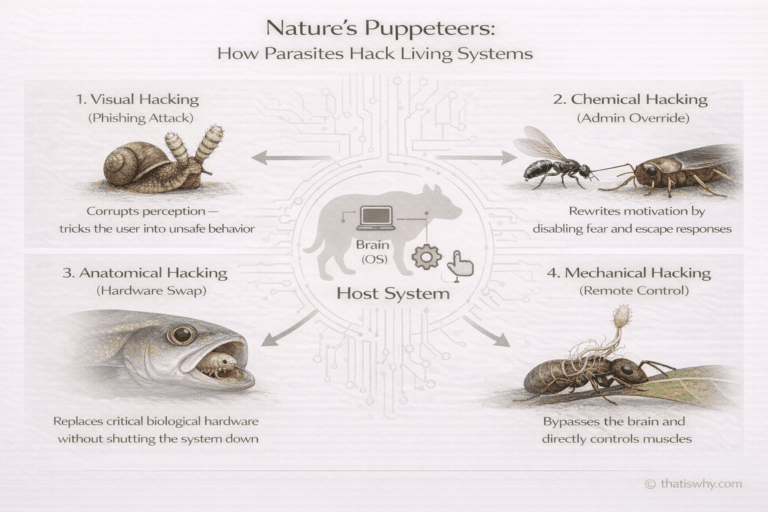
Normally, that system works great. But the fungus pulls a heist. It doesn’t attack the Pilot. It ignores the cockpit entirely. Instead, it invades the hydraulic lines in the legs. It cuts the wires connecting the cockpit to the limbs and hotwires the engine directly.
So, the Pilot is still sitting in the chair. It can see the cliff coming. It can scream. It can smash the “Emergency Stop” button. But the suit doesn’t respond. It just keeps walking. The ant is trapped in a vehicle that is being driven from the backseat.
The Invasion: Bypassing the Pilot
For decades, every scientist on Earth assumed the fungus attacked the brain. It made sense. If you want to hijack a car, you grab the steering wheel, right?
Wrong.
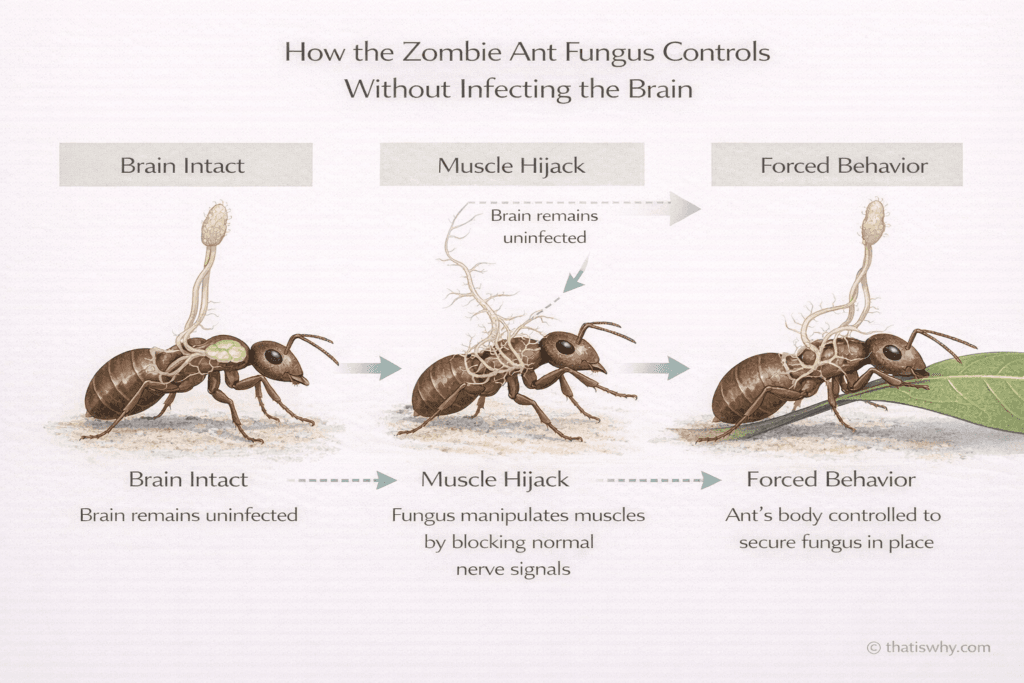
In 2017, a team at Penn State University decided to check. They used 3D electron microscopy to slice an infected ant into thousands of microscopic layers and map the infection cell-by-cell.
What they found blew the lid off the zombie theory. The fungus had invaded the entire body. It had built a massive, interconnected network that wrapped around the ant’s muscle fibers, physically cutting the connection between the nerves and the limbs.
But when they looked at the brain? It was spotless.
The fungus had deliberately created a “Demilitarized Zone” around the brain. And this is the genius part. The fungus doesn’t know how to walk over a twig or navigate a forest floor. It’s a mold. So it keeps the Pilot alive to handle the complex navigation. It lets the ant do the hard work of staying alive, while it quietly steers the body toward its doom.
The Death March
So, if the brain isn’t in charge, who is driving?
The fungus starts dumping a chemical cocktail directly into the muscle tissue. It hotwires the legs, forcing them to contract in a twitchy, unnatural rhythm.
This triggers the infamous “Zombie Walk.” The ant stops working. It drops its food. It turns away from the safety of its colony and walks alone into the jungle. And it isn’t walking randomly; it is hunting for a very specific location.
It climbs to exactly 25cm (10 inches) off the ground. It finds a North-facing leaf (for temperature stability). It seeks a spot with exactly 95% humidity.
This is the “Goldilocks Zone.” If the ant stops too high, the fungus will dry out and die. If it stops too low, it will rot. The fungus uses the ant’s own sensory organs to scan the environment, piloting the hostage body until it finds the perfect micro-climate to set up its grave.
The Death Grip
Once the ant reaches that perfect leaf, the fungus executes its final, irreversible command.
It forces the ant to clamp its mandibles onto the main vein of the leaf. It bites down with a force that would normally break its jaw. And then, the fungus destroys the machinery.
It causes the jaw muscles to atrophy almost instantly, locking them into a state of permanent rigor mortis. The ant isn’t just holding on; it is now physically fused to the plant. Even after death, even after the body rots away, that head will remain clamped to the leaf.
The Mech Suit has been parked. The engine is cut.
Only now, when escape is physically impossible, does the fungus finally show mercy. It consumes the brain, killing the Pilot to fuel the final stage: a giant fungal stalk that bursts through the back of the head to rain spores on the colony below.
It’s Not Just Ants
The idea of your body disobeying your brain sounds like sci-fi, but we see echoes of it in human medicine all the time.
The Human Lockjaw You know the disease Tetanus? We call it “Lockjaw” for a reason. The bacteria releases a toxin that causes your muscles to spasm and lock up, completely ignoring your brain’s commands. It’s the same basic principle: a peripheral override where the Pilot loses control of the Suit.
Botox On a lighter note, we actually pay good money for this. Botox works by severing the chemical signal between your nerves and your muscles. You tell your forehead to frown, but the message never arrives. We are essentially using a mild version of the Cordyceps trick—disconnecting the Pilot from the controls—just to smooth out a few wrinkles.
Fact vs. Fiction
Before you start building a bunker, let’s clear up the biggest myths that The Last of Us popularized.
Myth #1: “The infected are aggressive.” In the game, zombie runners sprint at you and bite.
The Truth: Real zombie ants are incredibly passive. They don’t attack; they stumble. They are solitary, confused, and weak. The fungus doesn’t want to fight a war; it just wants to find a nice leaf. Aggression would be a waste of precious calories.
Myth #2: “It’s coming for us next.” Could this jump to humans?
The Truth: Not unless you get really, really cold. Fungi are notoriously temperature-sensitive. Our bodies run at 98.6°F (37°C), which is a furnace compared to an ant. Ophiocordyceps evolved to thrive in the cool ambient air of the rainforest. It literally cannot survive inside us. We are too hot to handle.
The Silent Passenger
When you see that iconic photo of the dead ant biting the leaf, with a fungal stalk growing out of its head, it looks peaceful. It looks like the circle of life.
But now you know the truth.
That ant wasn’t a willing participant. It wasn’t a mindless drone. For the last few hours of its life, it was a silent passenger in a vehicle it couldn’t control, watching in horror as it was driven to its own grave.
It’s not a zombie story. It’s a kidnapping story. And in the brutal efficiency of the rainforest, nature is the most effective kidnapper of all.
How We Researched This :
To get the real story, we bypassed the video game lore and went straight to the 2017 Penn State study led by Maridel Fredericksen and David Hughes. Their use of 3D electron microscopy provided the “smoking gun” evidence that the fungus surrounds the muscles but spares the brain.
This distinction—Peripheral Control vs. Central Control—is what led us to the “Mech Suit” analogy. It helps visualize exactly how an organism can be controlled without being “mind-controlled.”