The Living Fortress: How Trees Engineer Their Way to Survival
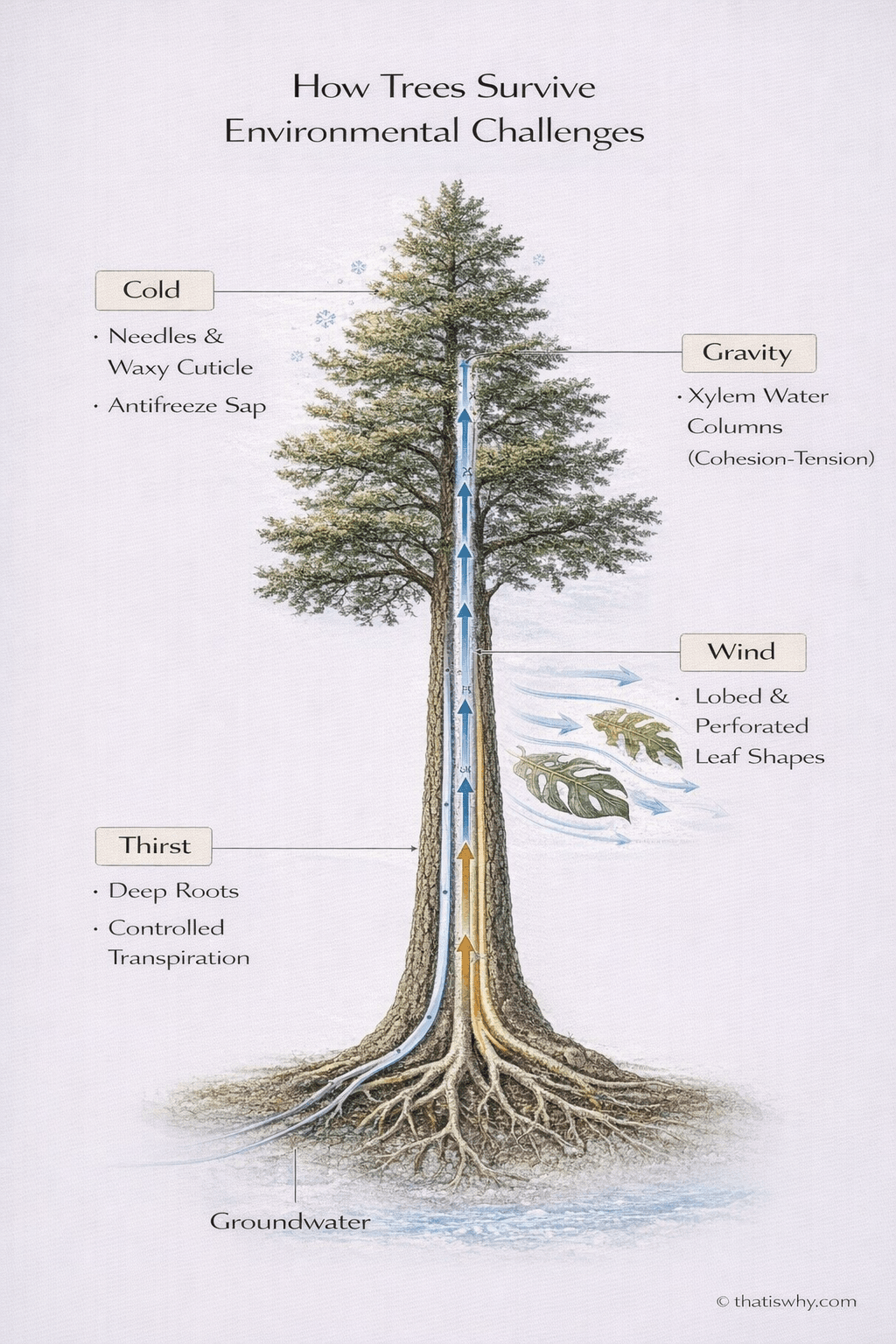
How do trees survive? A tree is not just a plant; it is a biological machine that solves complex engineering problems. It defies gravity with hydraulic suction, regulates temperature with aerodynamic leaf shapes, survives freezing winters with antifreeze sap, and builds its own skeleton out of thin air. Evolution is the architect, and every feature of a tree is a calculated solution to the physical challenges of Gravity, Wind, Cold, and Thirst.
That is the technical definition. But if you really want to understand what is happening in the woods, you need to change how you look at a tree.
Usually, we treat trees like furniture. They are just the green background noise of our hike, static, peaceful, and boring.
But if you strip away the bark and look at a tree through the eyes of an engineer, that “boring” plant is actually a terrifyingly complex machine. You are looking at a skyscraper that builds itself out of thin air. You are looking at a hydraulic pump capable of lifting thousands of gallons of water thirty stories high without a single moving part. You are looking at a chemical factory that brews its own antifreeze to survive the winter.
A tree is not just a plant; it is a Living Fortress.
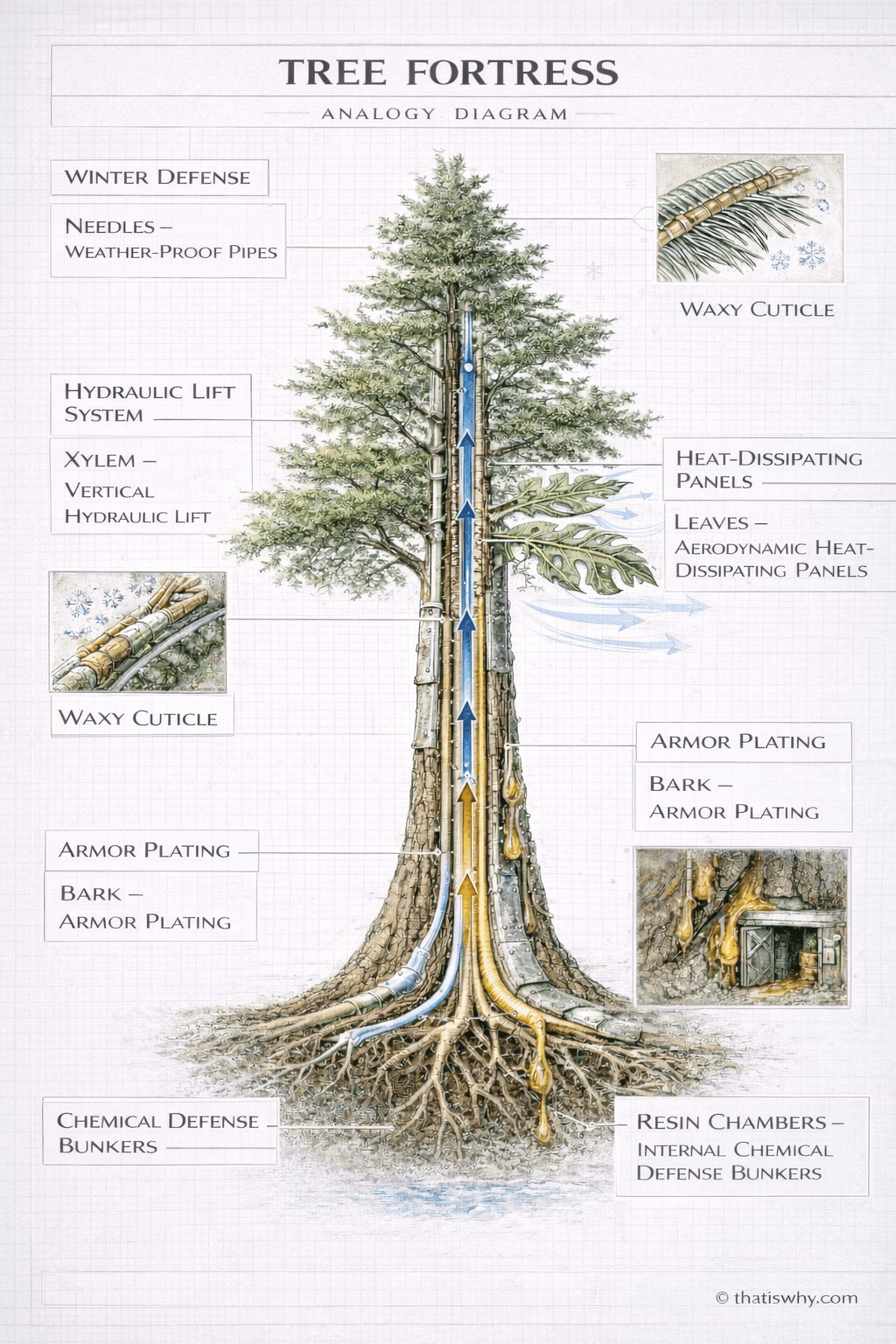
Every bump on the bark, every curve of a leaf, and every drop of sticky goo is a specific solution to a deadly physics problem. For millions of years, trees have been fighting a silent war against four main enemies: Cold, Gravity, Wind, and Thirst.
To survive, they had to become the greatest engineers on Earth. Here is how they did it.
Challenge 1: The Winter Problem (The Pipe Design)
Look at the first problem: Winter.
Winter isn’t just cold; it’s dry. The ground freezes, which means the water is locked up in ice. Essentially, winter is a desert.
Maple tree with big, broad leaves, he is in trouble. Those leaves are giant, wet surfaces. If he leaves them out in the dry January air, they will lose all their water, and he will freeze-dry in about a week.
So, he has no choice : Just quit. Drop the leaves, go dormant, and sleep it off.
And then you have what the Pine tree does: Engineer a solution.
The Pine tree decided it wanted to stay open year-round. So, it reinvented the leaf. It took that big, flat solar panel and rolled it up into a tight, hard cylinder—a Needle. By rolling it up and dipping it in wax, the tree created a “weather-proof pipe.” It’s less efficient at catching sun, sure, but it’s tough enough to survive the freeze.
[Read the Deep Dive: Why Some Trees Have Needles]
Discover the “Wet Towel” physics behind nature’s most durable leaf design.
Challenge 2: The Gravity Problem (The Hydraulic Skyscraper)
Once you solve winter, you have to deal with your neighbors.
The forest is a crowded place. If you want sunlight, you have to get above the guy next to you. This starts an arms race for height. But the taller you get, the harder you have to fight Gravity.
How do you get water from the dirt to a leaf that is 300 feet in the air?
We use massive electric pumps to get water to the top of a skyscraper. Trees don’t have electricity. They don’t even have a heart to pump blood.
Instead, they use The Sun.
It turns out, trees are actually solar-powered vacuum cleaners. The water inside the trunk sticks together like a magnetic chain. When the sun hits a leaf at the top and evaporates a drop of water, it pulls on that chain. That tug travels all the way down to the roots, dragging gallons of water up the trunk against gravity. It’s genius because it’s free energy.
[Read the Deep Dive: Why Do Trees Grow Tall?]
Explore the “Magnetic Chain” analogy and find out why trees can’t grow taller than 400 feet.
Challenge 3: The Wind Problem (Aerodynamics of the Canopy)
So you’ve grown tall. That’s great for getting sun, but now you are totally exposed.
Up at the top of the canopy, the wind is howling and the sun is beating down. If you put a big, flat leaf up there, it acts like a sail. It catches the wind and—snap—there goes your branch. Even if it doesn’t break, that big flat surface traps heat. It basically cooks itself.
So, what do you do? You have to become an aerodynamicist.
You stop making perfect circles and you start getting weird with geometry.
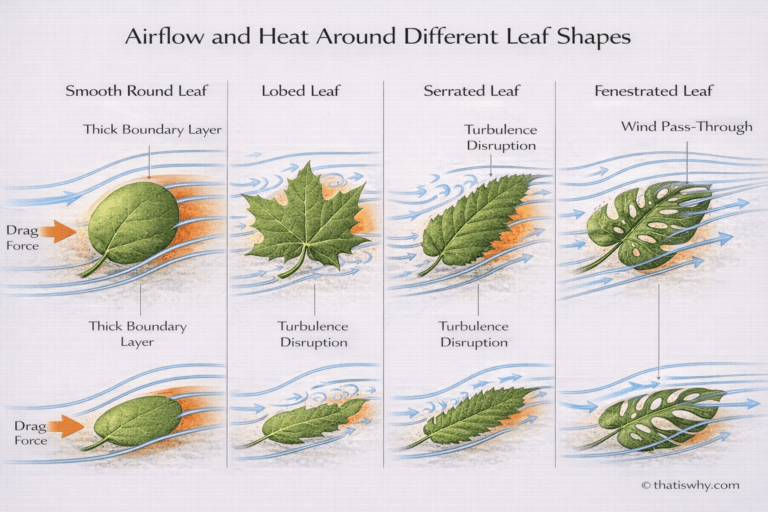
Look at an Oak leaf. It has those deep, finger-like lobes. Those aren’t just for style. They act like radiator fins to create turbulence and whisk away the heat. Or look at the Monstera plant. It literally punched holes in its own leaves to act as vents. It lets the wind pass right through instead of fighting it.
It’s not art; it’s a calculation. Every leaf shape is a specific answer to a specific wind problem.
[Read the Deep Dive: Why Do Leaves Have Different Shapes?]
From “Hot Potatoes” to “Escape Hatches,” see how physics dictates the shape of every leaf.
Challenge 4: The Fuel Problem (The Two-Way Highway)
Finally, you have a logistics problem.
A tree is basically a vertical city. You have water at the bottom (roots) and a factory at the top (leaves). You need to get raw materials UP to the factory, and you need to get the finished product (sugar) DOWN to the rest of the city.
To handle this, the tree engineered a Two-Lane Highway.
Lane One is the Xylem. That’s your “Water Main” shooting water up. Lane Two is the Phloem. That’s your “Food Truck” bringing the sugar down.
But here is the catch: That sugar is delicious. Bugs want to steal it. So, the tree also had to build a weapon system. It produces Resin—that sticky goo that ruins your car. It stores this stuff in defensive bunkers. If a beetle tries to drill into the highway to steal the sugar, the tree blasts it with resin, drowning the pirate and sealing the hole.
[Read the Deep Dive: Why trees produce sap ?]
Learn the difference between the tree’s blood (Sap) and its weapon (Resin)—and why one goes on pancakes and the other destroys windshields.
The Silent Architect
The next time you walk past a tree, don’t just see a plant.
See the machinery.
See the hydraulic pumps silently lifting tons of water against gravity. See the aerodynamic leaves slicing through the wind. See the chemical bunkers waiting to defend the fortress.
You are looking at a structure that has solved engineering problems we humans are still scratching our heads over. It filters its own fuel, builds its own solar panels, and fights its own wars. It is the ultimate survival machine, hiding in plain sight.
How We Researched This :
This pillar page serves as the synthesis of our deep dives into structural botany. We aggregated the core principles from our research on xerophytic adaptations (Needles), plant hydraulics (Cohesion-Tension), biophysics of leaf shape (Boundary Layers), and plant defense chemistry (Resins). Our goal was to unify these disparate biological fields under a single, cohesive narrative.
But simply listing biological functions—stomata, xylem, terpenes—we knew that just isn’t helpful. Our real job began when we asked, “What does this feel like?” That question led us to the “Living Fortress” analogy—a simple story to make the complex evolutionary engineering of trees feel intuitive.