Why Do Trees Grow Tall
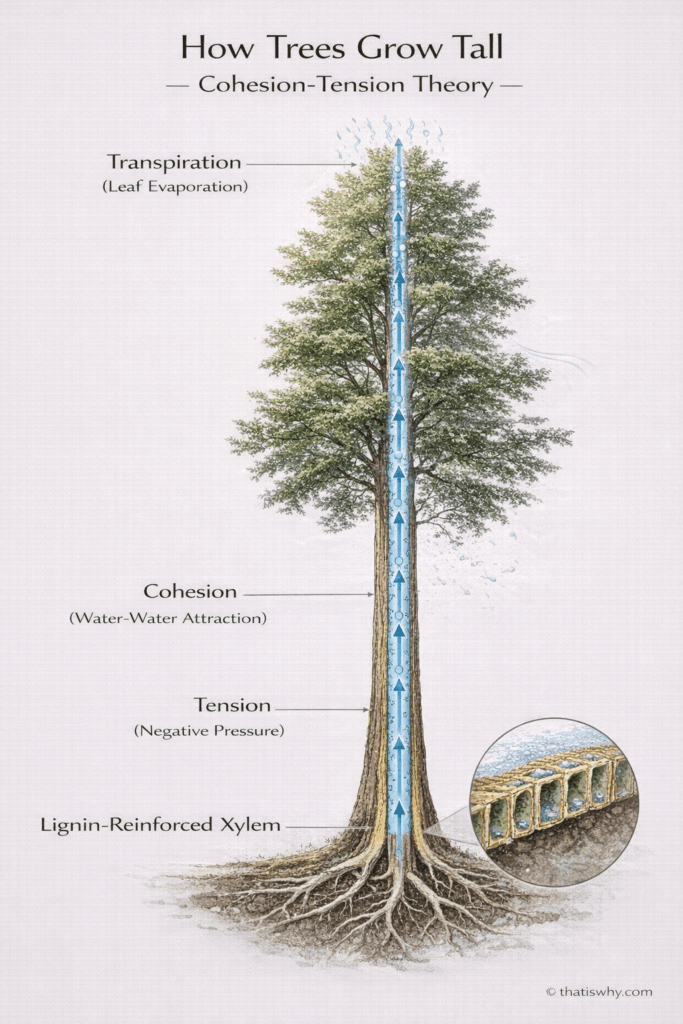
The primary driver is competition for sunlight. In a dense forest, height is an evolutionary “arms race”, if a tree is shaded by its neighbors, it loses energy and dies. To win this race, trees evolved lignin to build rigid woody skeletons and a hydraulic system based on Cohesion-Tension Theory, allowing them to pump water hundreds of feet against gravity without using a mechanical pump.
That is the textbook answer. It’s a precise and scientifically accurate. But frankly, it doesn’t capture what is actually happening out there in the woods.
To see what I mean, I want you to picture a skyscraper.
Now, imagine trying to build that skyscraper out of nothing but sugar and water. No cranes. No steel beams. No electricity. And you have to build it while it’s being buffered by gale-force winds.
That is exactly what a Giant Sequoia or a Coastal Redwood does every single day.
When you stand at the base of a 300-foot tree, it’s easy to feel small. And when you look up, it doesn’t just feel small; it’s confusing. Because from an engineering standpoint, growing tall is a terrible idea.
Think about the cost. You have to burn massive amounts of energy to build a wooden skeleton just to stand up. You turn yourself into a lightning rod. You risk getting blown over in every storm.
So, why do it? Whatever the reward is at the top, it must be incredible to justify that kind of risk.
How on earth do they lift thousands of gallons of water thirty stories into the air?
To understand the “how,” we first have to understand the “why.” And that requires us to look at the forest not as a peaceful garden, but as a battlefield.
The Shadow War: Why Bother?
Why not just stay low? Why not be a moss or a nice, safe shrub and save all that energy?
The answer is what we will call the Shadow War.
We like to imagine forests as these peaceful, harmonious communes, but they are actually slow-motion war zones. In a dense forest, sunlight is the only currency that matters. It’s food. It’s life. And there is a finite amount of it.
Imagine you are a young sapling. If your neighbor grows one inch taller than you, they cast a shadow on your leaves. They are literally stealing your solar power. If you don’t catch up, you starve.
It’s a classic “Prisoner’s Dilemma.” If all the trees just agreed to stay ten feet tall, everyone would get plenty of sun, and nobody would have to waste energy building massive trunks. But if just one tree decides to cheat and grow to eleven feet, it wins everything. So, everyone else has to panic and grow to twelve feet.
The result is an evolutionary arms race to the canopy. To survive this war, trees evolved Lignin. This is the hard stuff that turns soft plant tissue into “wood.” It’s the concrete and rebar of the plant world.
But winning the war creates a new problem. Once you build a 300-foot skeleton, you have a massive plumbing issue. How do you get a drink of water when your mouth is in the dirt and your leaves are in the clouds?
Why “Capillary Action” Doesn’t Work
If you remember your 8th-grade science class, you probably learned that trees move water using something called Capillary Action.
This is the phenomenon where water naturally “climbs” up a narrow tube or soaks into a paper towel because water likes to stick to surfaces. It’s a nice, simple explanation.
Here is the problem: It is also dead wrong.
At least, it’s wrong for anything taller than a bush. Capillary action is incredibly weak. In a tube the size of a tree’s plumbing, the physics simply doesn’t hold up. That’s fine if you are a geranium or a blade of grass. But if you are an Oak, let alone a 300-foot Redwood, that force is useless.
If trees actually relied on capillary action, our forests would be ankle-high. We need a force that is exponentially stronger.
The Magnetic Chain
We have to change how we visualize water to understand the real engine. We usually think of water as a loose, like a ball pit where everything tumbles around freely.
But at the molecular level, water is sticky.
I want you to imagine a long chain of those strong, silver magnetic balls that you might have on your desk. They snap together tightly.
Now, picture a clear plastic tube running from the ground all the way up to the roof of a skyscraper. Inside that tube is a single, continuous chain of these magnetic balls, all clicked together in a line. The bottom of the chain is sitting in a bucket of loose magnets, the chain runs vertically up the tube held together by its own magnetism, and the top magnet is sitting right at the opening of the tube on the roof.
Now, imagine the Sun is a giant hand that reaches down, grabs the top magnet, and plucks it out of the tube.
Because the magnets are stuck together, what happens? The whole chain moves up.
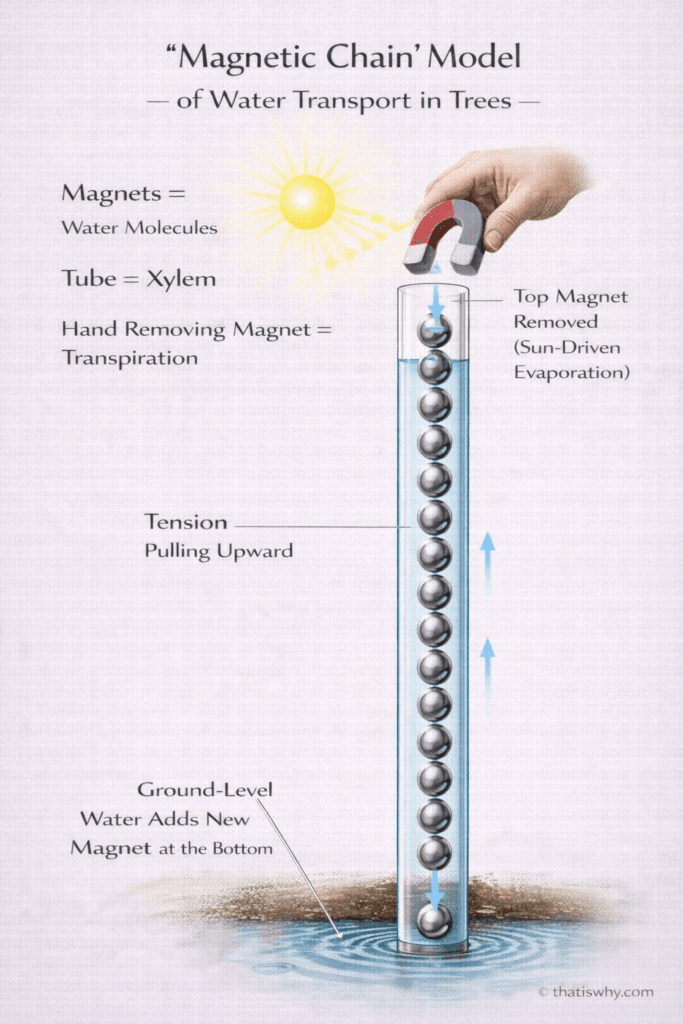
When the top magnet is removed, it magnetically pulls the one beneath it, which pulls the one beneath it, all the way down to the bottom bucket, where a new magnet clicks onto the end of the chain.
This is the Cohesion-Tension Theory.
Inside the tree, water molecules act like these magnets. They are attracted to each other by a force called Cohesion. When the sun evaporates a molecule from the leaf—a process called Transpiration—it creates a “vacancy” at the top. The outgoing molecule tugs on the chain to fill the spot, pulling the entire column of water up the trunk.
This changes everything about how we see the tree. It means there is no pump at the bottom pushing water up. Instead, the tree relies on the “magnetic” strength of the water to hold itself together while being sucked from the top.
Solar-Powered Suction
This system is brilliant because it is entirely free. The tree doesn’t spend a single calorie of its own energy to move water.
Think about that for a second. We spend billions of dollars on electricity to pump water around our cities. The tree outsources the entire job to the sun.
The sun provides the heat to evaporate the water. The cohesion of the water provides the “rope.” The tree just has to provide the pipes.
These pipes are called Xylem, and they are essentially microscopic straws made of dead cells stacked end-to-end. Because they are dead, they are rigid and reinforced with lignin. This stiffness is crucial because it prevents them from collapsing under the intense suction—exactly like how a plastic straw collapses if you try to suck a super-thick milkshake too hard.
The suction is actually so powerful that on a hot, sunny day, a tree physically shrinks. Measurements show that tree trunks are actually thinner in the afternoon, when the suction is at its peak, than they are at night, when the tree relaxes. The tree is literally squeezing itself just to get a drink.
The Limit: When Physics Breaks
If this system is so perfect, why aren’t trees a mile high? Why don’t we have a Jack and the Beanstalk situation where trees grow right into the stratosphere?
The answer is Gravity.
Even our “magnetic chain” has a breaking point. As the tree gets taller, the weight of that water column gets heavier, and the tension required to pull it up gets more extreme.
Eventually, the tension becomes too great for the water molecules to hold onto each other. The magnets pull apart.
This is a failure called Cavitation. A bubble of vacuum or air forms in the tube, instantly snapping the chain. Once the chain is broken, the flow stops dead. That specific pipe is now useless, and the part of the tree it was feeding dehydrates and dies.
Physicists and biologists have actually crunched the numbers on this. They calculated that the theoretical limit for this “water rope” mechanism on Earth—fighting our specific gravity and air pressure—is somewhere around 120 to 130 meters (about 400 to 425 feet).
Seeing the Invisible Limit
Once you understand “Water Ropes” and the limits of suction, you start seeing this invisible barrier in your daily life.
For example, think about drinking straws. Have you ever tried to use a really long novelty straw? It gets hard, right? Physics actually dictates that you cannot suck water up a straw longer than about 10 meters (33 feet). After that point, the vacuum isn’t strong enough to fight gravity, and the water boils into vapor. Trees only beat this limit because the water is pulling itself via cohesion rather than just being pushed by atmospheric pressure.
You can also see this principle in action at the florist. Why do they always tell you to cut flower stems underwater? It’s not just to keep them wet. It’s because if you cut the stem in the air, the “water rope” inside the stem snaps. Air rushes into the tube, creating an embolism that blocks the flow. By cutting them underwater, you keep the magnetic chain continuous so the flower can keep drinking.
The Vertical Battlefield
The next time you look at a tall tree, don’t just see a wooden statue. See a dynamic, high-stakes battle against gravity.
See the Shadow War driving it upward. See the Molecular Rope silently sliding up the trunk, powered by the sun.
The tree is a masterpiece of hydraulic engineering, surviving on the razor’s edge of physics. It pumps tons of water skyward without a single moving part, all to capture the light that keeps the forest alive.
But water isn’t the only thing moving in that trunk. While the Xylem pulls water up, the tree has a completely different system to push the sugar it makes down to the roots. But that is a sticky story for another time.
How We Researched This :
To ensure we weren’t just repeating common myths, we looked at the specific hydraulic constraints of vascular plants. We referenced the pioneering work on the Cohesion-Tension Theory and modern studies on xylem embolism limits published in journals like Nature and Tree Physiology. We also looked at the physics calculations regarding the maximum height of trees based on gravitational potential and water potential.
But equations about “MegaPascals of negative pressure” can be dry. We knew that just isn’t helpful. Our real job began when we asked, “What does this feel like?” That question led us to the “Magnetic Chain” analogy—a simple story to make the complex physics of molecular bonding feel intuitive.