Why The “Femme Fatale” Firefly Is a Nature’s Spy
The Date from Hell
Imagine you are a male firefly. You are cruising through the summer night, flashing your heart out, looking for love. You signal your specific code: “Short-flash, Short-flash, Pause.”
Suddenly, you see it. Down in the tall grass, a female flashes back. And she doesn’t just flash randomly; she responds with the exact sequence that means “I’m interested.” It’s the biological equivalent of a perfect Tinder match.
Your heart pounds. You dive down. You land next to her. She is beautiful. She is huge.
And then she bites your head off.
Welcome to the world of the Femme Fatale Firefly (Photuris). She wasn’t looking for a boyfriend; she was looking for a meal. And to get it, she just hacked your entire communication network.
The Wiretap
To understand how this murder happens, you have to realize that a summer meadow isn’t just a pretty light show. It’s a battlefield of encrypted radio signals.
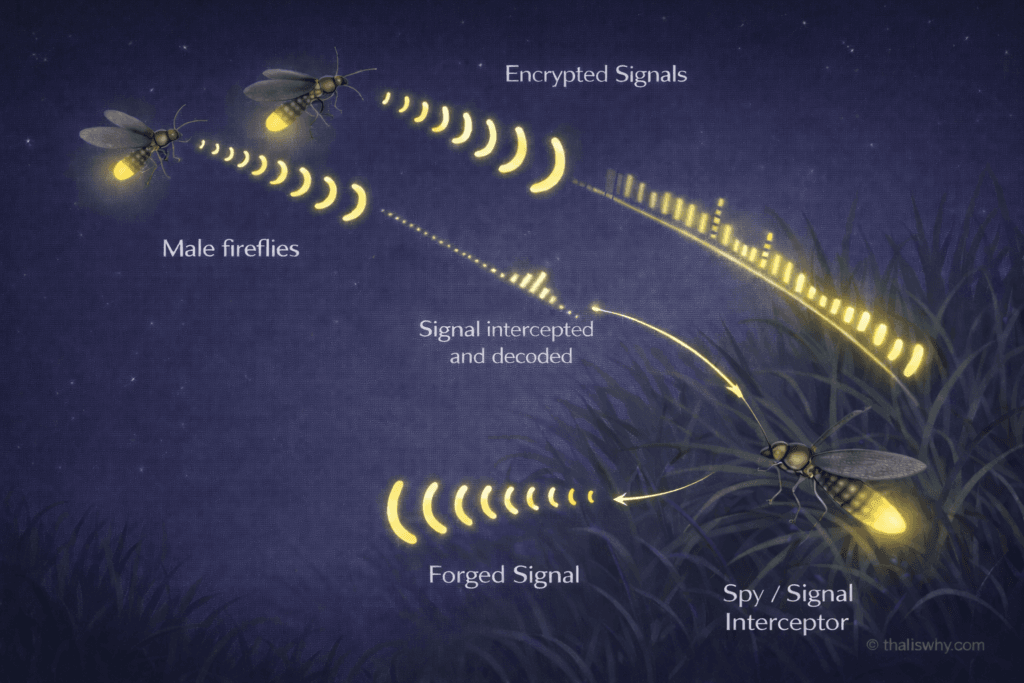
Every species of firefly has its own secret language. Some flash a fancy “J-shaped” swoop, while others do a frantic double-blink or a long, steady glow. These codes are passwords, designed to keep the species separate and ensure a male only finds a female of his own kind. It’s supposed to be a secure channel.
But the Photuris female is a biological hacker. She sits in the grass, scanning the airwaves, wiretapping the whole conversation.
She watches the males flying above. When she sees a pattern she recognizes—like that specific “J-swoop”—she doesn’t just watch. She accesses a library of codes stored in her brain, finds the correct “password” for that specific male, and flashes it back to him.
She is a spy operating behind enemy lines, broadcasting fake signals to lure the pilots into a fatal landing.
The Code Breaker
The scary part isn’t that she lies. It’s how many lies she can tell.
Most mimics in nature are stuck with one disguise. A stick bug looks like a stick. It can’t wake up one morning and decide to look like a leaf.
But the Photuris female is a linguistic genius. She is a polyglot. Researchers have watched a single female mimic the flash patterns of five different species in a single night.
If a pyralis male flies by, she flashes the pyralis code. If a macdermotti male flies by ten minutes later, she switches languages instantly and flashes the macdermotti code. She has a library of passwords stored in her tiny brain, and she knows exactly which one to use to unlock each victim.
She is adapting in real-time. She analyzes the input, decrypts the signal, and outputs the perfect forgery. This isn’t just instinct; it is a level of cognitive flexibility that we rarely see in insects. She isn’t just hungry; she is scary smart.
Stealing the Armor
So why does she do it? Why go to all the trouble of learning five different languages just for a meal?
The answer is simple: She isn’t hunting for calories. She is hunting for Chemical Weapons.
The males she eats (the Photinus species) are loaded with a powerful defensive toxin called Lucibufagins. It’s basically high-grade insect poison. It tastes so bitter that if a spider catches one, it will cut the firefly out of its web just to get the taste out of its mouth.
The Photuris female is born without this superpower. She is defenseless. So, she steals it.
By eating the male, she absorbs his toxins into her own blood. She becomes poisonous. And here is the kicker: She passes this stolen armor directly into her eggs. She ensures her babies are protected from predators before they even hatch.
She is a spy, an assassin, and a thief. But ultimately, she is a mother doing whatever it takes to protect her kids.
Counter-Intelligence
Of course, the males aren’t just letting their signals get hacked. This is an evolutionary war zone, and they are developing counter-intelligence.
They are getting paranoid. Some males have switched to “Radio Silence.” They fly low and dark, sneaking up on a potential female without broadcasting their code, trying to verify her identity visually before they commit.
Others have developed a Two-Factor Authentication protocol. Instead of landing right next to the female (the kill zone), they land a few inches away. They approach on foot, inspecting her size. If she looks too big—the spy is a giant compared to them—they abort the mission.
It’s a high-stakes game of hide-and-seek, where a single unencrypted signal means death.
Myth-Busting the Meadow
Before you start looking at every firefly as a monster, let’s clear up the facts.
Myth #1: “It’s a cannibal bloodbath out there.” People assume all fireflies are eating each other.
The Truth: Not even close. Most adult fireflies are pacifists—they don’t eat at all. They just want to mate and die. Only the Photuris females have turned to a life of crime. Even the males of her own species are innocent (and probably terrified of her).
Myth #2: “It’s just an accident.” Maybe the male just crashed into the wrong girl?
The Truth: It is highly calculated. Studies show the female will ignore males if she doesn’t know their code. She targets specific victims, adjusts her timing to the millisecond, and aims her lantern to mimic the posture of the prey. It is premeditated murder.
The Secret War
Next time you see a field of fireflies blinking in the summer, look closer.
To us, it looks like a fairy tale. It looks peaceful. But if you know the code, you realize you are looking at an active war zone.
The air is filled with desperate pilots broadcasting their coordinates into the dark, hoping for a friendly response. And down in the grass, the enemy spies are listening, decoding the signals, and waiting for the right moment to launch their ambush.
It’s a beautiful light show, sure. But it’s also the highest-stakes espionage thriller on Earth, happening right in your backyard. And the scariest part? The better the code-breaker gets, the more beautiful the show becomes.
How We Researched This :
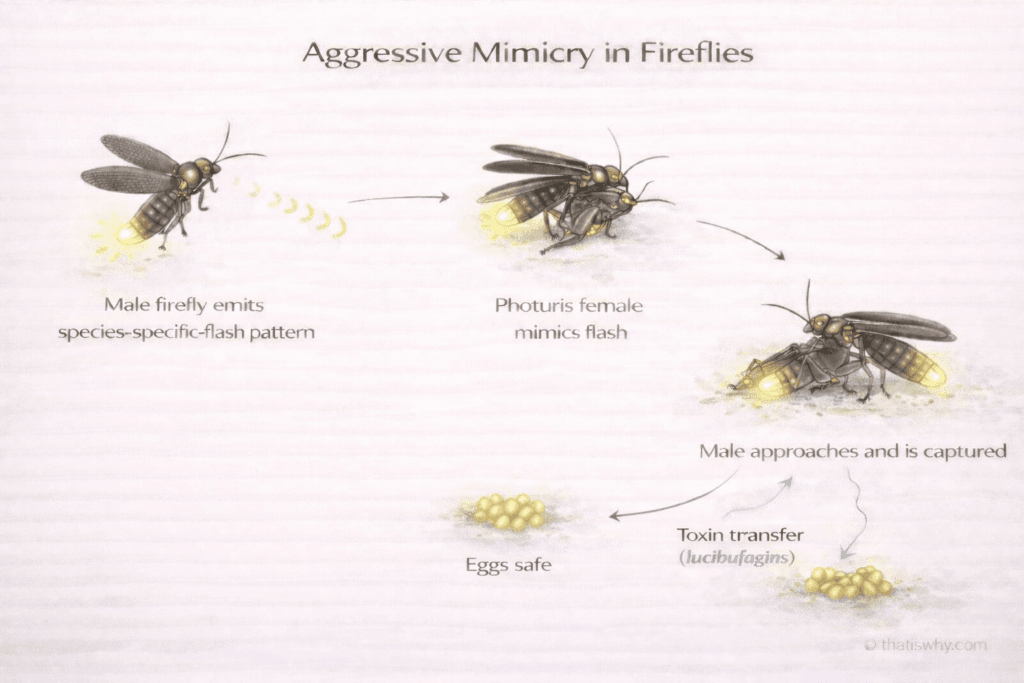
To get the details right, we relied on the extensive behavioral studies of Sara Lewis at Tufts University, the world’s leading expert on firefly behavior. Her work on “Aggressive Mimicry” revealed the chemical motive (Lucibufagins) behind the attacks.
But we knew that just citing behavioral studies isn’t helpful. Our real job began when we asked, “What does this feel like?” That question led us to the “Wiretap” analogy—a simple story to make the complex world of encrypted bioluminescent signals feel intuitive.