Why Nature Is The Ultimate Hacker (The Science of Zombie Animals)
The Original Hacker
We are obsessed with cybersecurity. We spend billions on firewalls, passwords, and encryption because we are terrified of someone hacking our systems.
But here is the scary truth: Nature invented hacking millions of years before we invented the computer.
If you strip away the fur and scales, every animal is basically a biological machine. It has hardware (muscles), software (DNA), and an operating system (the brain). And just like any computer, if you know the code, you can break in.
We call them “Zombie Animals,” but that sounds like a movie monster. The reality is much smarter. The creatures that do this are Nature’s Puppeteers.
They are biological engineers that have figured out how to bypass the firewall (the immune system), rewrite the admin privileges (neurochemistry), and even swap out the hardware (anatomy). They don’t just kill their hosts; they drive them.
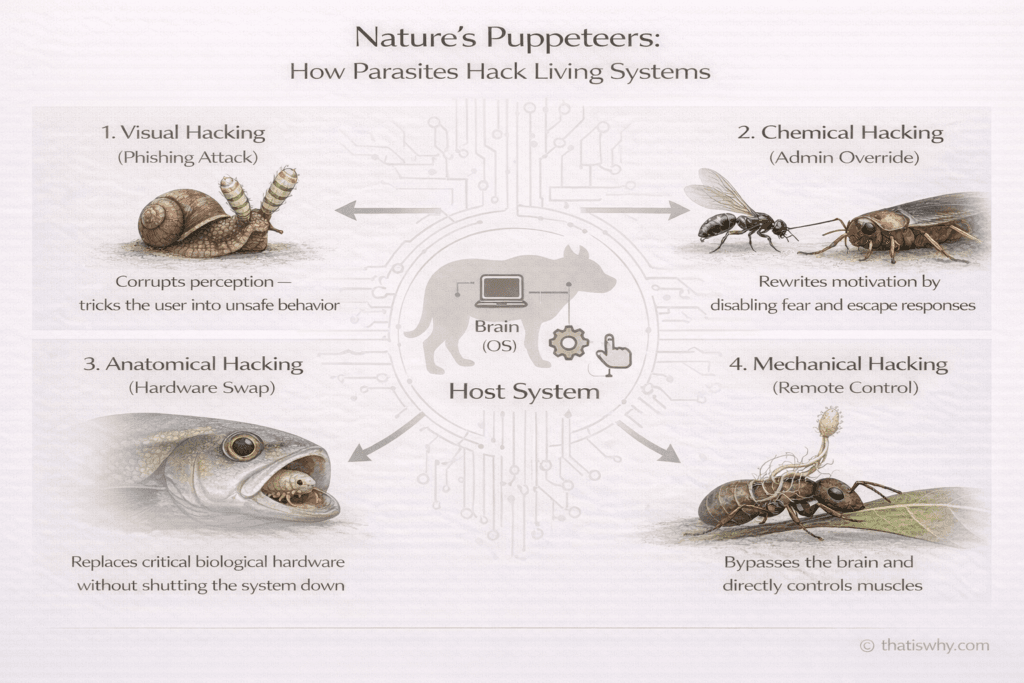
How do they do it? It basically comes down to four specific hacking techniques.
You have the Visual Hackers, who corrupt the host’s perception of reality, the Chemical Hackers, who rewrite motivation at the molecular level, the Anatomical Hackers, who physically replace broken hardware. And finally, the Mechanical Hackers, who bypass the brain entirely to drive the muscles directly.
Visual Hacking: The Phishing Scam
The easiest way to hack a secure system isn’t to brute-force the password. It’s to trick the user into clicking a bad link. In cybersecurity, we call this “Phishing.” In nature, we call it Aggressive Mimicry.
And nobody does it better than the parasitic flatworm Leucochloridium paradoxum.
Its target is a snail. Now, snails run a very simple operating system. Rule #1 is: Avoid Light. It’s their firewall against predators. As long as that rule holds, the snail is safe.
So the worm doesn’t fight the snail physically; it corrupts the input data. It invades the snail’s eye stalks and starts pulsing with hypnotic colors. But crucially, it chemically flips the snail’s behavior from fearing light to loving it.
The snail isn’t “broken” in the traditional sense. Its legs work. Its appetite works. But it has clicked the wrong link. It happily marches into the blazing sun—and into the beak of a bird—believing it is doing the right thing. It is the ultimate user error, engineered by a worm that knows the code better than the host does.
Read the Deep Dive: Discover how a flatworm turns a shy snail into a suicidal disco ball. That Is Why Zombie Snails Have Pulsing Disco Eyes
Chemical Hacking: The Admin Override
Sometimes, you can’t just trick the user. You have to break into the admin account and rewrite the permissions.
This is the terrifying genius of the Emerald Jewel Wasp. Its target is the American Cockroach—a tank of an insect that is six times its size.
In a brawl, the roach crushes the wasp. So the wasp doesn’t brawl; it performs neurosurgery. It stings the roach directly in the brain, but it doesn’t inject a poison to kill it. It injects a blocker that targets a single neurotransmitter: Octopamine.
Think of Octopamine as the “Run.exe” file in the roach’s operating system. It’s the chemical that says, “Danger! Run!” The venom effectively deletes that file. The roach is left physically perfect—its legs work, its radar works, it isn’t paralyzed. But it has lost the permission to move. It stands there, fully awake but totally indifferent, waiting for the wasp to lead it to its grave like a dog on a leash.
Read the Deep Dive: See how a tiny wasp performs brain surgery to create a compliant slave. That Is Why The Jewel Wasp Is Nature’s Neurosurgeon
Anatomical Hacking: The Hardware Swap
In the tech world, a “Hot Swap” is when you replace a critical component without shutting the machine down. It requires insane precision. Nature figured it out millions of years ago.
Enter the Tongue-Eating Louse.
This parasite crawls into a fish’s mouth and destroys the tongue. Normally, this is a fatal system error—Target Not Found. The fish starves. But the louse doesn’t let the system crash. It latches onto the muscle stub and physically replaces the missing organ. It becomes a living prosthetic.
This is the part that freaks me out: The host accepts the upgrade. The fish actually uses the parasite to grind food. It integrates the bug into its daily life. The hacker hasn’t just broken into the machine; it has become a load-bearing wall. The fish is now physically dependent on the thing that mutilated it. It’s a perfect, horrifying partnership where the victim keeps the villain alive just to eat dinner.
Read the Deep Dive: Meet the parasite that cuts off a tongue and takes its place. That Is Why The Tongue-Eating Louse Is Nature’s Living Prosthetic
Mechanical Hacking: The Remote Control
Finally, we have the most brutal hack of all. If you can’t crack the password to the brain, you just cut the wires and hotwire the hardware directly.
This is the terrifying genius of the Zombie Ant Fungus (Ophiocordyceps).
We used to assume this fungus attacked the brain. But a recent study showed us the truth is way worse. The fungus actually builds a “Demilitarized Zone” around the brain, leaving it completely intact. Why? Because it needs the pilot alive to process visual data.
Instead, the fungus invades the muscles. It wraps around the fibers and physically severs the connection between the brain and the legs. Then, it dumps contraction chemicals directly into the limbs.
The result is a living puppet. The ant is fully conscious. It is likely screaming “Stop!” inside its own head. But the legs are marching on their own. The fungus drives the ant like a remote-control car to a precise spot in the jungle, locks the jaw, and then—only when the job is done—does it finally kill the prisoner.
Read the Deep Dive: Learn why The Last of Us got the science wrong (and why the truth is scarier). That Is Why The “Zombie Ant” Is A Prisoner In Its Own Body
The Extended Phenotype
Why does nature do this? Why go to all the trouble of hacking another animal?
Biologist Richard Dawkins calls this the “Extended Phenotype.” It’s a fancy term for a simple, terrifying idea: Your genes don’t just stop at your skin.
Usually, we think of genes as blueprints for our bodies. My genes build my eyes; your genes build your hands. But these parasites have evolved genes that reach outside their own bodies to build things in the world. A beaver’s genes build a dam. A spider’s genes build a web.
And in the case of the zombie makers, their genes build behavior in other animals. The wasp’s genes are effectively driving the roach. The worm’s genes are painting the snail. The host stops being an individual animal and becomes a tool—an extension of the parasite’s own body.
It is the ultimate efficiency. Why spend energy building your own legs when you can just hijack someone else’s?
The Human Connection
We like to think we are immune to this. We have big brains and free will. We aren’t snails. But we are biological machines just like everything else, and we can be hacked.
The Anger Virus Rabies is the classic example. The virus needs to spread, so it hacks the brain to make the host aggressive and terrified of water. It turns a person into a weaponized delivery system.
The Cat Lady Parasite Then there is Toxoplasma. It infects mice to make them love cats, but it also lives in billions of humans. Studies suggest it might subtly alter our personalities, making us reckless. We might be driving the car, but something else is nudging the steering wheel.
The Puppet Master in Your Gut But the biggest hack might be happening right now in your stomach. Your gut bacteria produce 90% of your body’s serotonin. They can influence your mood and cravings. When you “decide” to eat sugar, is that your free will? Or is it a bacterial colony hacking your brain because they are hungry?
The Ultimate Hacker
We treat “Mind Control” like science fiction. We treat zombies like movie monsters. But if you look at the natural world, the concept of “free will” starts to look terrifyingly fragile.
Right now, all over the planet, there are armies of creatures walking around that are not in control. Crabs, ants, fish, and snails—driven by pilots that shouldn’t be there.
Nature is the original hacker. It has spent millions of years finding the exploits in the code of life. And it teaches us a lesson we probably don’t want to hear: No system is perfectly secure.
If it has a brain, it can be tricked. If it has muscles, it can be driven. If it has a tongue, it can be replaced. These parasites aren’t just gross biological oddities; they are master engineers who have cracked the ultimate code: How to steal a life.
How We Researched This
This guide synthesizes the field of Neuroparasitology, drawing on the concept of the “Extended Phenotype” to explain how biological entities can hijack foreign nervous systems. We categorized these parasites by their “Attack Vector”—Visual, Chemical, Anatomical, and Mechanical—to provide a structured framework for understanding the complex biology of host manipulation.
But we knew that just listing scientific classifications isn’t helpful. Our real job began when we asked, “What does this feel like?” That question led us to the “Hacker” analogy—a simple story to make the complex evolutionary engineering feel intuitive.