Why Nature Is The Ultimate Engineer – The Hive Mind Architects
What is the best animal architect? Nature’s best architects are the “Hive Minds”—termites, bees, and ants. These social insects use Swarm Intelligence to build complex structures like air-conditioned mounds, geometric honeycombs, and living bridges without any central leadership or blueprints. They achieve this through Stigmergy, a mechanism of indirect coordination where individual actions stimulate the next action in the group.
That is the definition, but reality is baffling.
If we want to build a skyscraper, we need architects, blueprints, foremen, and project managers. We need a hierarchy.
Nature builds cities that are, relative to size, taller than the Burj Khalifa. And it does it with a workforce that is often blind, deaf, and has a brain the size of a grain of sand. There are no blueprints. There are no foremen yelling orders. There is no plan.
But somehow millions of individual insects work together to perform miracles. They aren’t just building homes; they are solving complex physics problems, thermodynamics, geometry, and materials science, using an operating system we are just starting to understand.
Let’s look at the four engineering disciplines of the wild.
The City That Builds Itself
How do millions of blind workers cooperate without a meeting? The secret is a concept called Stigmergy.
In a daily construction site, information flows from the top down. The Architect draws the plan, the Foreman yells the orders, and the Worker lays the brick. In a hive, information flows from the bottom up. The structure is the blueprint.
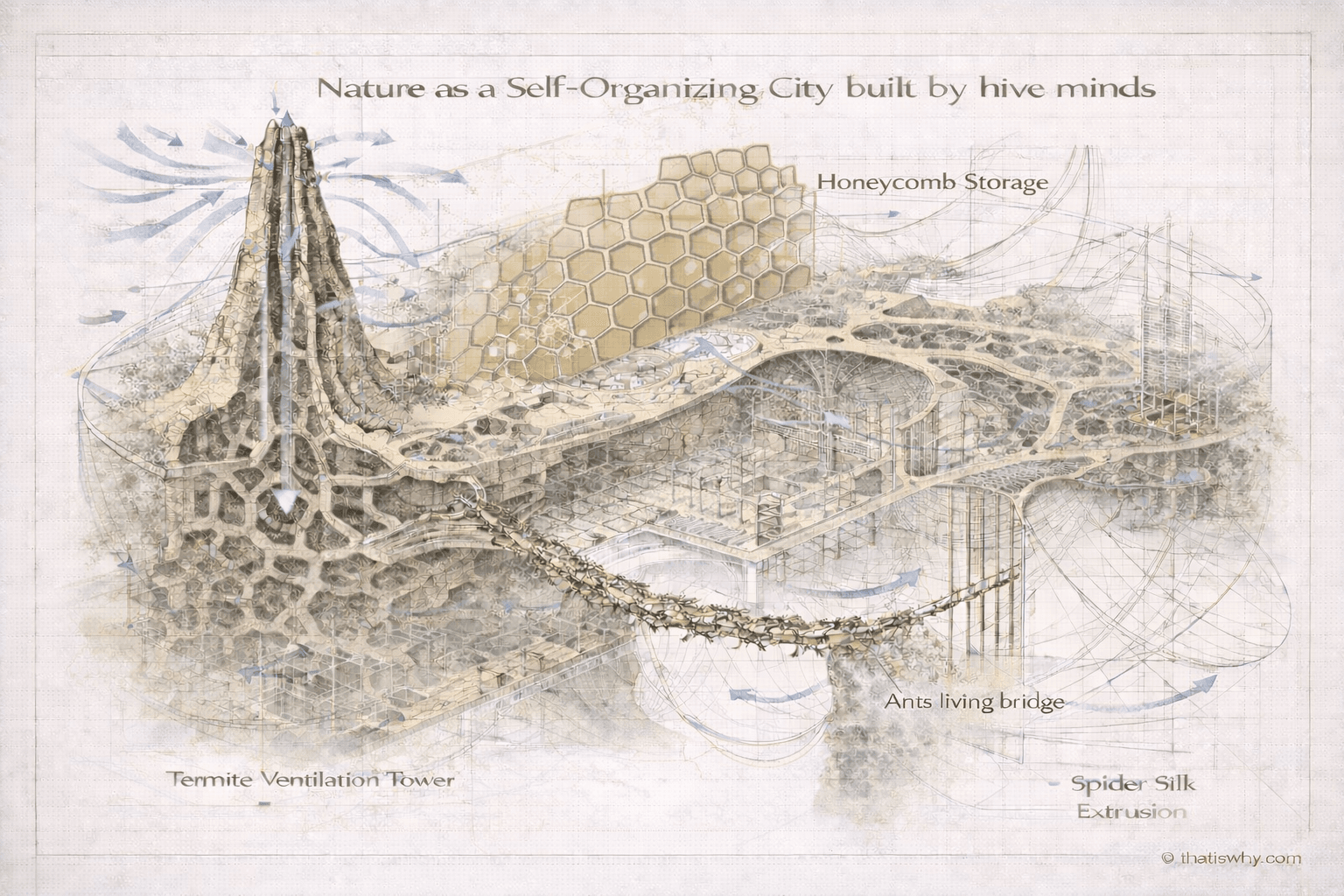
Imagine a city where there is no mayor and no zoning laws. But every time someone drops a brick, that brick leaves a chemical signal that says, “Put another brick here.” As the wall grows, the signal changes. If the wall gets too high, the wind hits it differently, changing the signal to: “Start curving the wall inward.”
The workers aren’t talking to each other; they are talking to the work. The environment itself tells them what to do next. It is a self-organizing city where the building process creates the instructions for the next step.
HVAC Engineering: The Climate Control
The first challenge of any architect is the environment. How do you keep a building cool in the middle of a desert without burning fossil fuels?
The Termite is the master of HVAC (Heating, Ventilation, and Air Conditioning). Termites farm a delicate fungus that dies if the temperature shifts by even a few degrees. To protect it, they build mounds that act as giant, external lungs.
These aren’t just piles of dirt. They are sophisticated machines that harness the wind. The shape of the mound creates pressure differences that suck stale air out and push fresh air in. They achieve perfect climate control, maintaining a steady 86°F (30°C), without a single fan or wire. It is passive cooling at its absolute peak.
Read the Deep Dive: Explore the air-conditioned cities of the savanna. That Is Why Termite Mounds Are Air-Conditioned Cities
Structural Geometry: The Storage Problem
The second challenge is budget. How do you store the maximum amount of inventory using the absolute minimum amount of building material?
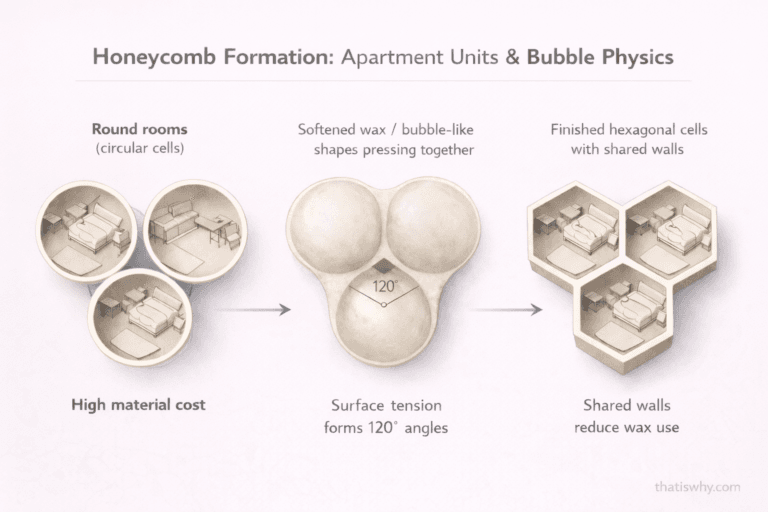
The Honeybee is the master of frugal engineering. Bees build with wax, which is incredibly expensive to produce (energy-wise). They can’t afford to waste a single ounce. If they built circular cells, there would be gaps (wasted space). If they built squares, they would use too much wax for the storage space gained.
So, they build Hexagons. It is the mathematically perfect shape. It holds the most volume with the least amount of wall. The bees didn’t just guess; they solved a geometry problem that mathematicians couldn’t prove until 1999. They are the ultimate minimalists.
Read the Deep Dive: See why bees chose the perfect shape. That Is Why Bees Build Hexagons (The Geometry of Survival)
Civil Engineering: The Logistics of Flow
The third challenge is logistics. How do you move an army across a jungle floor without building roads?
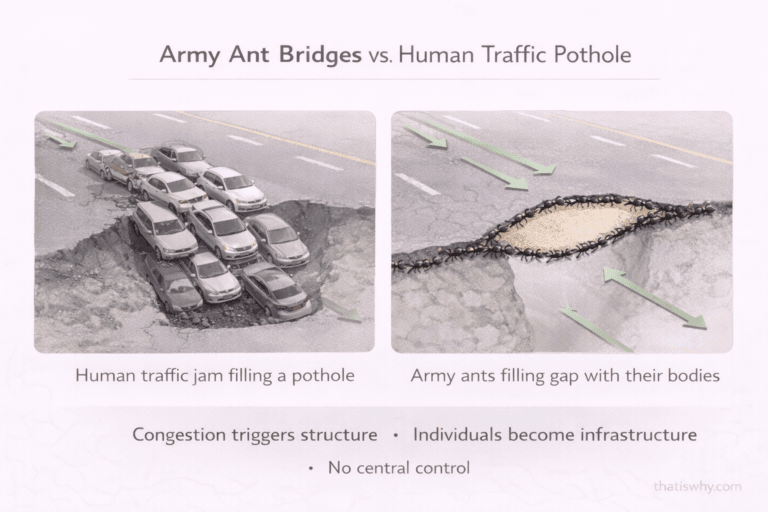
The Army Ant puts our civil engineers to shame. Civilisation build concrete bridges that sit there for 100 years, whether anyone uses them or not. It’s wasteful. Army Ants build Living Bridges. When the colony hits a gap, workers link their bodies together to form a structure instantly.
But the genius part is the math. They run a real-time cost-benefit analysis. If a bridge ties up too many workers, they realize it’s “too expensive” and abandon it. They optimize their traffic flow like a liquid computer, building and dissolving highways exactly when and where they are needed.
Read the Deep Dive: Discover the ants that build bridges out of their own bodies. That Is Why Army Ants Build Living Bridges (The Algorithm of the Swarm)
Materials Science: The Impossible Fiber
The final challenge is the building material itself. How do you create a cable that is thinner than a hair but strong enough to stop a flying insect at full speed?
The Spider is the master of chemical engineering. Our factories need 1,000°F heat and toxic acids to make Kevlar. Spiders do it with room-temperature water. Inside their bodies, they store silk as a liquid gel. As they squeeze it out, they use precise pressure and acidity to align the molecules instantly. They transform liquid into solid in milliseconds.
The result is a fiber that is stronger than steel and tougher than Kevlar. It is the holy grail of materials science, produced in a factory the size of a pea.
Read the Deep Dive: Learn how spiders print steel from water. That Is Why Spider Silk Is Stronger Than Steel (The Impossible Chemistry)
Stealing the Blueprints
We used to think we were the master builders. Now, we are realizing we are just students sneaking into the library to copy the answers. This is the field of Biomimicry—the art of stealing nature’s patents.
We are finally deciphering the blueprints.
The HVAC Blueprint Architects in Zimbabwe built the Eastgate Centre by copying the termite mound’s passive ventilation system. By using wind tunnels and thermal mass instead of electric AC, the building uses 90% less energy than its neighbors. It breathes like a lung.
The Logistics Blueprint Delivery giants like FedEx and Amazon use “Ant Colony Optimization” (ACO) algorithms. Instead of pre-planning every route, their software releases “virtual ants” (data packets) into the network to find the shortest path in real-time, saving millions of gallons of fuel.
The Materials Blueprint Chemical engineers are racing to clone spider silk. If we can replicate the spinneret’s cold-fusion process, we can print biodegradable plastics, bulletproof clothing, and suspension cables that are stronger than steel but dissolve in the dirt when we’re done with them.
But the biggest lesson isn’t about strength or speed; it’s about sustainability. Nature builds cities, bridges, and factories without burning a single drop of fossil fuel. It has been field-testing these designs for 3.8 billion years. Every bad design went extinct. What’s left, the honeycomb, the mound, the web, is the perfect architectural drawing.
How We Researched This :
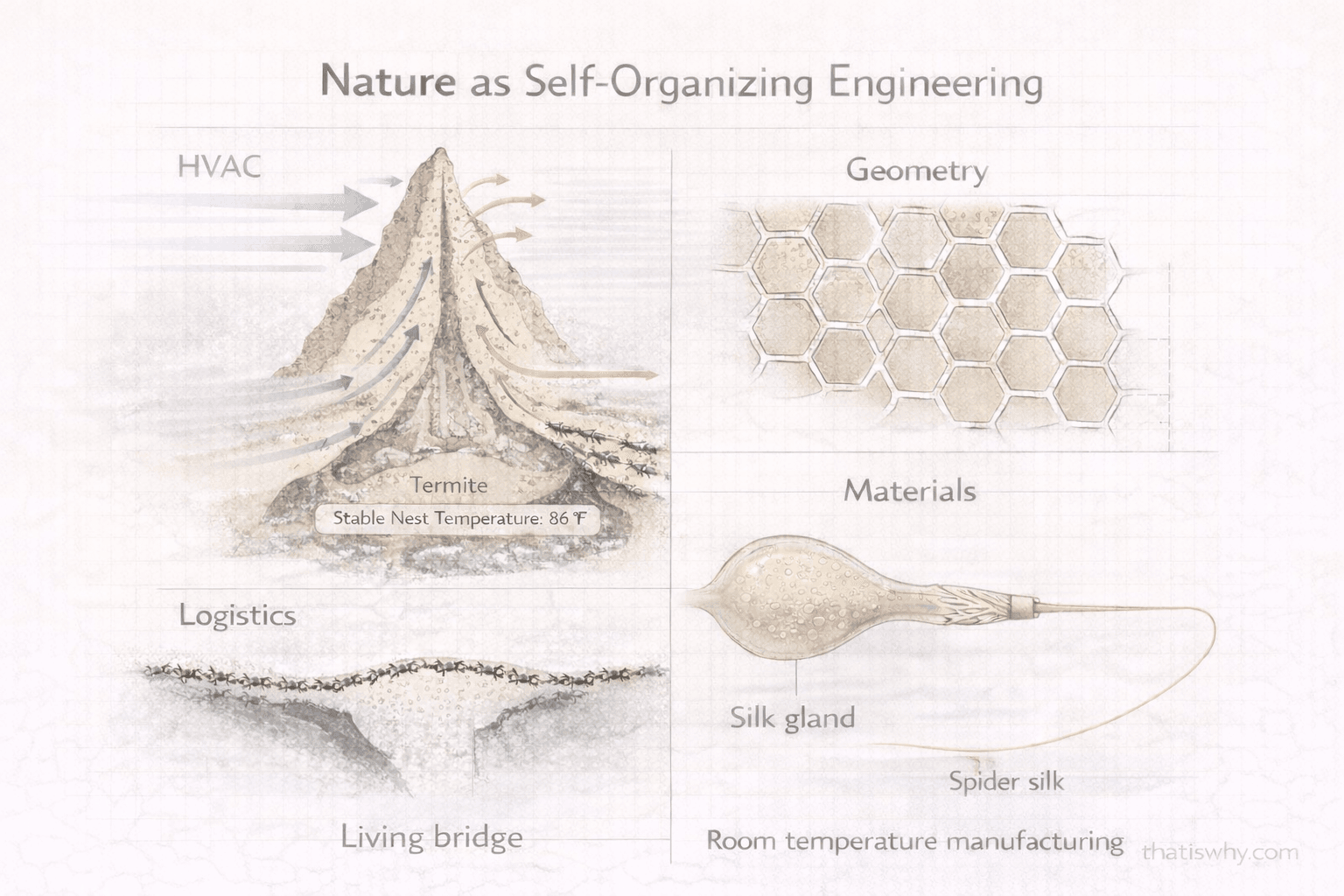
This guide synthesizes the principles of Swarm Intelligence and Biomimicry to categorize the engineering feats of the animal kingdom. We moved beyond simple “Animal Facts” to focus on the Engineering Disciplines—HVAC, Geometry, Logistics, and Materials—showing how nature solved these problems long before we did.
But we knew that just listing disciplines isn’t helpful. Our real job began when we asked, “What does this feel like?” That question led us to the “Self-Organizing City” analogy—a simple story to make the complex concept of emergent behavior feel intuitive.