Why Army Ants Build Living Bridges – The Algorithm of the Swarm
Why do army ants build bridges? Army ants build living bridges to create shortcuts over gaps, maximizing the efficiency of their foraging columns. The colony performs a real-time cost-benefit analysis: if a bridge saves enough travel time to justify tying up workers in the structure, they build it. If the bridge is too long and “expensive” in terms of manpower, they abandon it and go around.
That is the biological reason. But watching it happen looks like science fiction.
Army ants are blind, deaf, and have brains smaller than a grain of sand but as a group, they solve logistics problems that would stump a civil engineer.
Most animals build homes out of materials. Birds use twigs. Beavers use wood. Army Ants are nomads. They never stop moving, so they can’t carry building materials with them.
So, when they encounter a gap in the forest floor, a stream, a leaf, or a crack,they don’t look for a stick. They build a bridge out of their own bodies.
They link their claws together to form ropes, ladders, and tunnels of flesh. They aren’t just bugs wandering in the woods. They are a living, breathing infrastructure project.
The Traffic Jam Solution
To understand how this works, you have to stop thinking of the ant as an insect and start thinking of the colony as Traffic.
You are driving down the highway and you hit a massive pothole. In our world, we slam on the brakes. We honk and we wait for the city to fix it.
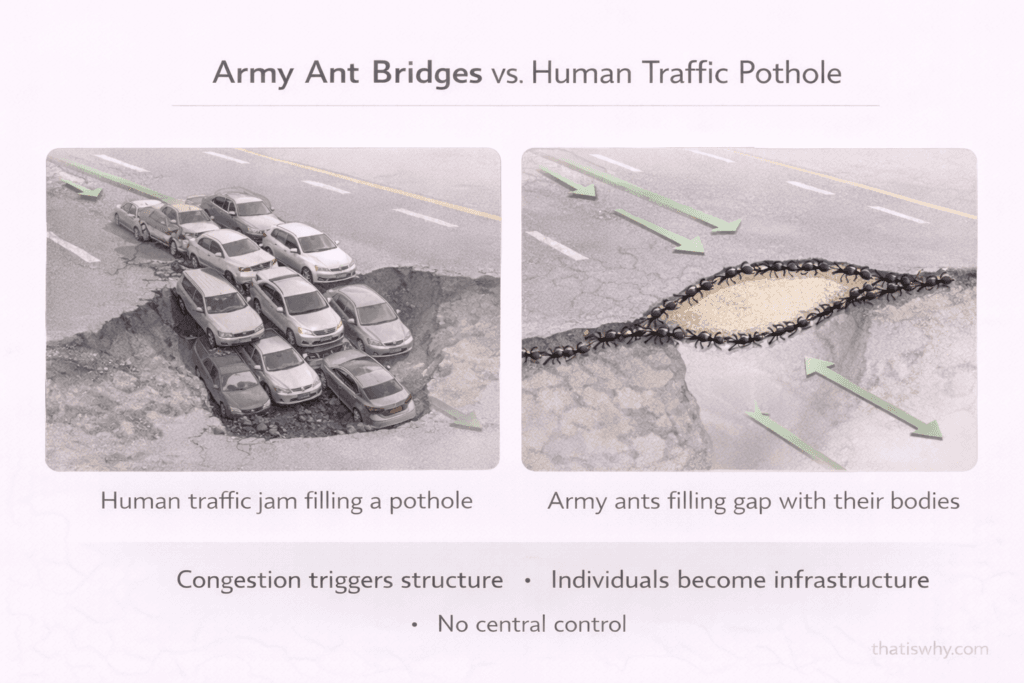
Army ants have a much faster solution. The first car to hit the pothole just drives into it. The second car drives on top of the first. The third car drives on top of the second. Within seconds, the cars have filled the hole with their own bodies and paved a smooth road for everyone else.
This is the golden rule of the swarm: When traffic gets bad, become the pavement.
The ants don’t have a leader shouting orders. They respond to Congestion. If an ant gets bumped too many times by the crowd behind it, it instinctively stops, crouches down, and locks its claws. It turns itself into a brick. The next ant climbs over it, gets bumped, and locks down too.
It wasn’t a plan; it was just an automatic reaction to a traffic jam.
Architecture of Flesh
The structure itself is a marvel of biological engineering.
Army Ants (Eciton burchellii) have special hooked claws on their feet (tarsi) that allow them to link leg-to-leg like living Velcro. When they link up, the strength is incredible. A single bridge might contain 100 ants suspended in mid-air, holding the weight of thousands of their sisters running across their backs carrying heavy larvae and prey.
But the coolest part is that the bridge is alive, if the traffic flow gets heavy, more ants stop and join the structure, widening the bridge to create a multi-lane superhighway. If the traffic dies down, the ants on the edges realize they aren’t being walked on anymore. They unlock their claws, stand up, and rejoin the march. The bridge literally dissolves the moment it stops being useful.
The Math of Survival
This is where the science gets mind-blowing. The colony has to make a mathematical choice.
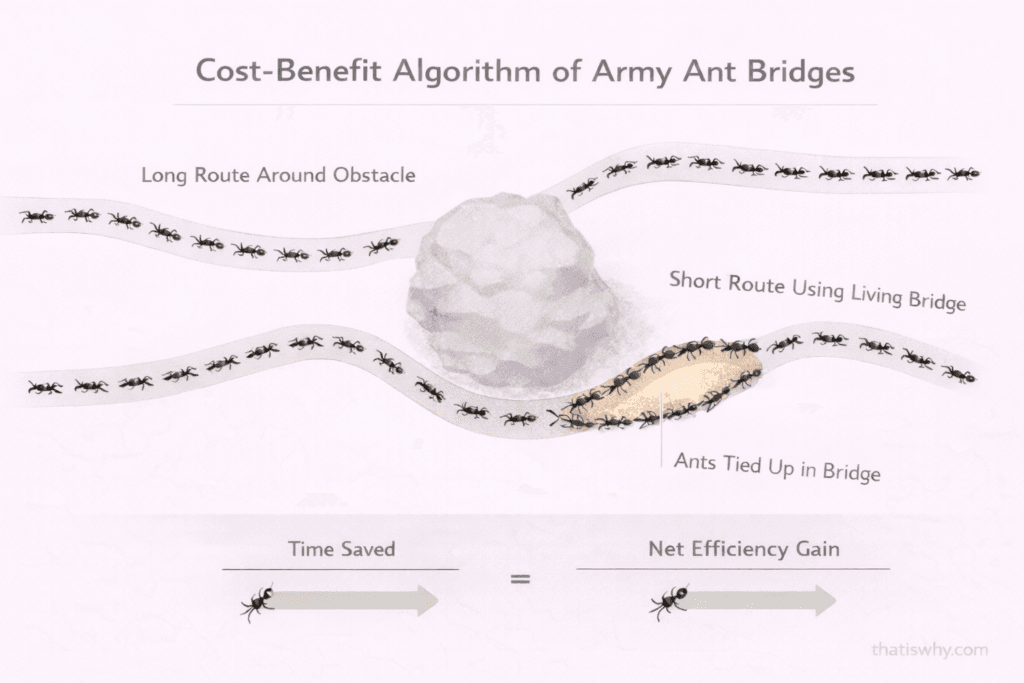
Every ant locked in a bridge is an ant that isn’t carrying food. A bridge costs labor. If you build a massive bridge to cross a huge gap, you might tie up 5,000 ants. That’s 5,000 fewer foragers bringing back dinner.
So, the swarm runs a constant Cost-Benefit Analysis. If the gap is small, the bridge is cheap. It only “costs” 50 ants to save the column 20 minutes of walking, the swarm builds. If the gap is huge, the bridge is too expensive. The swarm senses that too many workers are being tied up, and they abandon the project to go the long way around.
The ants naturally find the perfect balance between speed and manpower. They optimize the route to maximize the calories delivered to the Queen per minute. It is logistics optimization that would make Amazon jealous.
The Pothole Fillers
It’s not just bridges. The ants are obsessed with road maintenance.
When you are carrying heavy prey, uneven ground is a killer. It slows you down. So, as the column moves, “Pothole Ants” will spontaneously drop into cracks, smooth out rough leaves, and plug holes in the dirt with their own bodies.
Why? Because a smooth road means faster delivery. By sacrificing a few hundred workers to act as living asphalt, the rest of the colony can sprint at top speed. It increases the overall efficiency of the swarm by up to 26%. And the moment the cargo is delivered, the road stands up and walks away.
The Hive Mind in the Machine
This “Swarm Intelligence” isn’t just cool biology; it is the blueprint for the future.
Self-Driving Cars: Traffic engineers are actually studying ants to fix gridlock. Instead of a central computer controlling every car (which is too slow), they are designing cars that talk to each other locally, just like ants bumping antennae, to solve traffic jams instantly.
Swarm Robotics: We are even building tiny robots that mimic this behavior. Imagine thousands of small drones that can link together to form a bridge for rescue workers during a disaster. We don’t need to program them with a complex plan. We just give them the simple rule of the Army Ant: “If you hit a gap, become the bridge.”
Myths of the Swarm
Before you start worrying about being eaten alive, let’s clear up the facts.
Myth #1: “The Queen is the General.” We assume the Queen shouts orders.
The Truth: The Queen is just cargo. She is blind and helpless. The intelligence comes from the bottom up. The workers figure it out themselves.
Myth #2: “They eat cows/people in seconds.” Movies show them stripping a skeleton clean in minutes.
The Truth: Army ants are slow. Unless you are tied down or unconscious, you can easily walk away from them. They eat insects, not livestock.
Myth #3: “The bridge ants die.” We assume it’s a suicide mission.
The Truth: They rarely die. They are built to take the weight. Once the column passes, they unlock and leave. It’s a temporary shift, not a sacrifice.
The Genius of the Crowd
When you look at a single Army Ant, you see a dumb, blind insect, it wanders aimlessly. It is effectively useless.
But when you put a million of them together, something magical happens. The individual stupidity vanishes, and a collective genius emerges. They become a super-organism that can solve geometry, engineering, and logistics problems that stump humans.
The Army Ant teaches us that intelligence doesn’t always live in a brain. Sometimes, it lives in the connection between us. Sometimes, the smartest thing you can do is hold hands and become the bridge.
How We Researched This:
To explain this phenomenon, we looked at the collective behavior studies of Dr. Iain Couzin and Dr. Simon Garnier. Their research on Eciton burchellii traffic dynamics provided the mathematical proof that these bridges are not random but are optimized algorithms.
But we knew that just citing traffic dynamics isn’t helpful. Our real job began when we asked, “What does this feel like?” That question led us to the “Traffic Jam” analogy—a simple story to make the complex logistics of swarm behavior feel intuitive.