Why the Gympie-Gympie Hurts for Years
The Gympie-gympie isn’t famous because it hurts.
It’s famous because the pain doesn’t seem to end when it should.
It’s often called the most painful plant in the world, which is true but incomplete. What makes it unsettling is that the pain can return months or years later, triggered by something as ordinary as cold water. By then, the plant is gone, but the sensation behaves as if the encounter never really ended.
Most pain in nature is brief. You touch the wrong thing, your nerves flare, you pull away, and the lesson is delivered. The Gympie-gympie breaks that pattern. A casual brush against its leaves can start something that fades, returns, and resurfaces when you least expect it.
That persistence is the clue. This isn’t just a stronger sting. It’s a different kind of defense. Touching the Gympie-gympie is like stepping onto a carpet scattered with broken syringes. The worst part isn’t the moment of contact, but what stays lodged in your skin afterward. Once that happens, the plant no longer needs to act. The mechanism is already inside you.
The Touch of Fire
People reach for extreme language to describe the Gympie-gympie because ordinary words fall short. Burning doesn’t last long enough. Electric doesn’t explain the way it builds. What stands out is not just intensity, but duration. The pain arrives, settles in, and refuses to behave like something temporary.
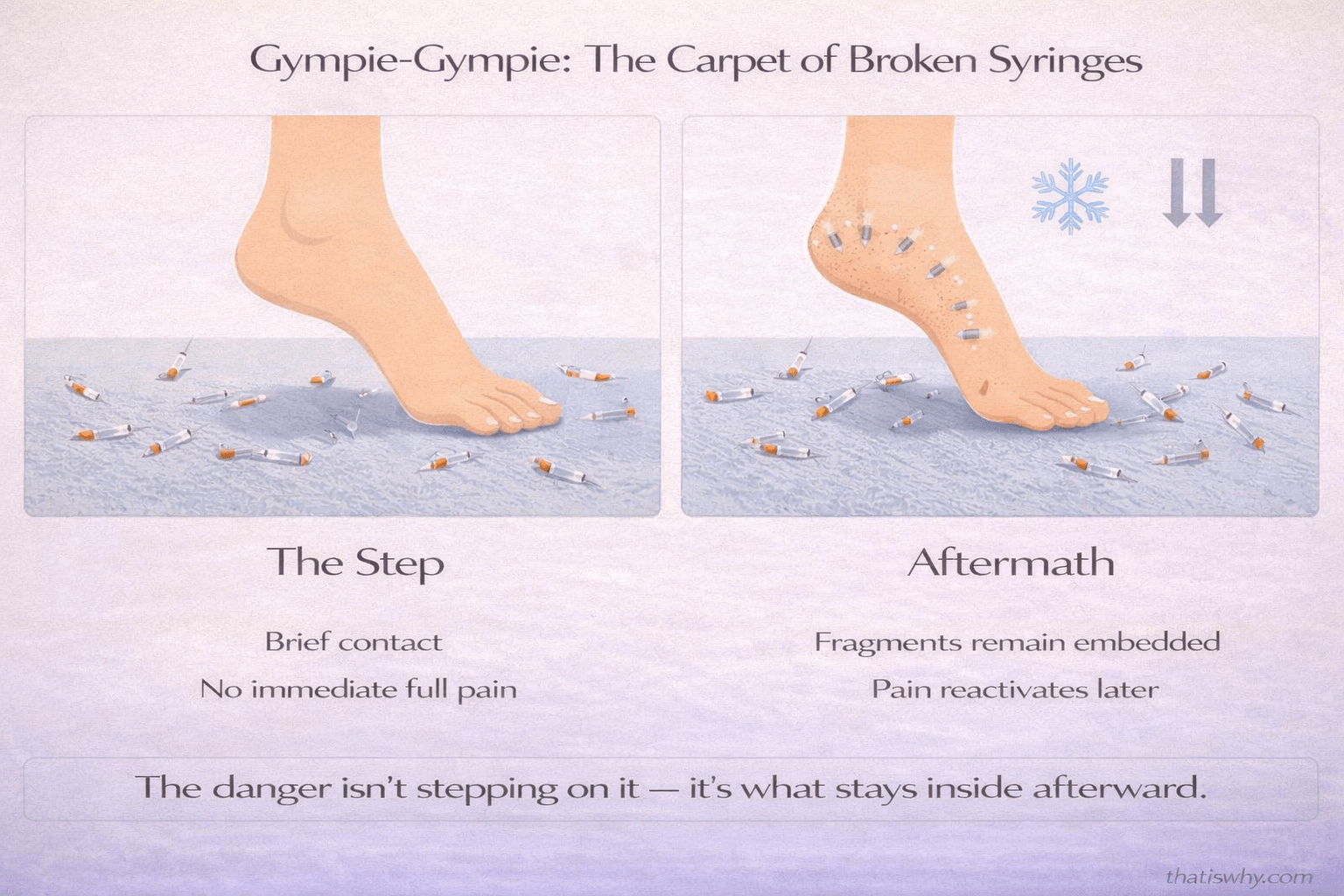
What’s surprising is how little contact it takes. There’s no dramatic grab and no obvious injury. You brush past the leaf and keep walking. Seconds later, something starts to build. Minutes later, it’s unmistakable. The skin doesn’t feel stung so much as occupied.
Days later, the pain may quiet without disappearing. Weeks later, it can seem almost gone. Then a cold shower or pressure in the wrong place brings it back at full volume, sharp and immediate, as if you’ve stepped down again.
This is where the experience stops feeling like a sting and starts feeling like that carpet of broken syringes. The damage isn’t concentrated in the moment. It’s in what stays embedded afterward. You don’t feel every shard at once. You notice them later, whenever something shifts.
Time doesn’t reliably make it safe. Fallen, dried leaves can still do the same thing years later. Once the plant has left something behind, it doesn’t even need to be alive anymore.
The Weapon: Fiberglass and Venom
Up close, it isn’t soft at all. The surface of its leaves is packed with microscopic hairs called trichomes, so dense they form an almost continuous layer. From a distance they look like fuzz. At scale, they behave more like hardware.
Each trichome is made of silica, which in practical terms means glass. They aren’t flexible and they aren’t meant to bend. Under magnification, their shape is uncomfortably familiar: long, narrow shafts tapering to fragile tips, closer to miniature needles than to anything we usually associate with plants.
Those tips are designed to fail. The moment they meet resistance, they snap, creating fresh, razor-sharp edges that slide into skin with very little force. What feels like a light brush is, microscopically, millions of tiny glass needles breaking and embedding themselves at once.
This is where the carpet of broken syringes becomes literal. The leaf isn’t delivering one clean injection. It’s shedding fragments each broken hair leaves behind a sliver of glass small enough to go unnoticed and sharp enough to stay lodged where it lands. The body reacts as it always does to foreign material, but glass is a stubborn guest. It doesn’t soften, dissolve, or disappear.
What makes this effective is how quietly it works. Like stepping off that imagined carpet, you don’t feel every shard right away. Some sit deeper, some closer to the surface, and all of them turn a brief encounter into something that unfolds slowly with movement.
The plant doesn’t rely on force or speed : it relies on numbers, fragility, and permanence.
The Toxin: Moroidin
Glass alone would already be a problem, but a familiar one. Splinters irritate, the body reacts, and over time they tend to work their way out. What makes the Gympie-gympie hard to forget is what those glass fragments carry.
Each microscopic needle contains a neurotoxic peptide called moroidin. It isn’t released in a single surge and it doesn’t break down quickly. Moroidin is unusually stable, binding to pain receptors and continuing to activate them instead of fading away. In effect, every shard behaves like a loaded syringe that never quite empties.
Stepping onto broken syringes isn’t dangerous because of one puncture, but because it leaves behind many tiny injection points, each capable of flaring on its own schedule.
The same thing happens in the skin. The glass holds the toxin in place, turning tissue into a scattered field of microscopic reservoirs. As long as those shards remain embedded, the system stays primed. The pain doesn’t need to be reapplied, it only needs movement.
That’s why the triggers feel so ordinary. Cold water, pressure, or a change in posture doesn’t summon the pain from memory. It presses tissue back onto what was never removed.
The recurrence isn’t mysterious : the floor was never cleared.
Why a Plant Would Build This
At first glance, this defense feels excessive. The pain is extreme, the mechanism elaborate, and the effects long-lasting. It only looks like overkill if you assume the goal is to stop an attack in the moment.
In a dense rainforest, encounters are constant. Animals move as they feed, brushing past hundreds of plants in a single outing. A defense that hurts briefly can be tolerated. A sting that fades is a cost an animal can learn to pay again.
The Gympie-gympie solves a different problem. It isn’t trying to win one interaction, it’s just trying to prevent the next one.
By leaving glass and toxin behind, it turns a momentary mistake into a lasting lesson. The pain resurfaces, often triggered by things unrelated to the plant itself, reinforcing the same message again and again.
This is where the carpet of broken syringes reveals its purpose. It isn’t laid down to injure once. It’s there to make the space unusable. You don’t step carefully back onto a floor you know still has shards embedded in it. You avoid it entirely.
From an evolutionary standpoint, that’s efficient. The plant doesn’t need to grow faster or recover repeatedly. It only needs to be remembered.
When Pain Becomes Memory
Seen through this lens, the Gympie-gympie stops feeling like an oddity and starts feeling like a clue. Similar strategies appear elsewhere in nature, usually in quieter forms.
Some animals don’t rely on speed or strength to avoid being eaten. Instead, they make the experience of attacking them unpleasant enough to reshape behavior long after the moment has passed. The goal isn’t to win the encounter, but to install hesitation.
We do the same thing. We rarely design systems to deliver maximum punishment once. We design them to linger just enough to change future decisions. The leverage isn’t in the initial penalty, but in the way it follows you.
The Gympie-gympie shows that this logic isn’t uniquely human. Instead of escalating force, it escalates consequence. The pain doesn’t need to be constant. It only needs to return often enough that forgetting becomes risky.
In crowded environments, memory is a powerful defense.
What People Get Wrong About the Gympie-Gympie
Myth #1: “It’s deadly.”
Truth: The pain can feel unendurable, but the plant almost never kills humans. Its reputation comes from duration, not body count. Larger animals are more vulnerable because they can receive massive exposure at once.
Myth #2: “It’s just a powerful poison.”
Truth: Without the glass, the toxin would behave like other venoms: intense but short-lived. Persistence comes from the delivery system.
Myth #3: “It stops being dangerous once it dies.”
Truth: Dead leaves can remain hazardous for years because the mechanism doesn’t depend on living tissue.
Myth #4: “Everything about it is toxic.”
Truth: In a strange contradiction, the ripe fruit is edible if the stinging hairs are removed. The defense is precise, not indiscriminate.
The Lesson That Stays
We often think of defenses as something that ends when contact ends. The Gympie-gympie challenges that idea. Its defense works because part of the encounter comes with you.
Long after the forest is gone, the body still remembers where it stepped wrong. Pressure or temperature can bring that awareness back, not as a story, but as sensation. The floor you crossed once never fully clears itself.
We build deterrents this way too, caring less about punishing a mistake once than about making sure it isn’t repeated. The systems that work best leave something behind, subtle enough to fade, persistent enough to guide behavior.
The Gympie-gympie arrived at the same logic through evolution alone. It doesn’t chase or threaten, once the shards are there, the message is installed.
Some defenses end when danger passes. Others reshape the landscape long after the moment is over. this plant belongs to the second kind.
How We Researched This :
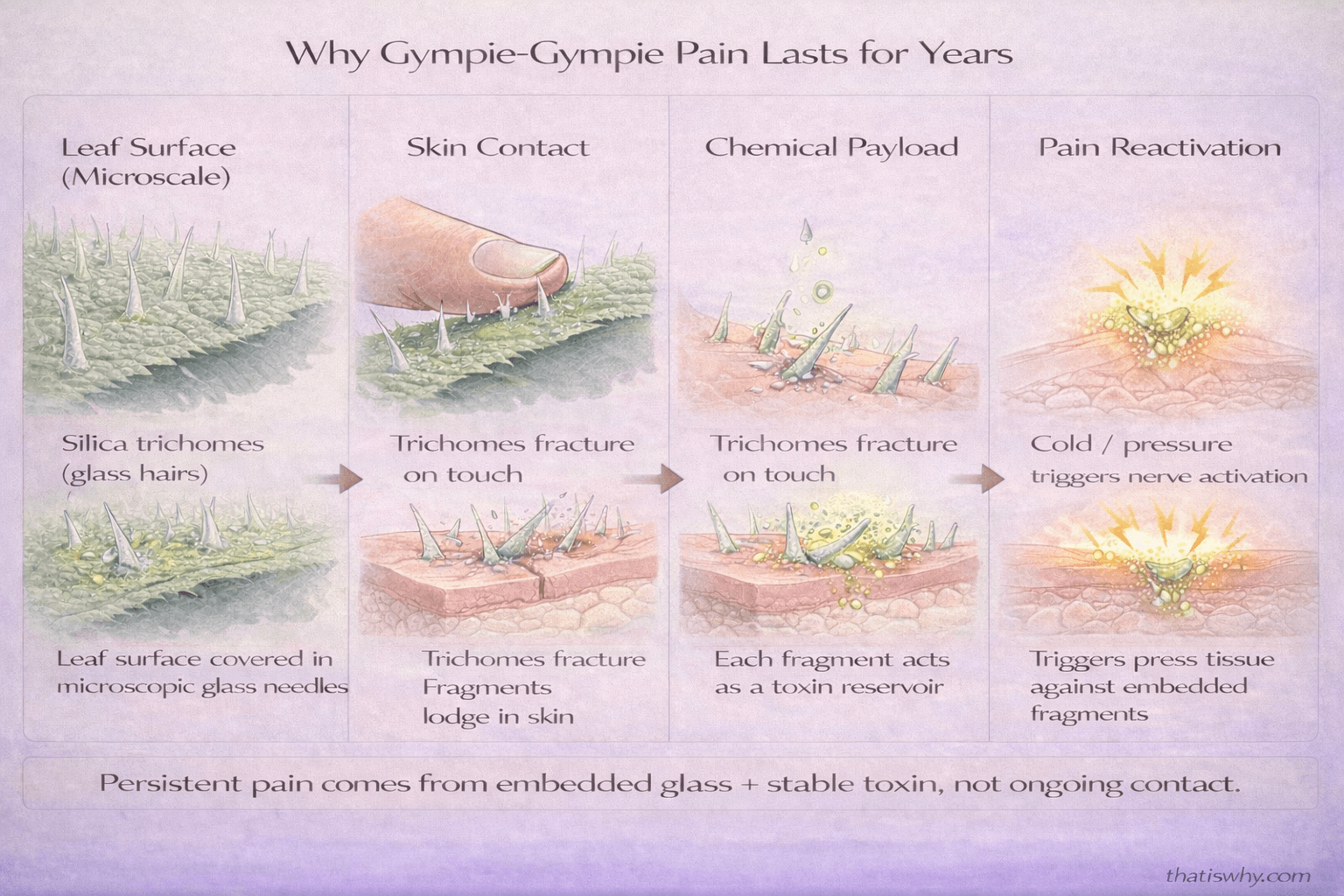
To explain why the Gympie-gympie’s pain lasts and returns, we examined microscopic studies of its silica trichomes and biochemical research on the neurotoxic peptide moroidin. Together, they show how glass fragments enter the skin, remain embedded, and continue activating pain receptors long after contact ends.
But listing mechanisms wasn’t enough. Our real work began when we asked, What does this feel like? That question led us to the “carpet of broken syringes” analogy. Framed this way, the biology collapses into a single, intuitive explanation for why the Gympie-gympie is so hard to forget.