Why Termite Mounds Are Air-Conditioned Cities
How do termite mounds work? Termite mounds function as passive ventilation systems that regulate the temperature of the underground nest. Contrary to the old “chimney effect” theory (heat rising), recent research shows the mounds act like lungs. They use wind energy to create pressure gradients, forcing fresh air into the porous walls and sucking stale air out, keeping the fungal gardens at a stable 86°F(30°C).
That is the science. But seeing it in the desert feels like magic.
If you stand in the African savanna at noon, you will bake. The temperature hits 100°F (37.7°C). The air is bone dry. But if you were to dig into the giant termite mound standing next to you, you would find a completely different climate.
Deep inside, it is a cool, comfortable 86°F(30°C). The humidity is perfect.
The termites have built a city that stays cool in the blazing heat without a single fan, wire, or drop of electricity. For decades, we thought they were building chimneys. We were wrong. They were building lungs.
The External Lung
To understand how a termite mound works, you have to stop looking at it as a house. The termites don’t live in the tall spire you see above ground. That would be suicide in the heat.
Instead, think of the colony as one giant, buried animal. The nest is the stomach. The tunnels are the veins. And that tower sticking out of the ground? It’s an External Lung.
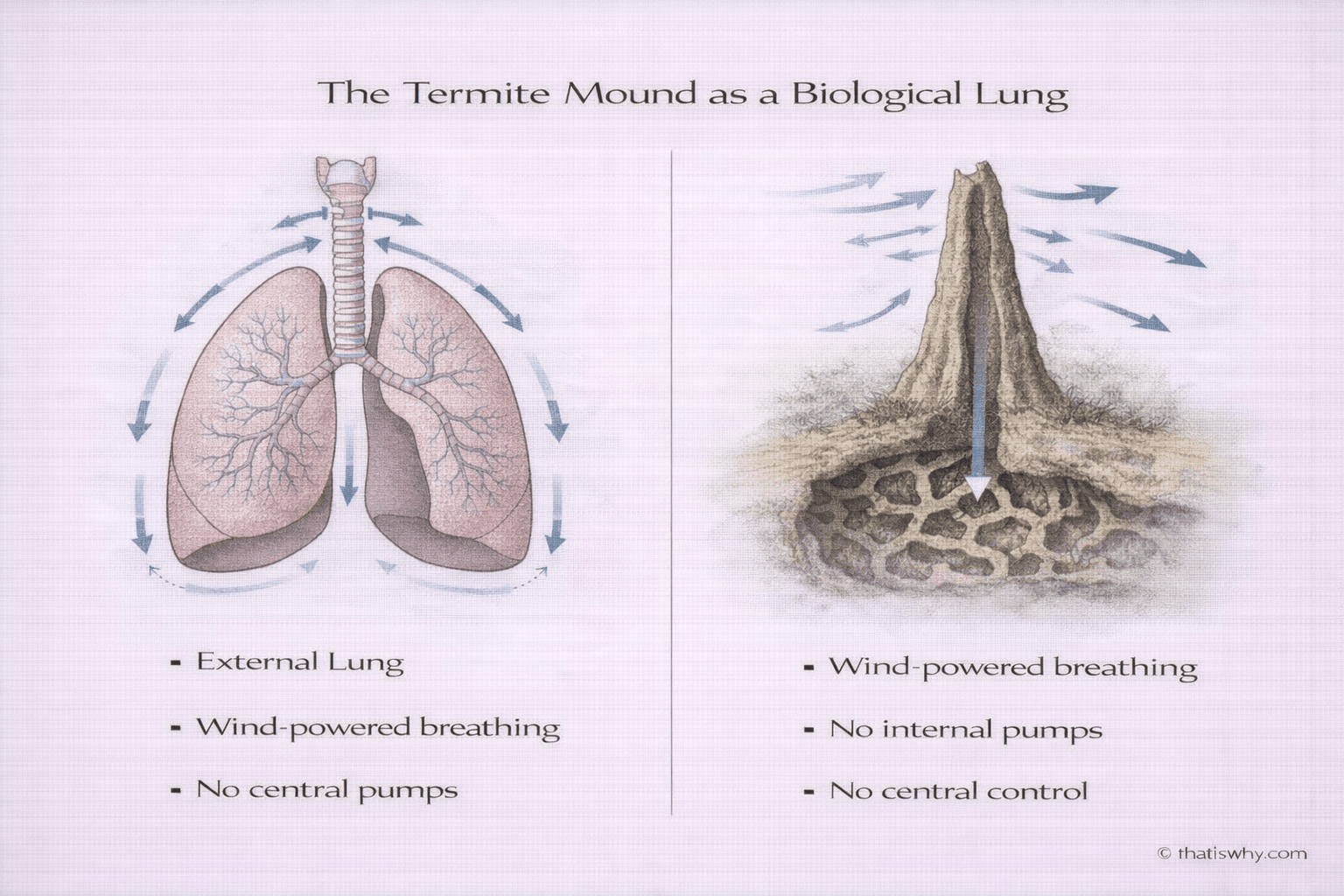
The termite colony is buried under tons of dirt. It is suffocating. So, it builds a massive, porous organ out of mud that reaches up into the wind. It uses the breeze to “inhale” oxygen and “exhale” carbon dioxide for the millions of insects living in the basement. It isn’t a chimney; it is a life-support machine.
The Broken Theory
For decades, we taught the “Chimney Effect” in schools. It was elegant and logical. The heat from the termites rises up, escapes the top, and sucks cool air in from the bottom. Simple physics, right?
Wrong.
In 2015, researchers finally tested it and found… nothing. The air inside wasn’t moving up.
How does it actually work? The Wind. The mound uses the breeze like a pump. When the wind hits the mound, it pushes fresh air into the front. At the same time, it creates a vacuum on the back that sucks the stale air out. It’s like blowing across the top of a straw. The mound doesn’t just sit there; it uses the wind to “inhale” and “exhale.” The harder the wind blows, the deeper the city breathes.
The Fungus Farmers
Why build a skyscraper just to cool the basement? Why do termites need such precise climate control?
It’s not for them, it’s for the farm while most people think termites eat wood, they don’t because they can’t actually digest it. They chew up the wood and bring it home to feed a specific fungus called Termitomyces. They cultivate this fungus in massive underground gardens, some the size of a living room. The fungus breaks down the tough wood into digestible sugars, and the termites eat the fungus.
But this crop is high-maintenance, it is a biological diva. It requires a constant temperature of exactly 86°F (30°C), if it drops to 84°F (28.8°C) or rises to 88°F (31.1°C), the fungus dies, and the colony starves. The entire massive mound, the “Lung”, is built solely to keep the climate control running for the mushrooms.
The Magnetic Compass
The engineering doesn’t stop at ventilation. Some termites are also solar architects.
In Australia, the Magnetic Termites build mounds that look like giant, thin tombstones where every single one of them points perfectly North-South.
This is passive solar design at its finest. In the morning and evening, when it’s cold, the broad, flat side of the tombstone faces the sun, soaking up the heat to warm the nest. But at noon, when the sun is brutal, only the razor-thin edge faces the heat. This minimizes exposure and keeps the nest from cooking. They are using geometry to control the temperature, aligning their entire city with the magnetic field of the Earth.
Stealing from the Architects
Our best engineers are finally starting to catch up to the termites.
In Zimbabwe, architect Mick Pearce built the Eastgate Centre, a massive shopping complex modeled entirely on termite engineering. It has no conventional air conditioning. Instead, it uses fans to suck cool night air into the hollow concrete walls, chilling the building so it stays cool all day.
The result is staggering. The building uses 90% less energy than a normal glass skyscraper. It saves millions of dollars in electricity.
Ironically, Pearce designed it based on the old “Chimney” theory. But even though the biology was slightly off, the principle of Passive Cooling worked perfectly. It proves that even when we misunderstand nature, copying it is still smarter than trying to reinvent the wheel.
Inside the Mound
Before you start picturing a termite queen sitting in a penthouse suite, let’s get the geography right.
Myth #1: “The Queen lives in the tower.” In movies, the heroes climb the mound to find the bugs.
The Truth: The mound is completely empty. It’s just air ducts. The Queen, the nursery, and the farm are all deep underground, sometimes six feet below the surface. The tower is just the AC unit on the roof.
Myth #2: “They open and close windows.” People imagine termites running around shutting vents when it rains.
The Truth: They don’t have valves. They control the airflow by slowly remodeling the mud walls over months. It’s a slow-motion renovation, not a daily switch flip.
Myth #3: “Termites are just pests.” We think they only exist to eat our houses.
The Truth: Only a few species eat houses. The mound-builders are critical soil engineers. They aerate the ground, recycle nutrients, and create oases of green grass in the dry savanna. They are the farmers of the desert.
The Living Machine
When you look at a termite mound, don’t just see a pile of dirt. See it for what it is: A living organ.
It is a solar-powered, wind-driven lung built by blind insects to keep a subterranean city alive. It breathes. It regulates. It protects.
The termite teaches us that you don’t need high-tech gadgets to solve a problem. You don’t need electricity to build an air conditioner. You just need to understand the wind, the sun, and the soil better than anyone else. The mound isn’t just a home; it is the ultimate proof that biology is the best engineer on the planet.
How We Researched This :

To get the real story, we looked at the biophysical studies of Turner and Soar (2008, 2015). They used 3D scanning and gas tracer fluids to debunk the classical “Chimney Effect,” proving that the airflow is driven by wind pressure, not heat convection.
But we knew that just citing fluid dynamics isn’t helpful. Our real job began when we asked, “What does this feel like?” That question led us to the “External Lung” analogy—a simple story to make the complex gas exchange of the mound feel intuitive.