Unusual Adaptations of Deep-Sea Animals – How to Survive the Abyss
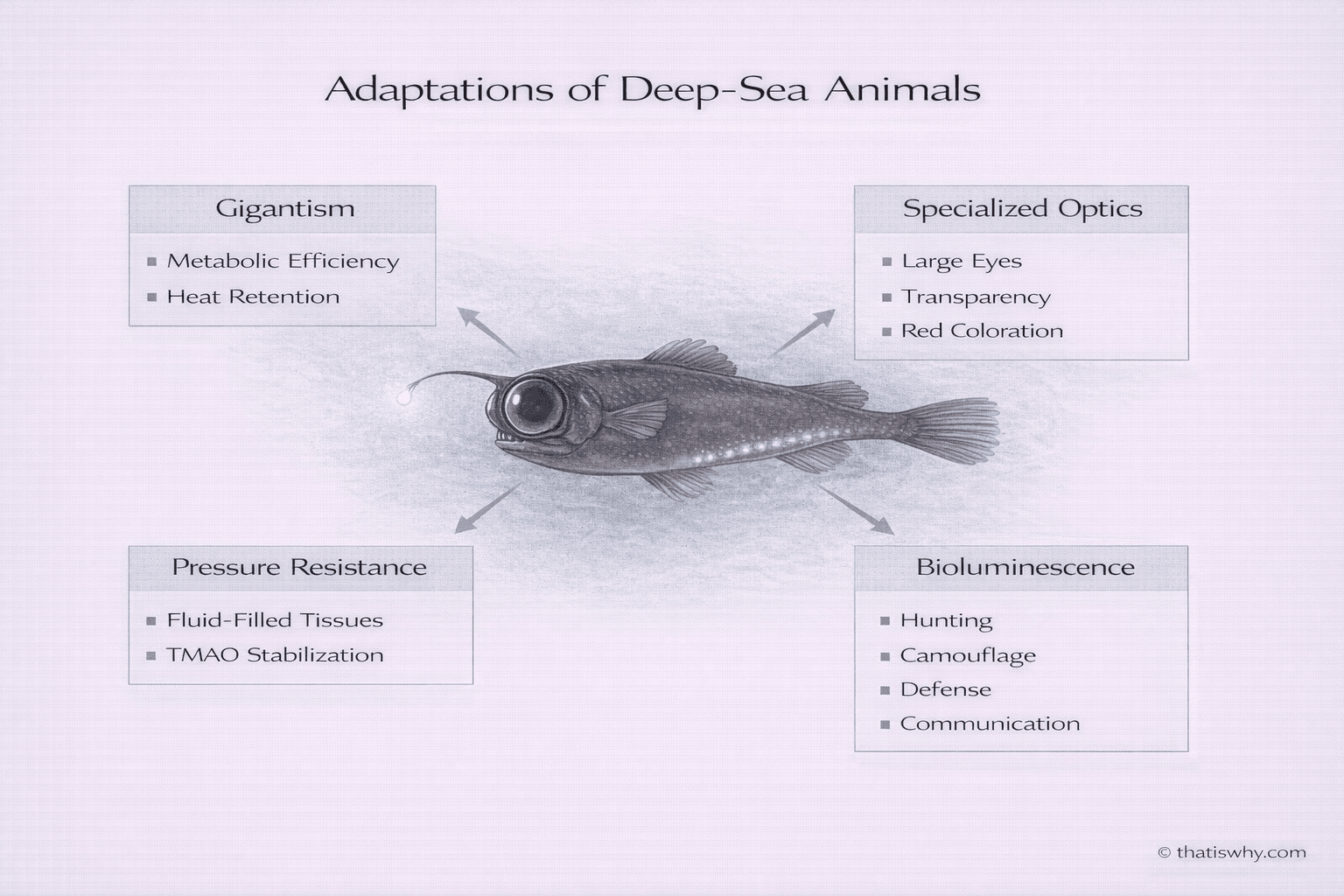
What are the main adaptations of deep-sea animals? Deep-sea animals survive the extreme conditions of the abyss through four primary adaptations: Gigantism (growing large to increase metabolic efficiency), Specialized Optics (massive eyes or invisibility to master the dark), Pressure Resistance (fluid-filled bodies to prevent implosion), and Bioluminescence (using light for communication, camouflage, and hunting).
That is the textbook list. But seeing it in action feels like visiting another planet.
We call Earth the “Blue Planet,” but that’s a bit of a lie. The surface is blue. The rest of it 95% of the living space on Earth, is pitch black.
The deep ocean is the most hostile environment we know of. It is freezing cold. The pressure is crushing. And there is almost no food. If you dropped a human down there, they would freeze, implode, and starve in seconds.
But if you drop a submarine down there, you don’t find a desert. You find a city. You find squids the size of buses and worms that glow in the dark. These animals aren’t monsters; they are master engineers. They have evolved a suite of adaptations to thrive in a place where physics says life shouldn’t exist.
Let’s look at the four survival systems they use to beat the abyss.
The Life Support System
To survive in the deep, you can’t just be a normal animal. You have to be a self-contained Space Station.
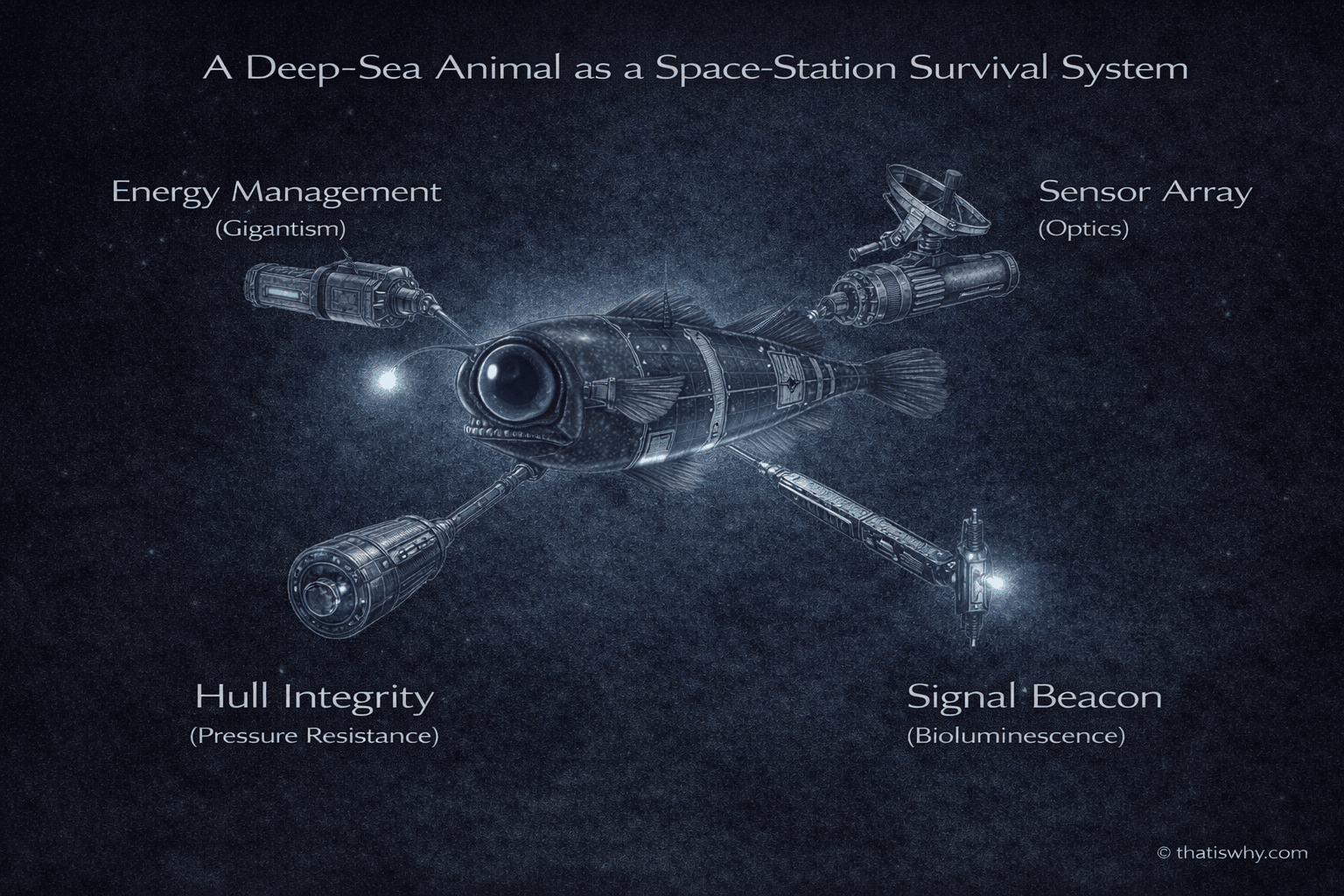
Think about the ISS floating in the void. It needs specialized systems to handle the vacuum, the cold, and the energy crisis. It can’t rely on the outside world for anything.
Deep-sea animals are exactly the same. They have evolved a biological “Survival Suit” made of four critical technologies. They need Energy Management (Gigantism) to store power in a food desert. They need a Sensor Array (Optics) to see in the pitch black. They need Hull Integrity (Pressure Resistance) to resist the crushing weight of the water. And they need Signal Beacons (Bioluminescence) to communicate across the empty void.
If any one of these systems fails, the station crashes. The animal dies.
System 1: Energy Management (Gigantism)
The first problem is fuel. There are no plants in the deep sea, which means there is almost no food. You might find one meal a year.
So, how do you survive the famine? You get huge. This is Deep-Sea Gigantism, and it’s the exact opposite of what you’d expect. Animals like the Colossal Squid and the Giant Isopod don’t grow big to fight; they grow big to endure.
The Logic: A big body is a more efficient machine. According to Kleiber’s Law, a large animal burns less energy per gram than a small one. Plus, the deep ocean is freezing, and Bergmann’s Rule tells us that larger bodies hold heat better. By combining massive size with extreme cold, these animals turn themselves into slow-burning energy tanks. They can gorge themselves on a single whale carcass and then coast on that fuel for years. They aren’t monsters; they are the most efficient batteries on Earth.
Read the Deep Dive: Why do deep-sea creatures grow so huge? Discover the “Smartphone Battery” analogy. That Is Why Deep Sea Creatures Grow Into Giants
System 2: Sensor Array (Optics)
The second problem is data. It is pitch black. How do you find the food you need to fill that massive body without crashing into a wall?
You upgrade your sensors. Deep-sea animals have entered an evolutionary arms race of Optics, and the designs are insane.
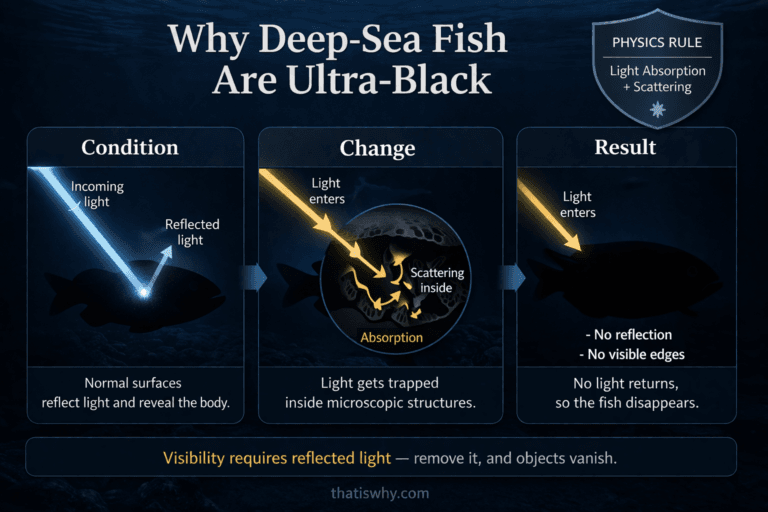
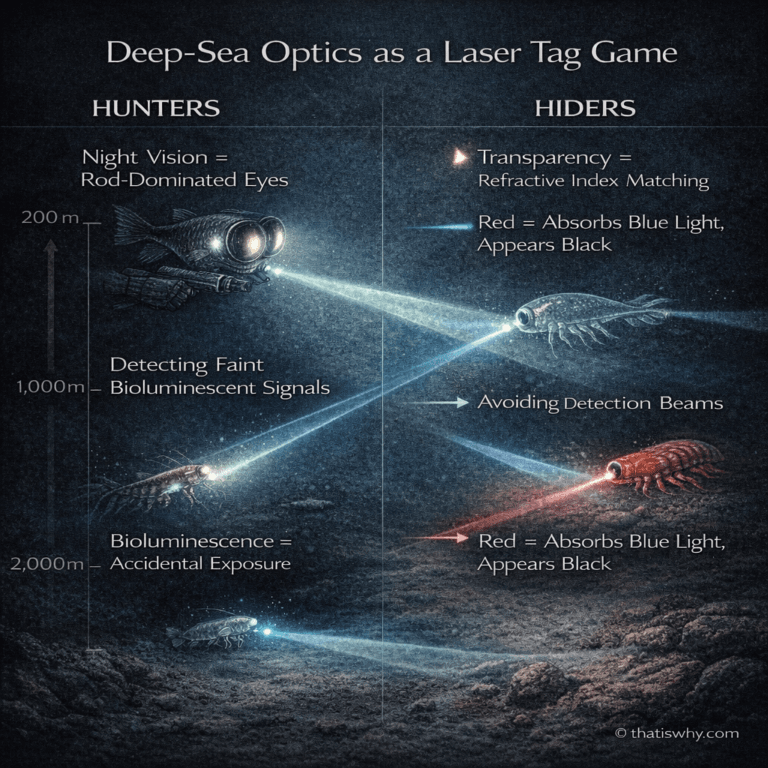
The Hunters: They have evolved massive, tubular eyes packed with sensitive rod cells. Look at the Barreleye fish, its eyes are literal green telescopes that rotate inside a transparent skull. It acts like military night-vision goggles, spotting the faintest spark of bioluminescence from a mile away.
The Hiders: If the hunters have night vision, the prey needs stealth. Some have evolved total Transparency, matching their refractive index to the water so light passes right through them. Others use Red Coloration, which turns pitch black in the blue light of the deep ocean. They use physics to delete themselves from the visual spectrum.
Read the Deep Dive: Why do deep-sea animals have giant eyes? Discover the “Laser Tag” war of the abyss. That Is Why Deep Sea Creatures Are Invisible
System 3: Hull Integrity (Pressure)
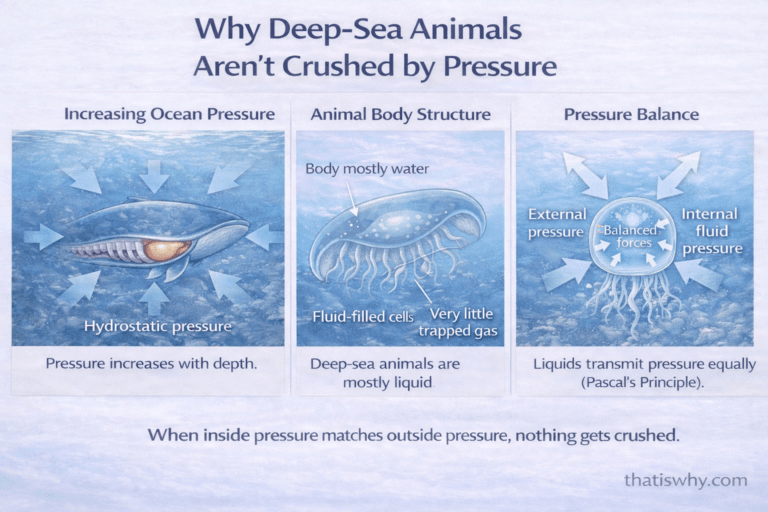
The third problem is the crush. At 8,000 meters, the water pressure is strong enough to snap a steel pipe like a toothpick.
How do fish survive without titanium armor? They do it by surrendering. They don’t build thick walls like a submarine; they build fluid walls like a Gel Pack.
They completely ditch the air bladders. They fill their cells with incompressible fluids. Because water cannot be compressed, the pressure inside the fish matches the pressure outside. It’s a perfect Judo move: use the water’s own properties to defeat it. To stop their proteins from warping, they use a chemical glue called TMAO. It holds their molecular structure together against the crushing weight. They survive the pressure not by fighting it, but by becoming the water.
Read the Deep Dive: Why don’t deep-sea fish implode? Discover the “Gel Pack” physics. That Is Why Deep Sea Fish Don’t Implode
System 4: Signal Beacon (Bioluminescence)
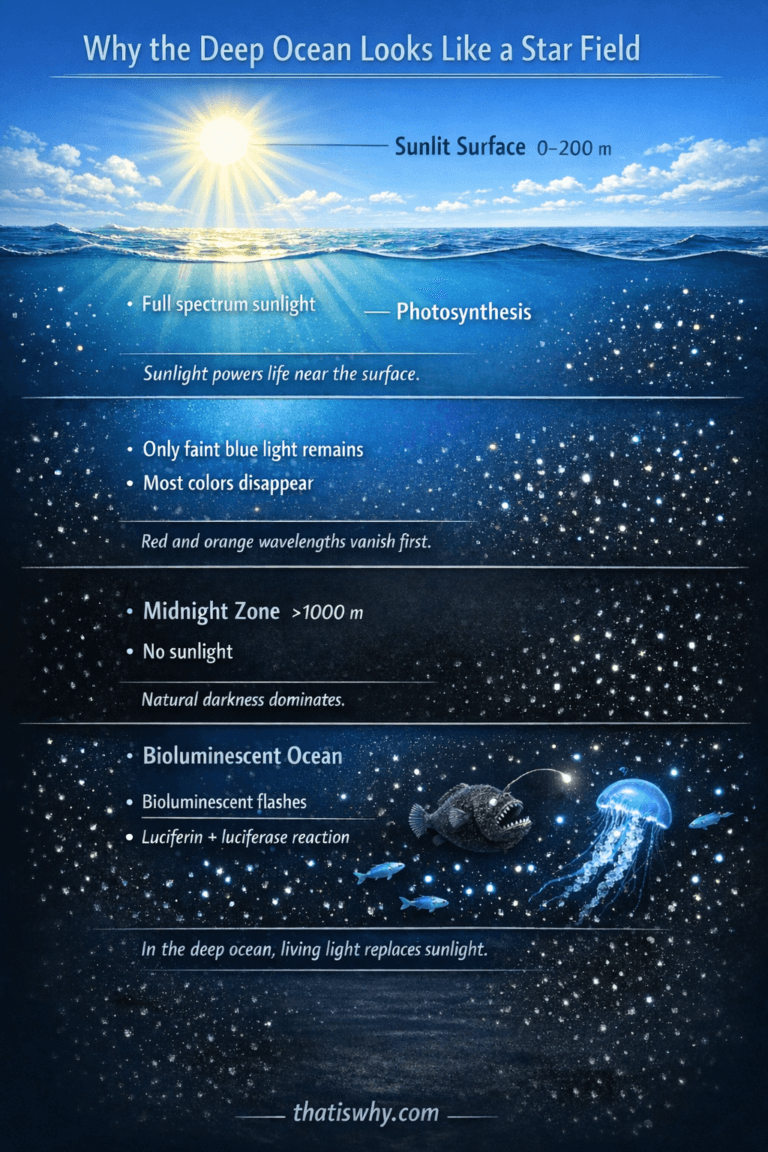
Finally, there is the problem of communication. In the dark, no one can hear you scream, and no one can see you wave. So, biology invented the lightbulb.
Bioluminescence is the universal language of the deep. It turns out, 90% of the animals down here glow. They mix chemicals like luciferin and luciferase to create “Cold Fire”—light without heat. And they use this technology for everything.
Anglerfish use glowing lures to bait prey into traps. Hatchetfish use belly lights to erase their own shadows from predators below. Vampire Squids spew glowing goo to blind attackers like a flashbang grenade. Firefly Squids flash specific patterns to find mates in the void.
It is the ultimate Swiss Army Knife, a single biological innovation that solves the problems of hunger, defense, and loneliness in the dark.
Read the Deep Dive: Why do deep-sea animals glow? Discover the “Swiss Army Knife” of light. That Is Why The Deep Ocean Is A Fireworks Show
The Blueprint for Aliens
Why does this matter? Why do we care about weird squids and glowing worms?
Because the deep sea is a practice run for the rest of the universe. When astrobiologists look at moons like Europa (Jupiter) or Enceladus (Saturn), they see ice-covered oceans. They see darkness, pressure, and cold.
If life exists there, it won’t look like a lion or a tree. It will look like this. Physics forces biology into specific shapes. Convergent evolution suggests that any life in a dark, high-pressure ocean will likely evolve the same solutions we see here: Gigantism for efficiency, Bioluminescence for communication, and soft bodies for pressure resistance. The deep sea isn’t just an ecosystem; it is the universal blueprint for life in the dark.
Myth-Busting the Deep
Let’s clear up a few misconceptions about our deep-sea neighbors.
Myth #1: “They are huge monsters.” We see the teeth and the eyes and assume they are man-eaters.
The Truth: Most of them are tiny. The “terrifying” Fangtooth fish is about the size of a grapefruit. They aren’t monsters; they are desperate survivors. The only reason they look scary is because they need big teeth to catch the one meal they might see all month.
Myth #2: “They explode at the surface.” We assume they pop like balloons.
The Truth: They don’t explode. They melt. Because they lack gas bladders, they don’t burst. But remember the “Gel Pack” body? Without the ocean’s pressure to hold them together, their structure collapses. They turn into a puddle of goo (like the famous Blobfish). It’s not an explosion; it’s a structural failure.
Lessons from the Void
We tend to look at deep-sea animals as “freaks” or “monsters.” But that is a surface-dweller’s bias.
They are success stories. They are living in the hardest level of the game, and they are winning. They have built biological Space Stations that can withstand crushing pressure, generate their own power, and communicate across the void.
They have hacked the fundamental laws of physics to build a civilization in a place that should be dead. The deep ocean isn’t a nightmare. It is the ultimate engineering lab. And as we look to the stars for other forms of life, we should remember that the most advanced astronauts in the universe are already swimming right beneath our feet.
How We Researched This :
This guide serves as the central hub for our deep-dive series into Ocean Adaptations. To build it, we synthesized the core principles of Metabolic Theory (Kleiber’s Law), Optical Physics (Refraction), and Biochemistry (Piezolytes).
But we knew that just listing biological traits isn’t helpful. Our real job began when we asked, “What does this feel like?” That question led us to the “Space Station” analogy—a simple story to make the complex, interlocking survival systems of the deep sea feel intuitive.