Why Deep Sea Creatures Are Invisible – The Optics of the Abyss
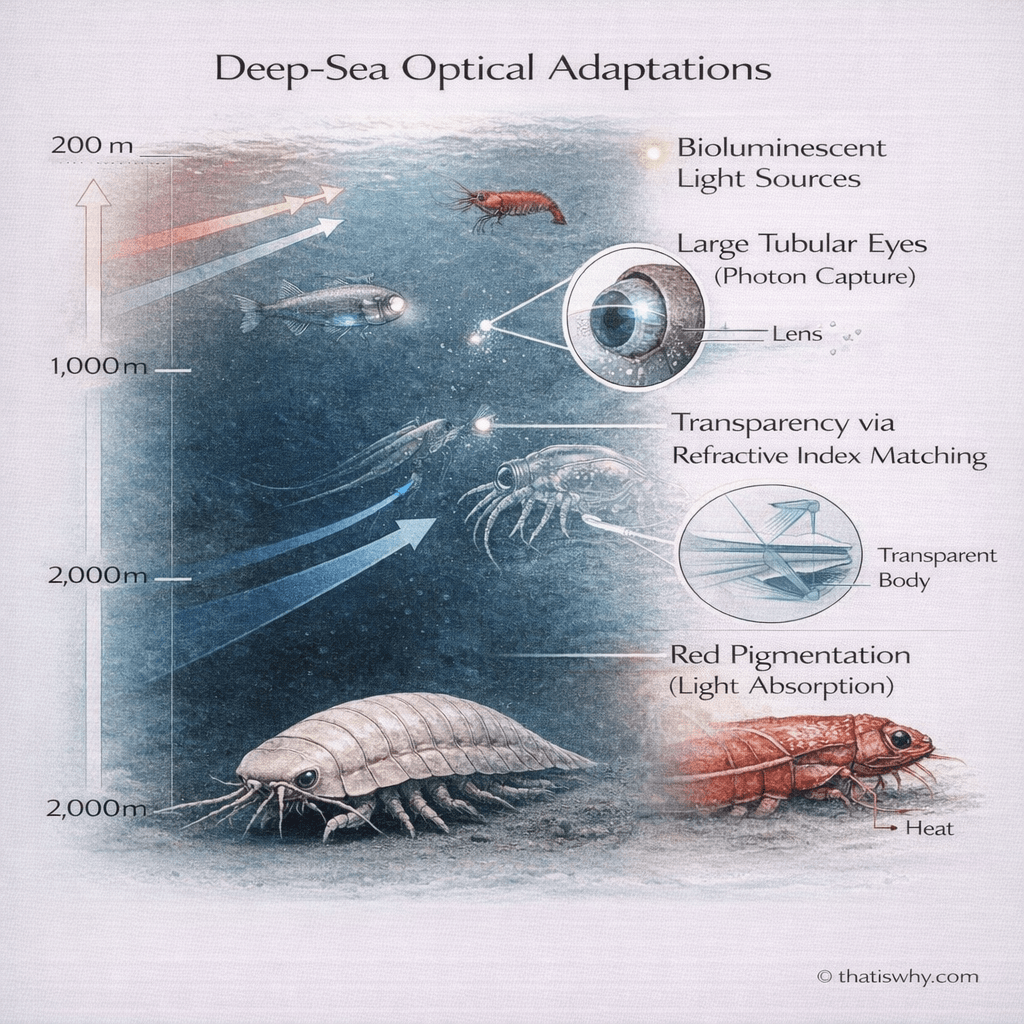
Why do deep-sea fish have big eyes? Deep-sea animals evolved massive, tubular eyes to capture faint bioluminescence in the dark. Their eyes are packed with rod cells, which are highly sensitive to blue light, allowing them to spot the silhouettes of prey or predators against the dim glow of the ocean..
If you dive down 1,000 meters into the “Midnight Zone,” sunlight is gone. It is pitch black. So why would animals evolve the biggest eyes on the planet in a place with zero light?
The Colossal Squid has eyes the size of dinner plates. The Barreleye Fish has eyes that look like glowing green telescopes inside a transparent skull. It seems like a massive waste of resources. Why build a super-sensitive camera if there is nothing to photograph?
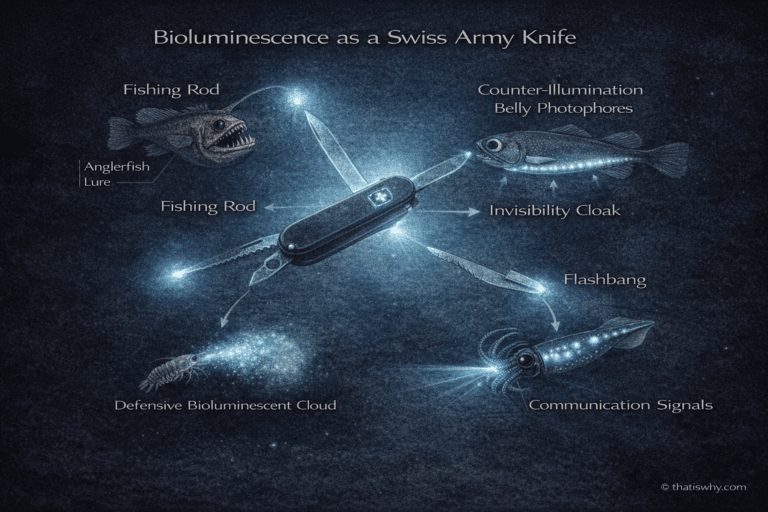
The answer is that the deep ocean isn’t actually dark. It is exploding with light. It’s just not the kind of light we are used to.
The Blackout Game
To survive here, animals are locked in an evolutionary arms race between detection and stealth. Tthink of it as the world’s deadliest game of Laser Tag.
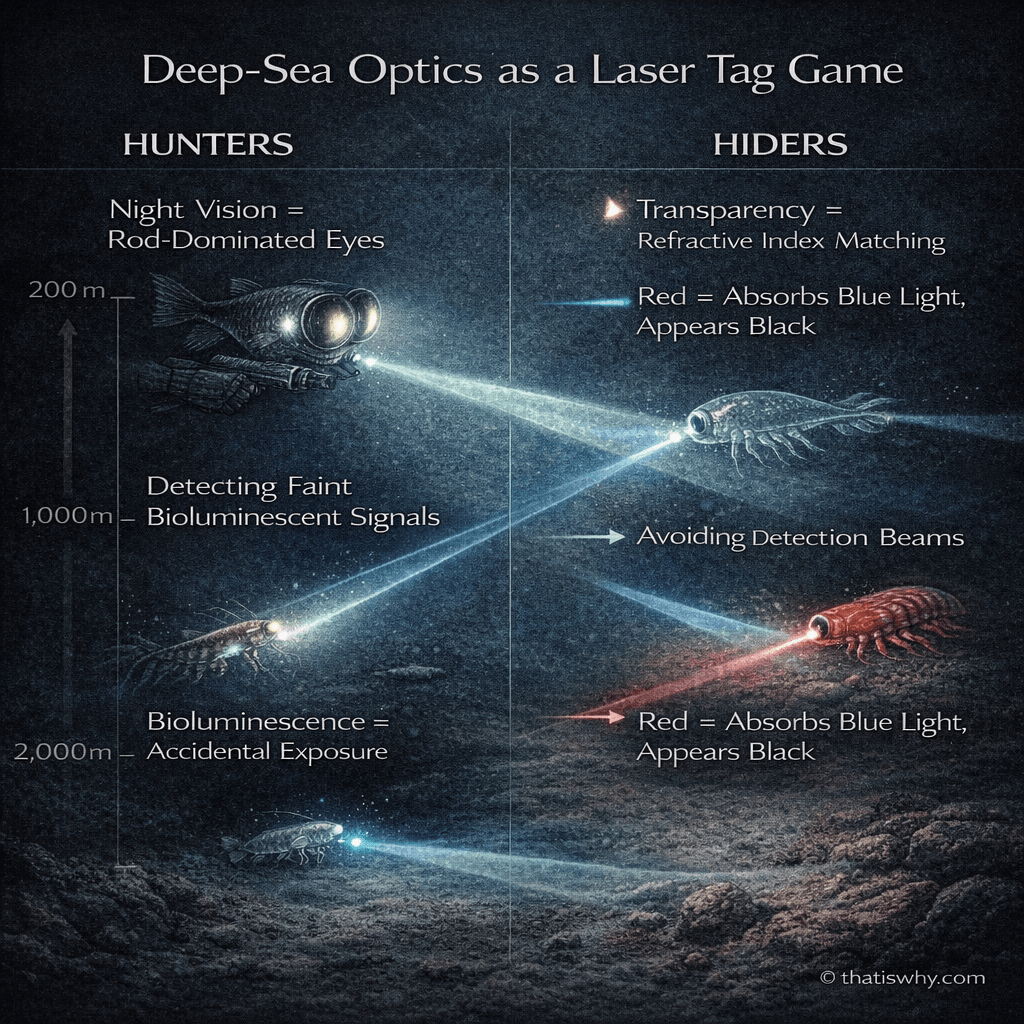
Imagine you are in a pitch-black warehouse. Every time you move, you risk flashing a light. The Hunters have upgraded their gear with military-grade night vision goggles that can spot a spark from a mile away.
To survive, the Hiders have to counter this tech. Some wear suits made of mirrors (Transparency) to let the beams pass right through them. Others wear suits made of Vantablack (Red Color) to absorb the light so they don’t reflect a thing. The deep ocean isn’t empty; it’s a high-stakes arena where one mistake lights you up like a target.
The Hunters: Night Vision
First, let’s look at the players wearing the Night Vision Goggles.
In the deep, food is scarce. If a shrimp flashes a light 100 meters away, you need to see it or you starve. This is why eyes get huge. It comes down to Photon Capture.
Think of an eye like a bucket collecting rain. A small bucket catches a few drops, which is fine for daylight. But a giant bucket catches every single drop.
But it’s not just size; it’s design. Deep-sea eyes have stripped out the color filters (Cones) and packed the sensor with high-sensitivity Rod Cells. They have built a biological version of military night-vision tech—designed not for clarity, but to spot the faintest silhouette against the black water.
The Ghosts: Transparency
If the hunters have night vision, how do you hide? Option A: Be a ghost.
Many deep-sea animals, like the Glass Squid,have evolved true Transparency.
This sounds simple, but in practice, it is a nightmare. Try dropping a piece of glass into a glass of water. You can still see it ? That’s because glass bends (refracts) light differently than water. That tiny bend creates a glint, and in the deep sea, a glint gets you eaten.
To be truly invisible, these animals have to match their Refractive Index to the seawater perfectly. They have to engineer their own bodies so that light passes through them without bending, scattering, or slowing down. It is the ultimate stealth suit: the hunter looks right at you, but sees nothing but the ocean behind you.
The Shadows: Red Color
But transparency is hard. You can’t make a brain or a stomach transparent; they are too dense. So if you can’t be a ghost, you choose Option B: Be a shadow.
You paint yourself Bright Red.
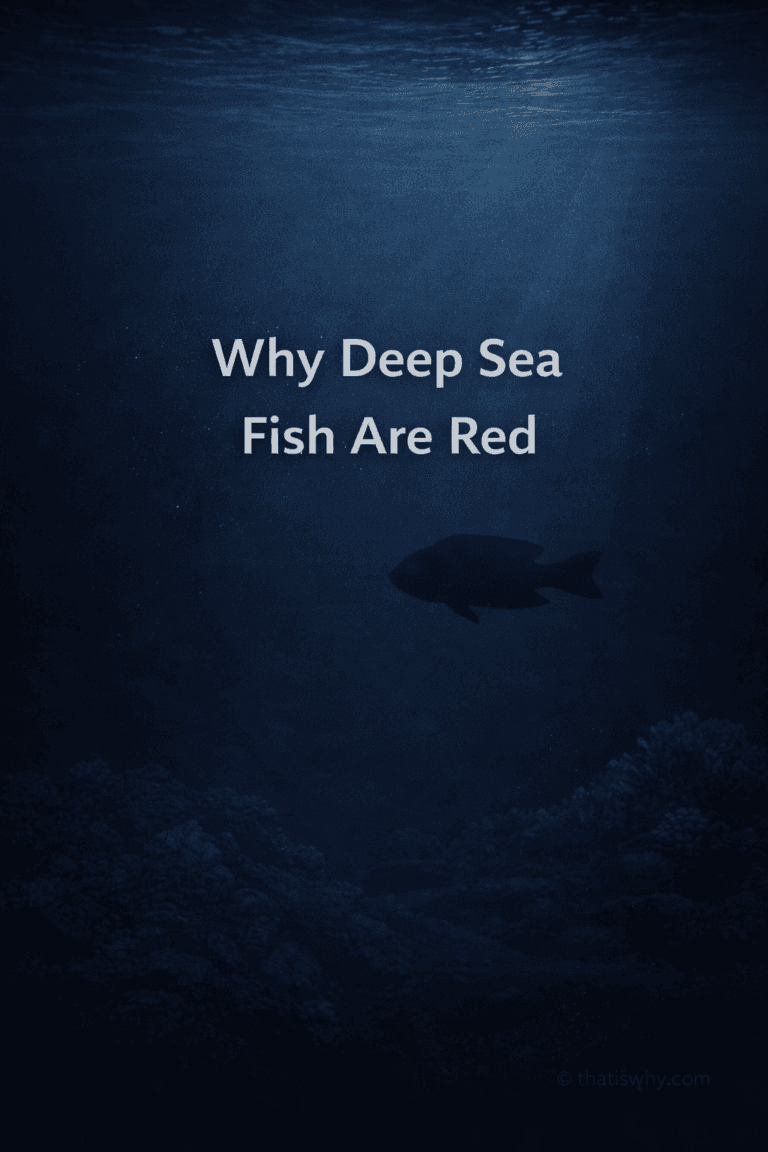
We’ve covered this before in Why deep sea fish are red, but it’s worth repeating because it’s so clever. Water acts like a blue filter. It absorbs red light instantly. In the deep ocean, red light physically does not exist.
If you wear a red suit in a blue room, you don’t look red. You look black. Animals like the Fangtooth use this physics trick to vanish. They absorb the blue searchlights of predators and reflect absolutely nothing back. They become walking voids, invisible to the night-vision goggles of their enemies.
Military Mimicry
This arms race between detection and stealth isn’t just for fish. We use the exact same physics in our own wars.
The B-2 Spirit Bomber The Stealth Bomber is basically a mechanical deep-sea fish.
It uses Radar Absorbent Material (the Red Suit) to stop signals from bouncing back to the enemy. It uses flat, angular shapes (like the Transparency trick) to deflect radar waves away from the receiver. We are spending billions trying to build a metal version of a Glass Squid.
Digital Eyes Every time you take a low-light photo with your phone, you are mimicking a deep-sea eye. Engineers are constantly trying to increase the “ISO” (sensitivity) of sensors, which is just a fancy way of packing more “digital rod cells” into the camera to catch photons in the dark.
Seeing in the Dark
Because the abyss is pitch black, we assume the animals there must be stumbling around blindly. That is a huge misconception.
Myth #1: “Deep sea animals are blind.”
The Truth: Only the ones that bury themselves in the mud are blind. The swimmers have the best eyes on Earth. They have to. In a world lit by bioluminescent flashes, being blind is a death sentence. They aren’t stumbling; they are sniping.
Myth #2: “Transparency is perfect.”
The Truth: It has a fatal flaw: The stomach. You can make your skin transparent, but you can’t make your lunch transparent. If a Glass Squid eats a glowing shrimp, that shrimp will shine right through its body like a beacon. To fix this, many transparent animals have opaque, mirrored stomachs to hide the evidence. It’s like putting a blackout curtain over your digestive system.
The Eternal Arms Race
The deep ocean isn’t an empty void. It is a crowded room where everyone is playing a deadly, high-stakes game of Laser Tag.
The Hunters are scanning the dark with eyes the size of dinner plates, hunting for a single spark. The Hiders are drifting by in suits made of living glass or cloaks of red velvet, betting their lives on their invisibility.
It is a world of extreme optics, where the only way to survive is to master the physics of light. You either see everything, or you ensure that nothing can see you. And in the dark, there is no second place.
How We Researched This :
To understand this visual arms race, we synthesized the principles of Optical Physics (specifically Refraction and Wavelength Attenuation) with marine biology studies on Retinal Density.
But we knew that just citing physics textbooks isn’t helpful. Our real job began when we asked, “What does this feel like?” That question led us to the “Laser Tag” analogy—a simple story to make the complex biological battle between detection and evasion feel intuitive.