Why Salmon Can Find Their Way Home Using a Chemical “Zip Code”
They leave home as juveniles, disappear into the open ocean for years, then return to the exact stream where they were born. No map or memory of the route it’s just chemistry.
Remembering a Place You’ve Never Seen Again
Salmon perform one of the most precise migrations on Earth. After hatching in freshwater, they are swept downstream, enter the ocean, and spend years roaming thousands of miles of open water. When the time comes to reproduce, they reverse course and return, not just to the right coastline or river system, but to the exact stream where their life began.
This is the part that tends to sound magical. How does an animal find a place it hasn’t visited since childhood, especially when ocean currents erase visual landmarks and reshape the environment constantly?
Salmon don’t remember home as a picture instead they remember it as an address.
The Chemical Zip Code
When young salmon, called smolts, begin their journey from freshwater to the sea, their brains undergo a brief but crucial learning phase. During this window, they lock in the unique chemical signature of their natal stream. That signature isn’t one smell but a combination of dissolved amino acids, minerals, and organic compounds carried by the water.
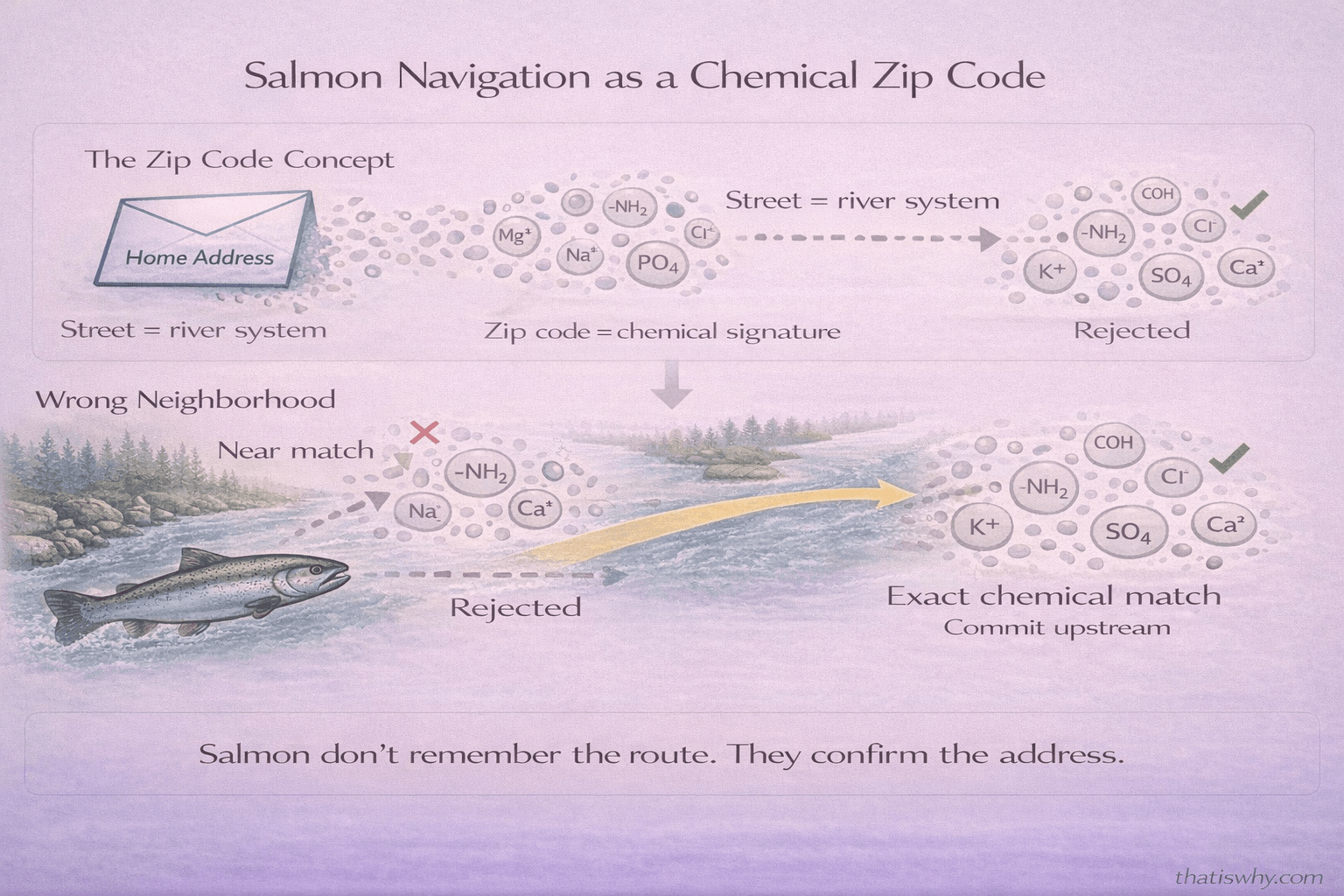
Think of it as a zip code made of chemistry.
Each stream has its own blend, shaped by local geology, plants, microbes, and upstream tributaries. Two rivers can look identical to us and still carry very different chemical “addresses.” The salmon doesn’t need to understand what those chemicals are. It only needs to recognize whether the pattern fits.
That memory doesn’t fade. It sits quietly in the background while the fish grows, feeds, and survives at sea.
The Ocean Crossing: Getting to the Right Neighborhood First
In the open ocean, that chemical zip code isn’t useful yet.
Currents mix everything. Water masses collide and disperse scent in all directions. Even an extraordinarily sensitive nose can’t follow an address when the ink has been smeared across an entire continent.
So the salmon switches strategies.
During the ocean phase, navigation becomes coarse rather than precise. Research suggests salmon rely on broad cues like Earth’s magnetic field and the position of the sun to stay oriented and reach the correct coastline. This isn’t about finding home. It’s about getting into the right neighborhood.
The zip code doesn’t disappear, it just waits.
Following the Zip Code Upstream
Once the salmon leaves saltwater and enters freshwater again, the problem finally becomes solvable.
Rivers behave differently from oceans. Water flows in one direction. Tributaries feed in predictably. Chemical signals stop dispersing and start stacking. As the salmon moves upstream, the chemical environment becomes more specific rather than less.
This is where the address begins to resolve.
The fish continuously samples the water flowing past its mouth and gills, comparing what it senses in real time to the chemical profile it memorized as a juvenile. When the match improves, it commits to that route. When it weakens, the salmon slows down, explores side channels, and reassesses.
From the outside, this can look like hesitation while in reality, it’s careful verification. Neighboring streams can be chemically similar without being correct, and this stage of the journey rewards patience over speed.
Biologists call this process olfactory imprinting, but that phrase makes it sound passive. What’s actually happening is active filtering. The salmon keeps checking whether the address still fits and rejects near matches until only one option remains viable.
By the time it reaches its spawning ground, the journey has collapsed from an entire ocean to a single chemically correct stretch of water.
When the Zip Code Breaks
For most of evolutionary history, this system worked beautifully.
The problem is that chemical zip codes only function if the address itself remains intact.
Rivers are not just channels of water. They are information systems. Flow carries chemical signals downstream in a precise order, and salmon depend on that order being stable. When we dam rivers, divert water, or reroute flows through concrete channels, we don’t just block movement. We scramble the address.
Hatcheries introduce a different failure mode. Juvenile salmon raised in artificial channels may imprint on chemical profiles that don’t correspond to natural spawning grounds. Years later, they return faithfully to an address that no longer leads to a viable destination.
In both cases, the navigation system works exactly as designed. The map has simply been rewritten.
This is why salmon declines are so difficult to reverse. The issue isn’t effort or intelligence. It’s that the environment no longer holds a clean address to read.
When Navigation Becomes a Language, Not a Sense
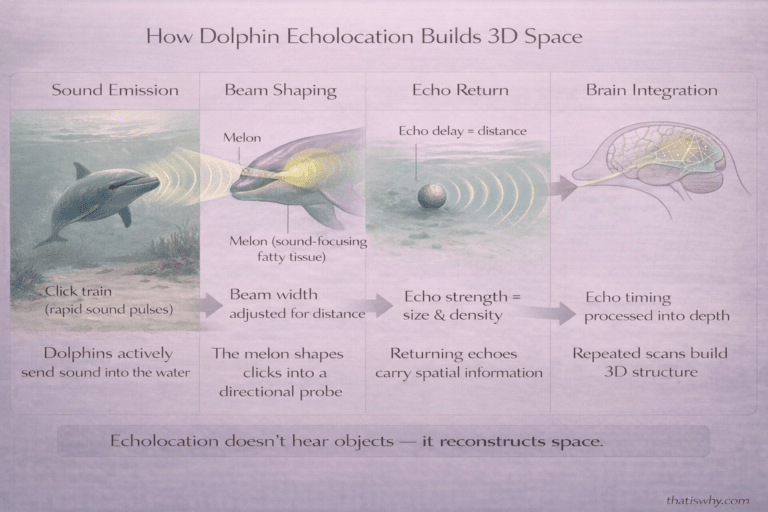
Ants read layered pheromone trails as distance and reliability, not just smell. Dogs reconstruct timelines from scent rather than objects. Dolphins, hunting in murky water, interrogate their surroundings with sound instead of light, extracting structure rather than images.
In each case, the sense itself is secondary. What matters is the translation.
Salmon take this idea to an extreme. They turn chemistry into coordinates, using smell not to explore the world but to verify their position within it. Every upstream decision answers the same question: does this still fit?
Salmon Navigation Myths That Miss the Point
Myth #1: Salmon simply follow Earth’s magnetic field all the way home
Truth: Magnetic cues help with long-distance orientation in the ocean, but they are far too coarse for pinpointing a specific stream. Chemical information is essential for the final approach.
Myth #2: Salmon remember the route like a mental map
Truth: Salmon don’t recall paths or landmarks. They continuously compare live chemical input to a stored reference, adjusting in real time.
Myth #3: If the scent is present, salmon will always find their way
Truth: The order and structure of chemical signals matter. When flow is altered, the address may no longer resolve even if the ingredients remain.
When the World Carries the Map for You
What makes the salmon’s journey remarkable isn’t just the distance or the endurance. It’s the discipline.
We often think of perception as something that happens inside the brain, but salmon show another option: let the environment do part of the work. The river holds the map while the chemistry holds the coordinates. The animal’s job is simply to keep asking whether what it’s sensing still fits.
It’s the same pattern you see elsewhere in the animal world, just expressed through a different medium. Dolphins, for example, don’t rely on light in dark water any more than salmon rely on landmarks in the open ocean. They read structure from sound instead of smell, but the principle is identical: don’t imagine the world, interrogate it.
What these systems have in common is restraint. They don’t overwhelm the brain with raw data. They translate the environment into something navigable, then trust that translation completely.
The salmon’s chemical zip code shows that finding your way doesn’t always require vision, memory, or even experience, but a world stable enough to hold an address and a navigator patient enough to verify it. It’s a quiet reminder that intelligence isn’t always about building better tools or sharper senses. Sometimes it’s about recognizing that the environment already carries the information you need, as long as you know how to read it.
How We Researched This :
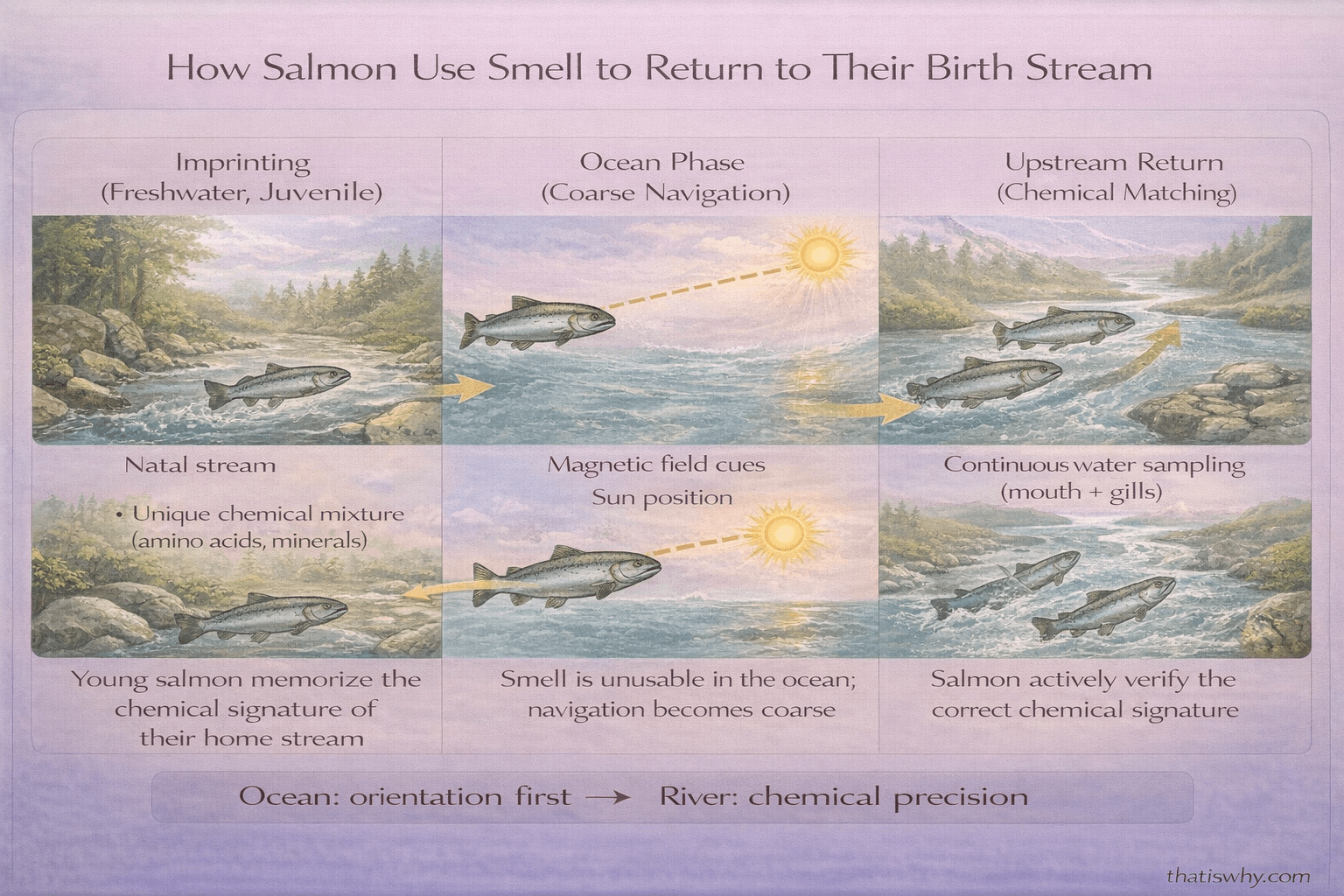
To explain how salmon navigate back to their birth streams using smell, we focused on experimental work in sensory biology and animal navigation rather than migration folklore. That included classic imprinting research by Arthur Hasler, modern behavioral and neurobiology studies published in journals like Proceedings of the National Academy of Sciences and Journal of Experimental Biology, as well as synthesis and field research summarized by NOAA Fisheries.
But we knew that simply naming terms like olfactory imprinting wouldn’t make the system intuitive. Our real work began when we asked, “What does this feel like ” That question led us to the “chemical zip code” analogy, a simple way to make complex sensory biology visual, concrete feel intuitive