Why Do Deep Sea Fish Explode When Brought Up?
If you have ever reeled up a deep-water fish and seen its eyes bulging or its stomach pushed out through its mouth, you probably wondered whether something inside it exploded. The truth is less dramatic and far more predictable: when pressure drops rapidly, trapped gas expands.
That single rule explains almost everything you are seeing.
The Fish That Came Up Wrong
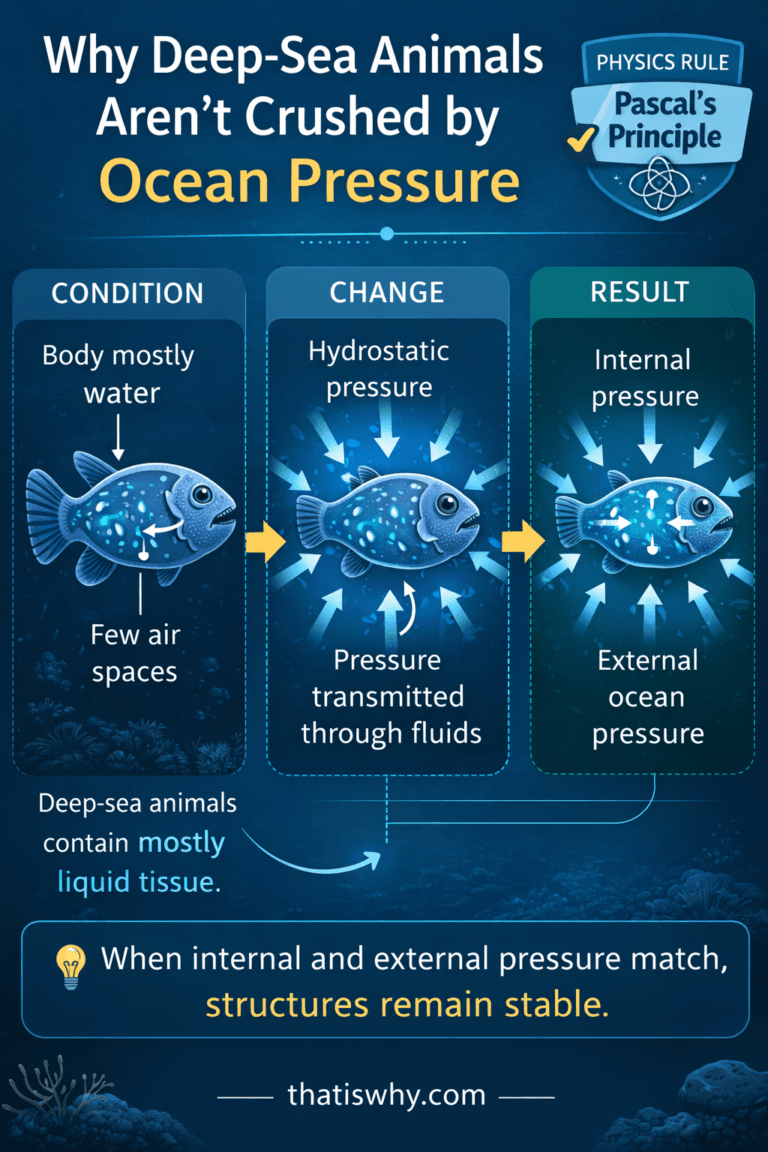
In previous article about the physics of pressure we saw why deep sea fish don’t implode, but when you try to get healthy-looking rockfish or red snapper from a hundred feet down, admire its color and size, and then notice that something about it looks deeply wrong.
Its eyes appear swollen and pushed outward, as though something inside the skull is pressing forward. In some cases, the stomach protrudes through the mouth like an inflated pink sac. The body feels unnaturally tight, stretched from the inside.
The first response is usually confusion followed by concern. Many anglers assume they reeled it in too quickly, that the fish was diseased, or that something ruptured internally.
The explanation is neither infection nor spontaneous internal failure. The explanation is pressure change governed by Boyle’s Law, which states that when external pressure decreases, the volume of trapped gas increases.
Unlike the blobfish, which collapses into a soft mass when brought up from depth because it relies on liquid-based buoyancy rather than trapped gas, many deep-sea fish contain a gas-filled organ called a swim bladder. That difference determines whether a fish melts or inflates during ascent.
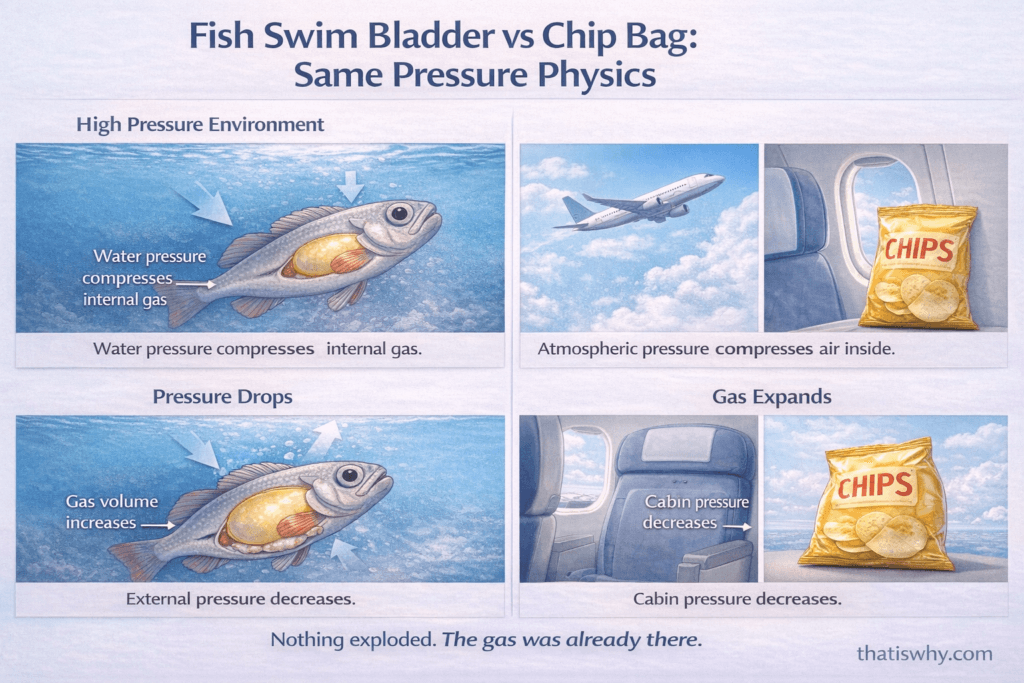
If you have ever taken a sealed bag of chips onto an airplane, you have already seen this principle at work. The bag appears normal at ground level, but as the aircraft climbs and cabin pressure drops, the air inside expands, stretching the packaging tight and puffing it outward.
Nothing new entered the bag during the flight. The gas was already there, compressed under higher pressure.
The fish on your line behaves the same way.
The Swim Bladder Is the Balloon Inside the Fish
Most deep-water fish carry an internal organ called a swim bladder, which is essentially a soft, gas-filled sac that allows them to hover in the water without constantly swimming. You can think of it as a built-in balloon that helps the fish stay balanced at a particular depth.
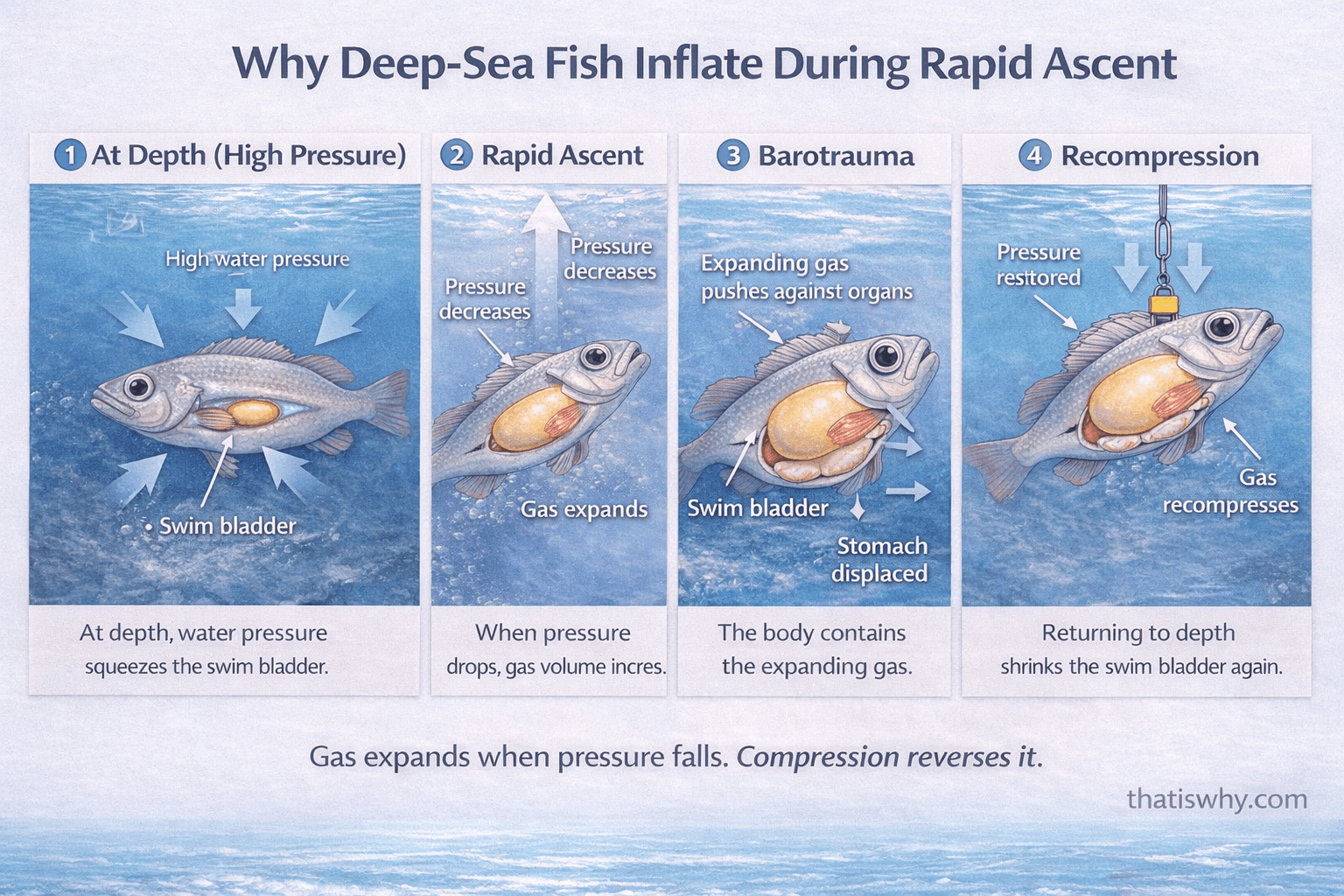
When a fish is one hundred feet below the surface, the weight of all the water above it presses inward with significant force. That pressure squeezes the gas inside the swim bladder into a smaller space, keeping it compact and stable inside the fish’s body. At that depth, everything is balanced because the water pressing inward matches the gas pressing outward.
As the fish is reeled toward the surface, the surrounding pressure decreases steadily. With less water pushing inward, the gas inside the swim bladder begins to expand. Gas always expands when pressure drops, and it does so automatically without waiting for the fish to adjust.
The sealed chip bag on an airplane shows the same principle in a familiar way. At ground level, the air inside the bag is compressed by normal atmospheric pressure. As the plane climbs and cabin pressure decreases, the air inside expands and stretches the bag tight. Nothing new enters the bag during the flight because the gas was already present, and only the surrounding pressure changed.
The fish experiences that same environmental shift as it rises. At depth, the gas inside its swim bladder is tightly compressed. As it ascends quickly, the drop in surrounding pressure allows that gas to expand. Unlike a chip bag, however, a fish’s body contains organs and tissues that cannot stretch freely. The expanding gas pushes outward against everything around it, and the body must absorb that force.
When the ascent happens slowly, some species can gradually adjust the gas inside their swim bladder. When the ascent happens quickly, the gas expands faster than the fish can compensate, and internal pressure builds rapidly.
What Happens When the “Chip Bag” Is a Living Body
When a sealed bag of chips puffs up on a flight, the plastic stretches outward because the air inside is expanding faster than the air outside is pressing back. The bag becomes tight and swollen because the balance between internal and external pressure has shifted.
Now imagine that instead of plastic packaging, the expanding air is trapped inside a living body.
The swim bladder sits inside the fish like that sealed pocket of air. At depth, water pressure presses inward from every direction, keeping the gas compressed and stable. As the fish rises quickly, the surrounding pressure weakens. The gas inside expands immediately, just like the air inside the chip bag.
The difference is that a fish does not have empty space inside it. The expanding gas pushes against organs, muscle, and bone. The pressure redistributes inside the body and moves toward areas of least resistance.
The eyes bulge because pressure from inside the skull pushes them forward. The stomach may protrude through the mouth because it is displaced upward by the expanding bladder beneath it. Nothing detonates. The gas expands, and the body has nowhere safe to accommodate the extra volume.
The fish is not malfunctioning. It is following the same rule that stretched the chip bag tight at cruising altitude.
Why This Looks So Violent, but Follows a Simple Rule
When a scuba diver ascends too quickly, dissolved gases inside the body can expand and form bubbles in tissues and blood. Divers call this decompression sickness, or the bends, but at its core it follows the same principle. Pressure decreases, gas expands, and tissue suffers if the change happens too quickly.
The rockfish or snapper you reel up rapidly is undergoing a similar rapid decompression event. The gas that kept it neutrally buoyant at depth expands faster than the body can safely adapt.
This contrast also explains why the blobfish behaves differently. A blobfish does not rely on a gas-filled swim bladder for buoyancy, which means there is no concentrated pocket of compressed gas waiting to expand during ascent. When pressure disappears, it sags because it depended on external support rather than internal gas.
The rockfish inflates because it carried a compressed gas pocket inside its own version of the bag. The blobfish collapses because it did not.
If the Fish Is Swollen, Can It Survive?
When a sealed bag of chips swells during a flight, it does not shrink again simply because you place it back in your backpack. The air inside expanded because surrounding pressure dropped, and the only way to restore the original shape is to increase the pressure around it again.
A fish with barotrauma is in the same situation.
When you reel a rockfish up quickly and its internal “chip bag” inflates, tossing it back at the surface does not solve the problem. The expanded gas makes the fish overly buoyant, so it floats instead of descending. Without deeper water pressing inward again, the swim bladder remains expanded.
This is why many released fish with obvious swelling drift helplessly.
The solution is not to puncture the fish in an attempt to release gas. The expanding air is not sitting in the stomach waiting to be popped. It is inside the swim bladder within the body cavity. Piercing visible tissue may cause additional injury without restoring balance.
The effective solution is to return the fish to depth using a descending device. As the fish is lowered, water pressure increases. The same force that once compressed the swim bladder at depth returns and shrinks the expanded gas back toward its original size. The internal “chip bag” tightens again because the surrounding water presses inward.
If the fish is returned quickly, many species can recover. The physics that caused the inflation is also what can reverse it.
The Three Biggest Misunderstandings About Exploding Fish
Myth #1: The Fish Literally Explodes
Truth: Nothing Detonates, but the Gas Inside Expands Rapidly
When anglers say a fish exploded, they are describing how dramatic the swelling looks. There is no internal blast. The gas inside the swim bladder expands as pressure drops, and the body must contain that expansion, just like a sealed chip bag stretching tight in thinner air.
Myth #2: Fish Do Not Feel Pain During Barotrauma
Truth: The Damage Is Severe and Very Likely Painful
Fish possess nerve endings and stress responses consistent with experiencing pain. Barotrauma involves extreme internal pressure changes and organ displacement. If you imagine the force required to stretch a chip bag tight, you can picture how much internal pressure builds inside living tissue.
Myth #3: Whales and Dolphins Should Explode Too
Truth: Marine Mammals Do Not Carry a Gas “Chip Bag” Underwater
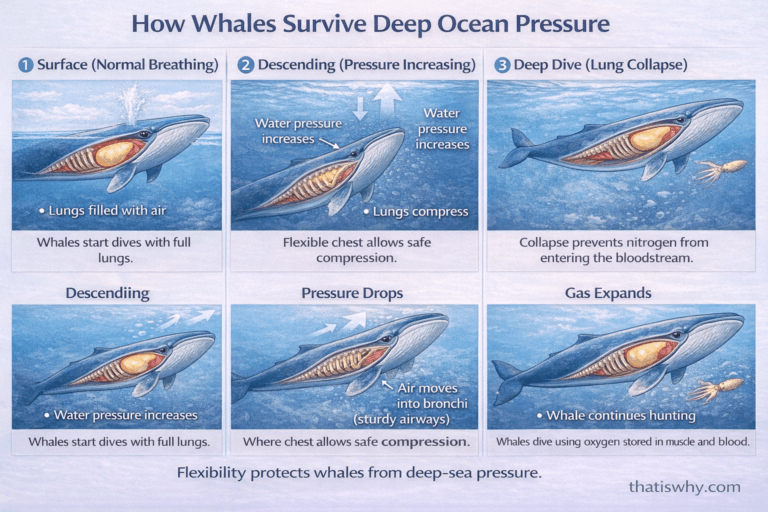
Whales and dolphins do not rely on gas-filled swim bladders for buoyancy. Their lungs collapse safely under pressure, preventing large compressed gas pockets from remaining inside during deep dives. Without a concentrated pocket of compressed gas, there is nothing to inflate dramatically during ascent.
The rule remains consistent. When pressure drops, gas expands. Whether inflation occurs depends entirely on what is inside the body.
The Fish Did Not Explode. It Entered a New Pressure World Too Quickly.
When a rockfish surfaces with swollen eyes and a stomach pushed outward, the scene looks violent enough to suggest catastrophic failure. What actually happened is far more predictable.
The fish crossed a pressure boundary too quickly.
At depth, the swim bladder was a tightly compressed pocket of gas held small by immense water pressure. As the fish rose, that pressure decreased. The gas inside expanded because gas always expands when pressure drops. The body absorbed that force because there was nowhere else for it to go.
The sealed chip bag behaves the same way. It swells when surrounding pressure falls. It does not malfunction : it responds. The fish is responding.
The broader lesson is simple. Stability depends on environment. A system that works perfectly under one set of conditions can strain under another if the transition happens too quickly.
Pressure shapes outcomes. Understanding that rule replaces shock with clarity, and clarity turns even the most dramatic sights into something understandable.
How We Researched This :
To explain this pressure-driven chain reaction, we looked at controlled pressure experiments demonstrating Boyle’s Law and gas expansion in fish swim bladders, as well as conservation research such as the study “Effectiveness of Descending Devices to Mitigate the Effects of Barotrauma among Rockfishes (Sebastes spp.) in California Recreational Fisheries.”
But we knew that simply citing pressure ratios and laboratory findings would not make the mechanics feel intuitive. Our real job began when we asked, “What does this look like in everyday life?” That question led us to the sealed chip bag on an airplane analogy, a familiar scenario that makes the relationship between falling pressure and expanding gas feel more intuitive.