Why Sound Doesn’t Travel Everywhere in the Ocean : Shadow Zones Explained
At first, it looked like an equipment problem. A signal would appear clearly on sonar steady, easy to follow and then, after the submarine changed depth by what didn’t seem like much, it would vanish. Not fade into noise, not break apart, just stop showing up.
What made it harder to explain was that the submarine hadn’t gone anywhere unusual. It was still nearby, still moving, still making the same amount of sound. In some cases, it was even closer than before.
From the outside, nothing had changed. But from the point of view of the listener, it was as if the path between them had quietly shifted.
The sound was still there. It just wasn’t reaching the same place anymore.
When Distance Stops Explaining What You Hear
What makes situations like that hard to reason through is how much we rely on distance to explain sound. If something is far away, it should be harder to hear. If it’s closer, it should be clearer. That pattern works almost everywhere else but in the ocean, that pattern can break.
You can detect something tens of miles away without much trouble, follow it for a while, and then lose it even as the distance closes. Not because it became quieter, and not because anything blocked the sound, but because the path the sound was taking no longer passed through where you were listening.
So instead of sound spreading out evenly in all directions, it behaves more selectively. Some paths carry it cleanly across long distances, while others miss you entirely, even when the source is close.
Once that starts to happen, distance stops being a reliable guide. What matters more is whether you happen to be in the path the sound is following.
A Beam That Doesn’t Go Where You Aim It
Take a flashlight and shine it through a glass of water. You point it forward, expecting the beam to land more or less straight ahead, but as it passes through the water, the light shifts slightly. It’s not a dramatic change, just enough that the spot it lights up isn’t exactly where you aimed it.
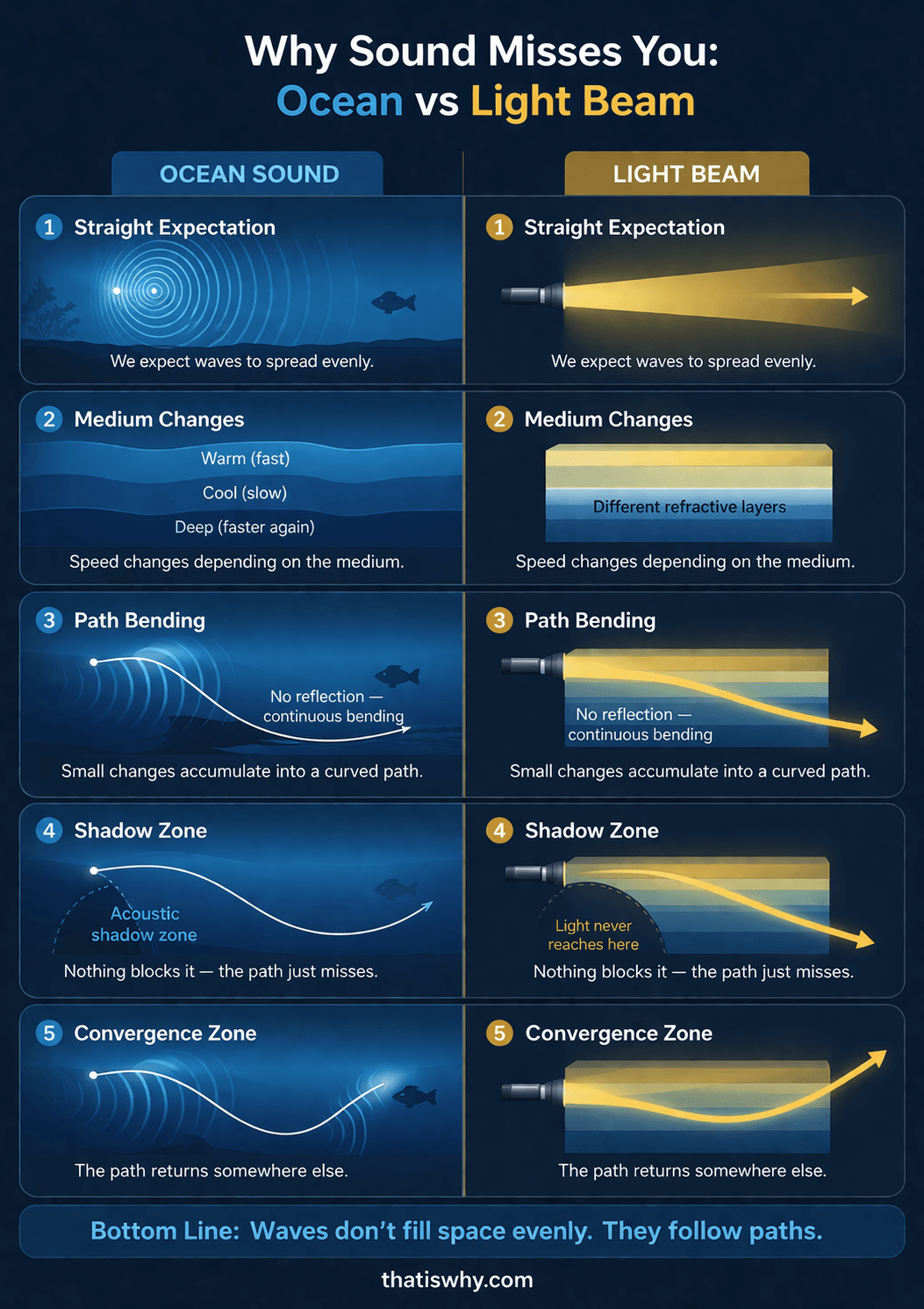
Now imagine that shift continuing instead of happening just once. As the beam moves forward, it keeps adjusting, drifting a little more with distance. Over time, that small change adds up, and the path it follows slowly pulls away from certain areas.
The result is a bit counterintuitive, you can have a space right in front of you that never gets illuminated at all, not because anything is blocking the light, but because the beam simply doesn’t pass through it.
Sound in the ocean can behave in much the same way. It doesn’t spread outward in every direction as evenly as we expect. As it travels, its path can shift just enough that it carries on past certain places, leaving them untouched even when they’re close.
Why the Path Keeps Shifting
What makes that beam drift like that isn’t something you can see directly. It comes from how uneven the ocean is as you move through it.
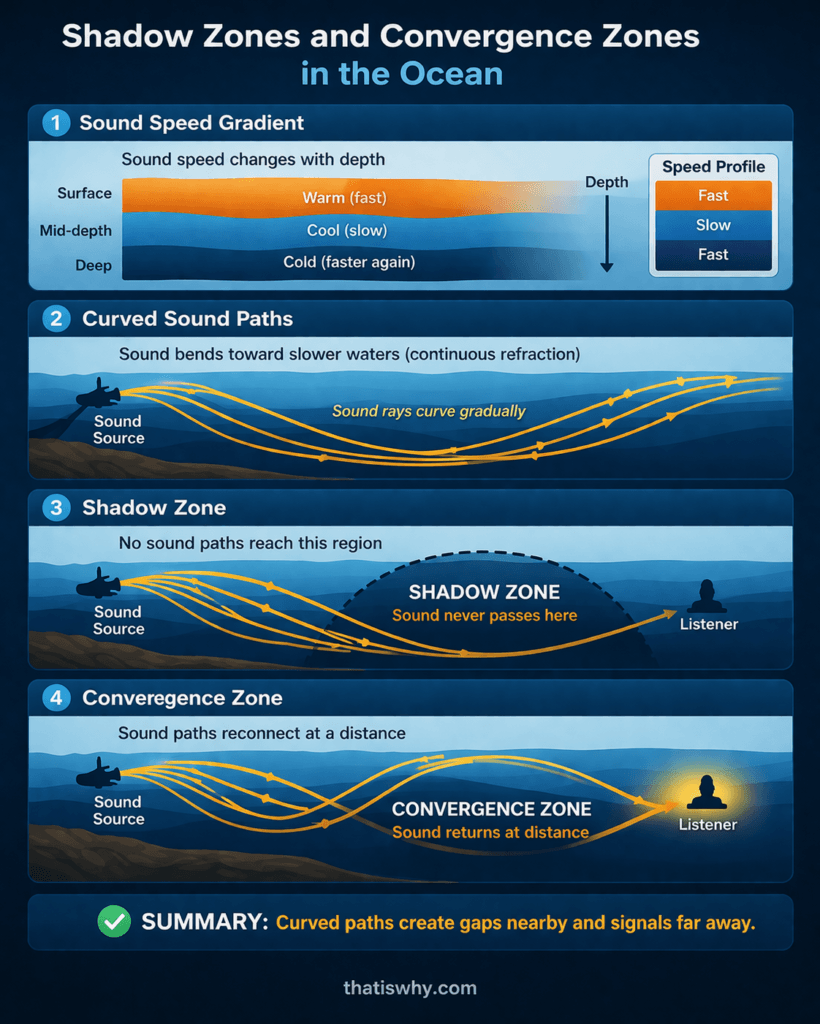
Near the surface, the water is warmer, and sound moves a little faster. Drop down a bit, and the temperature falls, and sound slows with it. Go deeper still, and pressure starts to build, and sound picks up speed again. So instead of one steady change, you end up with layers where sound is always moving a little faster or a little slower depending on where it is.
If you keep that flashlight in mind, this is what keeps the beam from staying straight. As it moves, it’s always slipping into slightly different conditions, and each small change shifts its direction just a little. On its own, the change is easy to miss, but as it keeps happening, the path starts to curve.
So the beam doesn’t spread out evenly. It drifts. It leans. And over enough distance, that’s enough to carry it away from places you might expect it to pass through.
Nothing is stopping it from getting there. It just never quite goes that way.
Where Those Missed Spaces Form
As the beam keeps curving, there are stretches of space it never quite passes through. Not because they’re far away, and not because anything is in the way, but simply because the path has already bent somewhere else. That’s what sits behind what are called acoustic shadow zones.
They aren’t areas where sound fades after reaching you. It never really gets there to begin with. The path runs past, above it, below it, sometimes just off to the side, and what’s left is a pocket that feels oddly cut off from everything around it.
From where you’re listening, it can feel confusing. Something can be close, still making sound, still active, and yet nothing arrives in a clear or steady way. Not because it’s too weak, but because the path the sound is following doesn’t pass through where you are.
So instead of the ocean being filled evenly, it starts to feel shaped, like certain directions carry sound cleanly, while others quietly miss you entirely.
Where the Sound Shows Up Again
If that path keeps drifting the way it does, it doesn’t just head off and disappear. It continues along that same curve, and given enough distance, it starts to bend back.
So while there are places nearby where the sound never passes through, there can be regions much farther away where it shows up again, still clear enough to recognize.
From the listener’s side, that can feel strangely out of sequence. A signal might be easy to pick up at a distance, steady and trackable, and then slip away as things get closer. Nothing about the source has changed, and yet the connection between the two seems to drop out. Then, farther out, it returns.
This is what sits behind what are called convergence zones, places where those curved paths bring the sound back into reach after carrying it away.
So instead of spreading outward in a simple way, the sound traces a longer route, leaving gaps nearby and then crossing paths again much farther out. You can be too close to hear something clearly, and then, at a greater distance, find yourself directly in line with it.
Moving Through What Others Can’t Hear
Many deep-diving animals move through the same layers where those paths shift. They aren’t surrounded by sound in all directions at once. Instead, it’s closer to moving through a space where some directions carry sound clearly while others fall just outside the path, even when something is nearby.
A hunting whale, for example, sends out clicks and listens for what comes back. But as it changes depth, it’s also changing how those paths line up. The sound it sends out doesn’t travel the same way at every level, and the echoes it receives don’t return along identical routes.
From the outside, it’s hard to say how deliberately this is used. But the effect is built into the space itself. Move slightly up or down, and the paths shift. What was just outside the beam can come into it, and what was clear a moment ago can slip away.
So instead of the ocean behaving like a place filled with sound, it starts to feel more like a moving pattern of paths. And depending on where you are, you can be right next to something and still fall just outside the line where the sound passes through.
What Feels Like Silence Isn’t Always Empty
Myth #1: If something is close, you should be able to hear it.
Truth: That assumption works in most places, but here it can fail in a very specific way. Something can be nearby, still making sound, and still go undetected if the path carrying that sound bends away before reaching you. Distance matters less than whether the path actually passes through where you are.
Myth #2: Shadow zones are quiet because sound disappears there.
Truth:Nothing is being turned off in those spaces. The sound is still moving, still carrying energy, just along a path that doesn’t cross that region. From the outside, it feels like silence, but it’s closer to being out of alignment than being cut off.
Myth #3: Sound spreads evenly in all directions underwater.
Truth:It might seem that way at first, but once those paths begin to curve, the spread becomes uneven. Some directions carry sound cleanly across long distances, while others are left untouched, even when they’re close to the source.
Where the Ocean Leaves Gaps in What You Hear
In one place, a path can carry a signal for enormous distances, holding it together as it moves. In another, just nearby, that same signal can pass by without ever crossing where you are, both are happening in the same water.
In the SOFAR channel the quiet room from earlier,the paths keep folding back into a narrow layer, so sound stays within reach and continues. Here, those paths drift in a different direction: they bend away, leaving spaces that never get crossed at all.
So you can end up in a part of the ocean where nothing seems to reach you, even though something much farther away is still connected to you through a path you can’t see.
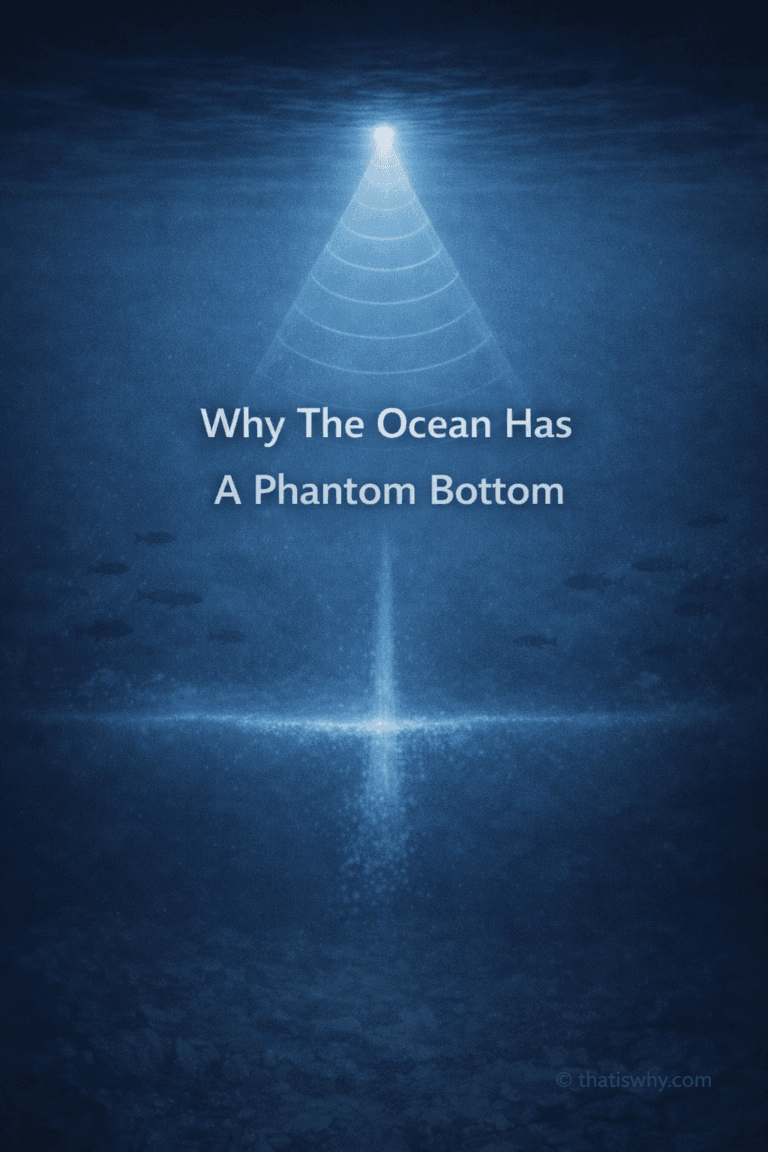
It’s a similar kind of mismatch to what shows up in the phantom bottom, where sound creates the sense of a surface that isn’t really there. In one case, something appears where there’s nothing. In the other, nothing seems to be there even when something is.
The sound hasn’t changed in either case; only the path has.
How We Researched This :
To explain how these acoustic gaps form, we looked at oceanographic research on sound propagation in layered water, including work from NOAA, naval sonar studies on convergence zones and shadow zones, and measurements of how sound speed shifts across thermoclines and deeper pressure layers.
But we knew that just citing refraction diagrams, sonar ranges, and temperature profiles isn’t helpful. Our real job began when we asked, “What does this actually feel like?” That question led us to the “flashlight-through-water” analogy—a simple way to make the idea of sound paths gradually bending and missing entire regions feel intuitive.