Why Shells Dissolve in the Deep Ocean
If you dropped a pearl into the deepest parts of the ocean, it would not simply sit on the seafloor forever.
Given enough time, it would slowly dissolve.
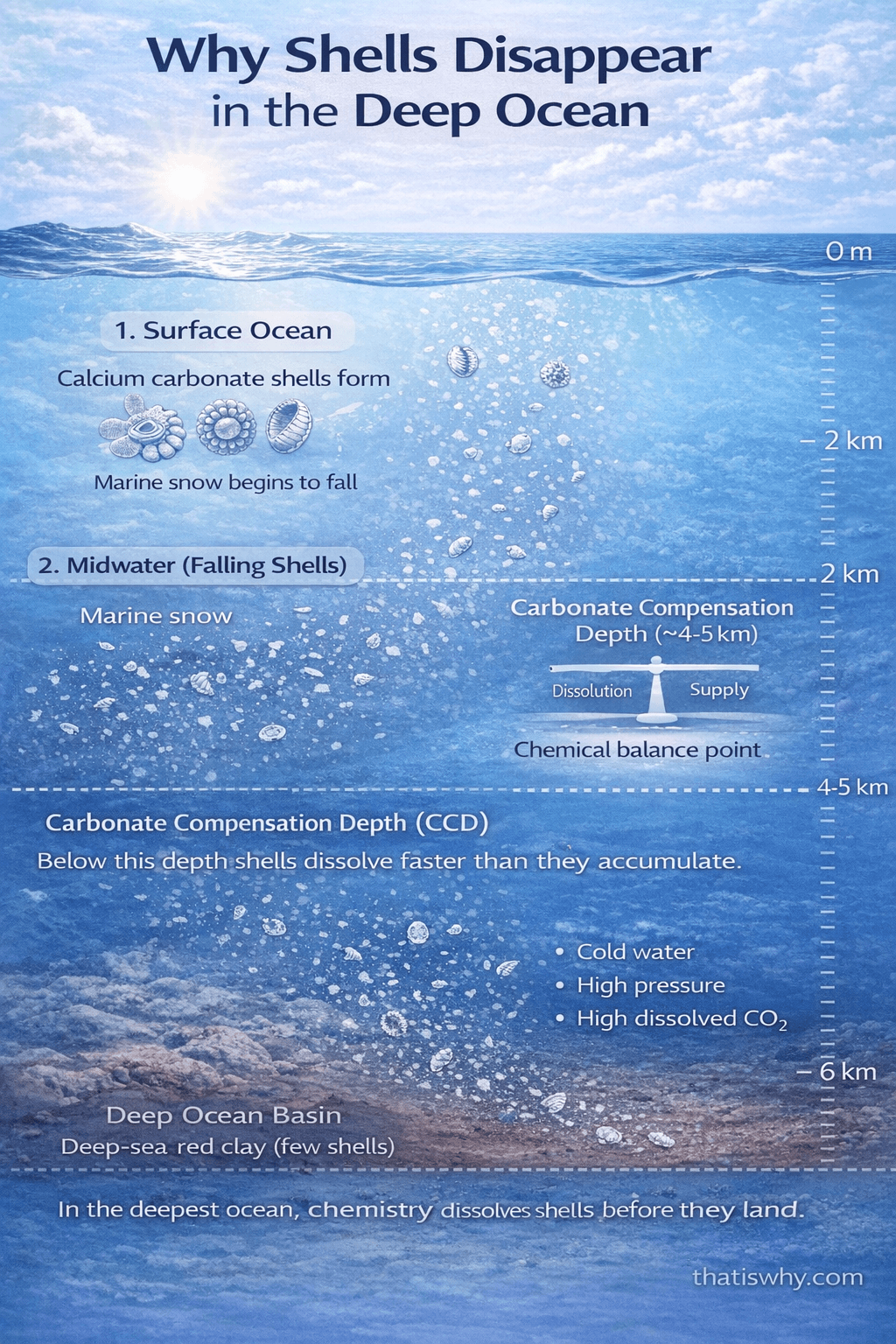
This happens because the deep ocean contains an invisible chemical boundary known as the Carbonate Compensation Depth. Somewhere between roughly four and five kilometers below the surface, seawater becomes so effective at dissolving calcium carbonate that shells and skeletons cannot accumulate on the ocean floor.
Above this depth, tiny shells and skeletons constantly drift downward like underwater snowfall. Oceanographers call this steady rain of microscopic remains marine snow. Over time those fragments settle on the seafloor and form thick layers of pale sediment.
Below the boundary, the story changes. The shells still fall, but they never make it to the bottom.
What Is the Carbonate Compensation Depth?
The Carbonate Compensation Depth, or CCD, is the depth in the ocean where calcium carbonate dissolves at the same rate that shells and skeletons sink from the upper ocean. Below this level, cold temperatures, high pressure, and dissolved carbon dioxide make seawater corrosive enough that calcium carbonate disappears before it can accumulate on the seafloor.
The Pearl That Would Slowly Disappear
A pearl is made mostly of calcium carbonate, the same mineral used by countless marine organisms to build shells and skeletons. In the shallow ocean that mineral remains stable, which is why beaches and reefs are full of shell fragments.
Deep water behaves differently.
The deeper ocean is colder, under greater pressure, and contains more dissolved carbon dioxide. Those conditions make seawater much better at dissolving calcium carbonate.The pearl would not crack or shatter, instead it would slowly fade away.
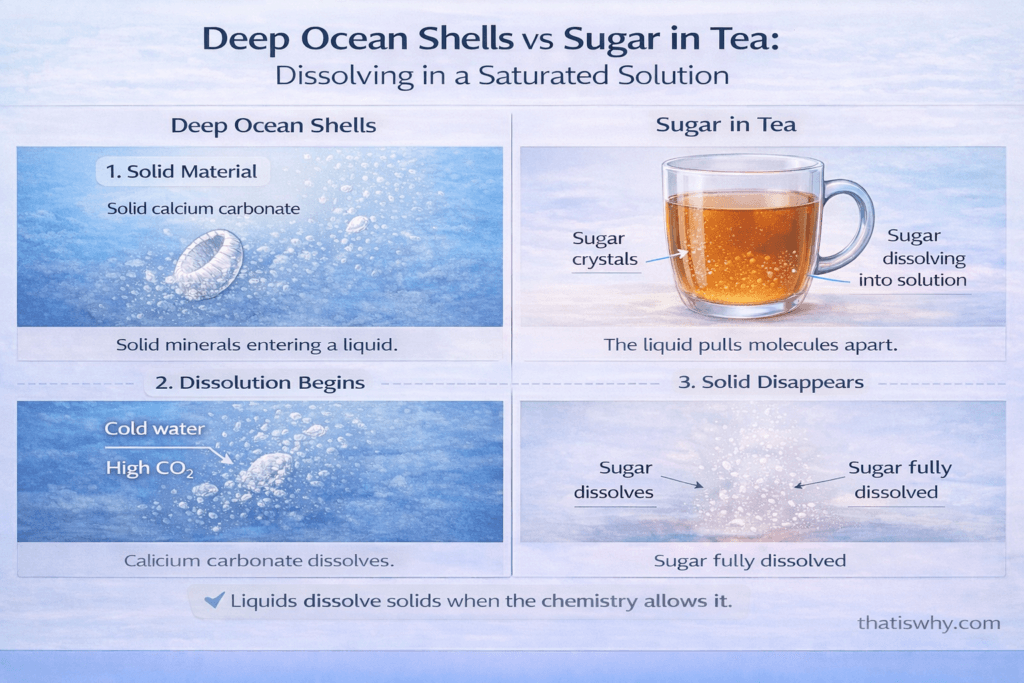
The process becomes easier to picture if you imagine stirring sugar into a cup of tea. At first the grains remain visible, but the liquid gradually pulls the crystals apart until they disappear completely.
Below the ocean’s chemical snow line, seawater behaves in a similar way toward shells. The water slowly pulls the mineral apart until nothing solid remains.
Why Deep Water Becomes “Hungry” for Shells
Imagine dropping a spoonful of sugar into hot tea. At first the crystals sink to the bottom, but the liquid slowly pulls them apart until the grains disappear. The tea is able to dissolve the sugar because the solution is not yet full of dissolved sugar.
In chemistry, the liquid still has room. The deep ocean behaves in a similar way with calcium carbonate, the mineral that forms most shells and skeletons in the sea.
Near the surface, seawater already contains plenty of dissolved calcium carbonate, which means the water is relatively stable for shells. When a shell sinks through these upper layers, the surrounding water has little chemical incentive to pull the mineral apart.
The deeper ocean is different.
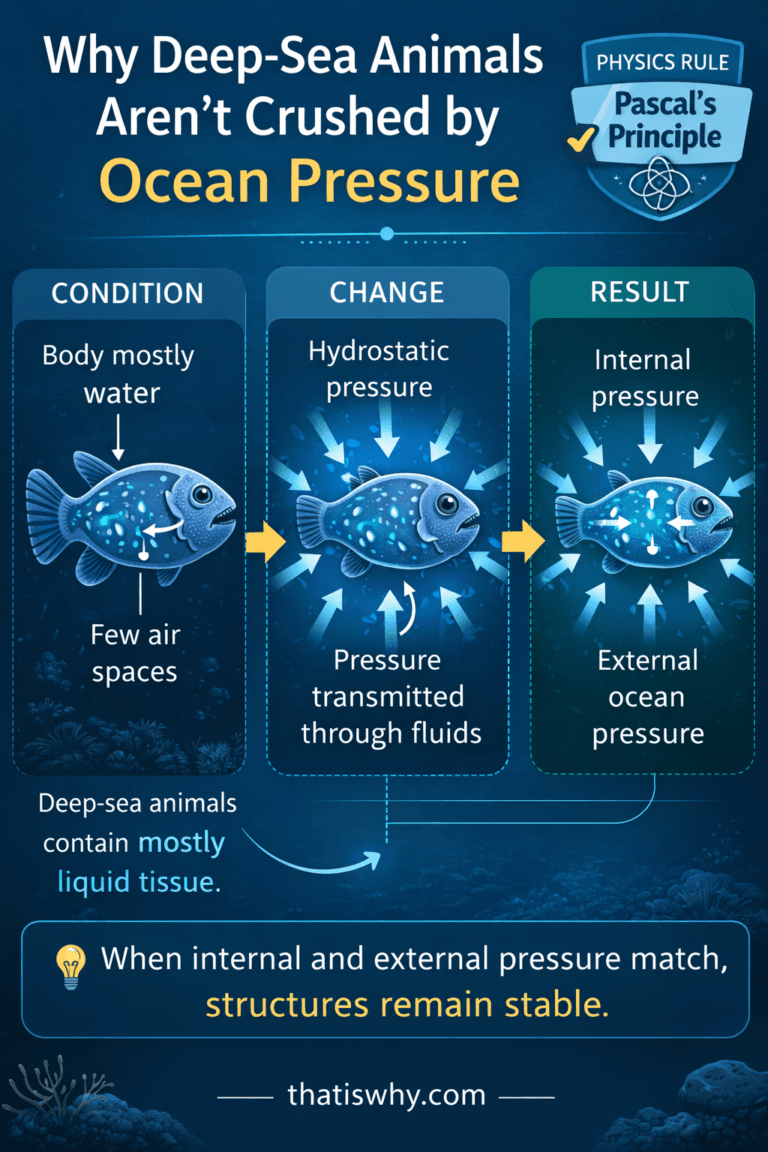
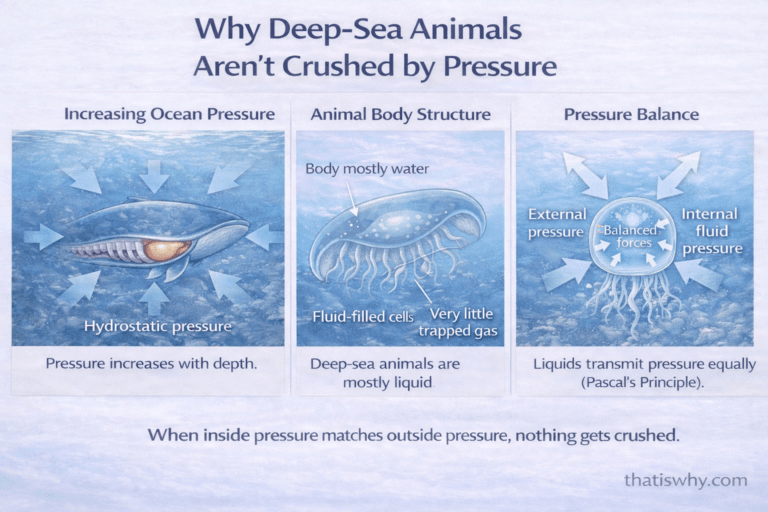
Pressure alone is not the main reason. As we explained in our guide to why the deep ocean cannot crush fluid-filled bodies, pressure mostly passes through liquids without destroying them. The real change here is chemical.
Cold temperatures, immense pressure, and higher levels of dissolved carbon dioxide change the chemistry of the water. Under these conditions, calcium carbonate becomes less stable, and seawater can hold more of it in dissolved form. That means the deep ocean behaves a little like tea that still has room for more sugar.
When a shell sinks into those depths, the water gradually pulls calcium carbonate out of the solid structure and dissolves it into the surrounding seawater.
The process is slow, but relentless. Once a shell falls below the Carbonate Compensation Depth, the rate of dissolution becomes faster than the rate at which new shells arrive from above.
The Survivors: How Trench Life Keeps Its Shape
How does anything down there keep a skeleton at all?
Life in the trenches solves this problem by quietly changing the rules. Some animals avoid building heavy mineral skeletons in the first place, while others protect their shells with coatings that slow the dissolving chemistry of the surrounding water.
One striking example is the Mariana snailfish, the deepest fish ever observed in the ocean. This animal lives nearly eight thousand meters below the surface, far beneath the ocean’s chemical snow line where ordinary shells struggle to survive.
Instead of relying on rigid mineral bones, the snailfish skeleton contains large amounts of cartilage, the same flexible material that forms the human nose and ears. Cartilage requires far less calcium than traditional bone, which makes it far less attractive to seawater that is slowly dissolving calcium carbonate.
In a sense, the fish avoids the problem by building a skeleton the water is not interested in dissolving.
Other animals take a different approach.
The Scaly-foot snail, a deep-sea snail that lives near hydrothermal vents, reinforces its shell with layers containing iron sulfide minerals. Instead of relying entirely on calcium carbonate, the snail builds something closer to natural armor.
The chemistry that quietly dissolves ordinary shells has far less effect on these metal-rich layers. These strategies reveal an important pattern in deep-sea life.
When the ocean begins dissolving your building materials, survival often means choosing different materials rather than trying to fight the chemistry itself.
When the Snow Line Starts Rising
The ocean’s snow line might sound like a distant curiosity hidden thousands of meters below the surface. Today that boundary is beginning to move.
As more carbon dioxide enters the atmosphere, a large portion of it dissolves into the ocean. When carbon dioxide mixes with seawater, it forms carbonic acid, which slightly lowers the ocean’s pH and increases the water’s ability to dissolve calcium carbonate.
In simple terms, the deep ocean becomes even better at dissolving shells.
This change gradually pushes the Carbonate Compensation Depth upward toward the surface. The invisible line where shells dissolve begins creeping into parts of the ocean that once allowed them to accumulate safely.
Imagine continuing to stir sugar into a cup of tea that is already close to dissolving its limit. Eventually the liquid becomes able to pull apart crystals that would normally remain stable.
The ocean behaves in a similar way as more carbon dioxide dissolves into seawater.
As the chemistry shifts, the safe zone for shell-building organisms becomes thinner. Corals, mollusks, and countless microscopic plankton depend on calcium carbonate to build their skeletons.
When the snow line rises, the space where those skeletons remain stable begins to shrink.
When the Ocean Becomes the Solvent
The deep ocean often feels mysterious because the forces at work there are invisible. Chemistry adds a quiet rule that determines what can exist at the bottom of the sea.
Calcium carbonate sits right on the edge of a delicate balance. In shallow oceans it remains stable enough to form reefs, shells, and microscopic skeletons that drift downward like falling snow.
In deeper water the chemistry shifts just enough that the ocean begins pulling that mineral back into solution. When sugar falls into tea, the crystals seem solid at first, yet the liquid gradually pulls the molecules apart until nothing remains visible.
The ocean performs a similar trick with shells once they sink below the Carbonate Compensation Depth. Above that boundary, shells accumulate on the seafloor while below it, the shells disappear before they ever reach the bottom.
Why the Deep Ocean Is Not a Graveyard of Shells
Myth #1: Deep pressure crushes shells
Truth: Chemistry dissolves them.
Pressure alone rarely destroys shells. The real change is chemical. Below the Carbonate Compensation Depth, seawater slowly pulls calcium carbonate out of shells the way tea dissolves sugar.
Myth #2: Shells always reach the seafloor
Truth: Many disappear before they arrive.
Tiny shells and skeletons constantly drift downward through the ocean like slow underwater snowfall. Above the snow line they settle and build thick layers of pale sediment. Below it, the falling shells dissolve along the way and never reach the bottom.
Myth #3: The deepest seafloor must be covered in shells
Truth: The deepest seafloor is mostly clay.
Because shells dissolve before they settle, the deepest ocean basins are not covered in shell fragments. Instead the bottom is made mostly of fine reddish sediment known as deep-sea red clay.
Where the Ocean Slowly Reclaims Its Minerals
When most people imagine the deep ocean, they picture pressure acting like a crushing weight, yet the deepest parts of the sea often change the world in a quieter way.
Think again about a cup of tea with sugar stirred into it. The crystals look solid when they first fall into the liquid, but the tea gradually pulls the molecules apart until the grains vanish.
The same quiet process unfolds in the deep ocean.
Below the Carbonate Compensation Depth, seawater becomes effective at dissolving calcium carbonate. As fragments of shell drift downward through the water column, the surrounding seawater slowly draws the mineral back into solution.
By the time many of those fragments would have reached the deepest seafloor, the solid structure has already disappeared.
Seen from this perspective, the deep ocean is not simply a place that buries the past : it is a place that quietly recycles it.
That pattern reflects a broader rule about how many natural systems work. Change does not always arrive through dramatic events. Often it unfolds through slow chemical balances that steadily reshape the environment, one dissolved grain at a time.
How We Researched This :
To explain why shells disappear in the deep ocean, we reviewed research in ocean chemistry, marine geology, and deep-sea biology. Foundational work by Wallace S. Broecker on ocean carbon chemistry and the global carbonate cycle, along with modern explanations from organizations like the National Oceanic and Atmospheric Administration and the Woods Hole Oceanographic Institution, helped clarify how the CCD shapes the deep seafloor.
But we knew that equations alone would not make the idea intuitive. Our real job began when we asked, “What does this actually feel like?” That question led us to the “sugar-in-tea analogy”, which makes the slow dissolving power of deep seawater feel intuitive.