Why the Immortal Jellyfish Still Loses the Game
If you injure yourself, the body does what it can and leaves a scar.
If you injure Turritopsis dohrnii, something far stranger happens: instead of trying to heal forward, the animal collapses its adult body and becomes young again.
This tiny jellyfish is often called “immortal,” not because it can’t be killed, but because it can restart its own life cycle. When it becomes injured, starved, or stressed, it abandons adulthood entirely and rebuilds itself from scratch.
That sounds impossible.
It isn’t magic : it’s biology making a very unusual decision.
The Life Cycle: Living With a Save File
Here’s the simplest way to make sense of what this jellyfish is doing.
Imagine a game you’ve put hours into. Once the character is built and the run is underway, every mistake sticks. Damage accumulates, options narrow, and eventually the run ends. There’s no way to return to an earlier version and try again.
That’s how life works for almost every animal on Earth.
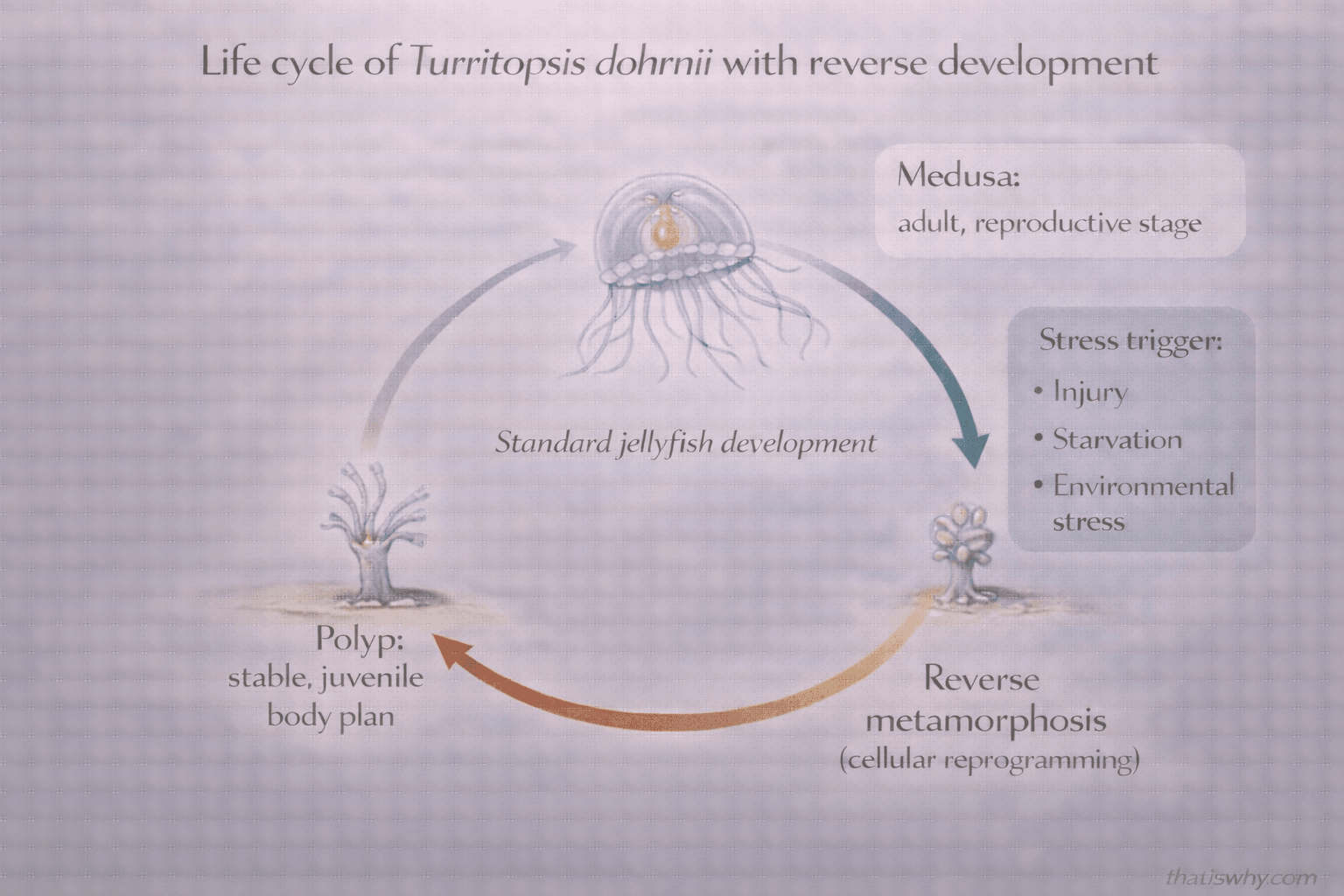
Jellyfish are no exception. They begin life as a polyp, a small, rooted form attached to a surface. Over time, that polyp produces a free-swimming adult called a medusa, the jellyfish shape we recognize. The medusa feeds, reproduces, weakens, and eventually dies. Once that adult body starts to fail, there’s nothing to fall back on. The system only moves forward.
Now here’s where Turritopsis dohrnii quietly breaks the pattern.
It’s still a jellyfish, and it follows the same polyp-to-medusa life cycle as the others. Nothing about its early development is unusual. The difference only shows up when the adult stage is clearly no longer viable.
When a typical jellyfish medusa is injured, starved, or worn down by age, it keeps going until the damage overwhelms it. Turritopsis, faced with the same situation, doesn’t try to patch a failing body or push through and hope for the best. When the adult form is past the point of recovery, it abandons that version altogether.
The tentacles retract. The bell collapses. The adult body contracts into a dense, jelly-like mass that sinks to the seafloor and attaches itself to a surface. At that point, the adult jellyfish you were watching is gone. That run has ended.
But the story doesn’t.
From that compact mass, the organism reorganizes itself into a polyp, the same early form it once started from. The genetic instructions remain intact, but the adult structure, along with the accumulated damage and limits that came with it, is left behind. Instead of continuing from a state that was clearly failing, the life cycle resumes from a configuration that already works.
What’s happening here isn’t healing or repair in the usual sense, and it definitely isn’t time running backward. The jellyfish isn’t fixing damage or undoing age so much as making a practical decision: it refuses to keep playing a version of itself that can no longer function, and instead resumes life from an earlier configuration it never erased.
Most animals don’t get that choice. This one does.
The Mechanism: Why the Save File Still Exists
Once you accept that the jellyfish can reload, a deeper question naturally follows.
If the adult body disappears, how does an earlier version still exist at all?
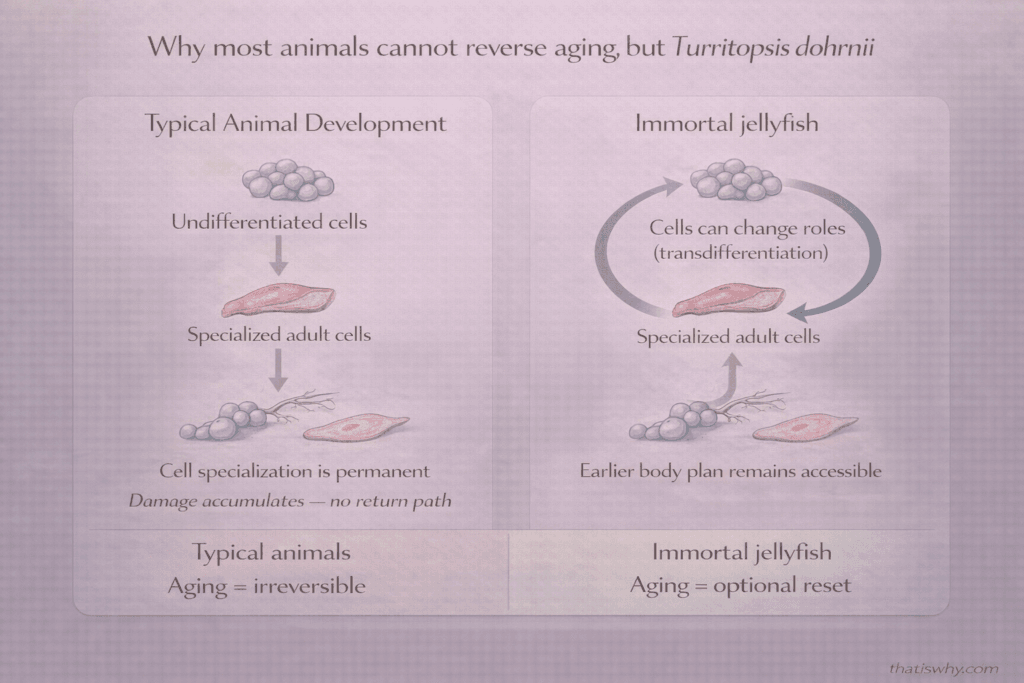
In most animals, it doesn’t. As bodies develop, they behave like systems that overwrite their own progress. Cells specialize as the organism grows. Muscle cells commit to contracting, nerve cells commit to signaling, skin cells commit to protecting. Each upgrade makes the current version more efficient, but it also assumes you’ll never need the earlier ones again.
That assumption explains why aging usually feels final. When a body starts to fail, there’s no earlier configuration left to return to.
Turritopsis dohrnii never fully commits to that model.
When the adult jellyfish collapses into its compact mass, the system doesn’t lock those late-stage roles in place. Cells step out of their adult jobs and return to a more flexible state, similar to how they behaved earlier in development. Instead of trying to repair a body that’s already failing, the organism drops that version entirely.
What it loads instead is a configuration that already exists.
The polyp isn’t just a childhood phase the jellyfish grows out of. It’s a stable version that remains available in the background, even while the adult form is running. When the adult configuration becomes too fragile to continue, the jellyfish exits that run and resumes life from the earlier one.
Seen this way, nothing about the process is magical. Time doesn’t reverse, and damage isn’t undone. The jellyfish simply refuses to keep playing a version of itself that can no longer work, and instead continues from a save it never deleted.
Most animals overwrite their past as they go. This one doesn’t.
When Restarting Beats Repair
Most living systems are built around repair. When something breaks, they patch it, reinforce it, and try to keep going. That works well, until damage stacks faster than it can be fixed. At that point, repair becomes a liability.
The jellyfish shows a different strategy: instead of endlessly maintaining a failing structure, it keeps access to a simpler, earlier configuration and isn’t afraid to return to it.
You can see versions of this logic all over biology.
Plants do it when they drop leaves instead of repairing them through winter. Some insects do it when they enter complete dormancy rather than trying to survive harsh seasons in an active state. Even at the cellular level, programmed cell death exists for the same reason: sometimes deleting and rebuilding is safer than fixing what’s already compromised.
What makes Turritopsis dohrnii special is that it applies this strategy to an entire body, not just a part of one.
Instead of treating adulthood as sacred, it treats it as conditional. Useful while it works. Disposable when it doesn’t.
Once you notice that distinction, the jellyfish stops feeling like a biological glitch and starts looking like an extreme version of a very old rule: systems survive longest when they know which states are worth preserving, and which ones aren’t.
Immortal Jellyfish Myths: What’s True — and What Isn’t
Myth #1: The immortal jellyfish can’t die
Truth: Turritopsis dohrnii can still die from predators, disease, or physical destruction. What it avoids is one specific losing condition: aging. The reset works against time, not against the world.
Myth #2: The adult jellyfish is the “real” form
Truth: In this species, adulthood is a temporary build, not the core identity. The polyp is the stable configuration. The medusa is a useful but fragile extension that gets abandoned when conditions turn against it.
Myth #3: This is about extreme longevity
Truth: This isn’t a lifespan trick. It’s a failure-management strategy. Instead of stretching a body past its limits, the jellyfish exits a failing configuration and resumes from a simpler one where those limits don’t exist yet.
Myth #4: This is a preview of human immortality
Truth: The ability depends on staying biologically simple enough that early configurations remain viable. Human bodies trade that flexibility for specialization very early on. What works for a jellyfish would collapse a system as complex as ours.
The Takeaway: Knowing When to Reload
It’s easy to look at Turritopsis dohrnii and imagine a fantasy of endless life, as if it’s found a cheat code the rest of biology somehow missed. But once you sit with the details, a different picture comes into focus.
This jellyfish doesn’t succeed by holding on longer or pushing harder. It succeeds by recognizing when a run has gone bad. When the adult body becomes too damaged, too rigid, or too costly to maintain, it doesn’t cling to that version out of loyalty or habit. It exits, reloads an earlier save, and starts again from a state where the system still works.
We tend to admire persistence above all else. We praise endurance. We tell ourselves that quitting is failure. But biology, at least in this corner of the ocean, is offering a quieter suggestion: sometimes the smartest move isn’t to keep playing a run that’s clearly unwinnable, but to let it go and return to a version where flexibility and possibility still exist.
The jellyfish isn’t immortal because it never loses. It’s “immortal” because it knows exactly when to reload.
How We Researched This :
To explain how the so-called immortal jellyfish restarts its life cycle, we relied on documented laboratory observations of Turritopsis dohrnii, from Stefano Piraino’s original description of reverse metamorphosis in 1996 (Biological Bulletin), followed by later cellular studies on transdifferentiation published in PNAS and reviewed by institutions like the Smithsonian Ocean Portal.
But we knew that just citing cellular terminology and life-cycle diagrams isn’t helpful. Our real job began when we asked, “What does this feel like?” That question led us to the save-file analogy—a simple story to make the complex biology of cellular reprogramming feel intuitive.