Why the Platypus Breaks the Rules of Mammals And How They Were Made
When the first platypus specimen arrived in England in 1799, scientists didn’t know what to do with it.
They genuinely thought someone was playing a joke. A duck’s beak stitched onto a beaver’s body and shipped halfway across the world for a laugh. One anatomist reportedly grabbed a pair of scissors and tried to cut the beak off.
Honestly? I get it. Even today, the platypus feels like an animal designed after a very long meeting where nobody agreed on anything.
It lays eggs while producing milk, hunts by sensing electricity instead of using sight, carries venomous spurs on its legs, and somehow still qualifies as a mammal by every biological definition we have.
So the obvious question is: what is this thing supposed to be?
Here’s the part that usually gets missed – the platypus isn’t a mistake : it’s a snapshot.
The Platypus Problem
We like our categories neat. Mammals here, reptiles there, clear lines no overlap.
Mammals, especially, feel like a finished product. Fur, warm blood, nipples, live birth. You either get the full set or you don’t.
The platypus ruins that story.
It belongs to a small group called monotremes, which split from the rest of the mammal family around 160 million years ago. That number matters, because it drops the platypus right into the middle of mammalian construction, when traits were still being added one by one.
This is where people usually imagine evolution going wrong. It didn’t.
Evolution just wasn’t done yet.
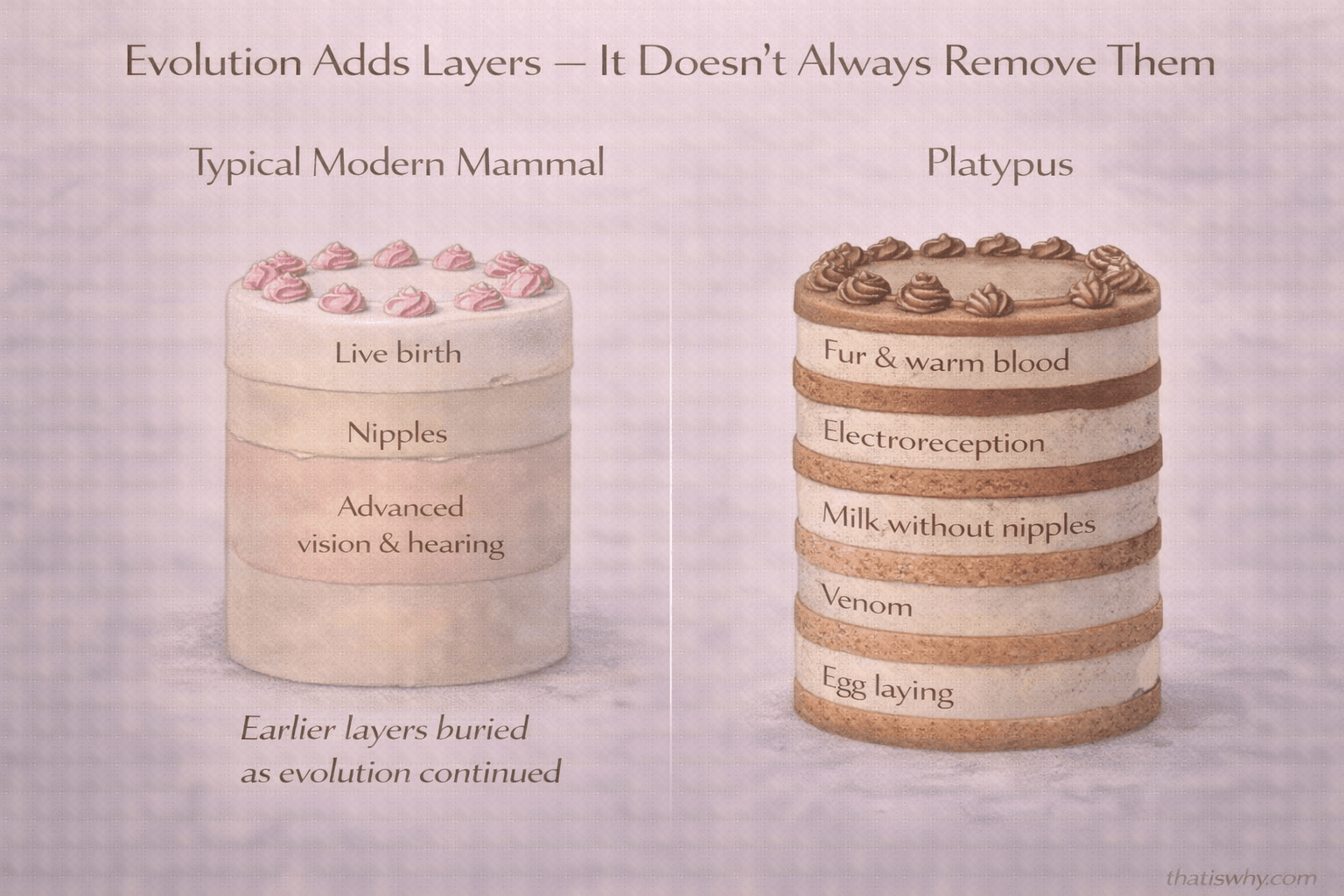
The easiest way to picture this is to stop thinking about evolution as a straight line and start thinking about it as a cake still in the oven. Ingredients get added, layers form, and sometimes the structure works perfectly well long before the decorations show up.
The platypus isn’t the finished cake.
It’s what the cake looked like halfway through, and it already tasted good enough to keep.
The Milk Patch: Lactation Before Nipples
Milk feels like the most mammalian thing there is. If you had to name one defining feature, that would probably be it.
Which is why the platypus immediately causes problems.
Female platypuses don’t have nipples. Instead, milk seeps from pores in the skin of the belly, pools in shallow grooves, and the young press their faces into the fur and lap it up.
At first glance, that sounds inefficient, a little messy almost unfinished.
That reaction makes sense, and it’s also exactly backwards.
Milk didn’t start as baby food. Early mammal ancestors were still laying soft eggs in damp burrows, which are basically perfect breeding grounds for bacteria. Skin secretions rich in fats and antimicrobial compounds helped keep those eggs hydrated and protected.
Nutrition came later but nipples came even later.
Most mammals added that delivery upgrade once live birth became the norm. The platypus didn’t need to, because the original system still worked.
The filling was already there. The fancy piping came later.
The Sixth Sense: Seeing With Electricity
The platypus bill looks ridiculous until you understand what it’s actually doing.
It isn’t a beak in the bird sense. It’s soft, flexible, and packed with sensors. When a platypus dives underwater, vision becomes unreliable, sound scatters, and smell dissolves into the current.
Instead of fixing those senses, evolution kept an older one exposed.
Every muscle contraction produces a faint electrical signal. A shrimp flicks its tail. A worm tightens its body. Those signals leak into the surrounding water. As the platypus sweeps its bill along the riverbed, it feels them directly and builds a working picture of where prey is hiding.
This sense is ancient.
Fish and sharks still use it today. As mammals moved onto land, sharper vision and better hearing were layered on top, and this older sense was buried.
In the platypus it never was the case, the cake kept rising, this layer stayed visible.
The Venomous Spur: A Layer That Never Came Off
Venom feels out of place on a mammal. It just doesn’t fit the mental image.
And yet, male platypuses carry a sharp spur on their hind legs, connected to a venom gland capable of delivering pain that can last for weeks. Even strong painkillers barely help.
During the breeding season, males fight each other, and underwater fighting is awkward. Biting is clumsy and wrestling wastes energy. The spur solves the problem efficiently, delivering enough pain to end the conflict without killing the opponent.
Early mammals used venom. Later mammals replaced it with other strategies.
The platypus never needed to.
No one scraped this layer off because it never stopped working.
The Egg: The Leather Shell
Platypus eggs aren’t bird eggs.
They’re soft and leathery, much closer to a reptile’s, and they’re laid in a protected burrow where the mother curls around them to keep them warm. There’s no hard shell, no nest, and no external incubation.
It feels fragile and that’s the point.
Hard shells came later as a solution to life in open air. Placentas came later still as a way to move development entirely inside the body. Early mammals had neither. They relied on location, behavior, and timing rather than armor or internal gestation.
This places the platypus egg very low in the recipe.
At that stage, reproduction wasn’t about control it was about balance. The embryo developed outside the body, but not fully exposed to the world. The mother could protect it without carrying it for months, which mattered for small, semi-aquatic animals with limited energy reserves.
Placentas solved a different problem, but they came with new costs. Longer pregnancies, higher energy demands, and greater risks followed that upgrade.
Most mammals made that trade. The platypus didn’t need to.
Its environment never pushed reproduction far enough toward danger to justify rebuilding the system. So that foundational layer stayed in place, quietly doing its job beneath fur, milk, and warm blood.
It isn’t outdated, It’s earlier and still effective.
Why the Platypus Isn’t Broken (and Why That’s Easy to Miss)
At first glance, the platypus looks like a pile of contradictions, which is why it’s often described as primitive, confused, or poorly designed.
Myth #1: “The platypus is a primitive or failed mammal.”
Truth: It isn’t primitive in the sense of being inferior. It’s specialized for an environment that never demanded later upgrades. Evolution keeps what works.
Myth #2: “If it kept older traits, evolution must have stopped.”
Truth: Evolution didn’t stop; replacement did. The platypus kept adapting without needing to rebuild its foundation.
Myth #3: “These traits survived by accident.”
Truth: Nothing here is accidental. Removing these layers would have made survival harder, not easier.
The Platypus Explained
Once you see the platypus as a cake still in progress, everything clicks.
Milk existed before nipples evolved, eggs came long before placentas replaced them, electric sensing predates sharp vision in murky environments, and venom solved real problems long before mammals found cleaner alternatives.
Most mammals buried those early layers as they kept building upward. The platypus didn’t need to.
That’s why it feels so strange. We’re seeing the bottom and middle layers at the same time.
And that discomfort should feel familiar.
We do this all the time. We judge things by how closely they match the finished version we’re used to. Anything that doesn’t fit looks broken, unfinished, or wrong.
The platypus is a reminder that understanding usually has to come before judgment, in biology, and pretty much everywhere else.
How We Researched This :
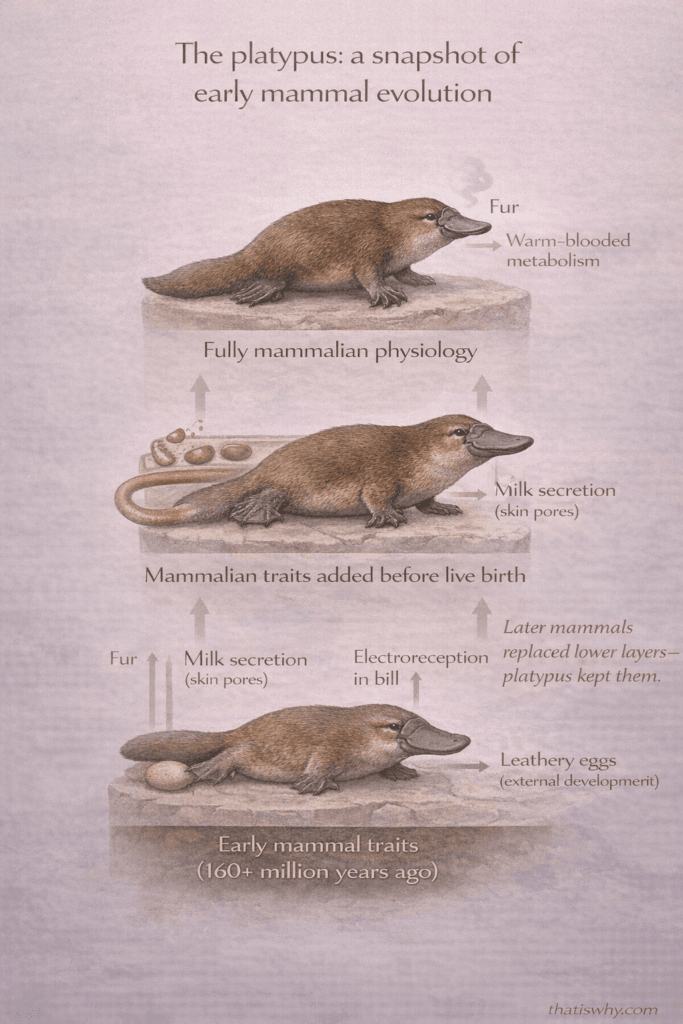
To understand why the platypus looks stitched together, we looked at research on monotreme evolution, including genomic studies showing that platypuses split from other mammals around 160 million years ago, alongside work on lactation, electroreception, venom, and early mammalian reproduction. Much of this research comes from Australian evolutionary biology programs and comparative studies published in journals like Nature and Science.
But facts alone don’t explain why this animal feels so confusing. That question led us to “the layer-cake” analogy, a simple way to visualize how mammal traits were added gradually, with some layers buried and others left exposed. It turns the platypus from a curiosity into a clear record of a process we’re still part of.