Why a Group of Fish Is Called a School
You’ve seen it in nature documentaries: thousands of fish moving as one, twisting and turning in perfect unison. We call it a school of fish.
But here’s the catch — that name only applies some of the time.
There’s another, more common name for a group of fish, and the subtle difference between the two explains how fish turn chaos into coordination.
The Party vs. The Parade
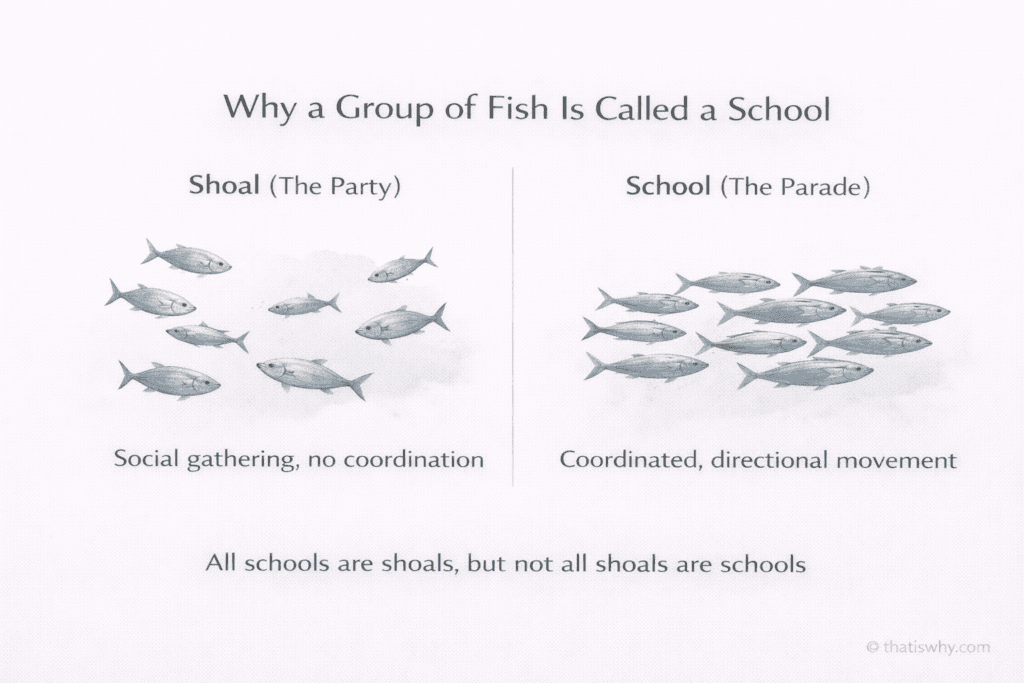
The secret to telling them apart isn’t some complicated scientific jargon. It’s actually as simple as telling the difference between a party and a parade.
Imagine a large gathering. Sometimes, you have a party. People are all in the same general area, hanging out and socializing, but they’re in smaller groups, facing different directions, and doing their own thing. That’s a shoal of fish.
But a parade is different. A parade has structure. It has direction. Everyone is organized, facing the same way, and moving as a single, unified entity with a clear purpose. That’s a school of fish—a synchronized swim team on a mission.
The simple rule is: all schools are shoals, but not all shoals are schools.
The Analogy Explained: This works because it perfectly captures the two different levels of social organization. A “party” is a loose, social gathering, while a “parade” is a highly coordinated, directional group. The limitation, of course, is that human parties and parades are for celebration. For fish, these behaviors are a matter of life and death.
The Science of the Swarm
We have our two names, the “party” (the shoal) and the “parade” (the school). But what’s the actual science that separates them?
A shoal is the simpler of the two. It’s really just a social gathering. As marine biologists would tell you, it’s any group of fish hanging out together, often for safety or just because they’re attracted to each other. They might even be different species. They’re in the same place, but they’re not a team. It’s social, but it’s disorganized.
A school is where that disorganization snaps into breathtaking, synchronized order. It’s a shoal that decides to act as one—a highly organized group, almost always of the same species, moving as a single, coordinated entity. They maintain precise spacing, they all face the same direction, and they turn in perfect, breathtaking unison. This is the “parade” behavior, and it’s triggered by a specific purpose, like migrating or, most dramatically, evading a predator. It’s the moment the party becomes a precision drill team.
The Power of the Swarm
This distinction between a shoal and a school isn’t just a vocabulary lesson. It’s a window into one of the most powerful strategies in the natural world, a principle I call “The Power of the Swarm.”
The idea is simple: a coordinated group can achieve incredible things that no single individual ever could. A single fish is just a meal. But a thousand fish moving as one? That’s a confusing, dazzling, and powerful superorganism.
But the real question is, who’s in charge? Who is the general commanding this army of fish? The answer is what makes swarm intelligence so profound: no one. There is no leader. The behavior isn’t a conscious choice; it’s a deep, instinctual drive. Each fish is simply following a set of simple rules—like “match the speed of your neighbor” and “don’t get too close”—and from these simple rules, an incredibly complex and intelligent group behavior emerges.
This same logic shows up across the animal kingdom, and it’s why many animal group names exist in the first place — each one tells a different kind of story.
Two Sides of the Swarm
This “Power of the Swarm” isn’t just for fish. Nature has discovered this trick over and over, using it for both breathtaking defense and brilliant offense.
For pure, overwhelming defense, there’s no better example than a murmuration of starlings. A single starling is an easy meal for a hawk. But a murmuration of thousands is a swirling, shape-shifting vortex of confusion. It’s a living cloud that overwhelms the predator’s senses, making it impossible to pick out a single target.
But the swarm isn’t just about hiding; it’s also about hunting. Think about a wolf pack taking on a moose. A lone wolf attempting that would be suicidal. But a coordinated pack is a different beast entirely. They become a single, intelligent predator, using complex strategy and communication to flank, wear down, and take down an animal many times their size. In both cases, the group becomes something more than the sum of its parts—a powerful, emergent intelligence.
The Reasons and the Relatives
So we know what a school is, but why do fish bother? It’s a classic case of survival of the group. A massive, swirling school makes it incredibly hard for a predator to single out one fish, which is a huge defensive advantage. But it’s also great for offense—more eyes searching for food means a better chance of finding it. And, of course, sticking together makes it much easier to find a mate.
But speaking of predators, what about the ultimate ocean predator? Is a group of sharks also called a school? No. And in a perfect example of how a name reflects reputation, a group of sharks has its own, much more fitting name: a shiver of sharks.
The Expert at the Aquarium
Now, when you stand in front of that massive aquarium exhibit, watching the shimmering, silver entity twist and turn, you’ll see it differently.
You’ll see the two stories playing out. The beautiful, chaotic party of the shoal, and the breathtaking, synchronized parade of the school.
You’ll have the key to the hidden logic of the swarm. And you’ll know the difference between a simple gathering of fish and a superorganism moving with a single, powerful mind. You’re not just looking at fish anymore; you’re reading the secret language of the ocean.
How We Researched This:
To answer this question, we consulted marine biology resources from NOAA and leading aquariums to clarify the crucial distinction between a ‘school’ and a ‘shoal’—a detail most other articles miss. But we knew that just listing facts isn’t helpful. Our real job began when we asked, “What does this feel like?” That question led us to the ‘Party vs. Parade’ analogy—a simple story to make the complex biology feel intuitive.