Why a Group of Crows Is Called a Murder
No other animal has a group name that sounds like a crime scene.
You have a pride of lions, a flock of sheep, a school of fish — all neutral, harmless words. But a group of crows? That’s a murder.
It’s a dark, violent name for a group of birds, and the reason has nothing to do with what crows actually do — and everything to do with how humans have feared them for centuries.
The Criminal Nickname
To get to the bottom of this, we have to stop thinking like a scientist for a second and start thinking like a storyteller. The name “a murder of crows” isn’t a scientific label. It’s a criminal nickname.
Think about it. Crows are jet-black, the color of night and bad omens. Their call isn’t a song; it’s a harsh, grating caw that sounds like a warning. And they’re smart—almost too smart, with a disconcerting intelligence that makes it feel like they’re always watching, always plotting.
When you put it all together—the dark feathers, the harsh sound, the unsettling intelligence—you don’t just get a bird. You get a character. You get a villain from an old folk tale.
And what do you give a great villain? A great, scary nickname. “Murder” is the crow’s criminal nickname, a name born out of the fear, superstition, and dark stories we’ve been telling about them for centuries.
The Analogy Explained: This works because it perfectly frames the name as a product of reputation, not reality. It separates the animal from the label we’ve given it. The limitation, of course, is that crows aren’t actually criminals. They are highly intelligent animals that were villainized by human superstition.
Building a Bad Rap
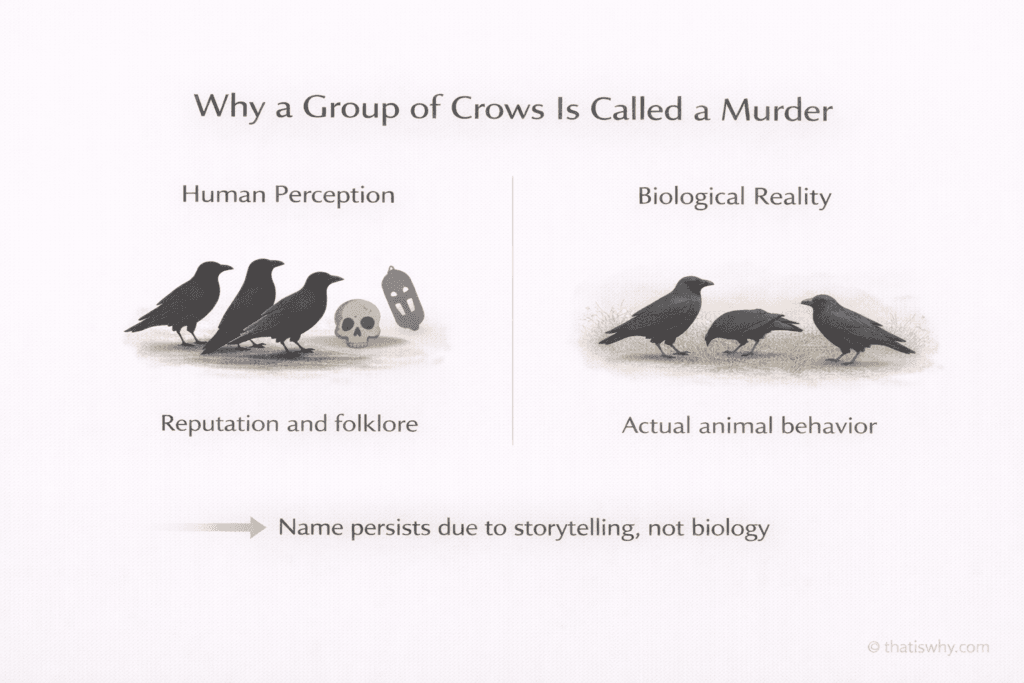
The case against the crow was built over centuries, and the first piece of evidence is the most gruesome. Crows are brilliant scavengers. In the long, brutal history of human warfare, a battlefield was a banquet. Our ancestors witnessed a simple, powerful equation over and over: a field of dead bodies equaled a sky full of black birds. The association became unbreakable in our collective imagination: a gathering of crows meant death had come to visit.
This real-world observation was then amplified by centuries of folklore. With their jet-black feathers and harsh, raucous calls, crows were perfectly cast as villains in our stories. They became omens of bad luck, messengers from the underworld, or the companions of witches. They looked and sounded the part, so we told stories that made it so.
But it’s a third, truly strange behavior that may have sealed their dark reputation. Crows are one of the few animals that seem to hold “funerals.” They will gather in a large, noisy group around a dead member of their own species. While scientists today are still studying this complex behavior, you have to imagine what it looked like to someone from the 15th century. It didn’t look like mourning. It looked like a sinister trial, as if the group were gathering to pass judgment on the deceased. It looked, for all the world, like a murder.
The Power of a Bad Reputation
So why did this name stick? Why “murder”?
It survived for centuries because it’s the result of a powerful combination of bad PR. You have a bird that looks the part, sounds the part, and always seems to show up at the scene of a crime. It’s a classic case of what I call “The Power of a Bad Reputation.”
The name “murder” isn’t a scientific truth; it’s a ghost story we tell ourselves about a bird. It’s a linguistic fossil, one of many strange collective names that reveal how humans have historically interpreted animals. Preserving the memory of our own ancient fear of the dark, of death, and from a creature smart enough to thrive in our shadow. It’s a chilling reminder that we don’t always name things for what they are, but for how they make us feel.
Seeing a Bad Rap Everywhere
Now that you have your archaeologist’s toolkit, you’ll realize our language is a rich fossil bed, just waiting to be excavated.
Take the crow’s larger, more ominous cousin, the raven. A group of them is called an “unkindness” or a “conspiracy.” You can feel the suspicion in those words. They’re names born from the same dark folklore, painting the raven as a cruel, plotting, and untrustworthy creature.
Sometimes the name isn’t about suspicion, but pure terror. The name a “plague” of locusts is a perfect example. It doesn’t just describe the insects; it describes the biblical disaster they bring, bottling up the feeling of watching your crops and your livelihood be devoured.
And it’s not just an ancient phenomenon. Even a modern, slightly humorous name like a “gang” of turkeys carries that same edge. The word “gang” perfectly captures that feeling of being stared down by an unruly, intimidating group of big male turkeys in the middle of the road.
A Quick Spotter’s Guide
Now, since we’ve already brought up the crow’s larger, more ominous cousin—the one with the equally dark nickname, an “unkindness”—it’s worth knowing how to tell them apart in the field.
People mix them up all the time, but there are a few dead giveaways. Ravens are massive, with a shaggy throat and a wedge-shaped tail. Their call is a deep, guttural croak. Crows are smaller, more social, and have that classic, nasally caw!
Knowing how to spot the adults leads to the final piece of the puzzle: the babies. After all this talk of murders, conspiracies, and unkindnesses, you’d expect the name for a baby crow to be something equally grim, right? Maybe “a misdemeanor of crows”?
But the reality is almost comically simple. They’re just called a chick.
A Story About Us
“A murder of crows.” It’s a heavy, undeserved nickname for an intelligent bird.
But the name was never really about the crow at all.
It was always about us. And it shows that the darkest stories we tell about the world are often just the stories we are telling about ourselves.
How We Researched This:
To answer this question, we dove into the history of collective nouns, consulting etymological sources like the Oxford English Dictionary and folklore guides. But we knew that just listing facts isn’t helpful. Our real job began when we asked, “What does this feel like?” That question led us to the ‘Criminal Nickname’ analogy—a simple story to make the complex history feel intuitive.