That is why Animals Have Strange Collective Names
A “flock” of sheep is simple. A “herd” of cattle is straightforward. But a “murder” of crows? A “parliament” of owls? A “skulk” of foxes?
Where do these strange, poetic, and sometimes dark names come from? They aren’t just random words. They are clues. They are tiny, fascinating stories about our own history, our fears, and our sense of wonder. This guide is the key to unlocking those stories.
The Antique Shop Discovery
To understand these strange names, we have to put on our detective hats. Imagine you’re in a dusty old antique shop, and you find a fascinating object—let’s say, an old wooden box.
At first glance, you just see the object itself. It’s a box. That’s its simple, modern name.
But then you look closer. You see a faded, hand-painted label on the side that calls it a “spice chest.” That’s a clue to its original purpose. Then you see a shipping stamp on the bottom from the 1800s that calls it “trade cargo.” That’s a clue to its history. And you notice the worn-down lid, which tells you how people actually used it every day.
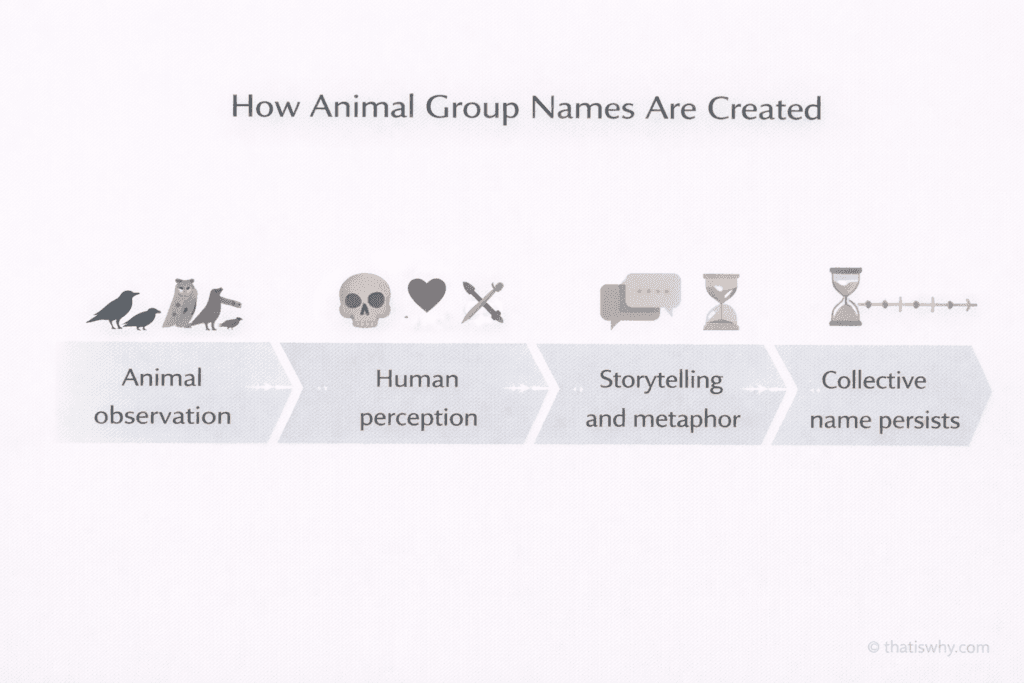
It’s the same box, but it has all these different labels from different moments in time, and each label tells you a different story. The names we have for animals are the exact same thing. They are historical labels, and they tend to tell three distinct kinds of stories:
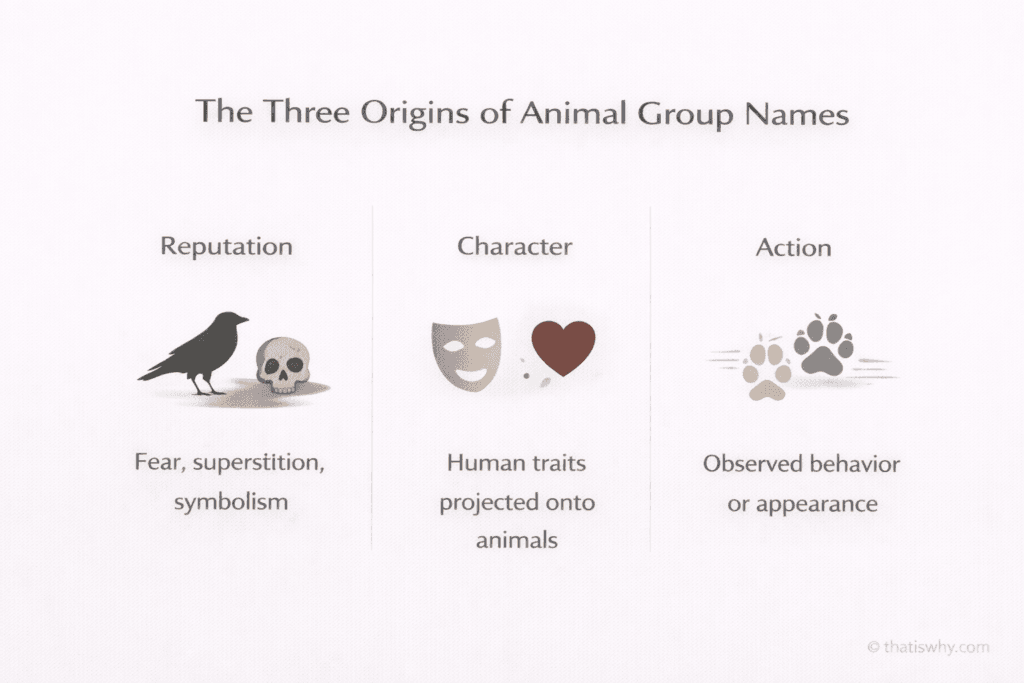
- Stories of Reputation: These are the darkest and most fascinating labels, born from our own human fears and an animal’s bad rap.
- Stories of Character: These are like personality portraits, capturing the “vibe” or character we project onto an animal.
- Stories of Action: These are the most literal labels, like photographs that capture what the animal is doing in a specific moment.
This guide is your key to reading those labels. The dig site is open.
Uncovering the Fossils: Three Wings of the Museum
As we begin our excavation, we find that these linguistic fossils aren’t all jumbled together. They’re organized into three distinct wings of a museum, each telling a different kind of story about our relationship with the animal kingdom.
The First Wing: Echoes of Reputation
Our tour starts in the darkest wing of the museum, the one dedicated to names born from fear and a bad rap. Here, the star exhibit is, of course, a “murder” of crows. This name is a direct result of the crow’s sinister reputation, born from centuries of fear and their chilling association with ancient battlefields.
Want to uncover the full story behind this sinister nickname? Read it here: Why a Group of Crows Is Called a Murder
Curator’s Note: These “names of fear” are fascinating because they are almost never about the animal itself. They are a perfect mirror of our own anxieties. We name things for the dark stories they represent to us.
The Second Wing: Portraits of Character
Moving into the next wing, we find names that are less about fear and more about personality. These are like portraits, capturing the “vibe” we project onto an animal. The main gallery features the “parliament” of owls, a name born from our respect for their solemn, judicious nature. Next to it, you’ll find the “skulk” of foxes, a name that perfectly captures their reputation for stealth and cunning.
Want to learn how C.S. Lewis made “parliament” famous? Read the full story here: Why a Group of Owls Is Called a Parliament Want to explore the “Old House” of the fox’s other names? Read it here: Why a Group of Foxes Is Called a Skulk
Curator’s Note: These “names of character” are all about anthropomorphism—our very human need to see our own traits in the world around us. We see an owl and think “wise judge,” so we name it accordingly.
The Third Wing: Snapshots of Action
The final wing of our museum is the most literal. These names are like photographs, capturing what the animal is doing or looks like in a specific moment. Here we have the “tower” of giraffes, which perfectly describes their height when standing still, but which changes to a “journey” the moment they start to move. And right beside it is the exhibit on fish, where a casual “party” is a “shoal,” but an organized “parade” is a “school.”
Want to learn more about these “verbs in disguise”? Read the full story here: That Is Why a Group of Giraffes Is Called a Tower or understand the “Party vs. Parade” difference? Read it here: Why a Group of Fish Is Called a School
Curator’s Note: These “names of action” are the most scientific of the bunch. They are born from pure, simple observation. They are a testament to our ability to find the perfect, poetic word to describe a specific behavior or appearance.
Language used as a Time Capsule
When you put all these fossils together, you realize that language isn’t just a tool for communication in the present. It’s a time capsule carrying messages from the past.
Think about it. The people who coined the term “a murder of crows” in the 15th century weren’t biologists. They were people living in a harsh, often brutal world, where a flock of black birds on a battlefield was a chilling and powerful symbol. That word, “murder,” doesn’t tell us about the crow; it tells us about the fear and superstition of the medieval mind. It’s a message from their world to ours.
The same is true for a name like “a parliament of owls.” This name would have made no sense to a culture that didn’t already associate owls with the wisdom of the goddess Athena. The name is a direct link to our mythological past, a tiny piece of Ancient Greece that has survived for thousands of years in our everyday language.
That’s the real power of these strange old words. Each one is a tiny, perfectly preserved piece of our own history. It captures the fears, the observations, the admiration, and the stories of the people who came before us. When you learn to read these names, you’re not just learning about animals; you’re learning about the history of the human mind itself.
Are These Names “Real”?
After all this talk of history and folklore, you might be wondering: are these official, scientific terms?
For the most part, no. A biologist studying crows wouldn’t write about a “murder” in their research paper; they’d simply say a “group.”
The answer is that most of them can be traced back to a single, fascinating source: a book from 1486 called The Book of Saint Albans. This book was a gentleman’s guide to hawking, hunting, and heraldry. Included within its pages was a long list of these “terms of venery,” or terms of the hunt.
It’s important to understand that these weren’t scientific terms. They were a kind of poetic, aristocratic slang, a way for nobles to show off their knowledge and wit. Some were based on observation (like “a business of ferrets”), while others were more like inside jokes or puns.
Over the centuries, most of the hundreds of terms from that book have been forgotten (no one talks about a “doctrine of doctors” anymore). But the most evocative and memorable ones—like “murder,” “pride,” and “parliament”—have survived. They were simply too good, too perfect, to be forgotten. They are powerful stories in a single word, and that’s why we still use them today.
Your Archaeologist’s Toolkit
So, the next time you hear a strange name for a group of animals—whether it’s a “murder,” a “parliament,” or a “journey”—you’ll have the key. You’ll know you’re not just hearing a quirky word.
You’re standing at the edge of a dig site, looking at a linguistic fossil.
And now, you have the archaeologist’s toolkit. You have the questions to ask. Is this a name born from the dark soil of fear and reputation? Is it a portrait, capturing the noble character of the animal? Or is it a snapshot, a perfect description of an action frozen in time?
You know how to look for the story, the human fingerprint, left on the natural world. That’s a skill that goes far beyond just knowing fun facts. It’s the ability to see the history, the poetry, and the humanity hidden in the simple words we use every day. All you have to do is stay curious.
How We Find the Story
The process for every article in this guide is the same. We start by consulting the best scientific resources we can find, from etymological sources like the Oxford English Dictionary to historical texts. But we know that just giving you the raw data isn’t helpful.
Our real job begins when we ask the most important question: “What does this feel like?”
That one question is the key that unlocks the simple analogies and clear stories that make the history unforgettable. It’s how we find the “Old House,” the “Casting Call,” and the “Antique Shop.” It’s how we translate the dry facts of etymology into the secret language of our ancestors.