Why The Axolotl Never Grows Up – The Peter Pan of the Lake
The Face That Never Ages
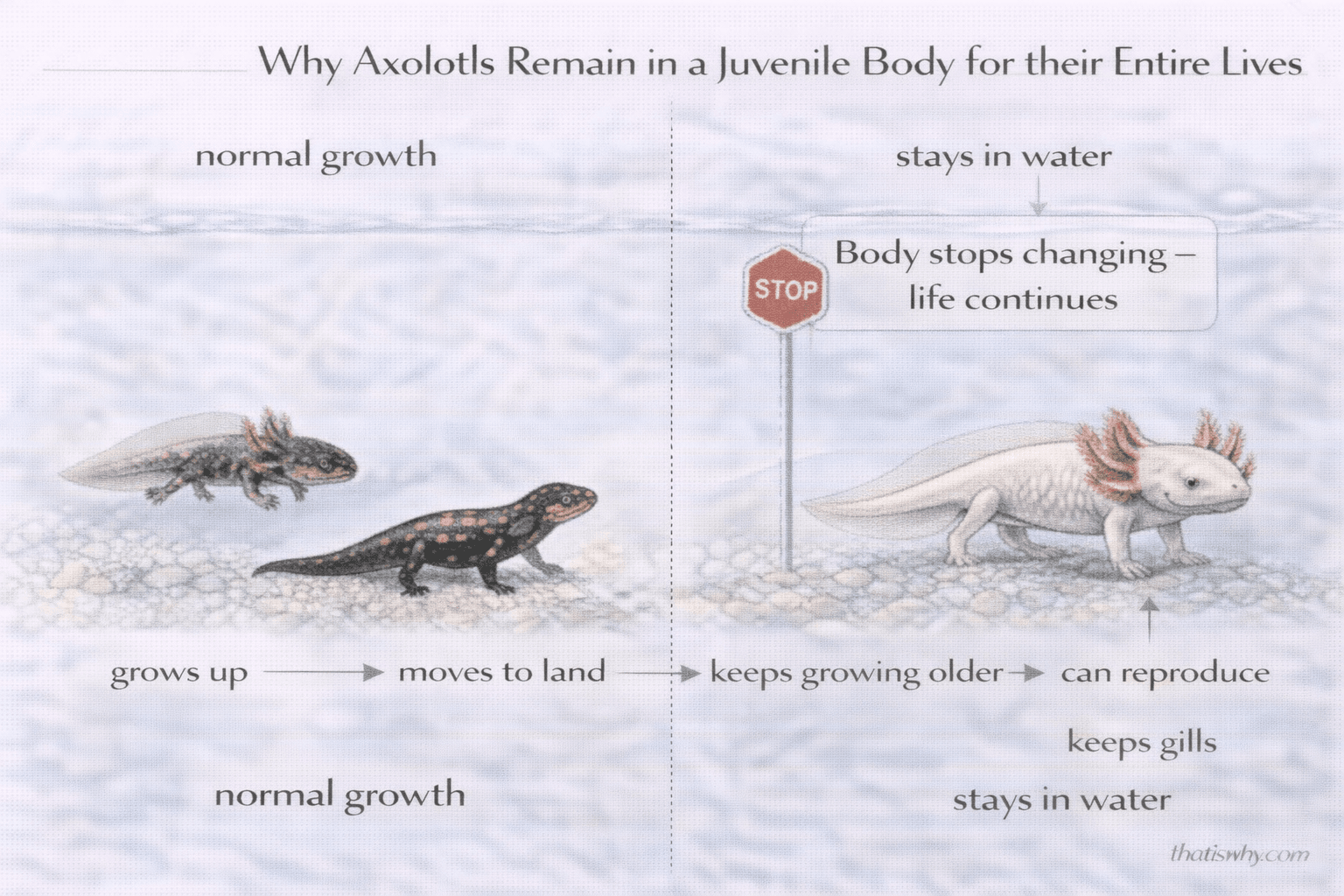
Why do axolotls look like babies forever? Axolotls exhibit a condition called Neoteny, meaning they reach sexual maturity while keeping their larval features—like external gills and tails. This happens because they lack the thyroid hormone needed to trigger metamorphosis. Basically, they are salamanders that forgot to grow up.
That’s the science but when looking at one makes you curious anyway.
They have that permanent, goofy smile, they have tiny, human-like hands. They have pink, feathery gills sticking out of their heads like a headdress. They are undeniably cute.
But this cuteness is actually a biological glitch. Every other amphibian, frogs, toads, newts, starts as a tadpole in the water and graduates to an adult into the land. The Axolotl refuses to graduate once he hits puberty he starts a family, and lives its entire life in the body of a toddler.
It is the Peter Pan of the animal kingdom, just here no Wendy or Neverland , the only reason is : it graduates in evolutionary laziness.
The Eternal Student
To understand the Axolotl, you have to look at its real estate.
The Axolotl is native to only one place on Earth: Lake Xochimilco in Mexico. Historically, this lake was an amphibian paradise. It was full of food, had zero large predators, and was surrounded by a hot, hostile land environment.
Think of the Axolotl as The Eternal Student.
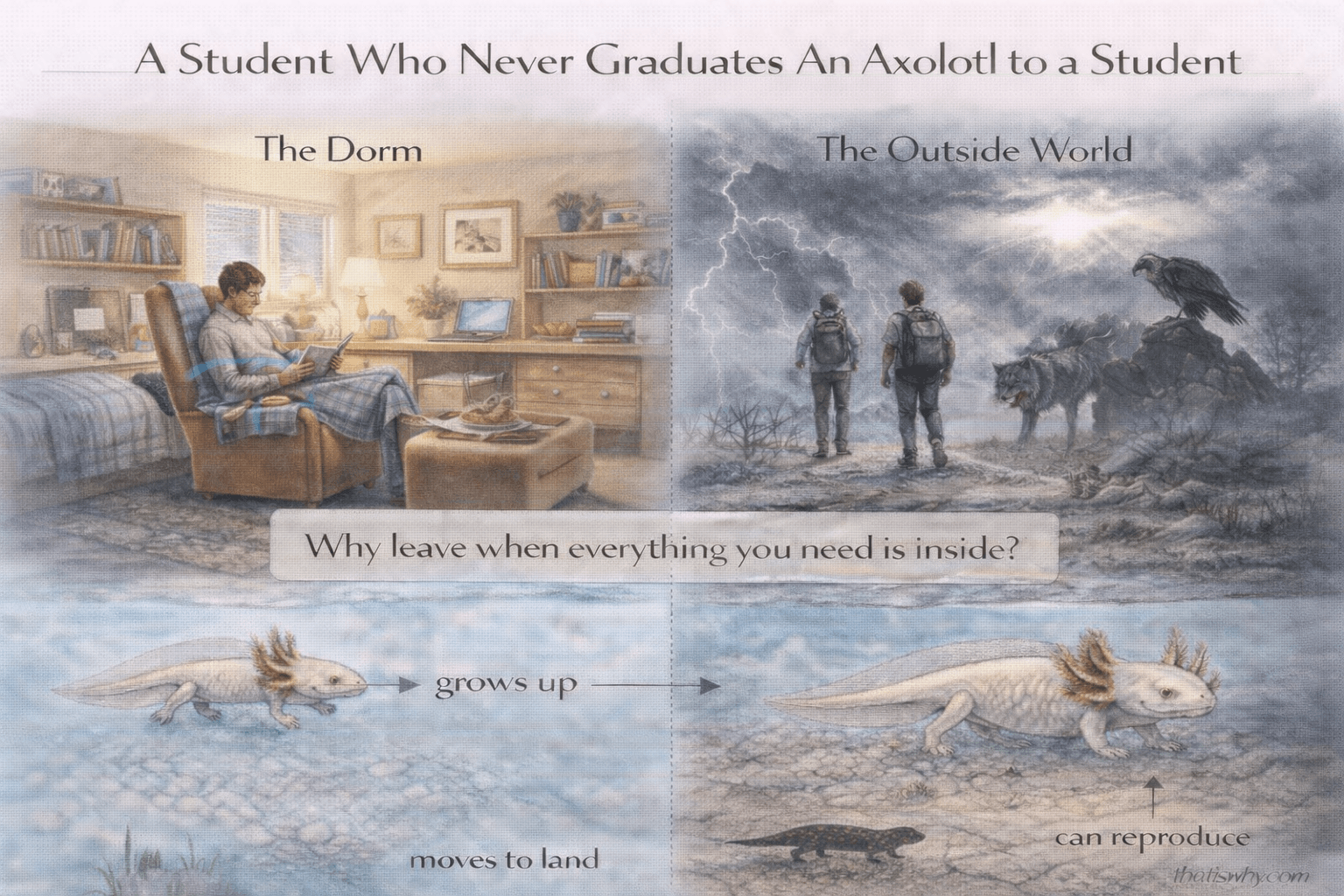
Imagine a college student living in a dorm. The dorm (The Lake) has free food, safety, and temperature control. The real world outside (The Land) is scary, dry, and full of predators. Most students graduate and leave because they have to. The Axolotl in the other hand realized it didn’t have to.
Growing up (Metamorphosis) is expensive. You have to lose your gills, grow lungs, and thicken your skin. Why bother? The Axolotl hacked the system. It figured out how to reproduce without graduating. It kept its student ID (the gills) forever, staying in the safety of the dorms while its cousins (the Tiger Salamanders) were forced to go out and get jobs on land.
The Missing Diploma
How did it pull this off? It comes down to a missing piece of paperwork.
Amphibian metamorphosis is triggered by the Thyroid Gland. To start the change, the brain orders the thyroid to release Thyroxine. This hormone is the official “Graduation Certificate.” It authorizes the body to drop the gills and move onto land.
But to print that certificate, the thyroid needs one specific ink: Iodine. The waters of Lake Xochimilco have almost zero iodine.
So, the Axolotl is stuck in administrative limbo, it has passed all the classes, it is ready to leave but unfortunately the office is out of ink and without that physical document (Thyroxine), the body assumes it isn’t allowed to graduate. It stays in the dorms forever, waiting for a diploma that never arrives.
The Forced Graduation
Here is the reality : the Axolotl isn’t incapable of graduating, it just needs the proper paperwork.
In 1863, scientists in Paris discovered something very interesting by adding Iodine to the water of an Axolotl tank suddenly, the thyroid woke up, it printed the diplomas.
The Axolotls began to change. they shed their gills, grew lungs, and crawled out of the water. They became Terrestrial Salamanders. The scientists had forced the students to graduate and to move into the real world.
But there was a catch. The “Adults” were miserable. They stopped eating, their immune systems crashed. They died within a few years, while their water-based brothers lived for 15. It turns out, the dorms weren’t just comfortable; they were protective. By forcing them to graduate, the scientists had evicted them into a world they weren’t ready for.
The Superpower of Youth
Staying in school forever gave the Axolotl two superpowers that human medicine is desperate to copy.
Extreme Regeneration : Because the Axolotl stays in an embryonic state, its cells never “lock” into a final form. They stay flexible then if an Axolotl loses an arm, it doesn’t grow a scar; it grows a new arm. It can regrow its tail, its spinal cord, and even 30% of its brain.
Cancer Resistance: You would think that cells that grow so fast would be prone to tumors. But Axolotls are incredibly resistant to cancer. Their body has a “check engine” light that is far superior to ours. They can regenerate perfectly without letting the growth spiral out of control. They have solved the balance between healing and disease.
Debunking the Cute Face
Let’s clear up a few misconceptions about the internet’s favorite amphibian.
Myth #1: “They are fish.” They have fins and gills.
The Truth: They are amphibians. They have lungs. If the water oxygen gets low, they will swim to the surface and gulp air. They are just really committed to the scuba life.
Myth #2: “They are easy pets.” Minecraft made them look like low-maintenance friends.
The Truth: They are incredibly fragile, their skin is permeable, meaning they absorb chemicals from the water. If the pH is wrong, or the temperature is too high, they die. They aren’t starter pets; they are chemistry projects.
Myth #3: “They are friendly.” They smile at you.
The Truth: They are vacuums, they will eat anything that fits in their mouth, including the limbs of their own tank-mates. They aren’t smiling; they are just waiting for you to get closer.
The Student Who Never Left
When we look at an Axolotl, we see a cute, smiling pet, but biologically, we are looking at a dropout student.
The Axolotl looked at the “Real World” of dry land and decided it wasn’t worth the tuition. It bet everything on staying in the water. It traded legs for gills and adulthood for immortality.
It reminds us that evolution isn’t always about moving forward or graduating to the next level. Sometimes, the smartest move is to hack the system, keep your student ID, and stay in the dorms forever.
How We Researched This :
To explain this biological anomaly, we looked at the endocrinology of Metamorphosis and the role of Thyroxine. We referenced the historical 1863 Paris Duméril Experiment that first proved Axolotls could be forced to transform.
But we knew that just listing hormones isn’t helpful. Our real job began when we asked, “What does this feel like?” That question led us to the “Eternal Student” analogy—a simple story to make the complex evolutionary strategy of Neoteny feel intuitive.