Why Your Goldfish Is The World’s First Hybrid Vehicle
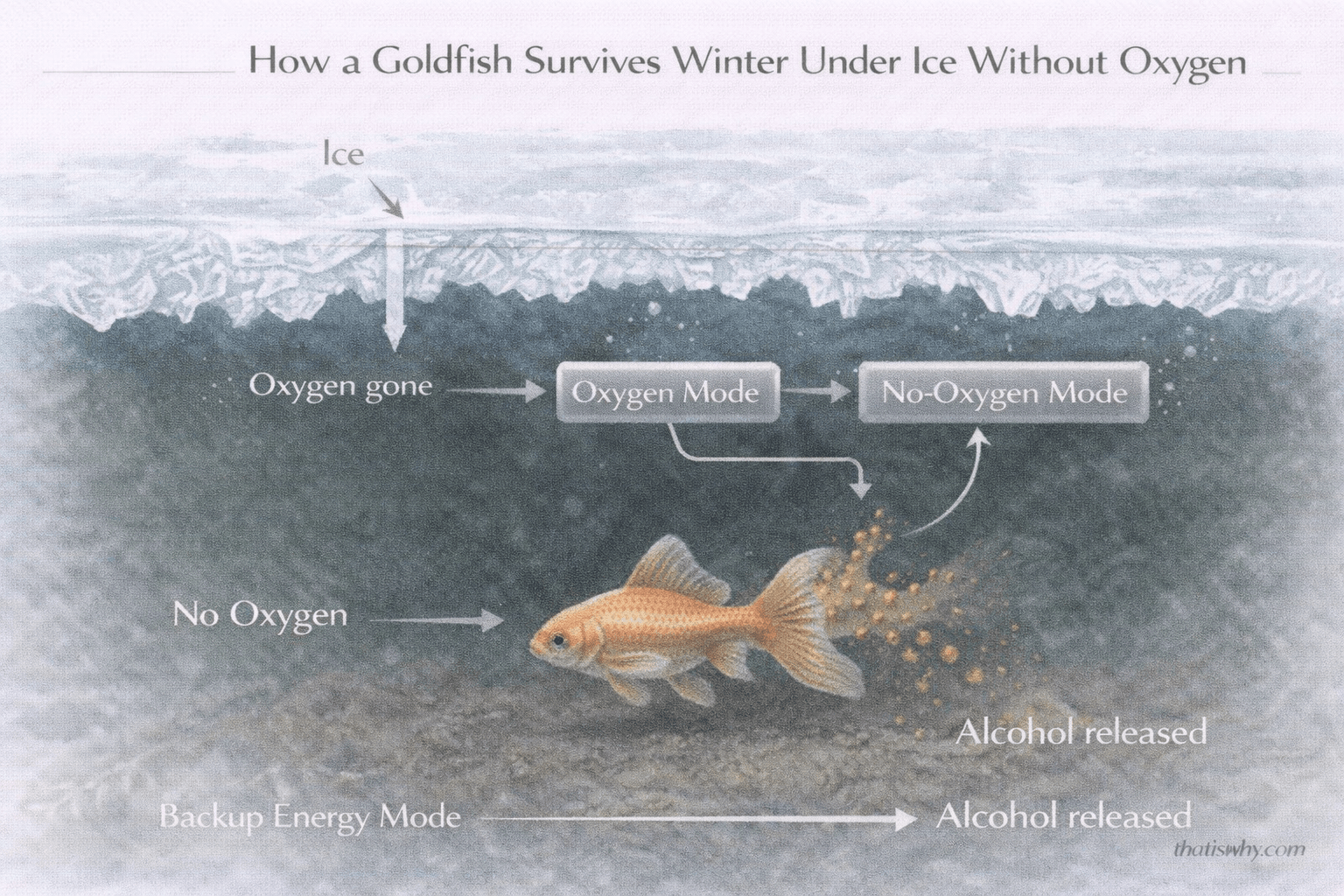
How do goldfish survive winter? Goldfish survive in frozen ponds by switching their metabolism from aerobic (using oxygen) to anaerobic (without oxygen). Unlike other animals that produce toxic lactic acid when oxygen is low, goldfish use a specialized enzyme set to convert metabolic waste into ethanol (alcohol), which they release through their gills. This allows them to survive for months in anoxic conditions.
That is the biological answer, but as usual understand what is really happening is where the fun is.
Imagine looking at a pond in January, the surface is locked under a foot of ice and down below, it is pitch black and freezing. The rotting leaves have sucked every last drop of oxygen out of the water.
For a Trout, this is a death sentence, but the Goldfish? It doesn’t care. It hangs there in the dark, totally relaxed, surviving for months without taking a single breath. It survives a condition that would kill a human in three minutes flat.
It doesn’t do this by holding its breath. It does it by swapping out its entire engine block.
The Flex-Fuel Engine
To understand how a fish beats suffocation, you have to think of its body like a car engine.
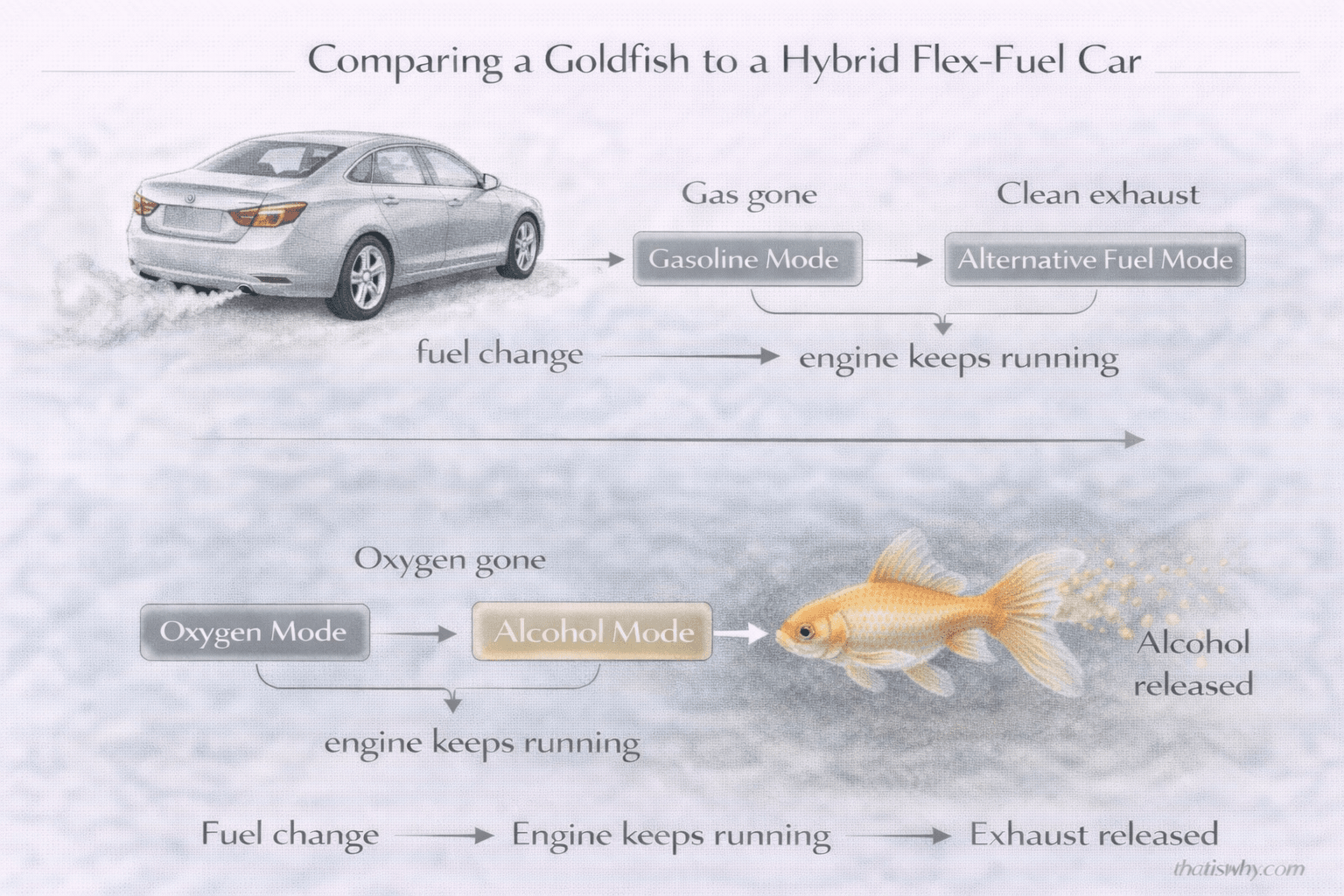
Most animals, including you, are standard Gasoline Cars. Our fuel is Oxygen. Our engine (the mitochondria) burns oxygen to create energy. If the oxygen tank runs dry, the engine sputters and dies. The car stops.
The Goldfish is different. It is a Hybrid Vehicle with a Flex-Fuel engine. When the oxygen runs out, it doesn’t stall. It flips a biological switch. It stops burning “Gasoline” (Oxygen) and starts running on “Moonshine” (Ethanol).
It is the only vertebrate that can pull up to the pump, see the ‘Out of Gas’ sign, and just decide to pour vodka into the tank instead. The engine keeps humming, the lights stay on, but the exhaust pipe starts pumping out pure alcohol.
The Problem: Dirty Exhaust
Why don’t all animals do this? Because burning “alternative fuel” usually destroys the engine.
When you sprint, your muscles run out of oxygen and switch to a temporary backup mode. But this mode produces a toxic waste product: Lactic Acid. This is the “burn” you feel in your legs. It’s like running a car in a closed garage, the carbon monoxide builds up. If that acid levels get too high, your blood turns acidic (Lactic Acidosis), your organs fail, and you die.
Most fish trapped under the ice have this same flaw. They try to run on backup power, but they have no way to vent the exhaust. The fumes fill the cabin, and they poison themselves within minutes.
The Solution: The Modification
But the Goldfish has a custom modification under the hood that no other vertebrate has.
It possesses a specialized enzyme called “Pyruvate Decarboxylase” that acts like a biological Catalytic Converter.
When the engine switches to backup power, this converter intercepts the toxic sludge (Lactic Acid) before it can clog the system. It chemically re-engineers the waste, turning it into Ethanol (pure alcohol).
This is a brilliant hack. Unlike acid, alcohol diffuses easily. It flows right out of the fish’s blood, through the gills, and dissolves into the water. The fish is literally venting its exhaust into the pond, keeping its own engine running clean while every other fish is choking on its own fumes.
The Genetic Accident
How did a humble goldfish get a high-performance engine that we don’t have? It won the genetic lottery.
About 8 million years ago, the ancestor of the goldfish accidentally cloned its entire genome, ending up with two full sets of instructions. Usually, this kills the animal, but for the carp, it was a massive upgrade. The first set of blueprints kept building the standard car, keeping the fish alive and swimming but the second set was just a pile of free spare parts lying in the garage.
That when evolution went wild. Since the fish already had a working engine, it could afford to get weird with the backup copy. It tinkered with the spares until they turned into alcohol-producing enzymes. The Goldfish is basically a mutant hot-rod that turned a factory glitch into a superpower.
Driving Under the Influence
This brings us to the obvious question: Is the fish drunk?
Technically, Yes. When a Goldfish is locked under the ice for months, pumping ethanol into the water, it eventually starts to re-absorb some of it. Scientists have measured blood alcohol levels up to 55mg per 100ml. To put that in perspective, that is above the legal driving limit in many European countries.
If your Goldfish was driving a car, it would get a DUI while in the pond, being tipsy is a survival strategy. The alcohol acts as a sedative; it slows the fish down, numbs the cold, and helps it sleep through the long, boring wait for spring.
Winter Myths
Let’s clear up a few misconceptions about keeping fish in the cold.
Myth #1: “They freeze solid.” We see them under the ice and assume they are popsicles.
The Truth: No. If a fish freezes solid, it dies. They need liquid water. They survive by hovering at the very bottom of the pond, where the water stays a liquid 4°C, protected by the ice sheet above.
Myth #2: “They hibernate.”
The Truth: It’s not hibernation; it’s Torpor. They are awake, just moving in slow motion to save energy. If you smashed the ice, they would slowly swim away.
Myth #3: “You need to feed them.” People worry the fish will starve.
The Truth: Do not feed them. In Torpor, their digestion shuts down. If you feed them, the food will rot inside their stomach and kill them. The alcohol engine keeps them running; they don’t need snacks.
The Million Dollar Machine
We tend to think of Goldfish as cheap, fragile carnival prizes that float belly-up if you look at them wrong.
But under the hood, they are tanks. They are evolutionary survivors that conquered the cold by building a custom engine that no other vertebrate has. They turned a random genetic typo into a high-performance feature.
So the next time you look at a Goldfish in a bowl, show some respect. You aren’t looking at a disposable pet. You are looking at the most advanced Hybrid Vehicle on the planet—a machine that can drive through hell by running on vodka.
How We Researched This :
To explain this biochemical trick, we analyzed the 2017 study by Dr. Michael Berenbrink at the University of Liverpool. His team mapped the specific protein pathways that allow the Goldfish (and its cousin, the Crucian Carp) to produce ethanol.
But we knew that just citing enzyme chains isn’t helpful. Our real job began when we asked, “What does this feel like?” That question led us to the “Hybrid Engine” analogy, a simple story to make the complex metabolic switch from oxygen to alcohol feel intuitive.