Why Cats Purr – The Healing Frequency
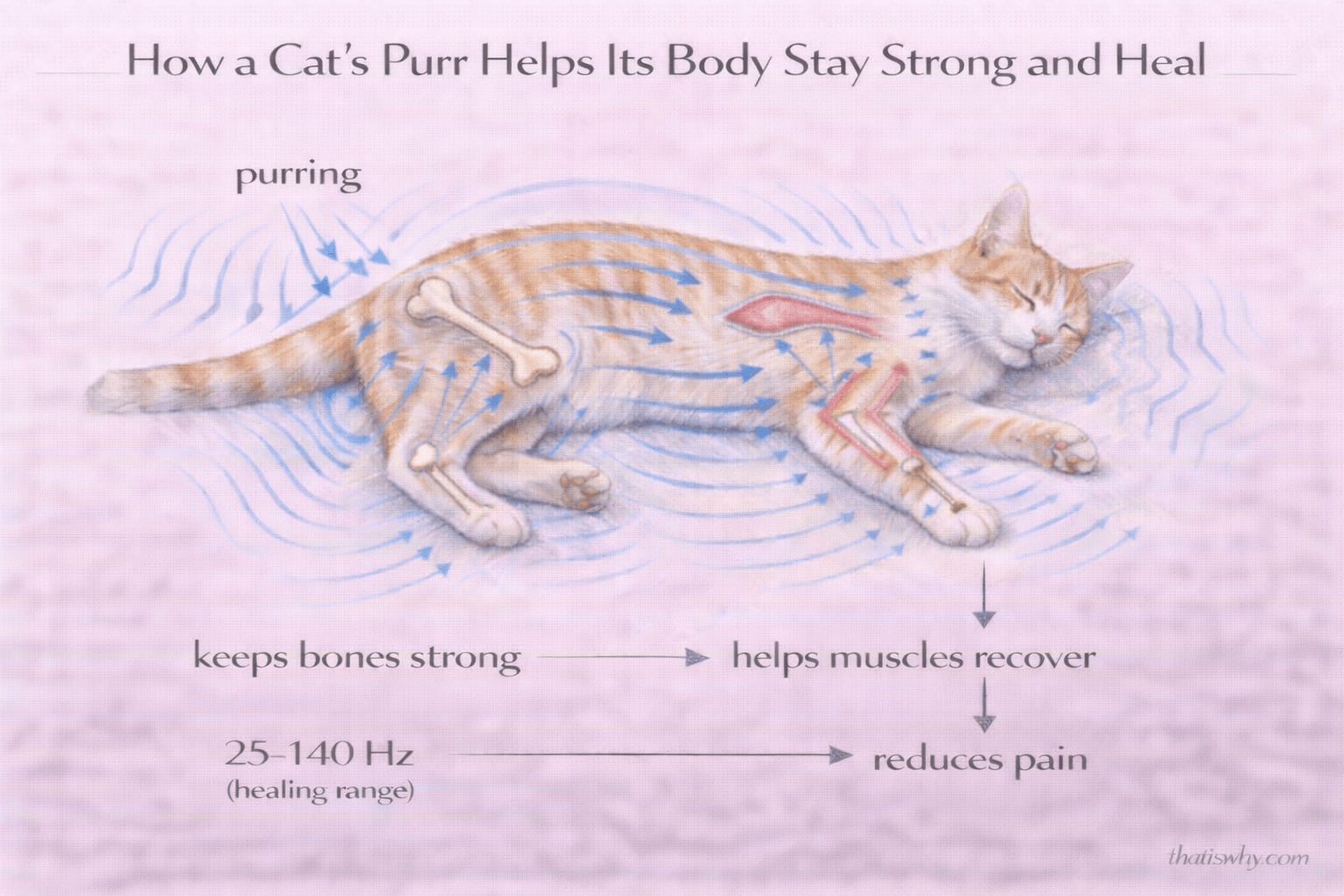
Why do cats purr? Research suggests that cats purr to heal themselves. They vibrate at a specific frequency range (25-140 Hz) that promotes bone density and muscle recovery. This allows them to counteract the negative effects of their sedentary lifestyle (sleeping 16+ hours a day) without having to exercise.
That is the biological/scientific answer, but for most of us, frequency healing seems like super power.
We assume cats purr because they are happy, it’s their way of smiling. But if you ask a vet, they will tell you a darker story. Cats purr when they are giving birth, they also purr when they are shot or when they are terrified at the vet’s office.
This breaks the “Happiness” theory. In the wild, making noise costs energy and attracts predators. If a cat is dying, why would it waste its last breath humming? The only logical answer is that the purr serves a vital function. It isn’t an expression of joy; it is a mechanism for survival.
The Sonic Gym
To understand why a cat purrs, you have to look at its very busy day program. Cats are evolutionarily lazy. They can sleep or rest for up to 20 hours a day to conserve energy for the hunt.
For any other animal, this lifestyle would be dangerous, bones need stress to stay strong which is called Wolff’s Law by the way. If you laid in bed for a month, your bones would lose density and your muscles would atrophy, you would wake up weak. But for a cat, he can wake up from a coma-like nap and instantly sprint up a tree or catch a prey.
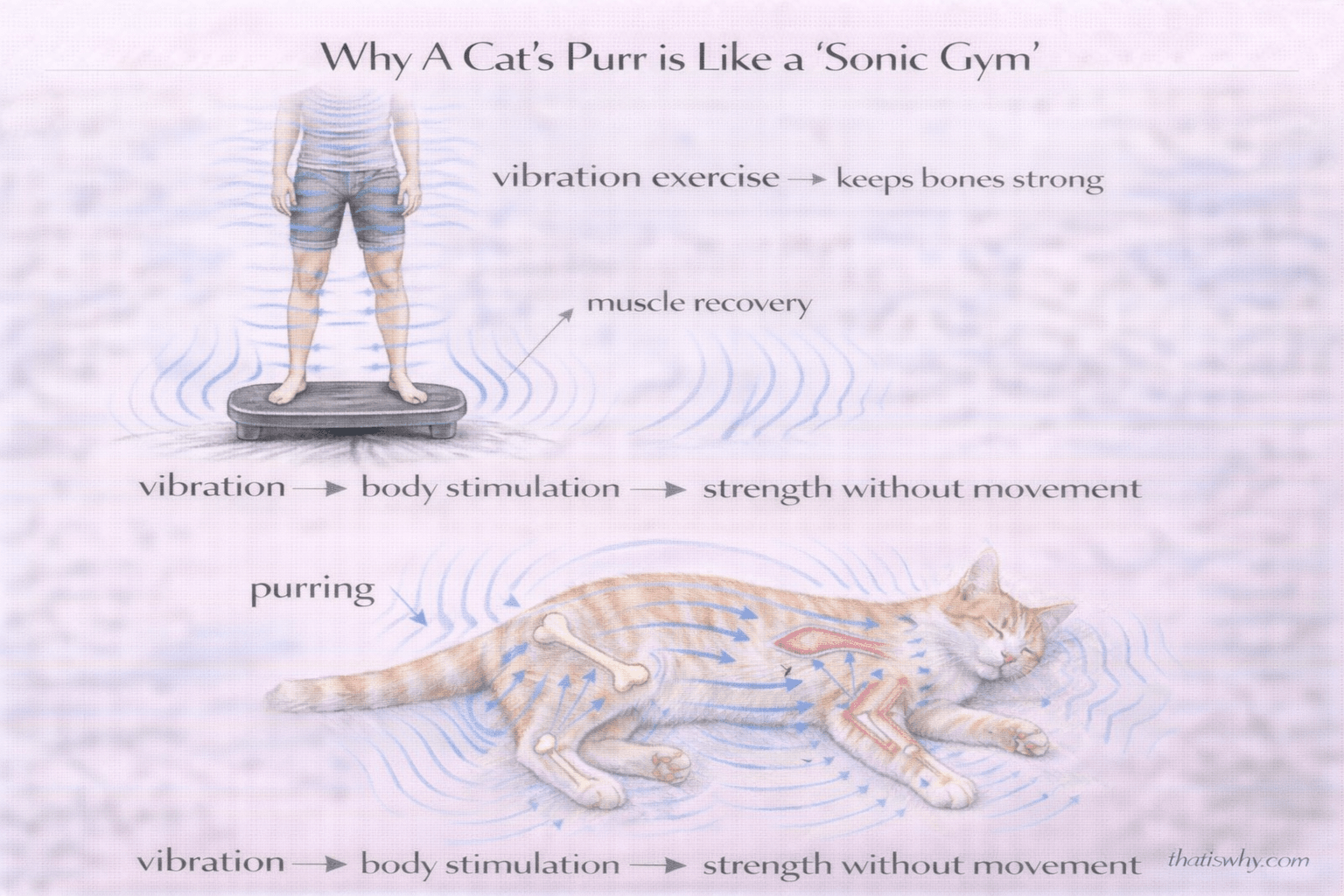
How? Because it has an internal Sonic Gym.
A cat’s purr creates a mechanical vibration that ripples through its skeleton. This vibration mimics the stress of impact. It tricks the bone cells into thinking the cat is running, even when it is sleeping. The cat is literally exercising its bones by humming at them. It allows them to maintain an Olympic athlete’s body without ever leaving the couch.
The Magic Number (25 Hz)
This isn’t just a theory; it’s calibrated physics.
Researchers found that every cat species operates its “Sonic Gym” at the exact same setting: 25 Hertz to 140 Hertz.
This range is the biological sweet spot. In traditional medicine, we know that vibrating a bone at 25 Hz mimics the stress of impact exercise. It tells the body, “We are lifting weights, build more bone!” Vibrating at 100 Hz helps repair torn muscles.
The cat hits all these frequencies naturally. When it purrs, it is turning on an internal vibration plate. It is blasting its own skeleton with a workout routine that repairs micro-fractures and strengthens the frame. It allows the cat to maintain the body of an athlete with the schedule of a couch potato.
The Crisis Purr
This explains the “Panic Purr.” When a cat is injured, it retreats to the locker room and activates its rehab protocol.
The vibration does two things: It mechanically stimulates bone repair, and it chemically triggers the release of Endorphins.
Think of it as a built-in morphine drip combined with a massage chair. The purr numbs the pain and calms the nervous system. It is the feline equivalent of an athlete icing a knee while taking painkillers. The cat isn’t saying “I love you”; it’s running an intensive recovery session to keep its body from shutting down.
Space Cats
The cat figured this out millions of years ago. We are just catching up.
The Astronaut Connection : NASA uses 25 Hz vibration plates to stop astronauts’ bones from dissolving in zero gravity. They are essentially standing on a mechanical cat.
Sports Medicine : Elite athletes use the same tech. Vibration therapy speeds up muscle recovery and increases bone density after fractures. We spend thousands of dollars on machines to replicate what a stray kitten does for free in an alley.
The Stress Killer : It works on regular people, too. Studies show that holding a purring cat lowers blood pressure and reduces heart attack risk by 40%. The frequency acts as a bio-feedback mechanism, syncing our nervous system with theirs.
The Roar vs. The Purr
Let’s clear up a few myths about the feline engine.
Myth #1: “Lions purr.” We imagine the King of the Jungle purring.
The Truth: Nope. Big cats like lions and tigers can Roar, but they can’t Purr. It’s an anatomical trade-off. To roar, you need a loose voice box. To purr, you need a rigid one. You can have a trumpet or a drill, but not both.
Myth #2: “It heals humans.” People think cats are magic wands.
The Truth: The frequency is medicinal, but the volume is low. Unless you strap 50 cats to your broken leg, the signal is too weak to fix a fracture. It helps, but it’s not a hospital.
Myth #3: “They purr while they sleep.” We think they purr all night.
The Truth: They only purr when they are awake or in light sleep. In deep sleep, the engine shuts off to save fuel. If your cat is purring, it knows you are there.
The Biological Machine
We love cats because they are soft but under the fur, they are marvels of bio-engineering.
They have solved the problem of atrophy and they have solved the problem of pain. They have built a high-tech gym into their own throats that allows them to get stronger by doing absolutely nothing.
Your cat isn’t just a pet. It is a self-repairing machine that hums while it heals. And every time it curls up on your lap and starts to rumble, it’s inviting you to share a little bit of that maintenance cycle. It’s the only gym membership in the world that works while you sleep.
How We Researched This
To explain this acoustic medicine, we analyzed the seminal study by Elizabeth von Muggenthaler at the Fauna Communications Research Institute. Her work recording the specific frequencies of felids provided the hard data linking purrs to the 20-140 Hz healing range.
But we knew that just citing frequencies isn’t helpful. Our real job began when we asked, “What does this feel like?” That question led us to the “Sonic Gym” analogy, a simple story to make the paradox of a lazy animal maintaining muscle mass feel intuitive.