Why The Venus Flytrap Can Count – The Green Calculator
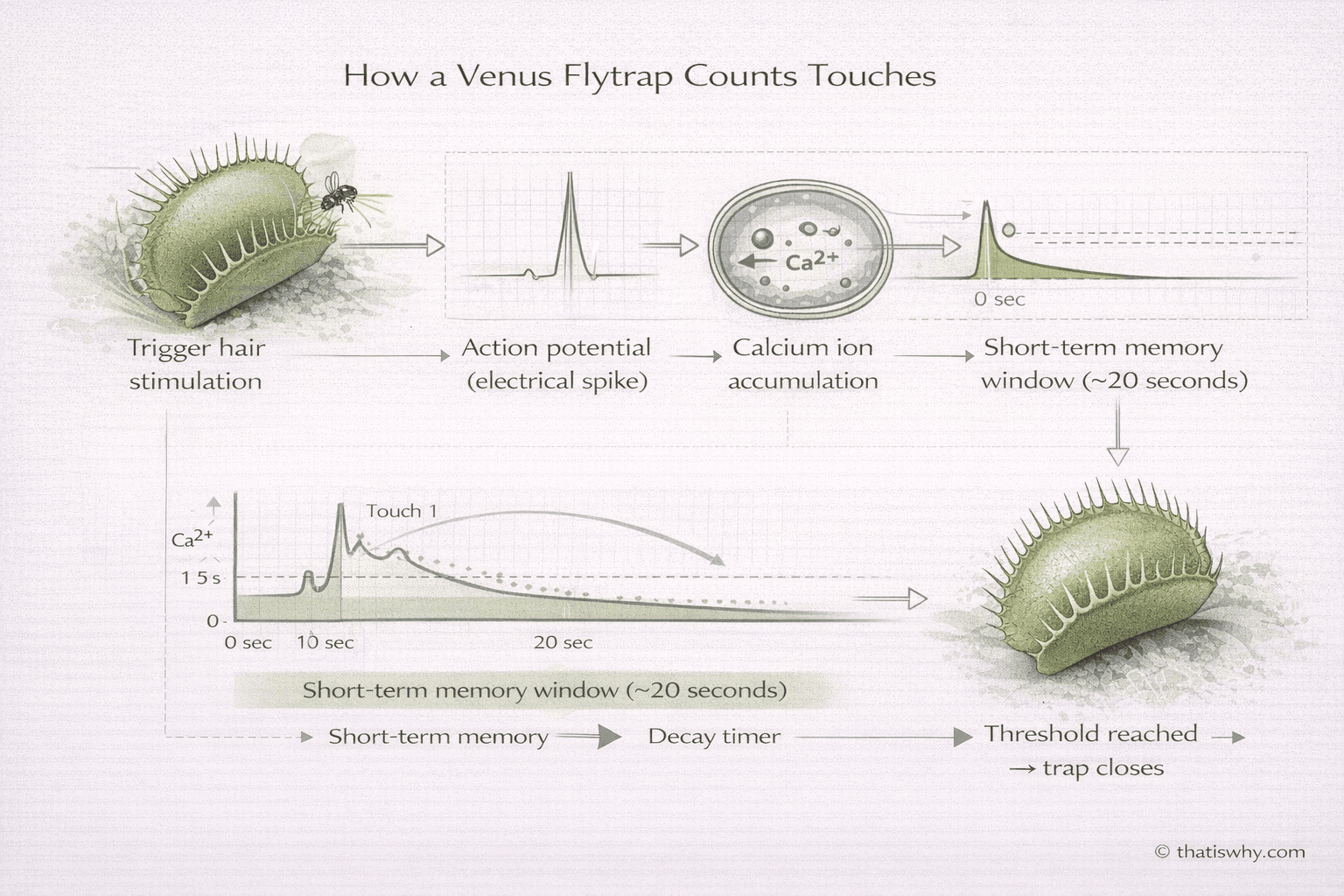
How do Venus Flytraps count? The Venus Flytrap uses a counting system to avoid false alarms. It requires two trigger hairs to be touched within 20 seconds to close. This proves the plant has “Short Term Memory”—encoded not in a brain, but in a buildup of Calcium Ions that fades over time.
That is the science. But seeing it happen feels like magic.
If you poke a Venus Flytrap once, nothing happens. You can poke it, wiggle your finger, and tease it. It sits there, frozen. But if you poke it twice? Snap.
This isn’t a simple reflex; it’s a calculation. To do this, the plant had to do something that should be impossible for a vegetable: It had to count.
How can a plant count to two? It has no brain. It has no neurons but the Venus Flytrap can calculate, memorize, and make life-or-death decisions in real-time. It isn’t just a flower; it is a green computer running a survival algorithm.
And it doesn’t just count to two. It counts to five.
The Smart Security System
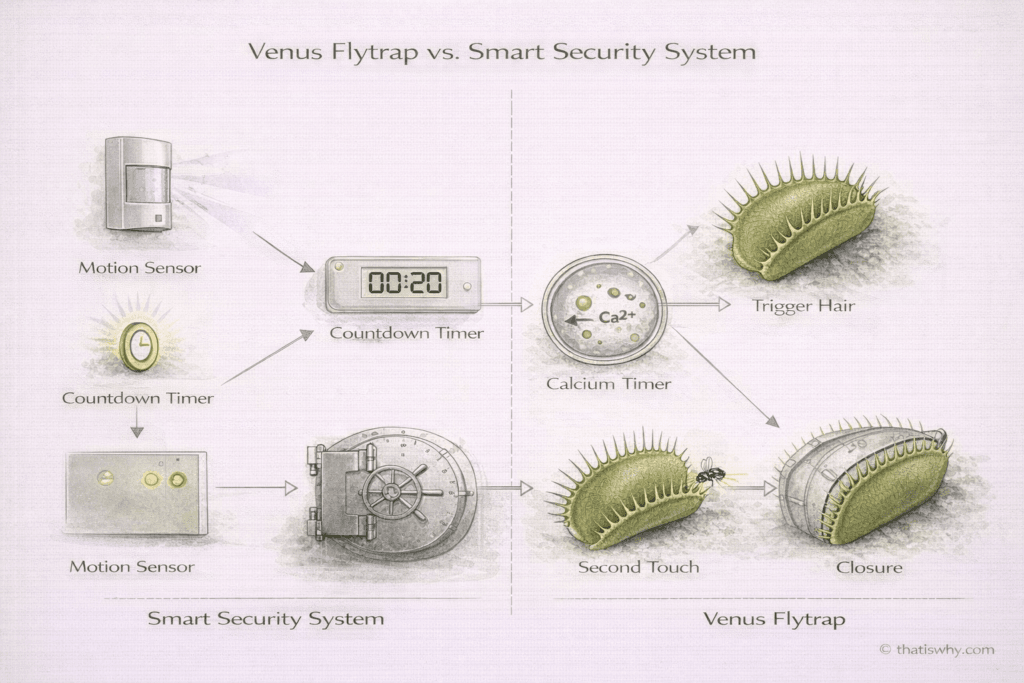
To understand why the plant needs to count, you have to understand its like a Smart Security System.
The Flytrap lives in swampy, nutrient-poor soil. It is biologically broke. Digesting a meal is incredibly expensive. Closing the trap and producing enzymes burns a massive amount of energy. If the plant closes on a false alarm, like a raindrop or a fallen twig, it wastes that energy for nothing. If it makes that mistake too many times, it starves to death.
So, the plant installed a Smart Security System.
Think of the trap as a high-tech vault door protecting the plant’s energy reserves. It is programmed with a fail-safe. It will never, ever close on a single signal. It requires a specific security code to confirm the target is real. That code is the number Two.
Touch 1: The Motion Sensor
Inside the trap, there are tiny trigger hairs that act like tripwires. When a bug brushes against one, it sends an electrical spike across the leaf.
This is Touch 1. In our analogy, the motion sensor just tripped. The security system wakes up and asks: “Was that a fly, or was it just a raindrop?”
Crucially, the door does not close. The plant isn’t stupid. It waits. It sets a chemical timer. When the hair is touched, the plant releases a pulse of calcium ions. Think of this like flipping an hourglass. The sand (calcium) starts draining immediately. The system gives the intruder exactly 20 seconds to prove it is real.
If nothing happens in that window, the hourglass runs out. The system resets. The plant literally “forgets” the touch ever happened.
Touch 2: The Lockdown
But if the intruder is a real bug, it won’t stop moving. It will brush against a second hair.
This is Touch 2. If this happens while the timer is still running, the security system confirms the target. “Confirmed. This is food.”
The response is instantaneous. The plant reverses the hydraulic pressure in its cells, and the trap snaps shut in less than a tenth of a second. The door is locked. The intruder is caged.
This is a brilliant piece of coding. Raindrops hit randomly; they rarely strike two specific trigger points within 20 seconds. Only a living, struggling creature triggers the double-tap. The plant filters out the noise and only spends energy on the signal.
Touch 5: The Biometric Scan
But the math doesn’t stop there. The door is locked, but the plant still hasn’t turned on the “Gas” (the digestive acid). Why? Because chemical digestion is energetically expensive. What if the trap closed on a dry leaf? Or a stone? If the plant pours acid on a rock, it burns calories for zero return.
So, it waits for the panic. As the trapped bug struggles to escape, it bumps into the trigger hairs again and again. Touch 3 tightens the grip, touch 4 makes the seal airtight to prevent leaks and finally, touch 5 breaches the chemical threshold.
The system verifies that the prisoner is soft, moving, and protein-rich. It finally authorizes the release of digestive enzymes, and the meal begins. If the trap closes on a stone, the stone won’t struggle. It won’t hit count 5. The plant calculates the error, unlocks the door, and spits the rock out to try again.
Green Nerves
The craziest part of this story isn’t the math; it’s the machinery.
When a hair is touched, the plant fires an Action Potential. This is a spike of voltage that travels across the cell membrane at high speed. If you hooked a Venus Flytrap up to an EKG machine, you would see the spike. It is the exact same electrical signal your brain uses to tell your heart to beat.
The Venus Flytrap has a nervous system. It just doesn’t have a brain. It proves that intelligence isn’t about having a skull; it’s about having the right wiring. It is essentially a biological computer running “If/Then” logic gates using calcium instead of silicon.
Garden Myths
Because this plant is famous, everyone thinks they can grow it. Most people kill it in a week. Let’s save you some trouble.
Myth #1: “Feed it hamburger.” We assume “meat is meat,” right?
The Truth: Hamburger is a death sentence. The fat rots faster than the plant can digest it, turning the trap black and killing it. Stick to live bugs.
Myth #2: “Water it from the tap.” It’s a plant. It drinks water.
The Truth: Tap water is poison. These plants evolved in swamps with zero minerals (that’s why they eat bugs in the first place). The minerals in your tap water will burn their roots instantly. Use distilled water or rain water, or don’t bother.
Myth #3: “It bites.” It looks scary.
The Truth: It’s actually pretty weak. If you stick your finger in, it feels like a soft pinch. And unless you wiggle your finger 5 times, it won’t even try to digest you. It’s smart enough to know you aren’t a fly.
The Green Accountant
When you watch a Venus Flytrap snap shut, it looks like a predator attacking its prey. It looks angry.
But now you know the truth. It isn’t anger; it’s accounting. The plant is running a brutal economic audit on every single thing that touches it. The security system counts the inputs, calculates the energy cost, and decides if the investment is worth the return.
It counts to two to filter out the rain. It counts to five to filter out the rocks. It is a master of efficiency, proving that you don’t need a brain to be a genius. You just need a good security system and the ability to do the math.
How We Researched This :
To explain this biological algorithm, we looked at the groundbreaking 2016 study by Rainer Hedrich at the University of Würzburg. His team attached electrodes to the plants and measured the specific “Action Potentials” (voltage spikes) generated by each touch.
But we knew that just citing voltage spikes isn’t helpful. Our real job began when we asked, “What does this feel like?” That question led us to the “Smart Security System” analogy—a simple story to make the complex chemistry of calcium memory and decision thresholds feel intuitive.