Biological Anomalies: Life That Breaks the Rules
Blood is red. Mammals give live birth. Skin is just a covering. Life only moves forward.
These feel like rules, until you meet the animals that survive by breaking them.
Biology textbooks tend to describe life as if it were built in a factory.
Every organism follows a clean blueprint. Parts are standardized, systems are elegant, blood is red, mammals give live birth, and life moves in a straight line from youth to old age. That picture is comforting because it feels orderly, predictable, and logical.
It’s also wrong.
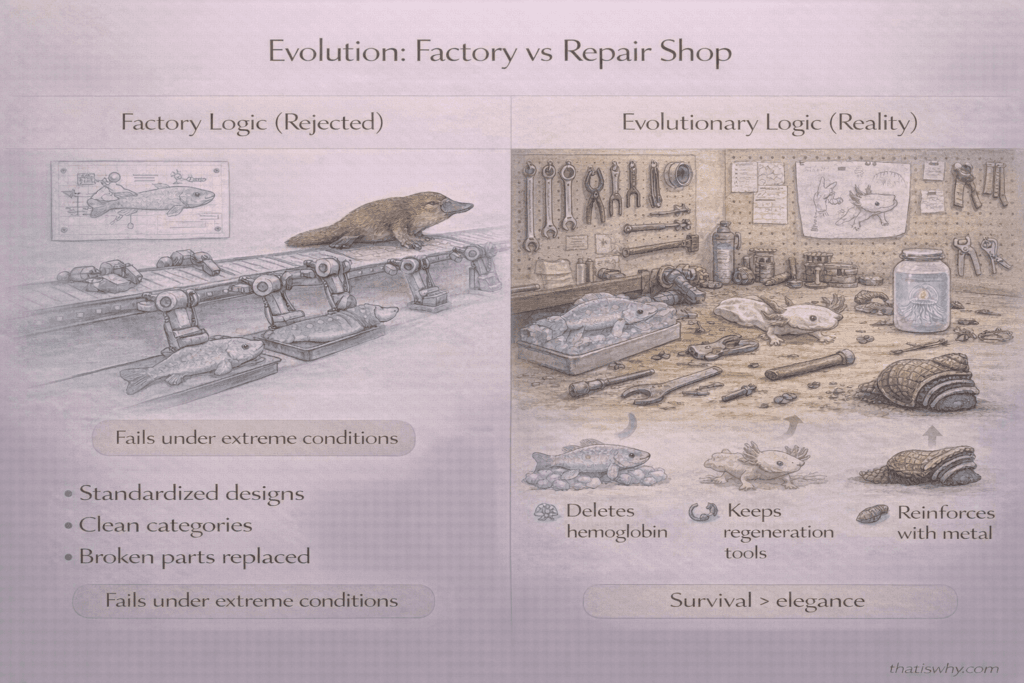
Out in the real world, evolution doesn’t behave like a factory at all. It acts more like a repair shop. When a system starts failing, because of cold, darkness, poison, starvation, or sheer bad luck, evolution doesn’t redesign life from scratch. It doesn’t care how things should work. It asks one practical question: what will keep this organism alive right now?
The animals below aren’t mistakes or curiosities. They’re successful repairs.
Breaking the Law of Blood
One of the first rules we learn in biology is that blood is red because it uses hemoglobin to carry oxygen. It’s efficient, reliable, and works beautifully, right up until the environment changes.
In the freezing waters of Antarctica, that efficiency becomes a liability.
The Antarctic icefish has blood as clear as water, with no red blood cells and no hemoglobin. Instead of forcing thick, sluggish blood through icy veins, evolution takes a simpler route and removes the part that keeps clogging the system.
Cold seawater holds enormous amounts of dissolved oxygen, and thin, watery blood flows easily, allowing oxygen to diffuse directly into the plasma. The heart doesn’t strain, the vessels don’t jam, and the system keeps running with less effort overall.
In a factory mindset, this would look like a design failure while in a repair shop, it’s the obvious fix.
👉 Read the deep dive: The Bloodless
Breaking the Law of Classification
Factories love neat categories. Mammal, reptile, bird, fish—everything labeled and shelved in the right place.
Repair shops don’t think that way.
The Platypus looks like a contradiction only if you expect evolution to clean up after itself. It has fur and produces milk, but it also lays eggs, hunts with electricity, and carries venomous spurs.
None of those traits were removed because none of them stopped working. Egg-laying still solved reproduction, milk still fed offspring, electroreception worked better than eyesight in muddy rivers, and venom handled competition when needed. Evolution didn’t replace these systems; it stacked them and moved on.
The confusion isn’t in the animal.
It’s in assuming biology ever cared about our labels.
👉 Read the deep dive: The Platypus Problem
Breaking the Law of Skin
In most animals, skin is a boundary. It protects what’s underneath, regulates temperature, and keeps the outside world at a distance. Communication and perception usually happen elsewhere.
The Cuttlefish ignores that division entirely.
Its skin is wired directly to its nervous system, with pigment sacs, reflectors, and light-scattering cells firing in precise patterns across the body in milliseconds. Color, contrast, and texture all change together, allowing the animal to camouflage, communicate, or overwhelm a prey’s visual system without moving.
From a factory perspective, this looks like terrible design. Displays belong inside, signals travel inward before coming back out, and surfaces stay passive. From a repair-shop perspective, the logic is much simpler. If instant visual control matters more than clean signal routing, you move the output directly to the surface.
The result is skin that doesn’t just hide the cuttlefish; it actively broadcasts information in real time, fast enough to matter.
👉 Read the deep dive: The Hypnotist
Breaking the Law of Time
Most living systems wear down. Damage accumulates, repairs become less effective, and eventually the system fails.
The Turritopsis dohrnii refuses to reach that point.
When its adult body becomes too damaged or stressed to continue, it doesn’t attempt another patch. Instead, it strips the system down and rolls back to an earlier configuration. Cells unlock their identities, reorganize, and rebuild the organism as a juvenile form that worked before the damage existed.
This isn’t healing or rejuvenation. It’s abandoning a failing build and restarting from a stable version that has already proven viable.
In repair-shop terms, this isn’t maintenance. It’s reinstalling an older system because the current one can no longer run reliably.
👉 Read the deep dive: The Immortal
Breaking the Law of Growing Up
In most animals, development is a one-way street. Cells specialize, flexibility disappears, and repair becomes limited.
The Axolotl never finishes that journey.
It retains juvenile traits for life while remaining reproductively mature, and more importantly, it never discards its repair tools. When it loses a limb, it rebuilds it completely—bone, muscle, nerves, and blood vessels all return, correctly wired and functional.
In a factory model, this would be impossible. Once parts are specialized, the molds are gone. In a repair shop, the axolotl simply never cleared the shelf. When something breaks, it doesn’t invent a new solution; it reuses one it never abandoned.
👉 Read the deep dive: The Eternal Student
Breaking the Law of Soft Bodies
Biology usually builds light and flexible structures. Metal is heavy, toxic, and reserved for tools, not tissues.
Then there’s the Scaly-foot snail.
Living near hydrothermal vents, this snail doesn’t try to sense danger earlier or escape faster. Instead, evolution reinforces the body itself. Iron from the environment becomes armor, plating the shell and scales with iron sulfide.
From a factory standpoint, this violates every materials guideline. From a repair-shop standpoint, it makes immediate sense. If soft parts keep failing under extreme conditions, you reinforce them.
👉 Read the deep dive: The Iron Knight
Breaking the Law of Kingdoms
Plants make energy. Animals consume it. That division feels fundamental—until it stops being useful.
The Spotted salamander quietly bends that rule early in life by hosting algae inside its tissues. Those algae photosynthesize, providing energy directly to a developing vertebrate.
It isn’t permanent or elegant, but it works long enough to matter. In repair-shop logic, this isn’t a redesign of biology; it’s a temporary workaround installed because survival can’t wait.
👉 Read the deep dive: The Solar Salamander
Why These “Exceptions” Aren’t Rare at All
Once you start seeing evolution as a repair shop, these animals stop feeling unique.
Scar tissue isn’t elegant, but it seals damage quickly. The human spine still carries stress fractures from an upright posture it was never built for. Aging itself looks less like a planned shutdown and more like the accumulation of fixes that worked earlier but stopped scaling later.
These anomalies aren’t edge cases. They’re simply louder examples of the same logic operating everywhere.
Evolution doesn’t chase perfection. It keeps systems operational.
What These “Biological Rules” Get Wrong
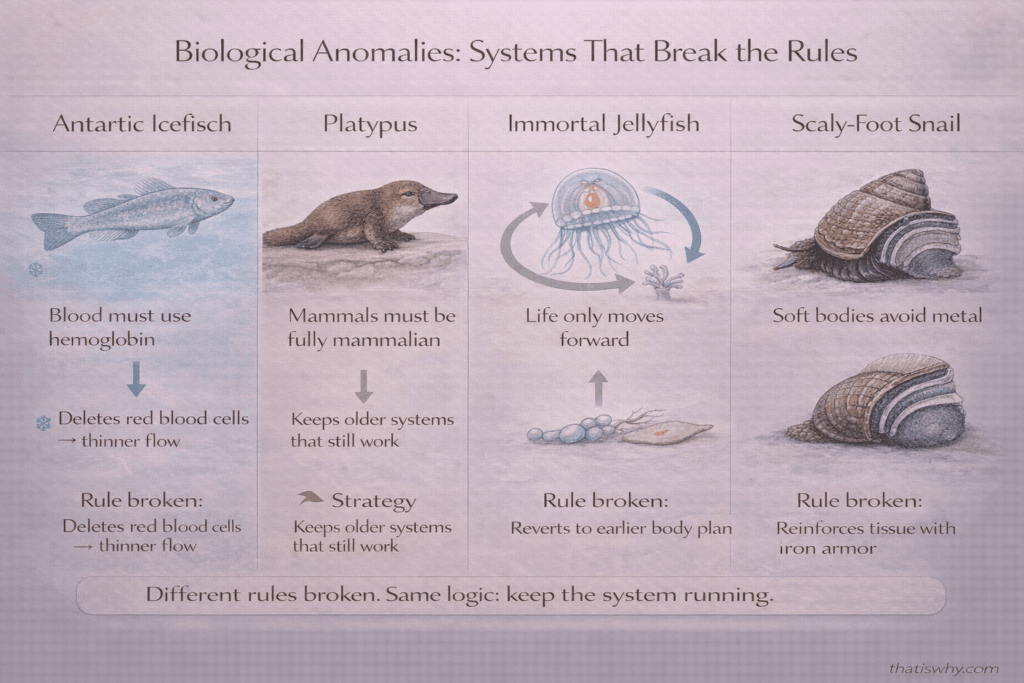
Myth #1: Blood must be red to carry oxygen
Truth: Red blood is efficient, not mandatory. The Antarctic icefish survives with clear blood because cold water holds so much oxygen that thin plasma works better than thick, cell-packed blood. Evolution didn’t improve the system—it simplified it.
Myth #2: Mammals are cleanly separated from reptiles
Truth: Those categories are human filing systems, not evolutionary boundaries. The Platypus keeps egg-laying, venom, milk production, and electroreception because none of those tools stopped working. Evolution doesn’t delete features just to look tidy.
Myth #3: Skin is passive protection
Truth: In the Cuttlefish, skin is an active interface wired directly to the brain. Color, contrast, and texture change in real time, turning the body surface into a display system when speed matters more than internal routing.
Myth #4: Aging is irreversible
Truth: Aging usually is—but not always. The Turritopsis dohrnii doesn’t repair damaged tissue. It abandons the adult body entirely and rebuilds itself from an earlier developmental state when the current version can no longer run.
Myth #5: Complex animals must “grow up” and lock their parts in place
Truth: The Axolotl never discards its developmental repair programs. By keeping those tools available, it can rebuild entire limbs long after most vertebrates would be stuck with scars.
Myth #6: Biology stays soft and organic
Truth: When softness fails, evolution reinforces. The Scaly-foot snail incorporates iron into its body, using metal armor as a direct response to life near toxic hydrothermal vents.
Remembering what these Truths have in common
None of these animals are trying to be impressive. They’re responding to pressure.
Each one shows the same underlying logic: when a standard design starts failing, evolution doesn’t argue with the rulebook. It patches, removes, reinforces, or reuses whatever keeps the organism alive.
That’s not rebellion it’ simple maintenance.
Still in the Shop
This page isn’t finished, and it never will be.
Every time we think we’ve mapped the limits of life, something else rolls into the workshop with a solution we didn’t expect. A new workaround, a new patch, another reminder that biological rules only matter until they stop working.
The hall of fame stays open, because the repair shop never closes.
Evolution Is a Repair Shop, Not a Factory
We tend to judge life the way we judge machines, by how cleanly they’re designed and how closely they match expectations.
Nature doesn’t share that standard.
Like any good repair shop, evolution leaves scars, keeps outdated parts if they still work, and installs ugly fixes when they solve urgent problems. Sometimes, those strange solutions turn out to be the most durable of all.
These animals don’t show us how life should work. They show us how it actually does.
How We Researched This :
To explain why some animals appear to break fundamental biological rules, we relied on peer-reviewed research across physiology, evolutionary biology, and developmental science. This includes studies on icefish blood chemistry, monotreme evolution, cephalopod neurobiology, transdifferentiation in Turritopsis dohrnii, salamander–algae symbiosis, and biomineralization in hydrothermal vent species, published in journals such as Nature, PNAS, The Biological Bulletin, and Science.
But listing mechanisms alone isn’t enough. Our real work began when we asked a simpler question: what does it feel like when a biological system is under pressure? That question led us to the “repair shop” analogy,a concrete way to understand evolution not as a blueprint-driven process, but as a series of pragmatic fixes that keep life running when ideal designs fail.