Why Evolution Favors the Liar (The Science of Deception)
The Trust Economy
What is Aggressive Mimicry? Aggressive Mimicry is a predatory strategy where an animal mimics a harmless or attractive signal to lure prey. Unlike camouflage (hiding), it involves active deception—using false promises of food, safety, or sex to trick a victim into a trap.
Scientifically, it’s called mimicry. But let’s be honest: It’s fraud.
We tell our kids that “Honesty is the best policy.” That’s a nice sentiment, but in the wild, honesty will get you eaten.
Nature runs on a Trust Economy. Every color and sound is a piece of currency. A red berry promises sugar. A bird alarm promises safety. A mating flash promises love. Animals trade these signals to survive.
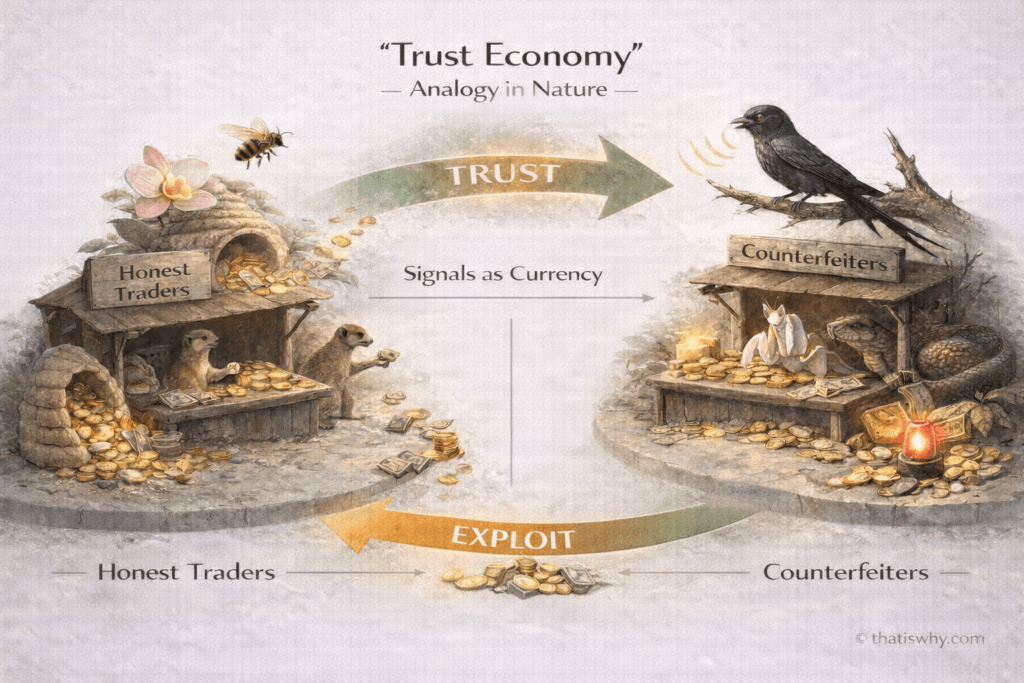
But wherever there is currency, there are counterfeiters.
Evolution has rewarded a special class of criminals who have learned to forge these signals. They don’t survive by being strong; they survive by flooding the market with fake information. They are the con artists of the animal kingdom.
Let’s look at the five ways they break the bank.
The Forgery: Printing Fake Money
The most basic way to cheat the system is to create a counterfeit bill that looks better than the real thing.
This is the strategy of the Orchid Mantis. Bees spend their lives searching for value. They hunt for bright colors and perfect symmetry, because in nature, those signals usually mean nectar.
The Mantis turns that instinct into a trap. It doesn’t just copy the currency; it perfects it. It creates a disguise that is pinker, brighter, and more symmetrical than the real orchids growing nearby. It creates a “Super-Normal” version of the signal.
Think of it like printing a $100 bill on shiny gold foil. To the bee, it looks infinitely more valuable than the faded, boring paper money (the real flowers) growing next to it. The insect ignores the safe bet, reaches for the fake cash, and pays for it with its life. It’s not just a disguise; it’s a temptation.
Read the Deep Dive: Learn why bees prefer this fake flower over the real thing. That Is Why The Orchid Mantis Is The Ultimate Con Artist
The Bait: The False Reward
Sometimes, you don’t need to forge the whole bill. You just need to dangle a prize in front of a greedy mark.
This is the brilliant hustle of the Spider-Tailed Viper. Most predators try to disappear. They rely on camouflage to stay hidden. This snake takes it a step further. It uses camouflage to hide the danger, but uses mimicry to advertise the reward.
It has evolved a tail tip that is a perfect biological sculpture of a spider—complete with a bulbous abdomen and ragged scales that look like legs. But the sculpture isn’t enough. The snake animates it. It moves the tail in a figure-eight pattern to mimic the skittering motion of prey.
The bird spots the “spider” and dives, completely ignoring the fact that the snack is attached to a venomous viper. The snake uses greed to blind the victim. It’s the oldest con in the book: Get them staring at the shiny object so they don’t notice the knife.
Read the Deep Dive: See the snake that uses a fake spider to fish for birds. That Is Why The Spider-Tailed Viper Is Nature’s Greatest Puppeteer
The Interception: Credit Card Fraud
Information is currency. And just like your credit card number, if you broadcast it loudly enough, someone is going to steal it.
This is the brilliant fraud of the Femme Fatale Firefly. Fireflies treat their flash patterns like secure PIN codes. A male flashes his code to offer his genetic investment, assuming only a female of his species has the key to verify it.
But the Photuris female is basically skimming the ATM. She sits in the grass, scanning the airwaves for a PIN she recognizes. When she spots a male, she flashes back the exact code he is waiting for.
The male thinks the transaction is approved. He flies down to deliver the goods. Instead, he gets liquidated. She eats him to steal his chemical defenses, effectively draining his account to fund her own family. It’s the ultimate financial crime.
Read the Deep Dive: Meet the predator that hacks the firefly’s love songs. That Is Why The “Femme Fatale” Firefly Is Nature’s Greatest Spy
The False Alarm: Market Manipulation
If you can’t trick them with greed, you trick them with panic.
This is the ruthless strategy of the Fork-Tailed Drongo, the only bird I know that understands insider trading. This bird spends most of his day acting as a legitimate security guard for Meerkats. He builds up “Market Confidence.” The Meerkats trust his data implicitly.
But when he sees a Meerkat holding a juicy scorpion, he decides to crash the market. He screams “EAGLE!” when the sky is totally empty. The panic forces the Meerkats to dump their assets (their food) and run for cover. The Drongo swoops in and collects the dropped goods for free. He is using fear to manipulate the economy, profiting directly from the chaos he created.
Read the Deep Dive: Meet the bird that lies for a living. That Is Why The Drongo Is Nature’s Greatest Con Artist
The Extortion: The Audit
Finally, there is the darkest form of exchange: The Hostile Takeover.
This is the brutal business model of the Cuckoo Mafia. The Cuckoo doesn’t bother with fake IDs or forged bills. She operates on pure leverage. She essentially walks into the host’s shop and demands a percentage of the profits.
The host isn’t tricked; it is coerced. It knows the Cuckoo egg is a parasite. But it also knows that the Cuckoo is watching. If it evicts the tenant, the landlord (the Cuckoo) will burn the building down. The host accepts the loss because paying the “tax” is the only way to avoid total liquidation.
Read the Deep Dive: Discover the bird that runs a protection racket. That Is Why Birds Raise Cuckoo Eggs (The Mafia Hypothesis)
The Economics of Belief
You might wonder: Why hasn’t evolution fixed this? Why do Meerkats still run every time the Drongo screams? Are they stupid?
No. They are just good accountants.
It comes down to The Cost of Error. If a Meerkat ignores an alarm and there is an eagle, the cost is total bankruptcy (Death). If it falls for a fake alarm, the cost is just a small fine (Lost Lunch).
It is always cheaper to be tricked than to be dead. The liars know this. They exploit that safety margin. They exist in the gap between “Caution” and “Survival.” Being gullible isn’t a flaw; it’s an insurance policy.
The Truth About Lying
We like to think of nature as “pure” or “honest.” But that’s a human fairy tale.
Nature is a cutthroat marketplace, and information is the currency. The Orchid Mantis prints fake bills. The Firefly steals PIN codes. The Drongo manipulates the stock market. And the Cuckoo runs the mob.
These animals prove that survival isn’t just about being strong or fast. It’s about being convincing. Lying requires intelligence. It requires empathy. You have to know what your victim wants before you can fake it.
In the brutal economy of evolution, the truth is cheap. But a perfect lie? That is a masterpiece.
How We Researched This :
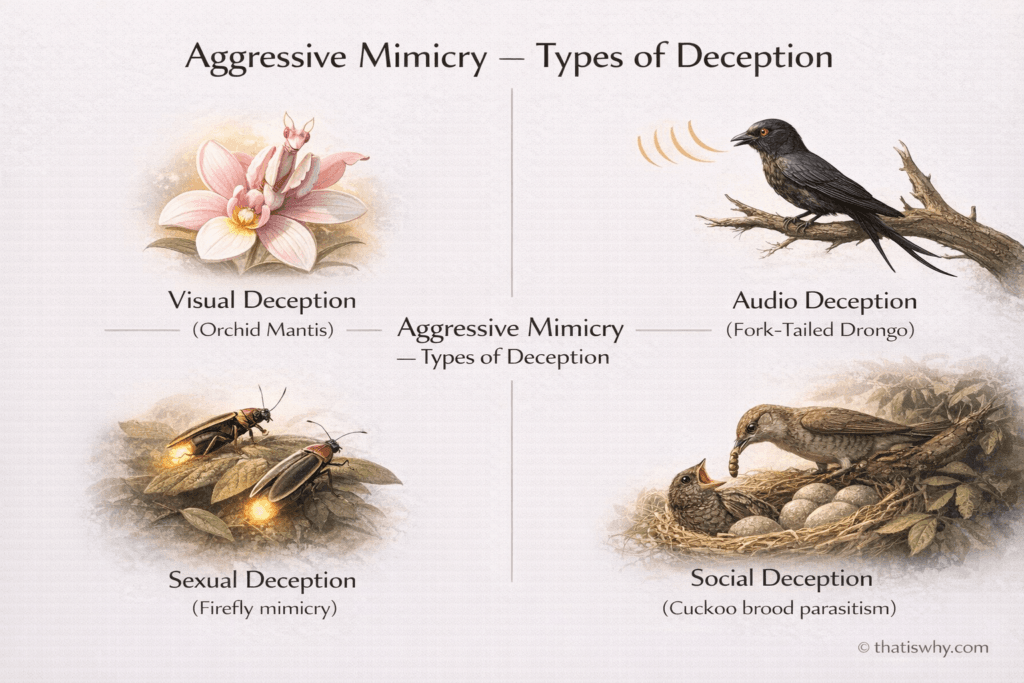
This guide synthesizes the principles of Evolutionary Game Theory and Signal Detection Theory to categorize the deceptive strategies used by predators. We moved beyond simple “Camouflage” (hiding) to focus on Aggressive Mimicry (active lying), grouping these animals by the type of information they manipulate—Visual, Audio, Chemical, or Social.
But we knew that just citing Game Theory isn’t helpful. Our real job began when we asked, “What does this feel like?” That question led us to the “Trust Economy” analogy—a simple story to make the complex biological arms race of signal and receiver feel intuitive.