Domestic Biology: The Secret Science Sleeping on Your Couch
The Wolf in the Living Room
We treat our pets like children. We buy them sweaters, bake them organic treats, and talk to them in embarrassing voices. We have softened their lives.
But we haven’t softened their biology. Under the hood, your pet is still a wild animal running high-performance survival software.
Your dog isn’t just a furry toddler; he is a bio-engineered wolf with a quantum compass in his eyes that can see the Earth’s magnetic field. Your cat isn’t just a lazy roommate; she is a liquid predator that vibrates at a specific frequency to heal her own broken bones. Your goldfish isn’t just a cheap decoration; it’s a chemical reactor that turns oxygen deprivation into vodka to survive the apocalypse.
We have domesticated their behavior, but we haven’t deleted their instincts. Your house isn’t a nursery; it is a laboratory. And the experiments are sleeping on your couch.
The Secret Identity
To understand our pets, we have to stop looking at them as dependent “Fur Babies” and start looking at them as Superheroes with Secret Identities.
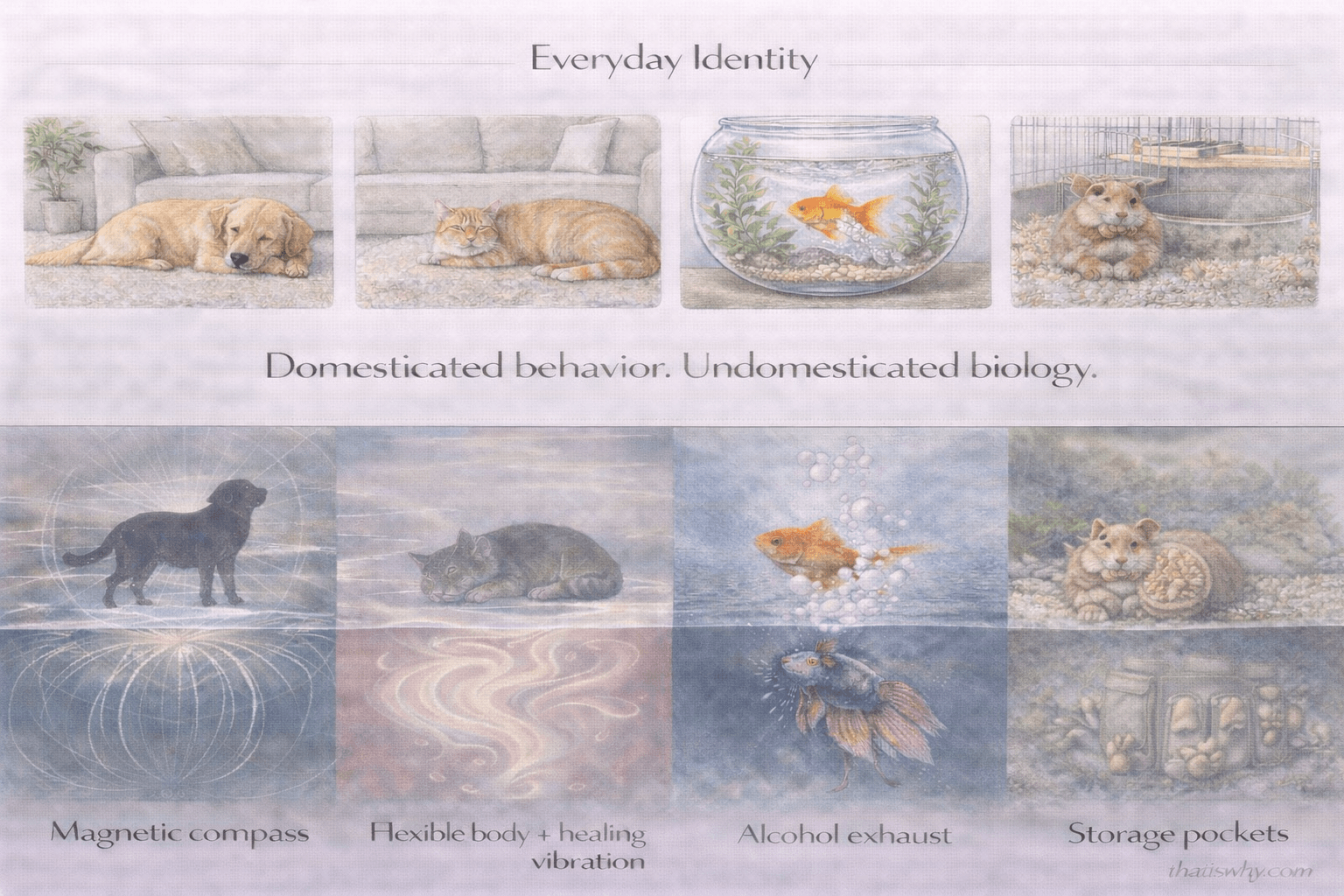
On the surface, they act like sidekicks. They beg for food, chase laser pointers, and sleep all day. They seem harmless. But that is just the Clark Kent persona.
In the wild, these animals were apex survivors. They evolved extreme superpowers, night vision, chemical synthesis, structural shifting, to survive in environments that would kill a us instantly. When we brought them indoors, they didn’t lose those powers. They just tucked them under their collars.
Let’s unmask the team.
The Physicists: Mastering Space
First, meet the Physicists. These are the team members who can manipulate matter and volume.
The Shapeshifter (The Cat) Physics defines a “liquid” as a material that changes shape to fit its container. By this definition, your cat is a liquid. Thanks to a disconnected collarbone, a cat can pour itself into a glass bowl or flow under a locked door. It can turn from a solid into a fluid at will.
Read the Deep Dive: That Is Why Cats Are Technically Liquids
The Heavy Lifter (The Hamster) Then there is the Hamster. It looks small, but it has a superpower: Infinite Storage. Its cheek pouches are specialized sacks that extend from the mouth all the way to the hips. It can carry 20% of its body weight in cargo without swallowing a crumb. It is a walking warehouse.
Read the Deep Dive: That Is Why Hamsters Are Walking Warehouses
The Chemists: Surviving the Toxic
Next, meet the Chemical Engineers. These are the aquatic pets that can survive in “Death Zones.”
The Brewer (The Goldfish) The Goldfish is the ultimate survivor. In a frozen pond with zero oxygen, any other fish would suffocate. But the Goldfish has a chemical hack. It switches its metabolism to stop burning oxygen and start fermenting sugar into alcohol. It survives the winter by turning its blood into vodka.
Read the Deep Dive: That Is Why Your Goldfish Is The World’s First Hybrid Vehicle
The Diver (The Betta) The Betta Fish lives in stagnant, oxygen-poor puddles where normal fish would die. To survive, it evolved a lung—the Labyrinth Organ. It carries a bubble of air inside its head, acting like a scuba diver. If you keep a Betta underwater, it will actually drown.
Read the Deep Dive: That Is Why The Betta Fish Drowns Without Air
The Navigators: Seeing the Invisible
Then there are the Sensors. These animals can detect forces that we are completely blind to.
The Compass (The Dog) Have you ever wondered why your dog spins before he poops? He isn’t being picky. He is calibrating. Dogs have Magnetoreception. They possess quantum sensors in their eyes (cryptochromes) that allow them to see the Earth’s magnetic field. They spin to align their bodies with the North-South axis, using the planet’s magnetic grid to drop a precise GPS pin on their mental map.
Read the Deep Dive: “That Is Why Your Dog Spins Before Pooping“
The Healers: Vibrational Medicine
Finally, meet the Medics. These animals have built-in systems to repair damage.
The Sonic Gym (The Cat) We think cats purr because they are happy. But they also purr when they are injured or dying. Why? Because the purr is a medical device. It vibrates at a specific frequency (25-140 Hz) that is proven to increase bone density and speed up muscle repair. A cat isn’t just making a noise; it is running a bio-mechanical maintenance cycle to keep its body from atrophying while it sleeps.
Read the Deep Dive: That Is Why Cats Purr (The Healing Frequency)
The Time Travelers: Refusing to Grow Up
And finally, the one who refuses to play by the rules of aging.
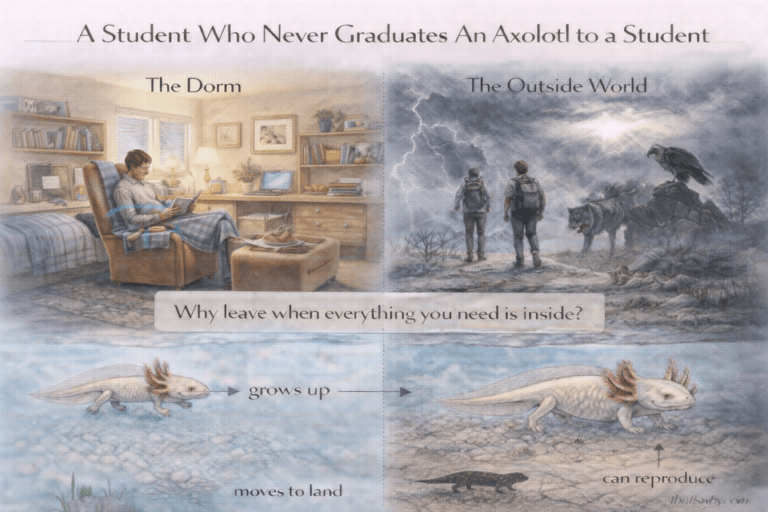
The Immortal (The Axolotl) The Axolotl is a salamander that hacked its own thyroid. It chemically blocked its own metamorphosis, choosing to stay a baby forever. By refusing to grow up, it retained its embryonic superpowers. While adult salamanders scar, the Axolotl can regenerate entire limbs, its spinal cord, and even parts of its brain. It traded adulthood for immortality.
Secret Identity Myths
Let’s clear up a few misconceptions about our superheroes.
Myth #1: “They are just like us.” We project human emotions onto them.
The Truth: They are aliens. Your dog smells time. Your cat hears electricity. They aren’t little human baby or buddy; they are specialized machines operating on a different frequency.
Myth #2: “They are simple.” We think they are dumb because they chase balls.
The Truth: They are specialized geniuses. A dog can detect a drop of blood in an Olympic pool. A goldfish can survive without oxygen. They aren’t simple; they are just optimized for a world we can’t see.
Myth #3: “They are harmless.” We think of them as soft and cuddly.
The Truth: They are apex predators we invited inside. Your cat is a lethal hunter with retractable knives. Your dog has a jaw pressure that can snap bone. They are safe only because they choose to be.
Myth #4: “They need us to survive.” We think they are helpless without kibble.
The Truth: They survived the Ice Age without us. The Goldfish conquered frozen ponds. The Cat conquered the desert. We didn’t save them; we just gave them a more comfortable headquarters.
Respect the Beast
It’s easy to look at our pets and see them as dependent, silly little things.
But that is a mistake. They are masterpieces of evolution. They are physicists, chemists, and navigators. They have conquered the cold, the dark, and the crushing weight of the world.
So the next time you look at your dog sleeping or your goldfish swimming, show some respect. You aren’t just looking at a pet. You are looking at a biological marvel that has agreed to share your couch.
How We Researched This :
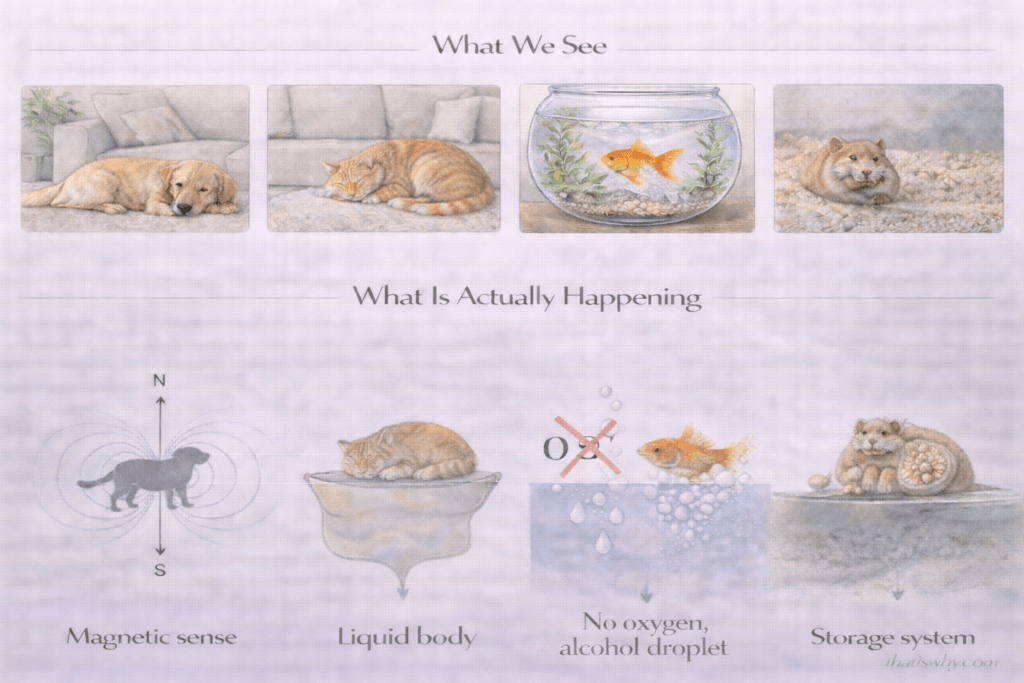
This guide synthesizes the fields of Veterinary Science, Evolutionary Biology, and Comparative Anatomy to explain the hidden physiological traits of common household pets.
We moved beyond simple care tips to explore the functional origin of these behaviors, revealing that what looks like a quirk (spinning, purring, gulping air) is actually a sophisticated survival mechanism.