Why Camel Humps Are Heat Engines, Not Water Tanks
Most people think a camel’s hump stores water, that’s wrong : it stores fat.
That sounds like a terrible idea in the desert. Fat is insulation, and insulation traps heat if you wrapped a desert animal in thick fat from head to toe, you would cook it from the inside out.
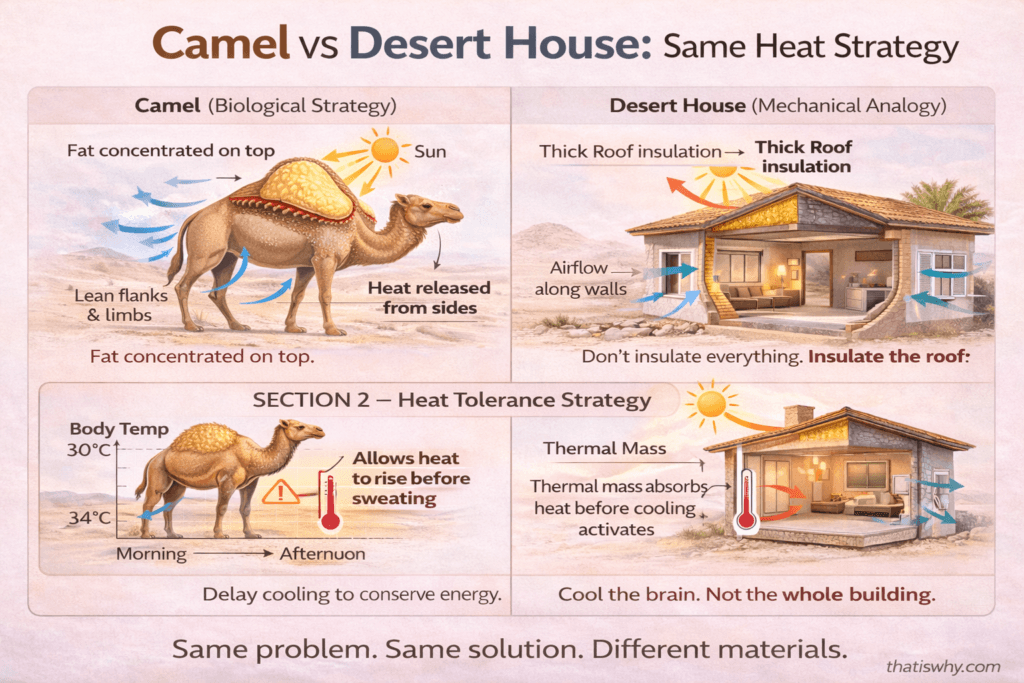
So camels did something smarter instead of spreading insulation across their entire body, they concentrated it in one place, on top, like a house in the desert with heavy roof insulation and breathable walls. The hump is not a water tank it is a thermal design decision.
The Fat Insulation Problem: Why the Camel Insulates the Roof, Not the Walls
Imagine building a house in the middle of the desert. You would not wrap the entire structure in thick insulation from floor to ceiling. If you did, you would trap heat inside and turn it into an oven. Instead, you would insulate the roof heavily to block the brutal midday sun, while allowing the walls to release heat when the wind moves through.
That is exactly what a camel is doing.
Fat is insulation, in cold environments, animals spread it evenly across their bodies to conserve warmth. In hot environments, that same strategy becomes a liability. A thick, uniform layer of fat would prevent the camel from shedding excess heat, especially when internal body temperatures naturally rise during the day.
Camels regularly allow their body temperature to fluctuate several degrees to avoid sweating away precious water. That flexibility only works if heat can escape. If their entire body were wrapped in insulating fat, every degree gained during the day would be trapped.
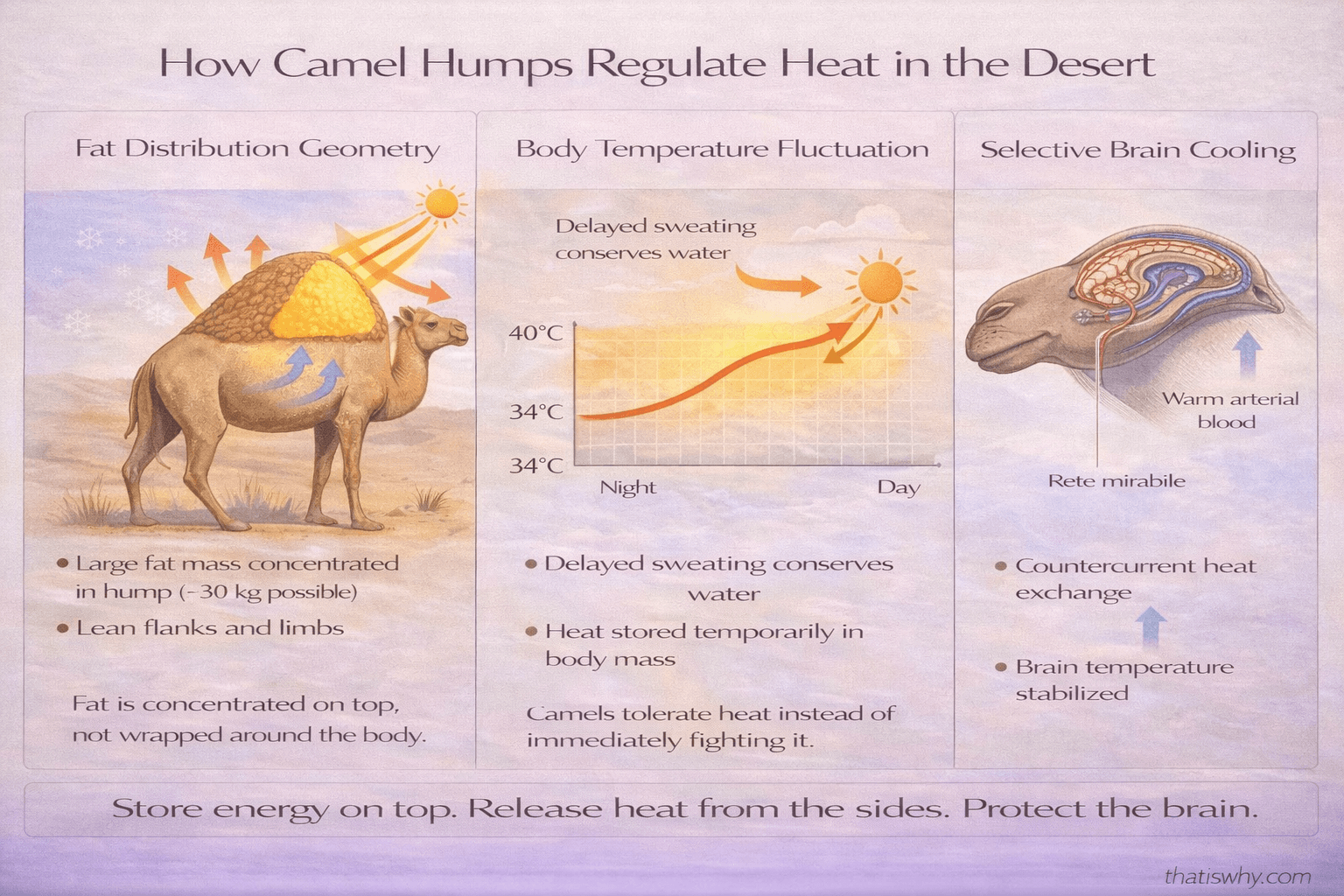
So instead of wearing a full thermal blanket, the camel stacks most of its fat into the hump, which sits directly under the desert sun. That concentrated fat layer acts like heavy roof insulation, blocking some solar radiation from reaching the organs below. At the same time, the flanks and limbs remain relatively lean, functioning like the exposed walls of that desert house, where moving air can carry heat away.
This redistribution changes the thermal geometry of the animal. The hump absorbs and buffers incoming solar heat, while the sides act as release panels. By localizing insulation instead of spreading it, the camel avoids turning its own body into a sealed furnace.
It looks like a storage bag and behaves like rooftop insulation.
The Water Myth: Why the Hump Is Not a Canteen
The water story is one of those ideas that feels right even if you have never checked it. Desert animal, big hump, obvious storage tank. It is clean, simple, and wrong.
The hump is almost entirely fat.
When the body breaks down fat for energy, it does produce water as a byproduct. For every gram of fat metabolized, a little over a gram of water is released. On paper, that sounds like a clever desert trick, almost like carrying an emergency water generator on your back.
The desert does not hand out free bonuses.
Burning fat requires oxygen, which means breathing. Every breath in hot, dry air pulls moisture out of the body. In extreme heat, evaporation becomes expensive. The water gained from fat metabolism is largely offset by the water lost in the process of using it. It is not a magic hydration hack. It is simply chemistry doing what chemistry does.
And here is the part that really gives the myth away.
If the hump existed mainly to store water-producing fat, there would be no reason to stack it on the roof. The camel could spread that fat evenly under the skin and still generate the same metabolic water. Instead, the fat is piled high on top, exactly where insulation makes the most thermal sense.
The placement tells you what the priority is.
The hump is first an energy reserve and a thermal design feature. Any water produced from metabolizing that fat is a useful side effect, not the core function. Camels survive dehydration because they conserve water aggressively, tolerate body water loss that would cripple other mammals, and reduce sweating until it is absolutely necessary.
The hump is not a portable water tank. It is rooftop insulation with a pantry inside.
Why the Camel’s Brain Stays Cool While the Body Heats Up
Camels do something that would make a human doctor nervous. During the day, their body temperature rises on purpose. Instead of sweating early and wasting water, they let themselves heat up several degrees under the desert sun. It is a smart water-saving trick, but it raises an obvious question.
If the whole body heats up, why does the brain not cook?
Because the camel cheats the system.
At the base of the skull sits a structure called the rete mirabile, which translates to “wonderful net.” It is a tight web of blood vessels where warm blood heading toward the brain flows right next to cooler blood coming back from the nose.
Think of two water pipes running side by side, one hot and one cool. Heat naturally moves from warmer to cooler surfaces. As the hot arterial blood climbs toward the brain, some of that heat leaks sideways into the cooler venous blood before it ever reaches the skull.
By the time the blood actually arrives at the brain, it has already been trimmed down a few degrees.
The nose helps power this system. Every breath causes evaporation inside the nasal passages, cooling the blood draining from that region. That cooler blood feeds directly into the rete mirabile, strengthening the heat exchange effect. Breathing is not just about oxygen here. It is part of a cooling loop.
The desert may heat the building but the control room stays protected.
The Blueprint Humans Copied
The hump stops looking strange once you stop asking what it stores and start asking what it solves.
Desert heat is a placement problem. Sun hits from above. Air moves along the sides. If you spread insulation evenly across the whole body, you trap heat everywhere and cook from the inside out. If you remove insulation completely, you lose stored energy when nights turn cold.
So the camel makes a compromise it stacks the insulation where the sun strikes hardest (on the roof) and keeps the sides relatively lean so heat can bleed off into the wind.
That is not weird biology that is thermal design.
Look at buildings in extreme climates. Architects reinforce rooftops and upper surfaces because that is where solar radiation does the most damage. Walls and shaded sides are left freer to ventilate. The goal is not to block all heat. The goal is to control its path.
Now look at engine cooling systems. Hot fluid runs beside cooler fluid in opposite directions, allowing heat to transfer before it reaches sensitive components. That is the exact logic inside the rete mirabile at the base of the camel’s brain.
Engineers eventually rediscovered what the desert already required.
What Everyone Gets Wrong About Camel Humps
Myth #1: The Hump Is a Water Tank
Truth: It is a concentrated energy pack placed exactly where heat hurts least.
A full hump can hold more than 30 kilograms of fat. That mass is not decorative. If it were spread evenly across the body, the camel would trap heat like a winter coat and overheat. By stacking it on top, the animal shields itself from direct solar radiation while leaving its flanks lean enough to release heat into moving air. It is not just storage it is placement.
Myth #2: Camels Survive Because They Don’t Sweat
Truth: They survive because they allow themselves to heat up before they cool down.
A human body fights temperature changes aggressively. A camel negotiates. During the day, its body temperature can rise several degrees before sweating begins. That swing reduces water loss dramatically. The hump absorbs part of the solar load, and the rest of the body tolerates the increase instead of reacting immediately. The desert punishes animals that panic, camel survives because it delays reaction.
Myth #3: The Hump Is the Whole Trick
Truth: It works only because the rest of the system cooperates.
The nasal passages reclaim heat and moisture before each breath leaves the body. The rete mirabile cools the brain even when core temperature climbs. Long legs lift the torso away from superheated sand. Thick fur reflects radiation instead of absorbing it. The hump is visible, so it gets the credit, survival here is coordination.
The Desert Doesn’t Forgive Bad Design
The camel’s hump looks wrong until you understand the rule it is following.
In comfortable environments, we spread solutions evenly. We insulate everything. We cool everything. We protect everything equally. That works when resources are abundant.
The desert does not allow that luxury.
If you try to protect the whole body equally, you fail. If you trap heat everywhere, you cook. If you sweat constantly, you dry out. Survival depends on choosing where the stress is allowed to accumulate and where it is absolutely forbidden.
The camel allows heat to rise in its muscles and skin. It allows temperature to fluctuate during the day. It allows the hump to absorb solar punishment from above but it does not allow heat to reach the brain unchecked.
The hump is not about storing water : it is about deciding what is worth defending, and that is a lesson far larger than the desert.
How We Researched This :
To explain why camel humps function as thermal regulators rather than water tanks, we looked at peer-reviewed research on Camelus dromedarius thermoregulation and selective brain cooling, including classic studies by Knut Schmidt-Nielsen on desert physiology and published work in The Journal of Experimental Biology on body temperature fluctuation and nasal heat exchange.
But we knew that just citing thermoregulation and countercurrent heat exchange would not make the system intuitive. Our real job began when we asked, “What does this feel like?” That question led us to the rooftop insulation analogy — a simple way to make localized fat storage and heat management feel intuitive.