Why Elephant Ears Work Like Giant Cooling Panels
A mouse freezes easily while an elephant overheats.
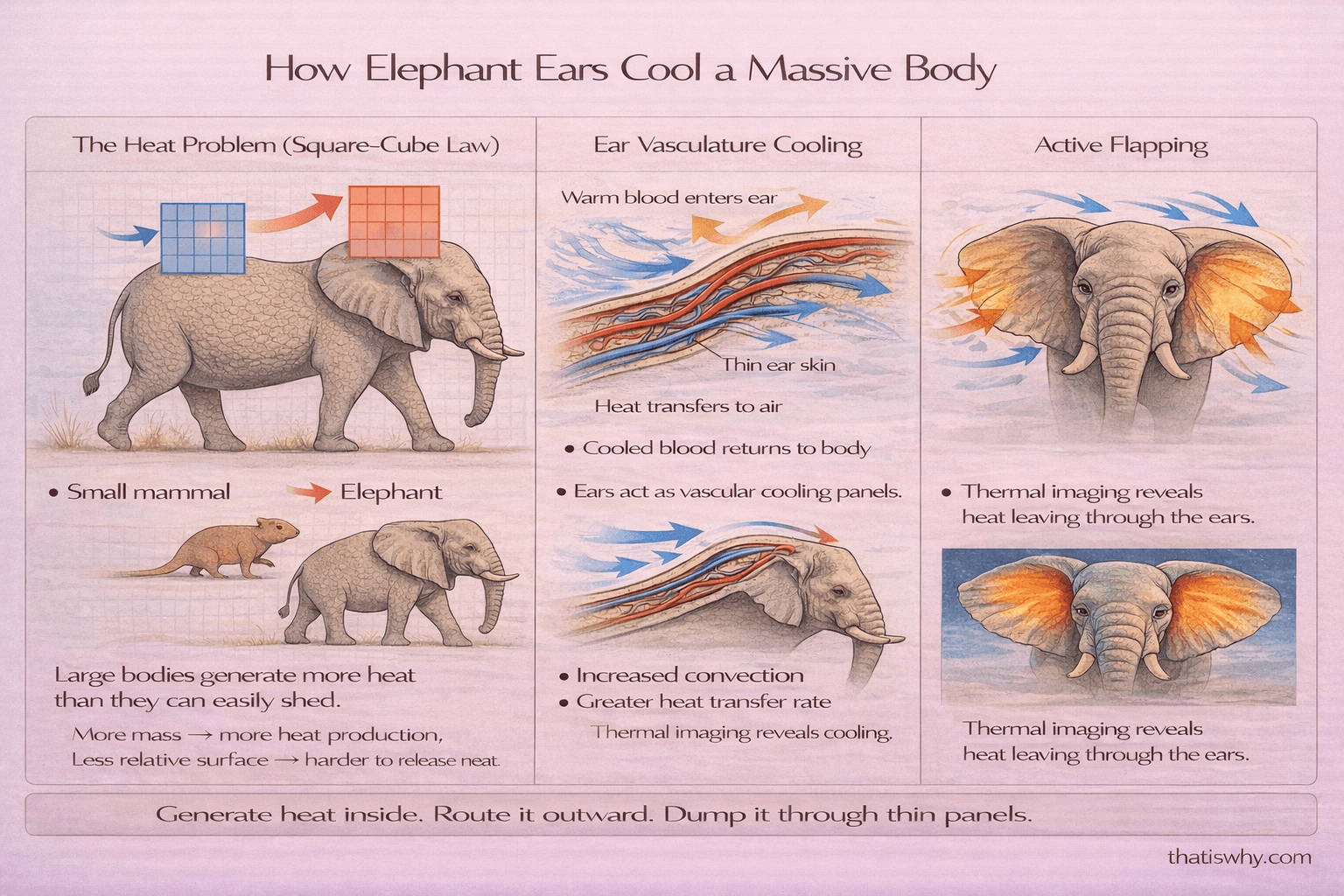
That sounds backwards until you look at the math. As animals get bigger, their volume grows faster than their surface area. More mass means more internal heat. Less surface relative to that mass means less ability to dump it.
By the rules of physics, an elephant should cook from the inside out but instead, it grows fins.
The Square-Cube Law: Why Getting Big Turns You Into a Furnace
In the last article, we saw how a camel survives by moving insulation to the roof and leaving the sides free to release heat. That worked because the camel is built for the desert and designed around heat management.
But now imagine scaling that body up ten times. When animals get bigger, they do not simply become scaled-up versions of smaller ones. The rules shift. The inside of the body grows faster than the outside. More muscle, more organs, more living tissue means more heat being produced every second, but the skin available to release that heat does not grow at the same pace.
Now imagine carrying several tons of living tissue under a blazing African sun. Every heartbeat generates warmth. Every digestive cycle generates warmth. Multiply that by thousands of kilograms, and you are no longer just large. You are constantly producing internal heat that must escape.
A small mammal struggles to stay warm. An elephant struggles to stay cool.
Think about a hot laptop sitting on your desk. If it has smooth sides and no openings, the heat builds up inside and performance drops. That is why laptops have wide vents and grills that let air flow across a larger surface. The computer still produces heat, but those openings give that heat somewhere to go.
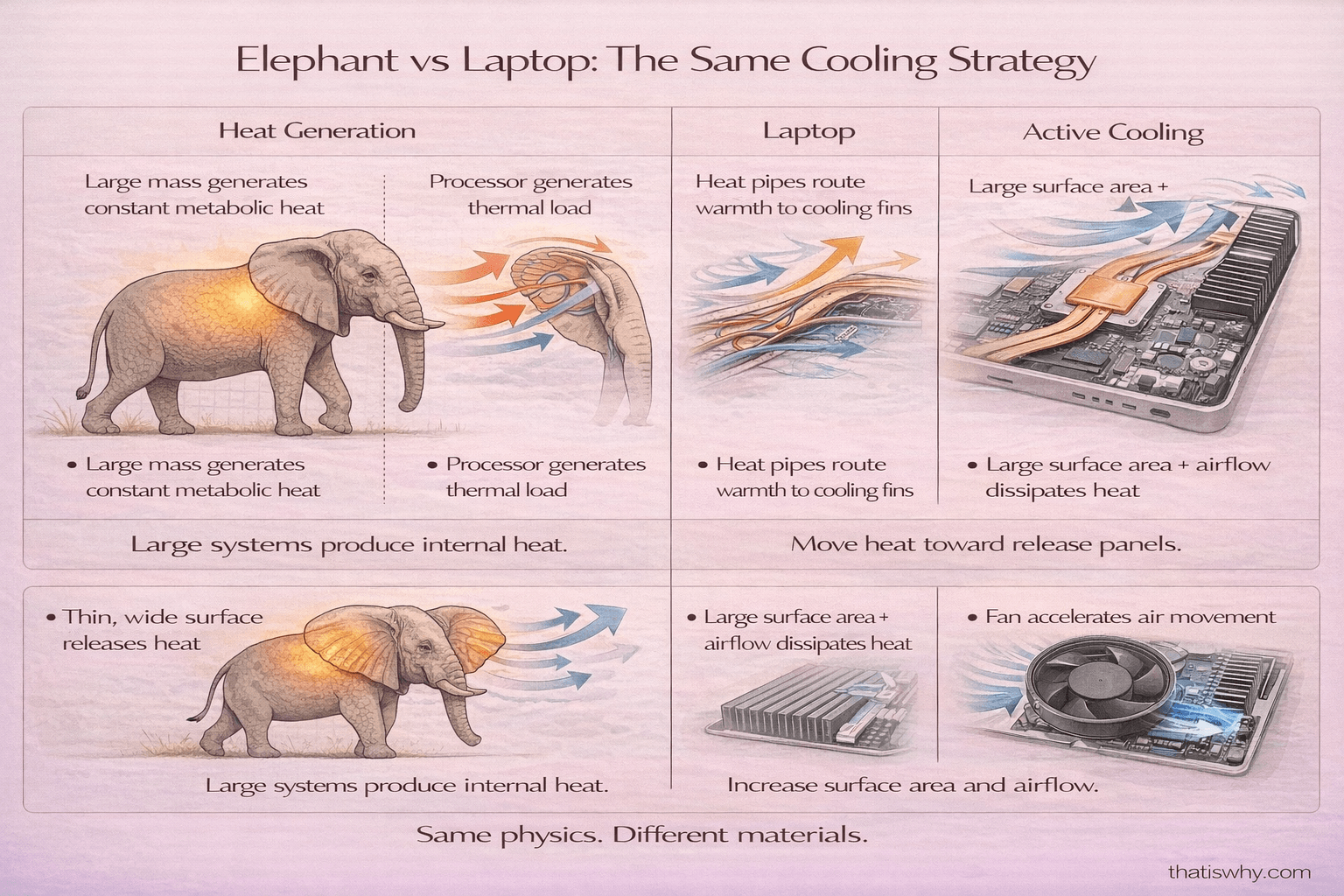
An elephant faces the same basic problem.
It cannot reduce how much heat it produces. It cannot shrink its internal organs. What it can do is grow large, thin extensions that allow heat to escape more efficiently.
Those wide, flat ears act like giant open vents.
They do not make the elephant lighter. They do not make it faster. They simply give heat a place to leave.
The Vascular Map: How Elephant Ears Actually Cool the Blood
If you look closely at the back of an elephant’s ear, it almost looks transparent. The skin is thin, and the veins spread across it in thick branching lines, like cables running under a glass panel.
That pattern is not decoration no it is plumbing.
Hot blood from deep inside the elephant’s body is pumped into those ears. Because the skin there is stretched wide and thin, the blood flows very close to the outside air. When wind passes over the ear, or when the elephant flaps it, heat transfers from the blood into the air.
Then the cooled blood circulates back into the body.
Return to the laptop example. When internal components heat up, the machine pushes warm air toward its vents so it can escape. The laptop is not reducing how much heat it produces; it is moving that heat toward areas designed to release it.
The elephant does the same thing with blood they use ears as vents.
Thermal camera images make this visible. The ears glow bright in infrared because they are carrying and releasing heat, while the rest of the body appears cooler by comparison. Researchers have measured noticeable drops in blood temperature after it passes through the ear before returning to the core.
Across a body that large, even a few degrees of cooling matters enormously.
The elephant is routing internal heat toward its natural cooling panels.
Active Cooling: Why Flapping Makes the System More Efficient
The ears are not passive panels hanging in the heat. The elephant actively moves them, and that movement dramatically improves the cooling process.
Think about a laptop that has been running for hours. If it sits in still air, the heat builds up around it and cooling slows down. If you place it near a fan, moving air carries heat away much faster because fresh air constantly replaces the warm air lingering around the vents.
Elephants create that moving air themselves.
When they flap their ears, they increase airflow across a wide, thin surface filled with warm blood. As air moves across the ear, heat transfers from the blood vessels to the surrounding environment more efficiently than it would in still conditions.
On extremely hot days, elephants add another layer to the strategy. They spray water behind their ears or coat themselves in mud. As that moisture evaporates, it pulls additional heat away from the surface, accelerating the cooling of the blood beneath the skin.
Instead of reducing how much heat their massive bodies generate, elephants improve how quickly that heat can leave. They circulate warm blood toward their natural vents and amplify the cooling with movement and moisture.
When Buildings Borrow the Elephant’s Trick
Once you understand what the elephant is doing, you start noticing the same idea in human design.
In hot climates, many buildings use wide external panels or shading fins that extend outward from the structure. Those panels increase exposed surface and control how heat interacts with the outside air. Air flows across them and carries warmth away before it builds up inside.
You see the same principle in vehicle design. Large trucks often have oversized front grills that allow as much air as possible to move across cooling surfaces. The engine still produces heat, but the front of the vehicle is shaped to release it efficiently.
The elephant follows that same logic in living tissue.
Instead of reducing the heat its body generates, it spreads part of itself outward and uses that extension as a cooling interface. The body can remain massive and powerful because the excess warmth is constantly routed toward those exposed surfaces.
The ears are architecture shaped by heat.
More Than Intimidation: What Elephant Ears Really Do
Myth #1: Elephants Flap Their Ears Just to Look Bigger or Intimidate
When an elephant spreads and flaps its ears, it can look dramatic, almost theatrical.
Truth:
Sometimes it is signaling, but if you watch elephants on a hot day, you will see the same movement when there is no rival around. The flapping increases airflow across a thin surface filled with warm blood, which helps cool the body more efficiently. The behavior becomes more frequent as temperatures rise, which tells you it is less about display and more about survival.
The ears may send messages, but they are primarily moving heat.
Myth #2: Big Ears Are Just a Random African Trait
People often compare African and Asian elephants and assume the difference in ear size is arbitrary.
Truth:
African elephants live in hotter, more open landscapes where sun exposure is intense and shade is limited. Asian elephants often inhabit forested regions, where canopy cover reduces direct solar load. Larger ears make more sense in environments where overheating is a constant risk.
Climate shapes anatomy.
Myth #3: Thick Skin Makes Elephants Heat-Resistant
Elephants look rugged, and their skin looks tough enough to handle anything.
Truth: Thick skin does not protect against internal heat buildup. An elephant’s size means it generates a tremendous amount of warmth simply by being alive. Without behavioral strategies like shade seeking, bathing, and active ear flapping, overheating would be a real threat.
Their size gives them power. Their ears make that power sustainable.
The Lesson in the Ears
When you see an elephant for the first time, the ears almost feel exaggerated, like someone turned the size dial too far. They flap slowly, almost casually, and it is easy to assume they are just part of the animal’s personality.
An elephant is massive in a way that changes the rules. That much living tissue produces heat constantly. If that heat had nowhere to go, size would become a disadvantage instead of a strength.
So evolution did something very practical, it gave the heat somewhere to leave.
The ears create space for blood to spread out, for air to move across. and for warmth to disappear before it becomes dangerous.
We often assume bigger means stronger and stronger means untouchable. The elephant quietly proves that being big comes with a cost, and surviving that cost requires design that may look excessive until you understand it.
Those ears are not a symbol of power; they are the reason power works at all.
How We Researched This :
To explain how elephant ears function as cooling systems, we looked at peer-reviewed research on elephant thermoregulation, including thermal imaging studies published in The Journal of Thermal Biology and anatomical analyses of ear vasculature in The Anatomical Record. Comparative studies on African and Asian elephant ear size relative to climate also helped clarify the environmental link.
But listing vascular maps and heat-transfer coefficients is not helpful unless you can picture it. The real question became, “What does this feel like?” That question led us to “the laptop-vent” analogy — a simple way to visualize how a massive body pushes internal heat toward wide, thin panels designed to release it efficiently.