Why The Spider-Tailed Viper Is Nature’s Greatest Puppeteer
Hoax or Horror?
Is the Spider-Tailed Horned Viper real? Yes. Pseudocerastes urarachnoides is a venomous viper found in the Zagros Mountains of Iran. It lures birds by wiggling a tail appendage that mimics a spider.
That is the science. But honestly, the first time you see it, you assume it’s a fake.
It looks like a genetic disaster. It looks like a rubber snake from a joke shop with a plastic spider glued to its tail. It looks so ridiculous that when scientists found the first specimen in 1968, they assumed the spider was a separate animal that had died in the alcohol jar. They dismissed it as a mistake for nearly 40 years.
But in 2006, a team went back to Iran and found a live one. And they watched the “mistake” start to dance.
It wasn’t a defect. It was the most sophisticated fishing lure nature has ever built.
The Ventriloquist
To understand how this snake hunts, you have to stop thinking of it as a predator. It isn’t hunting; it is performing.
I call this snake the Ventriloquist.
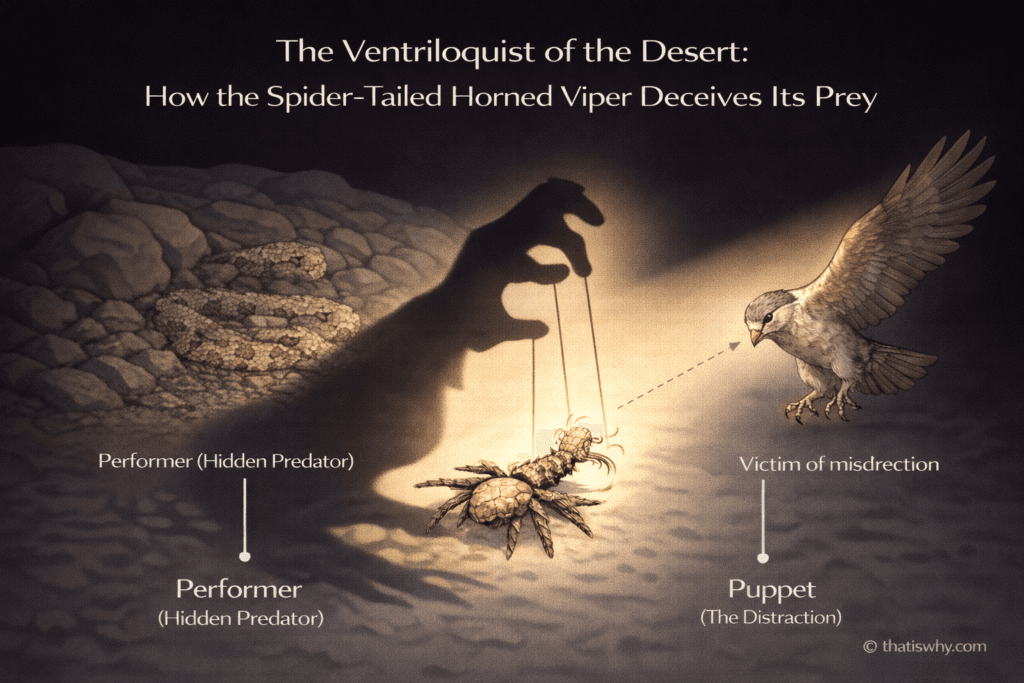
Think about how a ventriloquist act works. The performer sits perfectly still and wears boring clothes so you ignore him. He throws all the attention onto the puppet, making it dance and talk.
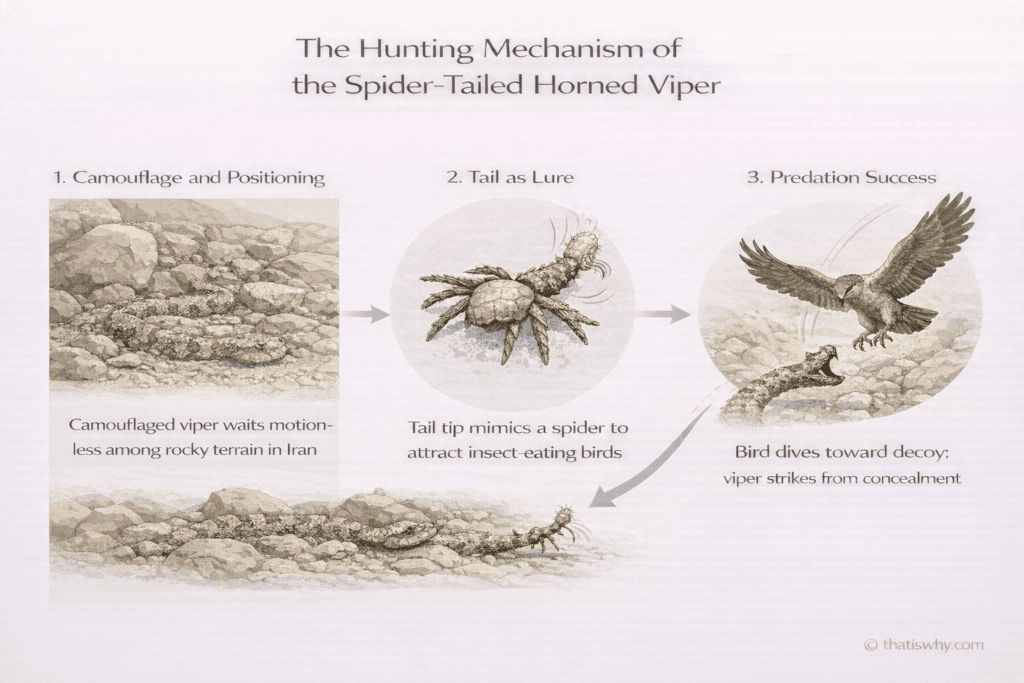
This snake is doing the exact same routine. Its body is roughly textured and colored to match the gypsum rocks of the Iranian mountains perfectly. When it freezes, it effectively deletes itself from the landscape. You could walk right past it and never know it was there.
But the tail is the star of the show. While the body plays “rock,” the tail plays “spider.” It creates a focal point that is impossible to ignore, forcing the audience (the bird) to look exactly where the snake wants them to look—away from the teeth.
Building the Puppet
So, how do you build a convincing puppet out of nothing but snake skin?
Evolution modified the snake’s tail bones into a knot to form the “body” and grew ragged scales to create the “legs.” It is a biological masterpiece.
But a perfect prop is useless without a puppeteer to pull the strings.
And this is where the snake earns its applause. It doesn’t just wiggle the tail randomly. It moves it in a precise Figure-8 pattern, perfectly mimicking the jerky, skittering run of a Camel Spider. The snake isn’t just dragging a lure; it is making the puppet act terrified to sell the lie to the audience.
The Trap Springs Shut
Most vipers are content hunting mice. But this viper has ambition. It wants to eat things that can fly.
Its targets are Warblers and Shrikes—smart, fast birds with excellent vision.
The trap relies entirely on the bird’s greed. The bird flies overhead and sees a fat, juicy spider running across a rock. It thinks it has found an easy lunch. It dives, ignoring the rock (the snake) and locking its eyes on the puppet.
It’s the perfect distraction. Just as the bird opens its beak to snatch the spider, the “rock” explodes. The snake strikes with blinding speed, catching the bird in mid-air. The predator becomes the prey. The bird thought it was hunting, but in reality, it was being fished.
Masters of Deception
This snake isn’t the only con artist in the animal kingdom. The trick of using your own body as bait is called Aggressive Mimicry, and it has evolved independently all over the world.
The Anglerfish Think of this as the deep-sea version. In the pitch black ocean, the Anglerfish dangles a glowing lure in front of its face. It’s the same basic scam: distract the prey with a shiny object, then eat them.
The Death Adder In Australia, the Death Adder does a budget version of the Viper’s trick. It has a thin, worm-like tail that it wiggles in the leaves to attract lizards. It’s less “high-tech” than the fake spider, but it works just as well.
The Alligator Snapping Turtle This turtle sits at the bottom of a river with its mouth wide open. Its tongue has a pink, wiggling appendage that looks exactly like a worm. Fish swim right into the jaws of the predator, thinking they found lunch. It’s a deadly magic trick that has worked for millions of years.
Debunking the Fake
Because this animal looks like a special effect from a bad horror movie, most people assume it’s a hoax. So let’s set the record straight.
Myth #1: “It’s a spider riding a snake.” It looks like a team-up, right?
The Truth: Nope. There is no spider. The lure is made of the snake’s own flesh and bone. If you cut it off (please don’t), the snake would bleed. It is as much a part of the snake as your nose is part of your face.
Myth #2: “It’s Photoshopped.” It looks like a bad CGI effect.
The Truth: It is 100% natural. It evolved over millions of years in the remote mountains of Iran. Nature doesn’t need Photoshop; it has natural selection.
Myth #3: “The tail is the weapon.” It looks like a stinging insect, so people assume the tail is dangerous.
The Truth: The tail is totally harmless. It’s just soft tissue. The danger is at the other end. While you are staring at the “spider,” you are ignoring the venomous fangs inches away from your hand. That’s the whole point.
The Secret on the Shelf
The story of the Spider-Tailed Viper is a lesson in humility.
In 1968, American scientists found the first specimen. They looked at the tail, saw the weird lump, and assumed it was a tumor or a birth defect. They preserved it in a jar in Chicago and labeled it “freak.”
For 40 years, the greatest discovery in herpetology was sitting on a dusty shelf in Illinois, dismissed as a mistake. It took a new generation of scientists to go back to the mountains and realize the “tumor” was actually a trap.
The snake was so good at deception that it didn’t just fool the birds; it fooled the experts. It hid its secret in plain sight, proving that sometimes, nature is much smarter than the people studying it.
How We Researched This :
To get the facts straight, we tracked the taxonomy history of Pseudocerastes urarachnoides. We dug up the original 1968 expedition reports that dismissed the tail as a defect, and contrasted them with the breakthrough 2006 study by Behzad Fathinia, which finally captured the snake hunting on film.
But we knew that just citing taxonomy papers isn’t helpful. Our real job began when we asked, “What does this feel like?” That question led us to the “Ventriloquist” analogy—a simple story to make the complex dual-deception strategy feel intuitive.