Why a Group of Foxes Is Called a Skulk
Noticed how some animal group names are just… weird? A “murder” of crows, a “parliament” of owls. But for my money, the names for a group of foxes are the most fascinating of all.
They aren’t just labels; they’re like an old house, filled with secret rooms and clues to the past.
What do you call a group of foxes, and what story is hiding in the walls of their names? Let’s grab a flashlight and find out.
The Old House
The best way to understand these weird names is to think of the fox not as an animal, but as an old house that’s been lived in for hundreds of years.
It’s a single house, but it’s filled with clues from different eras. When you start exploring, you’re like an archaeologist.
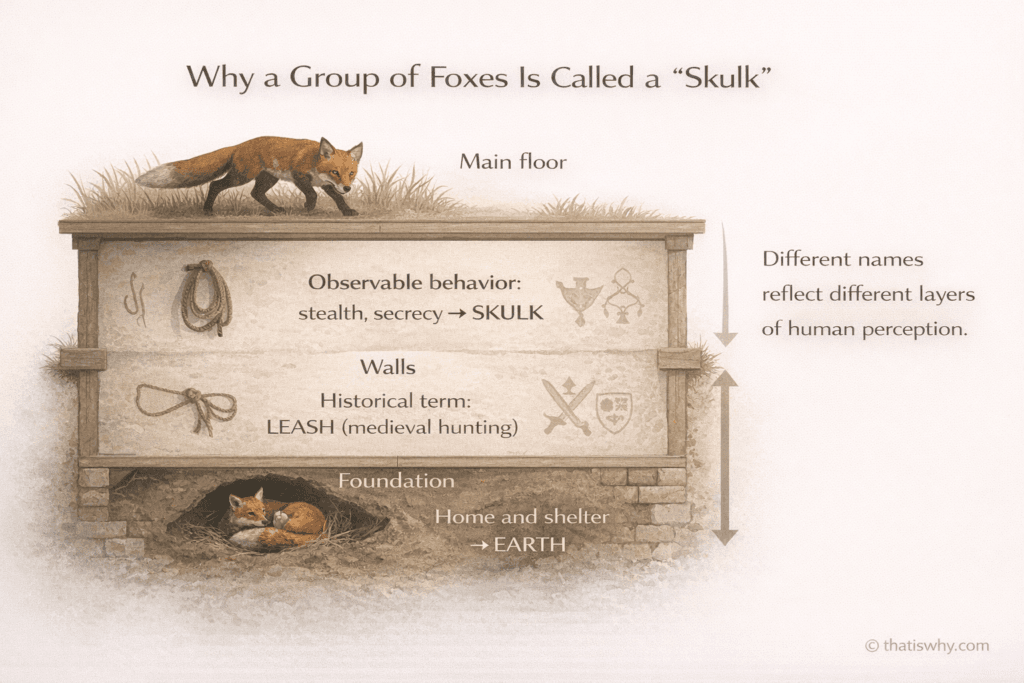
- You notice the worn path in the hallway, showing how the current family moves through the space every day. That’s “a skulk of foxes.” It’s a name based on current, observable behavior.
- You pull up the modern carpet and find strange, outdated wiring in the walls from a 1920s renovation. It’s not how we’d do it today, but it’s a part of the house’s history. That’s “a leash of foxes.” It’s a historical name, a relic of a bygone era.
- You go down to the foundation and look at the very ground it’s built on. That’s “an earth of foxes.” It’s the name for the physical home itself.
The names aren’t different things. They’re just different layers of the same house’s long, complicated story.
The Analogy Explained: This works because the names we use for foxes were coined in different eras and for different reasons. The “Old House” metaphor allows us to see them as historical layers stacked on top of each other, each revealing something different about our relationship with the animal. The limitation is that a house is a static object. Foxes are living, breathing creatures, and the names we use are just a snapshot of our perception, not the full picture of their complex lives.
The Exploration: Uncovering the Layers
Our tour begins on the main floor, in the here and now. You can almost feel the life of the house around you. See that worn path in the hallway carpet, showing how the family moves quietly from room to room? That’s our first discovery. It’s a name that describes pure behavior: a “skulk” of foxes. It comes from the verb “to skulk,” and it perfectly captures the cunning, stealthy character of the animal.
But this house is old. What happens when we start digging? Let’s pull up these floorboards… wait, what’s this? Tucked away in the walls is a piece of strange, outdated wiring. It’s a relic from another time. That’s our second name: a “leash” of foxes. As the Oxford English Dictionary could tell you, this is an ancient term from medieval hunting, where a “leash” meant a set of three animals on a tether. It’s a piece of our own history, forgotten in the walls.
Every old house has its foundation, though. Let’s head down to the basement. Down here, we’re not looking at behavior or history, but the very ground the house is built on. This gives us our final name: an “earth” of foxes. “Earth” is the traditional name for a fox’s den. This name is about the fundamental security of family and home.
Etymology as Archaeology
Okay, this is the part that gives me goosebumps. See what we just did? We weren’t just looking at words; we were doing a kind of archaeology. This is a perfect example of Etymology as Archaeology.
When an archaeologist finds a shard of pottery, they don’t just see a piece of clay; they see a whole civilization. When we find a word like “leash,” we’re digging up a linguistic fossil. We’re uncovering a specific moment in human history, a time of formal hunts and a world where animals were categorized by their use to us.
Every strange collective noun is a tiny fossil, preserving a piece of our culture, our fears, and our admiration right there in the open.
Digging Up Other Linguistic Fossils
And this is the best part. Once you start thinking this way, you realize these linguistic fossils are everywhere, just waiting to be discovered.
Take an “obstinacy” of buffalo. Can’t you just feel the grit and frustration in that word? It’s a perfect fossil of the pioneer experience, staring down a powerful, stubborn, unmovable force of nature. The name itself is a monument to the animal’s sheer willpower.
Then there’s my personal favorite: a “business” of ferrets. It’s just so perfect. It has nothing to do with money; it comes from the old word “busyness.” It perfectly bottles up the feeling of watching them—that perpetually active, curious, almost frantic energy. It’s a name that zigs and zags just like they do.
And some names aren’t about frustration or energy, but pure awe. Think about a “charm” of hummingbirds. That’s not a description; it’s a feeling. It’s the only word our ancestors could find for the dazzling, enchanting magic of seeing a group of these tiny hovering jewels. It’s a name that feels like a magic spell.
The Fox in Real Life
After all this talk about group names, you might be thinking, “Wait a second, aren’t foxes supposed to be loners?”
That is a brilliant question, and it gets to the heart of the fox’s complex character. And the answer is yes… and no.
You’re right that foxes are almost always solitary hunters. They don’t hunt in packs. But they aren’t total recluses. They often live in small, tight-knit family groups, usually centered around a breeding pair and their offspring. So when you see a “skulk,” you’re likely seeing a family going about its business.
And that family, of course, starts with the babies. If you’re lucky enough to spot one of these family units, you’ll need to know what to call the little ones. A baby fox is officially called a kit, which is my personal favorite. But you’ll also hear them called cubs or pups—all are perfectly correct.
A Story in a House
So, the next time you hear “a skulk of foxes,” you’ll know it’s not just a weird name from a trivia list.
You’ll know you’re just looking at one room in a fascinating old house. You’re seeing one layer of a story that’s been built over centuries—a story of character, of history, and of home. It’s a beautiful reminder that every name has a history, and every word tells a story.
How We Researched This:
To answer this question, we went beyond a simple list. We consulted etymological sources, including the Oxford English Dictionary, and historical texts to understand the context and origin of each distinct name for a group of foxes. But we knew that just listing facts isn’t helpful. Our real job began when we asked, “What does this feel like?” That question led us to the ‘Old House’ analogy—a simple story to make the complex linguistics feel intuitive.