Why a Group of Owls Is Called a Parliament
Have you ever felt like you were being judged by a bird?
That’s the feeling I get when I lock eyes with an owl. It doesn’t chirp or flutter away. It just sits there, swiveling its head with an unnerving stillness, and stares. Those huge, round eyes seem to follow you with a kind of solemn, serious gravity.
It feels less like you’re looking at an animal and more like you’re standing before a silent, feathered tribunal.
The Casting Call
Here’s the best way to think about these weird collective nouns. Imagine you’re a casting director for a big movie called The Animal Kingdom. Your job is to assign each animal a role that perfectly fits its character.
What role would the owl play?
With its solemn gaze and dignified posture, the owl isn’t cast as the bumbling sidekick or the frantic action hero. It’s cast as the wise, serious judge. The elder statesman. The deliberator.
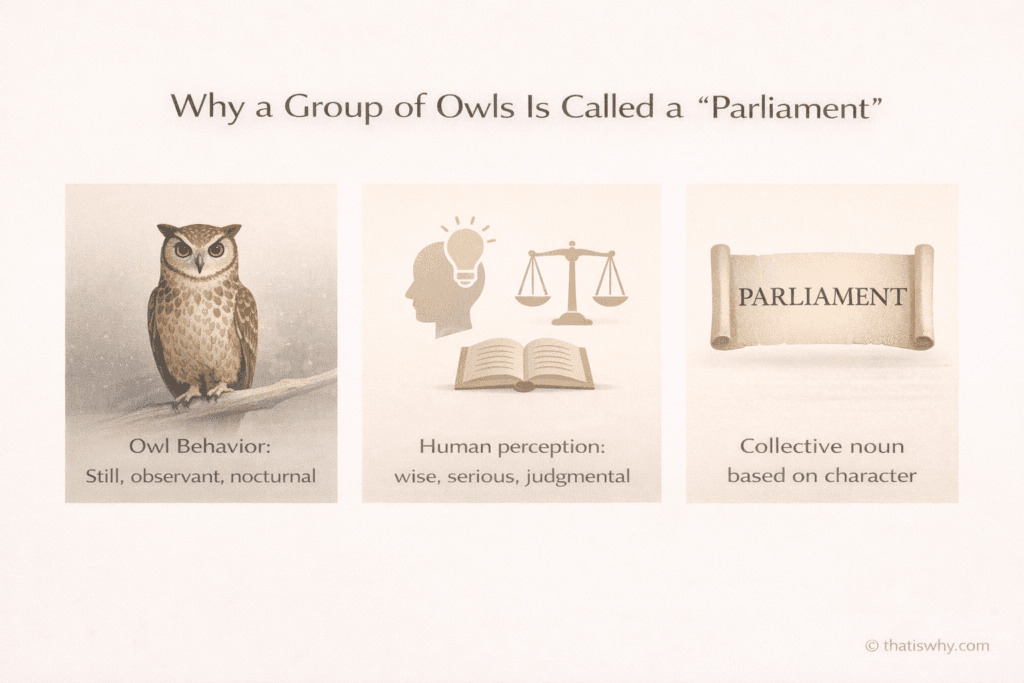
And what do you call a formal assembly of wise, solemn judges who gather to deliberate? You call it a parliament. The name isn’t a label; it’s a character archetype.
The Analogy Explained: This works because these names are all about character. We’ve assigned the owl a personality—”wise” and “serious”—and the name “parliament” is a direct reflection of that human projection. The limitation, of course, is that owls aren’t actually holding debates or passing laws. They are wild predators. The name tells us far more about our own perception of the owl than it does about the owl’s actual daily life.
This idea — that animal group names reflect how we perceive character, not biology — shows up again and again across the animal kingdom.
The Origin Story: From Ancient Greece to Narnia
So where did this “wise judge” character come from? The story has two main parts.
First, we have to travel back to Ancient Greece. The city of Athens was named for Athena, the goddess of wisdom, war, and strategy. And what was her symbol? The owl. The “owl of Athena” was seen as her companion, flying through the night and bringing her wisdom from the darkness. For thousands of years since, this connection has been unbreakable in Western culture: owls equal wisdom.
But that just sets the stage. The real trendy moment, the reason this term is so famous today comes from a much more modern source. The term was cemented in our popular imagination by the author C.S. Lewis in his 1950 classic, The Lion, the Witch and the Wardrobe.
In the book, there’s a scene where a council of talking owls meets to discuss important matters. And what does Lewis call this meeting? A “parliament of owls.” That single use in such a beloved book brought the term to life for millions of readers, and it has been stuck in our culture ever since.
Words as Portraits
This is a perfect example of a principle I like to call “Words as Portraits.”
A photograph captures reality exactly as it is. But a portrait is different. A portrait is an artist’s impression of a subject’s character. The artist might emphasize the kindness in someone’s eyes or the strength in their jaw.
These collective nouns are portraits, not photographs. The name “parliament” doesn’t capture the scientific reality of an owl’s life. It captures our artistic, cultural impression of the owl’s solemn, wise, and judicious character. It’s a word-painting of how we see them.
A Gallery of Word-Portraits
We saw this same principle at work when we investigated the names for a group of foxes, where words like “skulk” and “leash” act as historical clues. Our language is a gallery filled with these amazing word-portraits for all kinds of animals.
Take a “pride” of lions. We don’t call them a “pack.” We call them a “pride.” That name is a portrait of our perception of them as noble, regal animals, full of dignity and social standing.
Or think about a “chatter” of budgerigars (parakeets). This name isn’t about character; it’s a portrait painted with sound. It perfectly captures the noisy, incessant, and cheerful sound of a group of them together.
But my absolute favorite has to be a “knot” of toads. I mean, come on! It’s a purely visual portrait. It so perfectly describes the lumpy, tangled way they huddle together, appearing as a single, bumpy knot of amphibians. It’s a name you can see.
The Owl’s Other Secret Names
We know now “parliament” is the headliner, the name everyone knows thanks to C.S. Lewis. But the linguistic rabbit hole goes a little deeper, and some of the other names for a group of owls are just as cool.
My personal favorite has to be a “stare” of owls. It’s so wonderfully direct. It’s a name born from that unsettling, captivating feeling of being watched by those huge, unblinking eyes. You can also find a “wisdom” or a “study” of owls, which are more direct nods to their ancient connection with knowledge and learning.
And while we’re on the topic of names, what about the babies? If you’re lucky enough to see one, you’re not looking at a chick or a fledgling. The proper, and frankly adorable, name for a baby owl is an owlet.
A Story of Character
The name “a parliament of owls” isn’t just a random, quirky term from a trivia book.
It’s a beautiful portrait, painted with the brushstrokes of ancient myth and finished with a frame built by one of the great storytellers of the modern era. It’s a name that has very little to do with what an owl does, and everything to do with the wise, solemn, and mysterious character we see when we look into its big, round eyes.
How We Researched This:
To answer this question, we went beyond simple definitions. We researched the etymology of collective nouns and traced the term ‘parliament of owls’ through literary history, including its famous use by C.S. Lewis. But we knew that just listing facts isn’t helpful. Our real job began when we asked, “What does this feel like?” That question led us to the ‘Casting Call’ analogy—a simple story to make the complex linguistics feel intuitive.