Why The Jewel Wasp Is Nature’s Neurosurgeon
When size doesn’t matter
In nature, size usually wins. If you put a heavyweight boxer in a ring with a toddler, you know who is going home in a stretcher.
That is exactly what the matchup between the Emerald Jewel Wasp and the American Cockroach looks like.
The roach is a tank. It is six times larger than the wasp, covered in heavy armor, and aggressive. The wasp is tiny, delicate, and looks like a piece of flying jewelry. In a fair brawl, the roach should crush it effortlessly.
But this isn’t a brawl.
The wasp doesn’t want to kill the roach. It wants to perform brain surgery on it.
When these two meet, the wasp doesn’t rely on brute force. It relies on a terrifying knowledge of neurochemistry. It is about to turn that aggressive giant into the most obedient dog you’ve ever seen.
The Chemical Leash
Most predators are blunt instruments. If a spider catches a fly, it just injects venom to paralyze it. It breaks the connection between the nerves and the muscles. The fly physically can’t move.
But the Jewel Wasp is way too sophisticated for that. It doesn’t want a paralyzed victim; it wants a compliant one.
I like to think of it as a Chemical Leash.
Imagine taking a huge, aggressive dog to the vet. If you try to drag it, it’s going to fight you. It will bite, scratch, and pull away. It’s a nightmare. But if the vet gives it a mild sedative, everything changes. The dog is still awake. Its legs still work. But the fight is gone. If you pull the leash, it just happily trots along behind you.
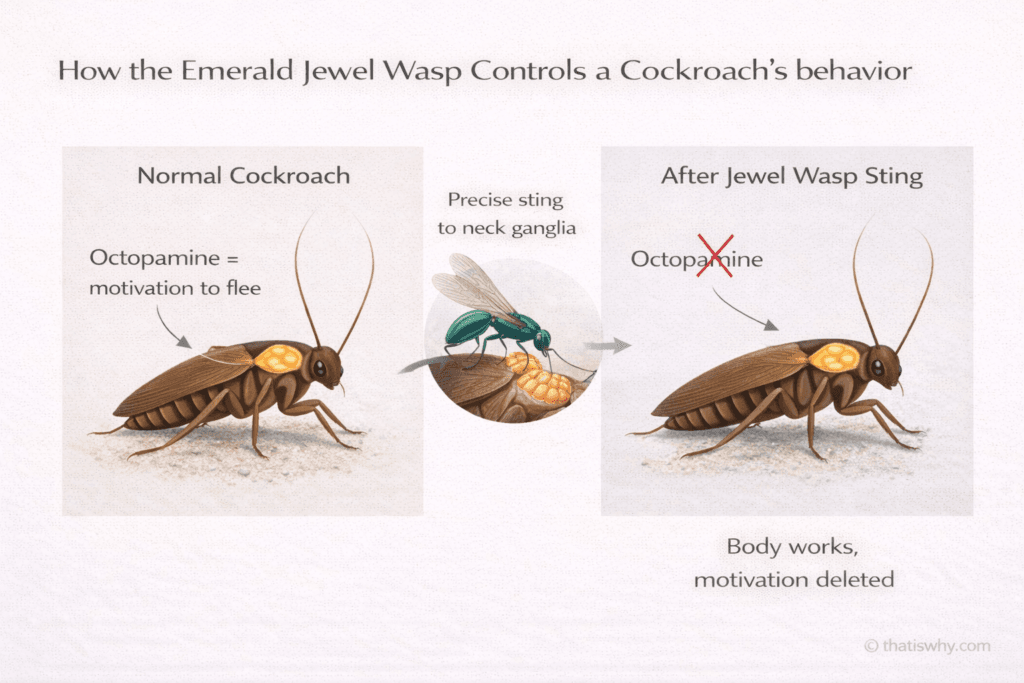
That is exactly what the wasp does to the roach. It doesn’t break the legs; it breaks the motivation. The roach isn’t paralyzed. It can fly. It can run away. But after the sting, it simply chooses not to. It becomes a passive follower, just waiting for the wasp to tell it where to go.
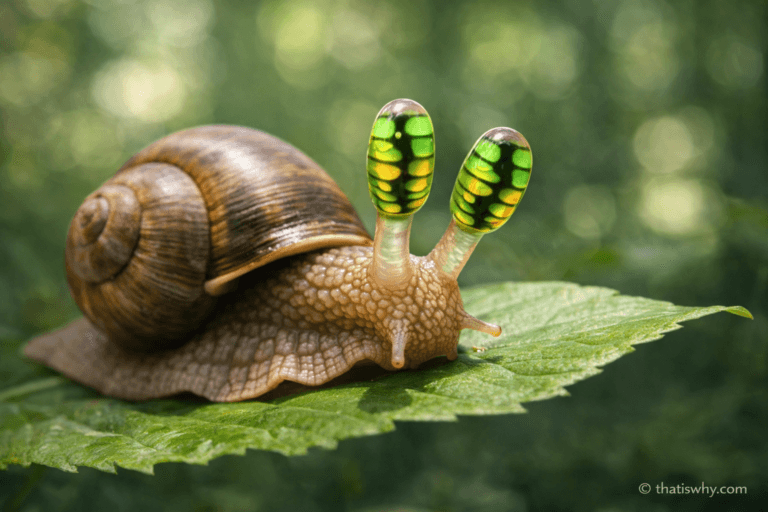
This kind of behavioral hijacking isn’t unique — other parasites, like the one responsible for “zombie snails”, use similar tricks to turn hosts into living billboards.
Step 1: The Handcuffs
The wasp knows it can’t win a wrestling match, so it cheats.
It launches a blitz attack from above, grabbing the roach’s head and delivering a lightning-fast sting to the torso.
This isn’t the brain surgery yet; this is just the prep work. The venom targets the specific nerve cluster that controls the roach’s front legs. Instantly, the legs go limp. The roach can still run with its back legs, but its ability to kick or protect its face is gone.
Basically, the wasp just handcuffed the roach.
Now that the patient is restrained and can’t block the scalpel, the wasp gets ready for the main event.
Step 2: The Brain Surgery
This is the part that makes neuroscientists jealous.
The wasp climbs onto the roach’s head, curls its abdomen, and inserts its stinger directly into the roach’s neck. But it doesn’t just jam it in there. The stinger is equipped with microscopic sensors that can actually “feel” through the roach’s brain tissue.
It navigates through the neck like a surgeon threading a catheter, searching for two specific pinpoints: the Ganglia (the insect brain).
Once it hits the bullseye, it injects a very specific cocktail.
It targets Octopamine. In insects, octopamine is the “Go” juice. It’s the chemical that screams, “Danger! Run!” The wasp’s venom blocks these receptors perfectly. It chemically deletes the concept of “danger” from the roach’s mind. The roach is now awake, healthy, and fully capable of running away. It just… doesn’t feel like it.
Walking the Dog
The aftermath is honestly disturbing to watch.
The initial paralysis wears off. The roach stands up. It grooms its antennae. It looks completely normal. If you poked it, it would scuttle away.
But it doesn’t run from the wasp.
The wasp—which remember, is tiny—walks up to this giant monster, grabs one of its antennae like a leash, and pulls. And the roach just… follows.
It follows obediently, like a well-trained Golden Retriever. The wasp leads it straight to a dark burrow. The roach walks willingly into its own grave. It doesn’t fight. It doesn’t panic. It just accepts its fate.
The Living Larder
Why go to all this trouble? Why not just kill the roach and drag it home?
Because the wasp doesn’t have a refrigerator. Dead meat rots.
The wasp lays a single egg on the roach’s leg and seals the burrow. The roach sits there in the dark—alive, breathing, and completely indifferent—waiting for the end.
When the egg hatches, the larva needs fresh meat. If the roach were dead, it would be toxic sludge by now. But because it’s alive, it’s a self-preserving meal.
The larva chews a hole in the roach and crawls inside. It eats the roach alive from the inside out. But here is the genius (and gross) part: It is a careful eater. It instinctively avoids the vital organs (heart and brain) for as long as possible. It keeps the host alive to ensure the meat stays fresh until the very last bite.
Hijacking the Human Brain
This sounds like a horror movie that only happens to bugs, but the chemistry is disturbingly close to home.
The Dopamine Link The wasp targets Octopamine, which is basically the insect version of Dopamine. We see similar issues in humans with Parkinson’s disease. Patients often experience “akinesia”—they physically can move, but they can’t initiate the action. The bridge between “I want to walk” and “I am walking” is broken. The wasp has simply weaponized a medical condition that we struggle to treat.
Copying the Homework In fact, human surgeons use the exact same strategy. When you go under for surgery, anesthesiologists often use a “two-step” punch: a paralytic to stop your muscles, and an anesthetic to stop your brain. We are basically copying the wasp’s playbook—using chemistry to separate the body from the will.
Debunking the Zombie
Before you tell your friends about this, let’s make sure you get the facts right. There are two big myths about this zombie.
Myth #1: “The roach is paralyzed.” Most people assume the venom freezes the roach. The Truth: Nope. If you took that roach and threw it in the air, it would fly. If you shocked it, it would jump. It isn’t paralyzed; it is profoundly indifferent. It has lost the choice to move, not the ability. It’s not a statue; it’s a puppet.
Myth #2: “The wasp drags the roach.” In photos, it looks like the wasp is hauling a heavy carcass. The Truth: The wasp isn’t strong enough to drag a roach that size. It isn’t hauling anything. The roach is walking under its own power. The wasp is just steering. It’s the difference between carrying a 100lb dog and walking it on a leash.
The Ultimate Checkmate
It’s easy to look at the Jewel Wasp and just see a monster. But if you look closer, you see a master surgeon.
This tiny insect has evolved a venom that doesn’t just attack the body; it targets the mind. It has identified the exact molecule that creates “free will” and figured out how to surgically switch it off—a feat that human neuroscientists are still trying to fully understand.
The roach in the burrow isn’t being held down by chains, webs, or walls. It is being held down by a few drops of chemistry. It is trapped in a prison of its own indifference. And honestly? In the brutal arms race of evolution, that is the most terrifying checkmate I’ve ever seen.
How We Researched This
To explain this “neurosurgery,” we looked at the specific chemical analysis of Ampulex compressa venom. We referenced studies from the Journal of Experimental Biology that identified the role of Octopamine blockers in the sub-esophageal ganglion.
We wanted to make sure we distinguished this from standard “venom.” Most venom destroys tissue or nerves. This venom modifies behavior. That distinction led us to the “Chemical Leash” analogy—helping visualize a system where the victim is still awake, but perfectly obedient.