Why The Tongue-Eating Louse Is Nature’s Living Prosthetic
The Fisherman’s Surprise
If you fish long enough, you see some weird things. But nothing prepares you for this.
Imagine you reel in a nice Red Snapper. It looks healthy, shiny, perfect. You pry open its mouth to get your hook back, and suddenly, you freeze.
Staring back at you from inside the fish’s throat is a pair of black, beady eyes. And they definitely don’t belong to the fish.
At first, it looks like a giant bug is sitting on the fish’s tongue. But if you look closer, the horror sets in: It isn’t sitting on the tongue. It is the tongue.
The fish’s actual tongue is gone. In its place sits a parasitic crustacean called Cymothoa exigua, better known as the Tongue-Eating Louse.
This isn’t just a parasite. It is the only known creature on Earth that functionally replaces a host’s organ. It is nature’s most horrifying—and impressive—prosthetic limb.
The Squatter Who Became the Furniture
Usually, parasites are just freeloaders. A tapeworm steals your lunch; a tick steals your blood. They show up, take what they want, and leave you weaker.
But the Tongue-Eating Louse is playing a completely different game. It is the only known parasite on Earth that doesn’t just damage an organ—it replaces it.
Think of it like a squatter breaking into your house. A normal burglar steals your TV and runs. This guy breaks in, rips out your kitchen table, and then sits down on the floor and becomes the table.
He eats some of your dinner every night, sure. But he also holds your plates. He stays steady so you can cut your steak. He integrates himself into the household furniture so perfectly that after a while, you actually rely on him to eat.
The louse steals the tongue, but it pays rent by doing the tongue’s job. And in the entire history of biology, nobody else has ever pulled that off.
The Demolition Job
Before the squatter can become the furniture, he has to clear the room.
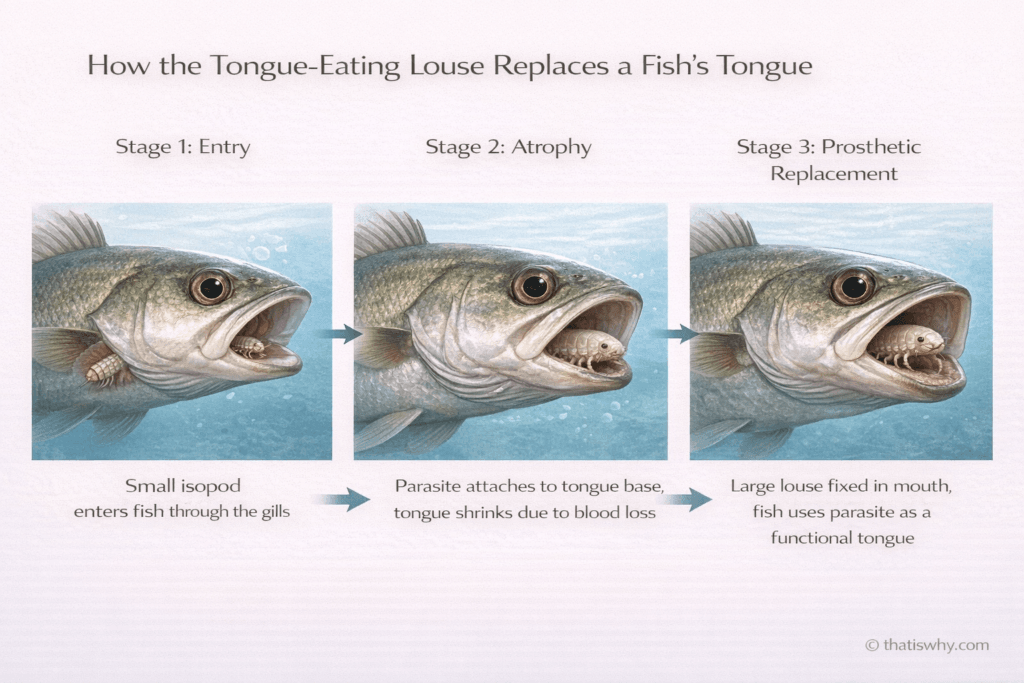
The Entry (The Break-In) The parasite slips into the fish through the gills. Think of this as sneaking into the hallway. He waits there, safe and hidden, growing larger until he’s ready to take the main room.
The Atrophy (The Eviction) He crawls into the mouth and latches onto the base of the tongue. He doesn’t smash the furniture; he just cuts the power. By drinking the blood, he starves the tongue of oxygen. Slowly, the old furniture withers, dies, and falls off, leaving the room empty.
The Installation (The Renovation) This is the part that defies logic. The squatter doesn’t leave. He backs into the empty space and hooks his legs into the floorboards (the muscle stub). He locks himself into place.
From this moment on, he is the table. When the fish tries to move its tongue, the parasite moves. The fish can press food against the bug’s hard shell to grind it down. It’s a seamless remodel—the fish just keeps eating, using the intruder as a dinner plate.
The Gender Swap
If becoming the furniture wasn’t weird enough, this parasite has another trick: It changes gender based on who else is home.
Scientists call it Protandric Hermaphroditism. I call it the weirdest roommate situation in the ocean.
Every louse enters the fish as a male. But once they get inside, they check the occupancy.
- If the Kitchen is Empty: The male moves in, kicks out the tongue, and transforms into a massive Female. She grows huge—sometimes over an inch long—to fill the entire oral cavity. She becomes the Lady of the House.
- If the Kitchen is Taken: The newcomer stays a small Male and has to crash in the guest room (the gills).
It gets weirder. The fish isn’t just a host; it’s a singles bar. The small male will occasionally crawl out of the gills to mate with the giant female on the tongue. She then releases hundreds of live young (larvae) directly into the water column to go find their own fish.
The fish’s mouth becomes a nursery, a dining room, and a bedroom all at once. And through it all, the fish just keeps swimming.
Meet the Cousins
You might be looking at this nightmare and thinking, “Thank god I live on land.” But you might want to check your garden.
The Backyard Connection The Tongue-Eating Louse is an Isopod. If you have ever turned over a rock and seen those little gray “Roly Polys” (or Pill Bugs) curl up into a ball—congratulations. You have met the family. The Roly Poly is basically a dry-land version of the tongue-eater. They share the same armored back and the same many-legged body. One just eats rotting leaves; the other eats tongues.
The Ultimate Bio-Hack On a serious note, this parasite is doing something human doctors dream of. We spend billions trying to make robotic limbs that integrate with human nerves. We struggle to make a hand that feels “real.” Meanwhile, this crustacean figured out how to seamlessly integrate itself into another animal’s muscular system millions of years ago. It’s the ultimate bio-hack, and it didn’t need a medical degree to pull it off.
Busting the Nightmare
Before you swear off seafood forever, let’s clear up a few myths about our new friend.
Myth #1: “The fish dies immediately.” Looking at the photo, you assume the fish is doomed.
The Truth: Surprisingly, no. The fish usually lives a long, relatively normal life. It hunts, eats, and grows. As long as the parasite doesn’t get so big that it blocks the throat, the fish is fine. It’s a bit underweight compared to its friends, but it survives. It’s a functional partnership, just a very creepy one.
Myth #2: “It wants my tongue.” People assume that if they swim in the ocean, a louse is going to swim into their mouth.
The Truth: Relax. These guys are incredibly picky eaters. They only target specific species of fish, like Snappers and Clownfish. If you pick one up, it might nip your finger with its claws, but it has zero interest in becoming your tongue. You are way too big, and your biology is all wrong.
A Perfect, Horrible Partnership
It’s easy to look at the Tongue-Eating Louse and just be disgusted. It is, objectively, a nightmare scenario.
But if you can look past the “ick” factor, you have to admire the engineering. Evolution created a creature that realized it didn’t need to hunt for food—it could just become the tool that processes the food.
The fish swimming in the ocean right now with a bug in its mouth isn’t a corpse. It’s a survivor. It has accepted a monster into its most intimate space and put it to work. It’s a forced partnership, sure. But in the brutal economy of the ocean, it works. And honestly? That kind of adaptability is the most impressive thing of all.
How We Researched This :
To write this, we dove into marine biology journals to understand the life cycle of Cymothoa exigua. We specifically looked at studies on Protandric Hermaphroditism to explain the gender-swapping mechanics that allow these parasites to colonize a host.
We also wanted to avoid the common trap of just calling it “gross.” We focused on the Functional Anatomy—the fact that the fish can actively use the parasite to grind food. That led us to the “Squatter Renovation” analogy, which helps visualize this not just as an infection, but as a twisted form of integration.