Why Arctic Terns Can Fly Pole to Pole Using a Built-In Bubble Level
It flies from the North Pole to the South Pole and back every year. The Arctic tern doesn’t follow maps, it checks whether the planet still feels level.
If the World Tilts, the Bird Knows
If you’ve ever used a bubble level to hang a picture, you already understand how the Arctic tern migrates.
You don’t measure the wall or calculate angles. You watch the bubble. When it settles in the center, you know you’re aligned.
The Arctic tern does something remarkably similar, except instead of checking a picture frame, it checks the entire planet.
Every year, this bird leaves the Arctic summer, flies across open oceans, crosses the equator, reaches the Antarctic summer, and then months later makes the same journey back north. The round trip adds up to roughly 44,000 miles, and over a lifetime it can approach a million miles flown.
So the real question isn’t how far it travels but how it knows when to stop.
The answer isn’t a stored route or a mental map. The tern carries an internal sense that works like a planet-scale bubble level. As it moves north or south, the Earth itself begins to feel subtly tilted. The bird doesn’t need to know where it is.
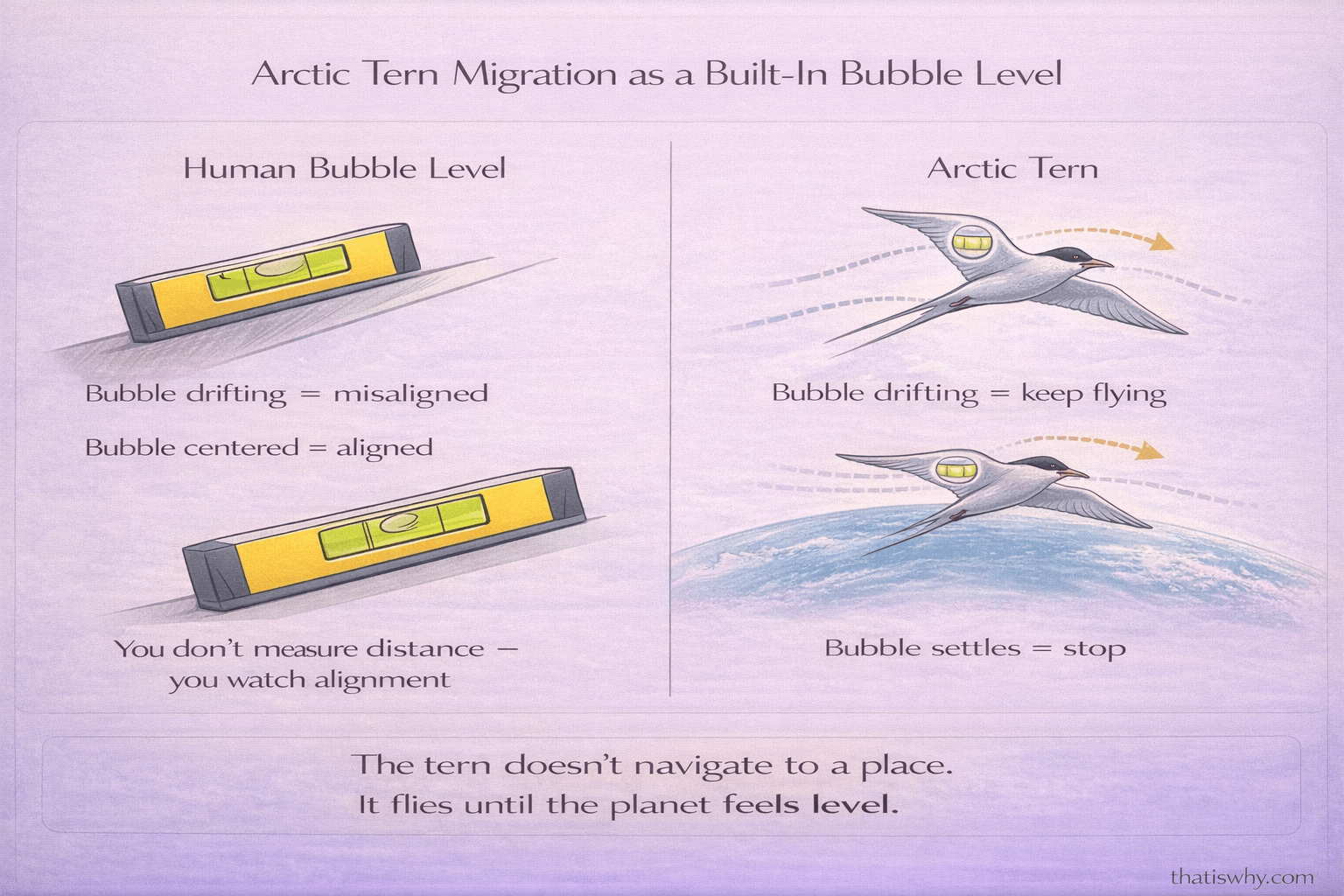
It only needs to know whether that internal bubble is still drifting.
When it is, the tern keeps flying while when it isn’t, the tern has arrived.
The Longest Commute on Earth
The journey only sounds unbelievable until you look at how it works.
Arctic terns don’t follow a single highway through the sky. One bird might drift east with the winds, another might swing west across open water, and a third might take a path no one has ever mapped. And yet, they still arrive in the same seasonal zones with eerie consistency.
That only makes sense if the destination isn’t a fixed place.
Think back to the bubble level. When you’re hanging a frame, you don’t care how you crossed the room or how crooked your steps were along the way. You only care whether the bubble has settled where it should. Distance and path stop mattering. Alignment becomes everything.
The tern flies with that same logic built into its body. As long as the planet still feels tilted the wrong way, the journey continues. Detours do not break the system, because the system never depended on a straight line in the first place.
The Bubble That Measures the Planet
What is the tern actually sensing when it checks whether the world still feels level?
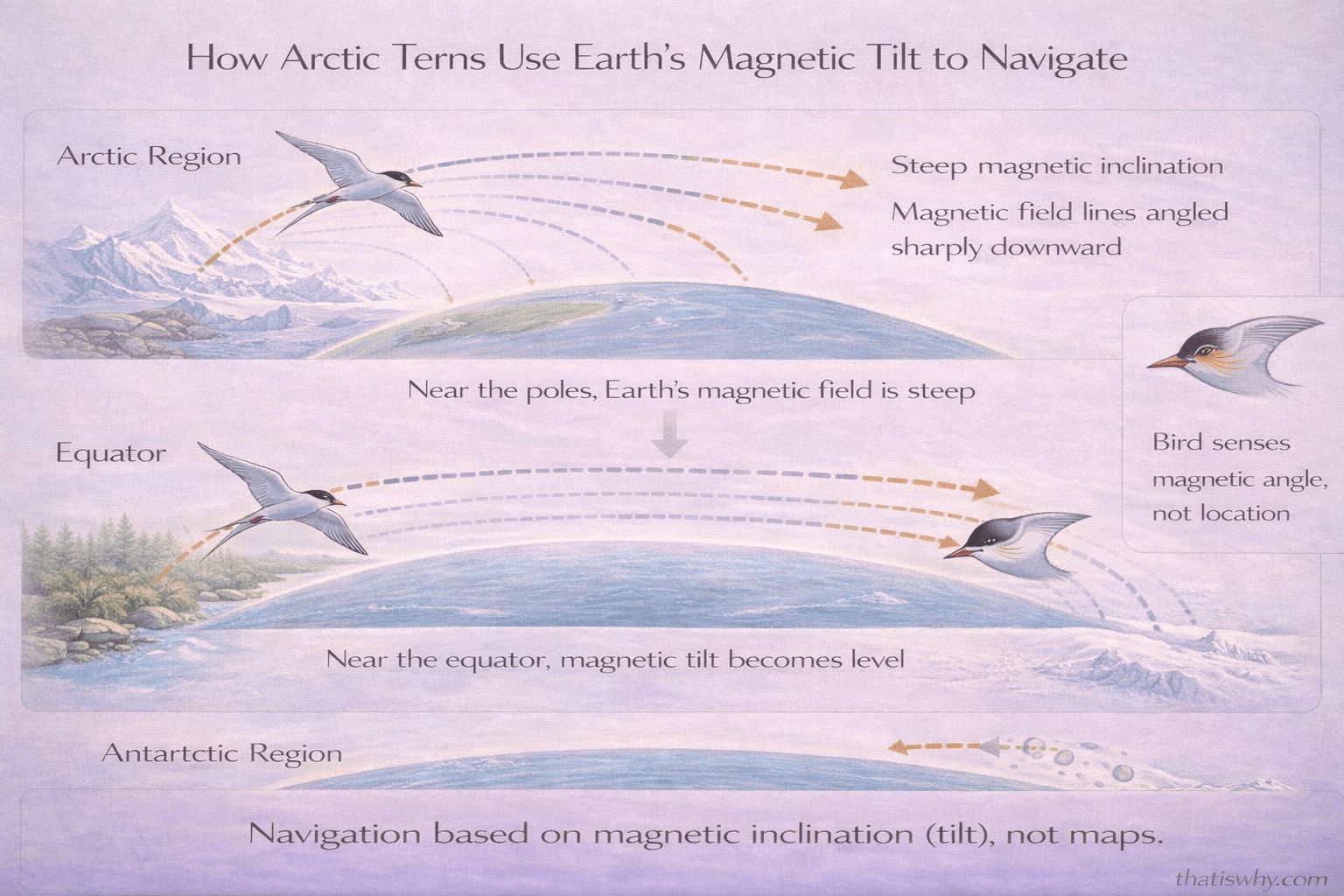
It isn’t detecting direction the way a compass does. A compass can tell you where north is, but it cannot tell you where you are. The tern needs something more informative than direction alone, it needs a sense of tilt.
Inside the bird are structures sensitive to the Earth’s magnetic field, not just its direction but its angle. Near the equator, that field runs almost flat, like a perfectly level tabletop. As you move toward either pole, the field begins to slope downward, becoming steeper and steeper.
Imagine walking across a gentle hill while holding a spirit level in your hands. You do not need to know the name of the hill or how far you have gone. You simply notice that the bubble keeps sliding. The farther you walk, the more it drifts. Eventually, it settles into a position you recognize. That is your signal to stop.
The Arctic tern experiences the planet in the same way. As it flies south, the internal bubble shifts predictably. The bird does not calculate latitude or distance. It keeps flying while the bubble feels wrong and eases off when it settles into the range that matches summer at the opposite end of the world.
Fine-Tuning with the Sky
A bubble level is reliable, but anyone who has hung a shelf knows you still glance around to make sure nothing is throwing you off.
The Arctic tern does something similar.
The magnetic “level” provides the global signal, but the bird quietly cross-checks it using the sun during the day and stars at night. These cues do not replace the tool. They steady it. They help the tern keep its internal reading calibrated as winds shift and clouds roll in.
Think of it as checking the edges of the frame while watching your spirit bubble. The main signal stays the same, but the visual cues help keep everything honest.
What matters is that the tern never lets these secondary cues take over. The sun does not define the destination, and the stars do not draw the route. They simply help the bird trust what the bubble is already telling it.
A Lifetime Spent Following the Tilt
Once you really sit with this system, the scale of the journey starts to feel almost inevitable.
An Arctic tern can live 30 years or more, repeating this pole-to-pole commute year after year. Not because it is stubborn or heroic, but because the signal it follows keeps repeating the same instruction.
As long as the planet still feels tilted the wrong way, the bird keeps going. When that tilt settles into something familiar, it stops, feeds, breeds, and waits. Months later, the signal quietly reverses, and the internal level drifts again.
What is bluffing how little memory this requires, the tern is not replaying last year’s route or consulting a stored map. Each migration is a fresh reading of the same signal, taken in real time. That is why young birds, on their very first journey, can cross entire oceans successfully. They are not retracing steps, they are checking alignment.
Storms do not break this system and detours do not confuse it, as long as the underlying tilt still feels wrong, the bird knows it has not gone far enough yet.
Common Misreads of the Pole-to-Pole Journey
When people first hear about the Arctic tern, they often picture a bird aiming for a destination the way we aim for a city on a map. That instinct makes sense but it is also where the misunderstanding begins.
Myth #1: The Arctic tern is navigating to a place.
Truth: It is navigating to a condition.
The bird is not trying to reach “Antarctica” as a labeled location. It flies until the planet’s tilt matches what summer is supposed to feel like. The tern does not care where the shelf is mounted. It only cares when the bubble finally settles.
Myth #2: This migration must rely on extraordinary memory.
Truth: It relies on remarkably little memory at all.
There is no stored route or archive of landmarks. Each journey is a fresh reading of the same signal. The bird succeeds not by remembering more, but by trusting a signal that keeps being reliable.
Myth #3: Precision like this requires complexity.
Truth: Precision comes from restraint.
The tern commits to one dominant signal and lets everything else quietly support it. That is exactly why a spirit level works. It ignores almost everything and focuses on the one thing that matters.
Myth #4: This is a sense humans cannot relate to.
Truth: We already use the same idea.
Your sense of balance does not tell you where you are. It tells you whether you are aligned. The tern did not invent a strange new strategy. It scaled a familiar one until it could span the entire planet.
Knowing Without Ever Asking Where You Are
The Arctic tern does not cross the world because it understands it in detail. It succeeds because it does not need to.
It never asks where it is on a map or how far it has already flown. It keeps checking one simple condition and lets the Earth do the rest. As long as the world still feels tilted the wrong way, the journey continues. When that feeling settles, the bird knows it is time to stop.
Once we understand the process the tern stops feeling like an outsider and starts looking like part of a pattern. Like mole is reading the ground through touch, the snake who reads prey through heat, or the salmon reads rivers through chemistry, the tern reads the planet itself, using tilt as its guide.
Different senses, same underlying idea.
Nature does not always solve problems by building better maps or storing more information. Sometimes it solves them by asking a better question. Not Where am I? but Does this still feel right?
It is a quietly uncomfortable thought for humans. We often judge intelligence by how much someone knows or how far ahead they plan. The Arctic tern suggests another option entirely: trust a reliable signal, keep checking your alignment, and let the world tell you when you have arrived.
How We Researched This
To explain how Arctic terns navigate across the entire planet without landmarks, we drew on a body of migration and sensory research spanning field tracking, laboratory experiments, and geomagnetic modeling.
We relied in particular on long-term geolocator studies from the British Antarctic Survey and the University of Oxford that mapped real Arctic tern flight paths across hemispheres, as well as controlled experiments published in Nature and Proceedings of the Royal Society B demonstrating magnetic inclination sensing in migratory birds. Work by Mouritsen, Wiltschko, and colleagues helped clarify how birds use the angle of Earth’s magnetic field, not just its direction, to infer latitude.
But citing magnetoreception papers alone doesn’t make the experience intuitive. Our real work began when we asked, what does this feel like ? That question led us to the “bubble-level analogy“, a simple physical tool explaining how sensing tilt can replace maps, routes, and destinations and keep intuitive feeling.